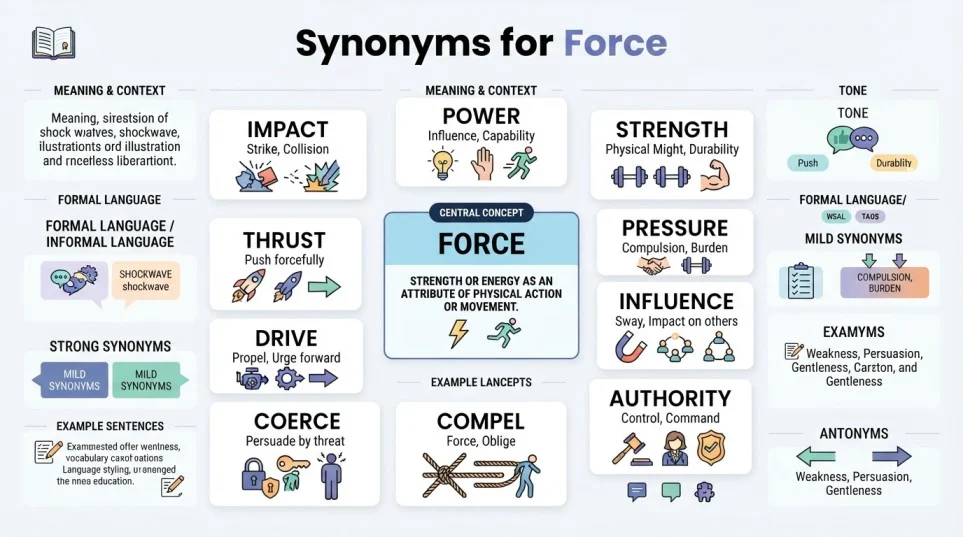
Have you ever written the word “force” several times in an essay, email, caption, or professional message and felt that your writing sounded repetitive? The problem is often not the word itself, but choosing a replacement that does not match your exact meaning.
The word “force” can describe physical strength, pressure, influence, authority, compulsion, or even military power. A strong vocabulary choice depends on what you want the reader to understand.
This guide explains synonyms for force with practical examples, tone differences, intensity levels, and context based recommendations. Whether you are writing an academic essay, resume, email, story, or social media caption, you will learn how to choose a more precise word.
What Does “Force” Mean?
“Force” means physical or mental power used to make something happen or make someone act. Depending on context, useful synonyms include power, strength, pressure, influence, coercion, authority, compel, push, drive, and thrust.
Meaning, Tone and Context
Simple Definition
Force generally means power or pressure used to produce an effect, movement, action, or result.
For example, you can use force to move an object, influence a decision, or make someone do something against their preference.
The meaning changes according to context. “The force of the wind” refers to physical power, while “force someone to leave” refers to compelling an action.
Part of Speech
“Force” can function mainly as a noun and a verb.
As a noun, it can mean strength, power, pressure, influence, or a group of people organized for a purpose.
Example: “The force of the storm damaged several buildings.”
As a verb, force means to make something happen or make someone do something.
Example: “The company forced the team to change its approach.”
Tone
The word “force” is usually neutral, but it can become negative when it involves unwanted pressure, violence, coercion, or domination.
In scientific or physical contexts, it is generally factual.
In emotional or interpersonal contexts, it can suggest conflict or lack of choice.
Formality Level
“Force” works in casual, professional, academic, technical, and creative writing.
However, more precise alternatives can make formal writing clearer. For example, “pressure” may be more accurate than “force” when discussing persuasion, while “compel” may be more appropriate when describing required action.
Common Use Cases
Force commonly appears when discussing:
- Physical strength
- Pressure
- Authority
- Influence
- Compulsion
- Scientific effects
- Conflict
- Military groups
- Motivation
- Strong emotional impact
Important Word Forms
Common related forms include:
Force: noun and verb
Forced: adjective and past form of the verb
Forcible: involving physical force
Forceful: powerful, assertive, or convincing
Forcibly: using physical power or strong pressure
Enforce: make a rule or requirement obeyed
Reinforce: strengthen or support something
When and How to Use “Force”
Use “force” when you need to communicate strength, pressure, compulsion, or power clearly.
Professional Example
“The manager used her authority to force the department to follow the new procedure.”
Personal Example
“I did not want to force my friend into making a decision.”
Academic Example
“The force of economic pressure influenced the policy change.”
Emotional Example
“Grief forced him to reconsider what mattered most.”
Creative Example
“The force of the waves pushed the small boat toward the shore.”
Social Media Example
“Sometimes you cannot force a situation to work. You have to let it develop naturally.”
Email Example
“We should not force a decision before the team has reviewed the available information.”
Another Word for “Force”
The best single replacement depends on what “force” means in your sentence.
- For professional writing, pressure, influence, authority, or compel can be more precise.
- For academic writing, pressure, influence, impetus, or constraint may work well depending on the subject.
- For casual conversation, push, make, or urge can sound natural.
- For emotional writing, compel, drive, or pressure can communicate stronger feelings.
- For creative writing, thrust, power, momentum, or might can create stronger imagery.
- For resumes and workplace writing, drive, influence, lead, and compel may be useful when they accurately describe an action or result.
- For social media captions, power, strength, push, and drive often sound more natural.
- For a stronger meaning, consider coerce, compel, domination, or violence, depending on the exact meaning.
- For a softer meaning, consider encourage, urge, influence, or pressure when the context supports them.
When Not to Use “Force”
“Force” can be too general when your sentence describes a very specific type of pressure or influence.
Instead of saying:
“The manager used force to change the employee’s decision.”
You might say:
“The manager used pressure to change the employee’s decision.”
The second sentence clearly suggests psychological or professional pressure rather than physical force.
Another example is:
“The speaker had a lot of force.”
This could mean physical strength, emotional intensity, persuasive power, or authority. A more specific word would tell the reader exactly what you mean.
Try “influence” for persuasive power, “authority” for official power, “strength” for physical ability, or “impact” for an effect on people or events.
Words Commonly Confused With “Force”
Force vs. Power
Force often emphasizes applied pressure or action. Power describes the ability or capacity to act, control, or produce an effect.
“Force” can suggest something being actively applied, while “power” can exist without being used.
Force vs. Pressure
Pressure is usually a form of influence that pushes someone toward a particular action.
Force can be more intense and may involve physical power or compulsion.
Force vs. Influence
Influence usually changes thoughts, choices, or behavior without necessarily removing freedom of choice.
Force suggests stronger pressure and can imply that the person has little or no choice.
Force vs. Authority
Authority comes from an accepted position, role, law, or responsibility.
Force can exist without legitimate authority.
Force vs. Strength
Strength describes physical or figurative capacity.
Force describes power being applied or exerted.
Force vs. Coercion
Coercion specifically involves pressuring or threatening someone into doing something.
Force is broader and can refer to physical, scientific, social, or psychological power.
Best Synonym by Context for “Force”
| Context | Best Synonym | Why It Works | Example |
|---|---|---|---|
| Formal writing | Compel | Clearly expresses required action | The evidence may compel further investigation. |
| Academic writing | Influence | Works well for social or intellectual effects | Economic conditions influence consumer behavior. |
| Professional or business use | Pressure | Clearly describes unwanted business pressure | The deadline put pressure on the team. |
| Resume | Drive | Can communicate motivation and initiative | She helped drive major improvements in customer service. |
| Casual conversation | Push | Natural and conversational | Do not push him into making a decision. |
| Creative writing | Thrust | Creates a vivid sense of movement | The current thrust the boat toward the rocks. |
| Emotional tone | Compel | Suggests a powerful inner reason | Her experience compelled her to speak out. |
| Strong intensity | Coerce | Clearly suggests unwanted pressure | The organization was accused of coercing workers. |
| Soft or moderate tone | Influence | Suggests effect without direct compulsion | Her advice influenced my decision. |
| Social media captions | Power | Short, clear, and expressive | There is power in choosing your own path. |
| Physical context | Strength | Directly describes physical ability | The bridge survived because of its structural strength. |
| Scientific context | Force | Precise when discussing physical effects | Gravity is a force that affects matter. |
| Leadership context | Authority | Highlights legitimate control | The director has authority over the department. |
Which Synonym Should You Choose?
Start by identifying what kind of force you mean.
- If you mean physical ability, choose strength, power, or might.
- If you mean pressure on another person, consider pressure, coercion, or compulsion.
- If you mean persuasive effect, influence is often more appropriate.
- If you mean official control, authority or control may be better.
- If you mean strong motivation, consider drive, impetus, or momentum.
- If you mean making someone act against their preference, compel, coerce, or constrain may provide greater precision.
Always consider tone. A word such as “influence” sounds more neutral than “coerce,” while “might” sounds more dramatic than “strength.”
Real Life Examples of “Force” in Sentences
School
“The teacher did not want to force students to participate before they understood the assignment.”
Workplace
“The new regulations forced the company to update its procedures.”
Writing
“The author uses the force of contrast to make the final scene more memorable.”
Conversation
“I do not want to force you to agree with me.”
Social Media
“Never force a connection that does not feel natural.”
Resume
“She helped drive a major increase in customer engagement.”
“We should not force a decision until everyone has reviewed the proposal.”
Storytelling
“A sudden wave forced the travelers to abandon their route.”
25 Synonyms for “Force”
The following words cover different meanings of “force.” Some are nouns and some are verbs, so they should be selected according to sentence structure and intended meaning.
| Synonym | Simple Meaning | Best Used For | Example Sentence |
|---|---|---|---|
| Power | Ability to act or create an effect | General strength and control | The machine requires enough power to operate safely. |
| Strength | Physical or figurative ability | Physical ability and resilience | Her strength helped her complete the difficult task. |
| Might | Great power or strength | Formal and literary writing | The army demonstrated its might during the conflict. |
| Energy | Active power or effort | Physical activity and motivation | The team brought fresh energy to the project. |
| Pressure | Influence that pushes someone toward action | Personal and professional situations | The deadline put pressure on the staff. |
| Influence | Ability to affect decisions or behavior | Social and professional contexts | Her advice had a strong influence on the outcome. |
| Coercion | Pressure that removes meaningful choice | Legal, social, and serious situations | The agreement was challenged because of alleged coercion. |
| Compulsion | A powerful requirement or urge | Formal and psychological contexts | He felt a strong compulsion to correct the mistake. |
| Authority | Legitimate power to direct others | Leadership and official settings | The supervisor has authority over the department. |
| Control | Power to direct or manage | Organizations and situations | The pilot maintained control of the aircraft. |
| Domination | Powerful control over another person or group | Conflict and competition | The team achieved domination during the second half. |
| Impetus | Something that causes action or change | Academic and formal writing | The discovery provided an impetus for further research. |
| Thrust | Strong forward movement or driving force | Physical and creative descriptions | The engine provides enough thrust for takeoff. |
| Drive | Energy or motivation that produces action | Work, goals, and motivation | Her drive helped the company reach its target. |
| Momentum | Growing strength that keeps something moving | Projects, movements, and progress | The campaign gained momentum after the announcement. |
| Impact | Strong effect on a person or situation | Business, writing, and analysis | The decision had a major impact on sales. |
| Intensity | Degree of strength or force | Emotions, activity, and physical effects | The intensity of the storm surprised residents. |
| Vigor | Strong energy and enthusiasm | Formal and positive writing | She defended her position with considerable vigor. |
| Potency | Strength or effectiveness | Medicine, chemistry, and figurative writing | Researchers measured the potency of the compound. |
| Violence | Physical force intended to cause harm | Conflict and serious situations | The protest ended without violence. |
| Troops | Organized military personnel | Military context | Additional troops were sent to the region. |
| Compel | Make someone act through strong pressure or necessity | Formal writing | The evidence may compel officials to respond. |
| Coerce | Force someone through threats or pressure | Serious interpersonal and legal contexts | No employee should be coerced into accepting unfair terms. |
| Impel | Drive someone toward an action | Formal and literary writing | A desire to help others impelled her to volunteer. |
| Constrain | Limit freedom or available choices | Academic and professional writing | Limited resources constrained the team’s options. |
Synonym Groups and Usage Differences
Professional vs. Personal Synonyms
Professional writing often benefits from precise and neutral words such as influence, pressure, authority, drive, and impact.
Personal communication may use simpler words such as push, make, or pressure, depending on the situation.
For example, “The policy influenced employee behavior” sounds more professional than “The policy pushed employees to change.”
Formal vs. Conversational Synonyms
Formal writing often uses compel, impel, constrain, coercion, and impetus.
Conversational English usually favors push, pressure, make, and drive.
The best choice should still depend on meaning. A formal word is not automatically a better word.
Academic Synonyms
Academic writing benefits from words that identify the exact relationship being discussed.
- Use influence when describing an effect on behavior or ideas.
- Use pressure when discussing external demands.
- Use constraint when something limits available options.
- Use impetus when an event encourages or initiates change.
Professional and Business Synonyms
In workplace communication, influence, authority, pressure, drive, and impact are especially useful.
For example, “The new regulation influenced our strategy” sounds neutral and precise.
“The new regulation forced our strategy” would be unclear because a strategy itself is not normally forced in the same way a person or action can be forced.
Creative or Literary Synonyms
Creative writing can use might, thrust, drive, intensity, and power to create stronger imagery.
For example:
“The might of the ocean overwhelmed the small vessel.”
This has a more dramatic effect than:
“The power of the ocean affected the vessel.”
Slang or Modern Synonyms
There are a few informal expressions that can communicate force or pressure.
Push is common in everyday speech.
Muscle can informally mean using power or influence to get something done, but it is not a direct replacement in every sentence.
For example:
“The company muscled its way into the market.”
This expression is informal and figurative, so it is usually unsuitable for academic writing.
Strongest vs. Weaker Synonyms
A useful intensity scale is:
Influence → pressure → compel → coerce → domination
These words do not have exactly the same meaning, but they generally move from relatively moderate influence toward stronger control or unwanted pressure.
Use the mildest accurate word. Choosing an unnecessarily strong synonym can make your writing sound exaggerated.
Emotional vs. Neutral Synonyms
Neutral choices include power, strength, influence, impact, and pressure.
More emotionally charged choices include coercion, violence, domination, and might.
If your goal is objective writing, choose a word that describes the situation without adding unnecessary emotional intensity.
Antonyms of “Force”
Because “force” has several meanings, its opposites depend on whether you mean pressure, power, compulsion, movement, or conflict.
| Antonym | Meaning | Example Sentence |
|---|---|---|
| Weakness | Lack of strength or power | The weakness of the structure became obvious. |
| Powerlessness | Lack of ability to control events | The workers felt a sense of powerlessness. |
| Restraint | Holding back instead of applying force | The officer showed restraint during the confrontation. |
| Freedom | Ability to act without coercion | Everyone deserves the freedom to make personal choices. |
| Choice | Ability to decide voluntarily | She accepted the offer because it was her choice. |
| Consent | Voluntary agreement | The procedure requires informed consent. |
| Permission | Approval to do something | The students waited for permission before leaving. |
| Release | Letting something or someone go free | The release of the animals took several hours. |
| Relaxation | Reduction of tension or pressure | Relaxation helped reduce the stress of the situation. |
| Gentleness | Use of a mild and careful approach | She handled the injured animal with gentleness. |
| Passivity | Lack of active resistance or action | His passivity surprised everyone during the discussion. |
| Inaction | Failure to take action | Continued inaction could worsen the problem. |
| Yielding | Giving way rather than resisting | Yielding to the other driver prevented a collision. |
| Cooperation | Working together voluntarily | Cooperation produced a better result than conflict. |
| Peace | Absence of violence or conflict | The community hoped for lasting peace. |
Comparison: “Force” vs. Similar Words
Force vs. Power
Main difference: Force usually emphasizes applied power, while power can describe the general ability to act or control.
Which one is stronger: Neither is always stronger. The context determines intensity.
Which one is more formal: Both work in formal writing.
Example with force: “The force of the wind damaged the roof.”
Example with power: “The government has the power to change the regulation.”
Force vs. Pressure
Main difference: Pressure usually describes influence that pushes someone toward an action, while force has a broader meaning.
Which one is stronger: Force can be stronger when it implies compulsion.
Which one is more formal: Both are appropriate in formal writing.
Example with force: “The law forced the company to change.”
Example with pressure: “Public pressure encouraged the company to change.”
Force vs. Influence
Main difference: Influence can affect behavior without removing choice. Force often suggests stronger compulsion.
Which one is stronger: Force is generally stronger.
Which one is more formal: Both are suitable for formal writing.
Example with force: “The regulation forced the company to comply.”
Example with influence: “Consumer preferences influenced the company’s strategy.”
Force vs. Authority
Main difference: Authority is legitimate power connected to a position or responsibility. Force can exist without legitimate authority.
Which one is stronger: Neither is automatically stronger.
Which one is more formal: Authority often sounds more precise in organizational contexts.
Example with force: “The officers used force to control the situation.”
Example with authority: “The director has authority over the department.”
Force vs. Strength
Main difference: Strength refers to capacity or ability, while force often refers to power being actively applied.
Which one is stronger: Neither is inherently stronger.
Which one is more formal: Both work well in formal contexts.
Example with force: “The force of the impact damaged the vehicle.”
Example with strength: “The bridge has enough strength to support the load.”
Force vs. Coercion
Main difference: Coercion specifically involves pressure, threats, or intimidation that influences someone against their preference.
Which one is stronger: Coercion usually communicates a more serious form of pressure.
Which one is more formal: Coercion is especially common in legal and academic writing.
Example with force: “The law forced the company to respond.”
Example with coercion: “The agreement was questioned because of alleged coercion.”
Common Phrases and Expressions with “Force”
1. By force
Meaning: Using physical power or strong pressure instead of voluntary agreement.
Example sentence: “The intruder was removed by force.”
2. Force of nature
Meaning: A powerful natural event or a person with exceptional energy and influence.
Example sentence: “The hurricane was a destructive force of nature.”
3. Force someone to do something
Meaning: Make someone perform an action against their preference or without genuine choice.
Example sentence: “You cannot force someone to trust you.”
4. Force the issue
Meaning: Make a situation or decision happen sooner instead of allowing it to develop naturally.
Example sentence: “The deadline forced the issue and required the team to make a decision.”
5. Force a decision
Meaning: Push a person or group into making a decision before they might otherwise choose to do so.
Example sentence: “We should not force a decision without reviewing the evidence.”
6. In force
Meaning: Officially active or legally effective.
Example sentence: “The new regulations are now in force.”
7. Force of habit
Meaning: Doing something automatically because it has become a regular habit.
Example sentence: “By force of habit, she checked her phone before going to bed.”
8. Join forces
Meaning: Work together to achieve a shared goal.
Example sentence: “The two organizations joined forces to support local students.”
Common Mistakes to Avoid
1. Using “Force” When a Precise Word Is Better
“The manager forced the team to improve.”
This is vague.
“The manager motivated the team to improve.”
The second sentence communicates a different and more specific idea when motivation, rather than compulsion, is intended.
2. Confusing Force With Influence
Influence does not necessarily remove someone’s freedom of choice.
If someone changes their mind because of advice, “influence” is usually more accurate than “force.”
3. Using a Casual Synonym in Formal Writing
Words such as push or muscle can sound too conversational in academic or professional writing.
Choose pressure, influence, compel, or another precise term when appropriate.
4. Using an Overly Dramatic Synonym
Do not use coercion, violence, or domination when the situation simply involves encouragement.
An unnecessarily intense word can distort the meaning of your sentence.
5. Repeating “Force” Too Often
Repeating the same word can make writing feel flat.
Instead, identify whether you mean power, pressure, influence, strength, motivation, or compulsion and choose accordingly.
6. Choosing the Wrong Emotional Tone
“Coerce” carries a much more negative meaning than “influence.”
Before replacing “force,” check whether your synonym adds an emotional judgment that the original sentence did not intend.
7. Using Slang in Academic or Professional Writing
Informal expressions such as “muscle” may work in conversation but can reduce clarity and professionalism in an essay, report, or business document.
FAQs
What is the best synonym for “force”?
The best synonym depends on meaning. Use power for general strength, pressure for influence, compel for required action, and influence for persuasive effect.
What is a formal synonym for “force”?
Formal alternatives include compel, coerce, constrain, impel, pressure, and influence. The correct choice depends on the exact relationship being described.
What is an informal synonym for “force”?
In casual English, push can often replace force when describing pressure or encouragement. “Make” can also work in everyday conversation when the meaning is clear.
What is another word for “force” in professional writing?
Useful professional alternatives include pressure, influence, authority, impact, drive, compel, and constraint, depending on the intended meaning.
What is the difference between “force” and “pressure”?
Force is broader and can describe physical power or compulsion. Pressure usually describes influence that pushes someone toward a particular action or decision.
What is the opposite of “force”?
Possible opposites include freedom, consent, choice, cooperation, restraint, and permission. The best antonym depends on which meaning of force is intended.
Conclusion
The word “force” can describe physical power, pressure, influence, authority, motivation, compulsion, or strong movement. Because it has so many meanings, the best synonym depends on the situation.
Use strength or power for physical ability, pressure for external demands, influence for persuasive effects, authority for legitimate control, and compel or coerce when someone is being pushed toward an action.
The most useful vocabulary habit is to ask yourself what you actually mean before choosing a synonym. A precise word is usually more effective than a complicated one.
For definitions and final editorial verification, check trusted dictionaries such as Cambridge, Oxford, Merriam Webster, Collins, or Britannica before publishing.
Discover More Post:
- 25+ Synonyms for Proficient | Meanings, Examples, and Best …
- 25+ Synonyms for Depression | Meanings, Examples, and …
- 25+ Synonyms for Marginalized | Meanings, Examples, and Best …