Do you find yourself writing “basically” again and again in emails, essays, captions, conversations, or professional messages? The word is useful, but repeated use can make your writing sound less precise.
Learning the right synonyms for basically helps you express the exact idea you mean. Depending on context, you may need a formal alternative such as “essentially,” a simple option such as “mainly,” or a conversational phrase such as “in simple terms.”
This guide explains the meaning, tone, usage, and differences among common alternatives. You will also find practical examples to help you choose the right word for school, work, social media, and everyday conversation.
What Does “Basically” Mean?
Basically means “in the simplest or most important sense” or “for the most part.” Common alternatives include essentially for formal writing, mainly for general use, simply for explanations, and more or less when describing something approximately.
Meaning, Tone and Context
Simple Definition
Basically is used when you want to present the main idea of something without discussing every detail.
For example:
“Basically, the project needs more time.”
This means that, when all the details are considered, the main point is that the project needs more time.
The word can also mean approximately or almost in some contexts.
For example:
“She is basically finished with the report.”
Here, basically suggests that the report is nearly complete.
Part of Speech
Basically is an adverb.
It modifies a statement by showing that the speaker is giving the essential point, general idea, or simplified version.
Tone
Basically usually has a neutral and conversational tone.
It can make an explanation sound simpler and more approachable. However, frequent use may make professional or academic writing seem less precise.
Formality Level
Basically is common in everyday speech and informal writing.
It can appear in professional communication, but a more precise alternative may be better in reports, academic essays, research writing, and formal presentations.
Common Use Cases
Basically is commonly used when:
- Summarizing an idea
- Simplifying complicated information
- Explaining the main point
- Describing something approximately
- Introducing a conclusion
- Clarifying an informal explanation
- Reducing unnecessary detail
Related Word Forms
Basically comes from the adjective “basic.”
Related forms include:
Basic: simple or fundamental.
Basics: the essential principles of a subject.
Basically: in the simplest or most important sense.
When and How to Use “Basically”
Basically works best when you want to reduce a complicated idea to its central point.
It is especially natural in conversation, informal explanations, and simple summaries.
Professional Example
“Basically, the client wants a faster delivery schedule.”
This is understandable, but “Essentially” may sound more polished in a formal report.
Personal Example
“Basically, I just wanted to make sure everyone was okay.”
Here, basically introduces the speaker’s main reason.
Academic Example
“Basically, the study examines how sleep affects concentration.”
In an academic paper, “essentially” or a more precise phrase may be preferable.
Emotional Example
“Basically, I felt like nobody was listening.”
The word keeps the sentence conversational and personal.
Creative Example
“Basically, the old house had become a memory of another time.”
A more descriptive alternative may create a stronger literary effect.
Social Media Example
“Basically, this is what happens when you try to cook without a recipe.”
The conversational tone works naturally for a caption.
Email Example
“Basically, we need your approval before moving forward.”
For a formal business email, “In summary” or a direct statement may sound more professional.
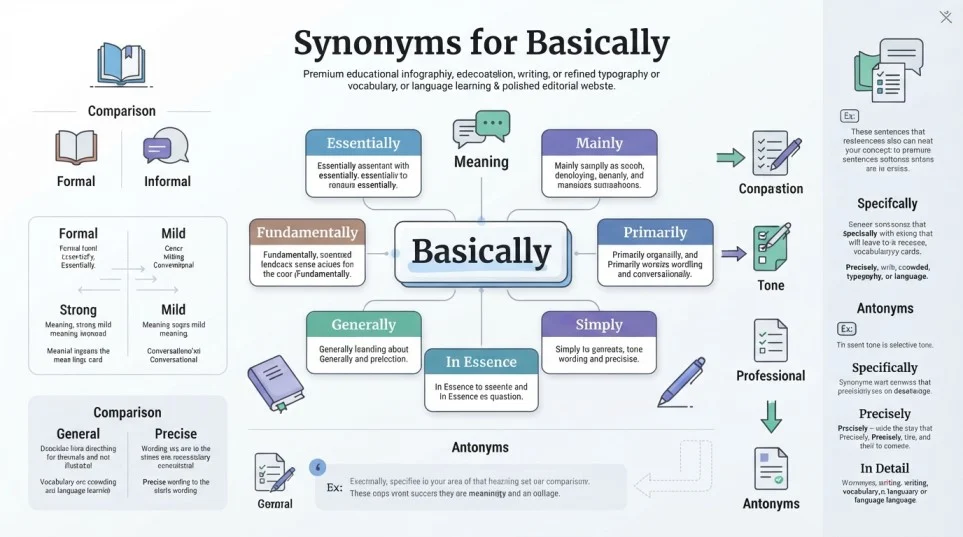
Another Word for “Basically”
The best single replacement depends on what you mean.
If you mean “in essence,” use “essentially.”
If you mean “mostly,” use “mainly” or “largely.”
If you mean “in simple terms,” use “simply.”
If you mean “approximately,” use “roughly” or “more or less.”
Professional Writing
Best choice: essentially
“Essentially, the proposal addresses three major concerns.”
Academic Writing
Best choice: fundamentally
“Fundamentally, the theory depends on two assumptions.”
Casual Conversation
Best choice: simply
“Simply put, we need more time.”
Emotional Writing
Best choice: at heart
“At heart, she wanted to feel understood.”
Creative Writing
Best choice: in essence
“In essence, the journey was about finding a sense of belonging.”
Resume or Workplace Use
Best choice: primarily
“Primarily responsible for coordinating client communications.”
However, resumes often benefit from removing the introductory adverb completely and using a direct achievement statement.
Social Media Captions
Best choice: honestly or simply, depending on the intended meaning.
“Simply put, this was the best part of the trip.”
Stronger Meaning
Best choice: fundamentally
Fundamentally suggests something connected to the core nature or foundation of an issue.
Softer Meaning
Best choice: generally
Generally presents an idea without making it sound absolute.
When Not to Use “Basically”
Basically can become vague when the reader needs exact information.
Instead of:
“Basically, the meeting starts soon.”
Write:
“The meeting starts at 2 p.m.”
The second version gives the reader useful information immediately.
Basically can also sound too conversational in academic writing.
Instead of:
“Basically, the experiment shows that…”
Consider:
“The results indicate that…”
Avoid using basically when you actually mean “specifically.”
Instead of:
“Basically, the three causes were…”
Write:
“The three primary causes were…”
A precise word often makes your writing clearer and more authoritative.
Words Commonly Confused With “Basically”
Essentially
Essentially means in the most important or fundamental sense. It is one of the closest formal alternatives to basically.
Fundamentally
Fundamentally refers to something at its foundation or core. It often sounds more analytical and formal.
Generally
Generally means in most cases or as a broad statement. It does not necessarily mean the same thing as basically.
Mainly
Mainly means chiefly or for the largest part. It focuses on importance or proportion rather than simplification.
Simply
Simply can mean in an uncomplicated way or merely. It is useful when explaining something clearly, but its meaning depends strongly on context.
Approximately
Approximately means nearly or around a particular amount. It should be used when basically means something close to a specific value.
Best Synonym by Context for “Basically”
| Context | Best Synonym | Why It Works | Example |
|---|---|---|---|
| Formal writing | Essentially | Sounds polished and precise | Essentially, the policy changes three procedures. |
| Academic writing | Fundamentally | Emphasizes the underlying principle | Fundamentally, the theory concerns human behavior. |
| Professional communication | Essentially | Keeps business language clear | Essentially, we need approval before proceeding. |
| Resume | Primarily | Shows the main responsibility | Primarily responsible for client communication. |
| Casual conversation | Simply | Sounds natural and clear | Simply put, we need more time. |
| Creative writing | In essence | Adds a reflective tone | In essence, the journey changed her life. |
| Emotional writing | At heart | Highlights the underlying feeling | At heart, he wanted to help. |
| Strong intensity | Fundamentally | Points to a core condition | Fundamentally, the system needs reform. |
| Mild or moderate tone | Generally | Avoids sounding absolute | Generally, customers prefer faster service. |
| Social media captions | Simply | Short and easy to understand | Simply put, this place is beautiful. |
| Approximate meaning | Roughly | Indicates an estimate | Roughly, half the group agreed. |
| Summarizing | In short | Signals a concise conclusion | In short, the plan is ready. |
| Explanation | In simple terms | Makes complex ideas accessible | In simple terms, the process saves time. |
| Business summary | At its core | Highlights the central issue | At its core, the problem is communication. |
| Everyday writing | Mainly | Means mostly or chiefly | The event is mainly for new members. |
Which Synonym Should You Choose?
Start by asking what you mean by basically.
If you mean the central idea, choose “essentially.”
If you mean the foundation of something, choose “fundamentally.”
If you mean mostly, choose “mainly” or “largely.”
If you want to simplify an explanation, choose “simply” or “in simple terms.”
If you mean an approximate amount, choose “roughly” or “approximately.”
If you are writing professionally, consider whether you can remove the word completely. Direct wording is often stronger than adding an introductory adverb.
Real Life Examples of “Basically” in Sentences
School
“Basically, the assignment asks us to compare two historical events.”
Workplace
“Basically, our team needs another week to complete the project.”
Writing
“The article basically explains why clear communication matters.”
Conversation
“Basically, I forgot to check the schedule.”
Social Media
“Basically, this is my favorite view in the city.”
Resume
Instead of writing “Basically responsible for managing accounts,” write:
“Managed client accounts and improved response times.”
“Basically, we need the signed document before Friday.”
A more professional version is:
“We need the signed document before Friday.”
Storytelling
“Basically, that moment changed everything.”
A more literary version could be:
“In essence, that moment changed the direction of her life.”
25 Synonyms for “Basically”
| Synonym | Simple Meaning | Best Used For | Example Sentence |
|---|---|---|---|
| Essentially | In the main sense | Formal and professional writing | Essentially, the plan requires more funding. |
| Fundamentally | At the foundation | Academic and analytical writing | Fundamentally, the issue concerns trust. |
| Mainly | Mostly or chiefly | Everyday and professional writing | The course is mainly designed for beginners. |
| Largely | To a great extent | Formal and analytical contexts | The outcome was largely influenced by timing. |
| Primarily | Mainly or chiefly | Business and professional writing | The program is primarily intended for new users. |
| Generally | In most cases | Broad statements | Generally, customers appreciate quick responses. |
| Principally | Mainly or chiefly | Formal writing | The facility is principally used for research. |
| Simply | In a straightforward way | Explanations and conversation | Simply put, the system needs an update. |
| In essence | In the essential sense | Formal and reflective writing | In essence, the proposal changes how resources are allocated. |
| In short | In a brief summary | Conclusions and summaries | In short, the team needs more time. |
| In simple terms | Explained without complexity | Teaching and explanations | In simple terms, the process converts data into useful information. |
| At its core | At the central point | Analytical and professional writing | At its core, the problem involves poor communication. |
| At heart | In the deepest sense | Emotional and personal writing | At heart, she wanted everyone to feel included. |
| For the most part | Mostly | Conversational and general writing | For the most part, the event went smoothly. |
| By and large | Generally or mostly | General observations | By and large, the changes were well received. |
| In principle | According to the basic idea | Formal and conceptual writing | In principle, the proposal could work. |
| In substance | In its essential content | Formal writing | In substance, both proposals address the same concern. |
| In summary | In condensed form | Reports and professional communication | In summary, the findings support the original conclusion. |
| In broad terms | Without detailed distinctions | Academic and professional explanations | In broad terms, the policy encourages responsible use. |
| More or less | Approximately or generally | Casual conversation | The project is more or less complete. |
| Roughly | Approximately | Numbers and estimates | Roughly, one third of the applicants qualified. |
| Approximately | Nearly or around | Formal numerical contexts | Approximately 500 people attended the event. |
| Virtually | Almost or nearly | Situations approaching completion | The work is virtually complete. |
| Practically | Almost or nearly | Informal and conversational contexts | The room was practically empty. |
| Broadly | In general terms | Academic and professional summaries | Broadly, the results support the proposed explanation. |
Synonym Groups and Usage Differences
Professional vs. Personal Synonyms
Professional writing usually benefits from “essentially,” “primarily,” “fundamentally,” “largely,” and “in summary.”
Personal communication can comfortably use “simply,” “basically,” “more or less,” and “for the most part.”
The difference is not always about correctness. It is mainly about precision, tone, and the expectations of the reader.
Formal vs. Conversational Synonyms
Formal choices include “essentially,” “fundamentally,” “principally,” “in substance,” and “in summary.”
Conversational choices include “basically,” “simply,” “more or less,” and “for the most part.”
Use the conversational options when your writing is meant to sound relaxed and natural.
Academic Synonyms
Academic writing generally benefits from precise terms such as “essentially,” “fundamentally,” “primarily,” “broadly,” and “in principle.”
However, the best word depends on the exact claim. Academic writing should favor accuracy over variation.
Professional and Business Synonyms
Business communication often works well with “essentially,” “primarily,” “largely,” “in summary,” and “at its core.”
When possible, replace vague introductory phrases with direct information.
For example:
“Basically, sales increased.”
A stronger version is:
“Sales increased by 18 percent.”
Creative or Literary Synonyms
Creative writing can use “in essence,” “at heart,” “at its core,” and “in substance.”
These expressions can add reflection or emphasis without forcing overly dramatic language into the sentence.
Slang or Modern Synonyms
There is no single slang replacement that always means basically.
Words such as “pretty much” and “more or less” are common in casual American English, but they are not suitable replacements in every formal situation.
Strongest vs. Weaker Synonyms
A useful intensity guide is:
Mild: generally
Moderate: mainly
Clear central meaning: essentially
Strong foundational meaning: fundamentally
Approximate meaning: roughly
Near completion or near certainty: virtually
Remember that intensity depends on meaning, not just the word itself.
Emotional vs. Neutral Synonyms
Neutral choices include “essentially,” “mainly,” “generally,” and “primarily.”
More reflective choices include “at heart” and “in essence.”
Emotional writing should use the second group only when the sentence genuinely discusses feelings, values, motives, or deeper meaning.
Antonyms of “Basically”
The opposite of basically depends on which sense you intend. If basically means giving the main idea or simplifying information, the following expressions can work as contextual opposites because they emphasize detail, precision, or specificity.
| Antonym | Meaning | Example Sentence |
|---|---|---|
| Specifically | In an exact or particular way | The report specifically identifies three causes. |
| Precisely | With exact accuracy | The instructions precisely describe each step. |
| Exactly | In complete agreement with the facts | The measurement was exactly 25 centimeters. |
| In detail | With considerable information | The guide explains the procedure in detail. |
| Thoroughly | Completely and carefully | The researcher thoroughly reviewed the evidence. |
| Explicitly | In a clearly stated way | The contract explicitly defines the responsibility. |
| Individually | Separately rather than generally | Each application was individually reviewed. |
| Particularly | With attention to a specific point | The report focuses particularly on customer retention. |
| Narrowly | Within a limited or specific scope | The question was narrowly defined. |
| Literally | According to the exact meaning | The phrase was used literally in the passage. |
| Technically | According to precise technical facts | Technically, the device meets the required standard. |
| Exhaustively | Covering all relevant details | The issue was examined exhaustively. |
| Meticulously | With very careful attention | Every record was meticulously checked. |
| Precisely stated | Expressed with exact wording | The requirement was precisely stated in the contract. |
| Point by point | Addressing each item separately | The manager answered the concerns point by point. |
Comparison: Basically vs. Similar Words
Basically vs. Essentially
The two words are often interchangeable when they mean “in the main sense.”
“Basically” sounds more conversational.
“Essentially” usually sounds more polished and formal.
Basically: “Basically, the plan needs more money.”
Essentially: “Essentially, the plan requires additional funding.”
Basically vs. Fundamentally
Fundamentally is stronger when discussing the underlying nature or foundation of something.
Basically can simply summarize the main point.
Basically: “Basically, the system has a communication problem.”
Fundamentally: “Fundamentally, the system has a communication problem.”
Basically vs. Generally
Generally means in most cases or as a broad observation.
Basically focuses on the essential point.
Basically: “Basically, the project is finished.”
Generally: “Generally, projects of this size require more time.”
Basically vs. Mainly
Mainly means mostly or chiefly.
Basically often means in essence or in simple terms.
Basically: “Basically, the issue is trust.”
Mainly: “The issue is mainly related to trust.”
Basically vs. Simply
Simply can mean in an uncomplicated manner or merely.
Basically usually introduces the central idea.
Basically: “Basically, we need a new approach.”
Simply: “Simply explain the problem to the team.”
Basically vs. Approximately
Approximately means close to a specific amount.
Basically usually does not express numerical approximation.
Basically: “Basically, the work is complete.”
Approximately: “Approximately 90 percent of the work is complete.”
Common Phrases and Expressions with “Basically”
1. Basically speaking
Meaning:
Used to introduce a simplified explanation or general conclusion.
Example sentence:
“Basically speaking, the two plans follow the same strategy.”
2. Basically, what I mean is
Meaning:
Used in conversation to restate an idea more clearly.
Example sentence:
“Basically, what I mean is that we need more preparation.”
3. Basically the same
Meaning:
Almost or generally the same despite small differences.
Example sentence:
“The two versions are basically the same.”
4. Basically done
Meaning:
Nearly finished or complete.
Example sentence:
“The presentation is basically done, but I still need to check the final slide.”
5. Basically impossible
Meaning:
Very unlikely or nearly impossible in practical terms.
Example sentence:
“Without additional funding, finishing the project this week is basically impossible.”
6. Basically nothing
Meaning:
Almost nothing or very little.
Example sentence:
“There was basically nothing left after the event.”
7. Basically everything
Meaning:
Almost everything or nearly all relevant things.
Example sentence:
“She knows basically everything about the project.”
Common Mistakes to Avoid
1. Using Basically When a Precise Fact Is Available
“Basically, the meeting starts soon” is vague.
“The meeting starts at 2 p.m.” gives the reader useful information immediately.
2. Confusing Basically With Generally
Basically concerns the essential point.
Generally concerns what happens in most cases.
Choosing the wrong word can change the meaning of your sentence.
3. Using a Casual Alternative in Formal Writing
“Pretty much” may sound natural in conversation but is often too casual for academic or formal business writing.
Consider “largely,” “essentially,” or “generally” when appropriate.
4. Using an Overly Dramatic Synonym
Fundamentally can sound unnecessarily serious when you simply want to summarize a basic point.
Choose the strongest word that accurately reflects your meaning.
5. Repeating Basically Too Often
Repeated use can make your writing sound predictable.
Replace some instances with a precise alternative or remove the word entirely.
6. Choosing the Wrong Emotional Tone
“At heart” suggests deeper feelings or motives.
Do not use it when you simply mean “mostly.”
7. Using Casual Language in Academic Writing
Expressions such as “pretty much” and “more or less” can sound too informal in research based writing.
Use precise academic language when the context requires it.
FAQs
What is the best synonym for basically?
“Essentially” is often the best general synonym because it preserves the idea of expressing the main or fundamental meaning while working well in formal and professional writing.
What is a formal synonym for basically?
“Essentially” is a strong formal synonym for basically. “Fundamentally” also works when you are discussing the underlying nature or foundation of an issue.
What is an informal synonym for basically?
“Simply,” “pretty much,” and “more or less” can work in casual conversation, depending on the intended meaning and sentence context.
What is another word for basically in professional writing?
“Essentially,” “primarily,” “largely,” and “in summary” can work in professional writing, but the best choice depends on whether you mean central, primary, general, or summarized.
What is the difference between basically and essentially?
Basically is more conversational, while essentially often sounds more polished. Both can mean that you are describing the main or fundamental point of something.
What is the opposite of basically?
There is no single universal opposite. Contextual opposites include “specifically,” “precisely,” “in detail,” “explicitly,” and “thoroughly” when greater detail or exactness is intended.
Conclusion
Basically is a useful word for expressing the central idea, simplifying an explanation, or describing something approximately. However, using the same word repeatedly can make your writing less precise.
For formal writing, “essentially” is often a natural choice. For foundational ideas, use “fundamentally.” For mostly, consider “mainly” or “largely.” For simple explanations, “simply” may work better.
The best synonym for basically is not always the most sophisticated word. It is the word that communicates your exact meaning, tone, and level of precision.
Before publishing vocabulary content, verify definitions and usage with trusted dictionaries such as Cambridge, Oxford, Merriam Webster, Collins, or Britannica.
Discover More Post:
- 25+ Synonyms for Proficient | Meanings, Examples, and Best …
- 25+ Synonyms for Depression | Meanings, Examples, and …
- 25+ Synonyms for Marginalized | Meanings, Examples, and Best …