The word forest is useful, but repeating it throughout an essay, story, caption, or description can make your writing feel predictable. The right alternative can make the setting more precise, professional, vivid, or emotional.
Whether you are describing a national park, writing a school essay, creating a travel caption, or building a fictional landscape, choosing a word such as woodland, grove, wilderness, rainforest, or timberland can change the meaning and mood.
This guide explains synonyms for forest by context, tone, intensity, and purpose. You will learn which alternatives work best in academic writing, professional communication, creative descriptions, casual conversation, and social media.
What Does “Forest” Mean?
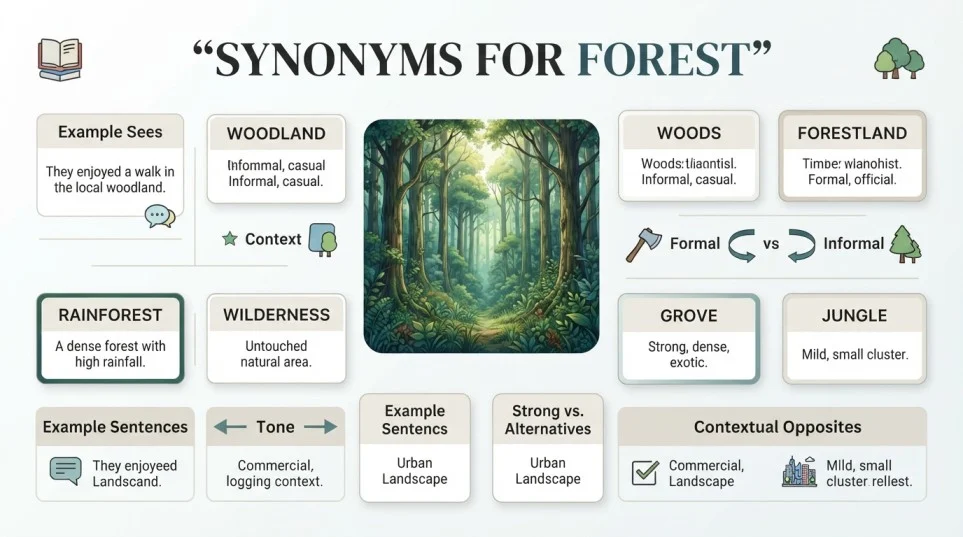
A forest is a large area dominated by trees and other vegetation. Common alternatives include woodland for general writing, timberland for professional contexts, woods for casual speech, rainforest for a specific ecosystem, and wilderness for a broader natural setting.
Meaning, Tone and Context
Simple Definition
A forest is a large area of land covered mainly by trees, plants, and other forms of natural vegetation.
Forests can vary greatly in size, climate, vegetation, wildlife, and geographic location. A forest may be tropical, temperate, boreal, dense, open, protected, or managed for timber.
Part of Speech
Forest is primarily a noun.
Example:
The hikers walked through the forest before sunset.
The word can also appear in descriptive compounds and expressions related to forestry, woodland, and natural habitats.
Tone
Forest usually has a neutral tone.
However, the surrounding language can make it sound peaceful, mysterious, threatening, majestic, remote, or adventurous.
Compare these examples:
The researchers studied the forest.
The travelers entered a mysterious woodland.
The hikers disappeared into a dense wilderness.
Each sentence creates a different impression.
Formality Level
Forest is appropriate in almost every type of English communication.
It works in school assignments, academic writing, business reports, environmental discussions, news writing, travel content, everyday conversation, and creative writing.
Common Use Cases
Forest is commonly used when discussing:
- Wildlife habitats
- Environmental conservation
- Hiking and outdoor recreation
- Geography
- Climate and ecosystems
- Forestry
- Travel
- Fiction and storytelling
- Nature photography
- Environmental science
Related Word Forms
Forest is a noun.
Related words include forested, forestry, forester, and forestation.
Example:
The region is heavily forested.
The organization studies sustainable forestry.
The forester inspected the protected area.
When and How to Use “Forest”
Use forest when you want a clear, general term for a substantial area dominated by trees.
Academic Context
Researchers examined how climate change affects forest ecosystems.
Professional Context
The company is developing a plan to protect nearby forest resources.
Personal Context
We spent the afternoon walking through the forest.
Creative Context
Mist drifted between the trees as the travelers entered the silent forest.
The basic word is often the safest choice when you do not need to emphasize a particular size, ecosystem, mood, or function.
Another Word for “Forest”
There is no single perfect replacement for forest in every sentence.
- For professional writing, timberland or forestland may work when discussing managed land or land resources.
- For academic writing, woodland, forestland, or a specific ecosystem term may provide greater precision.
- For casual conversation, woods is natural and familiar.
- For emotional writing, wilderness can create a stronger sense of remoteness.
- For creative writing, wildwood, grove, or woodland can create a more distinctive atmosphere.
- For resume or workplace writing, forestland, timberland, or forest resources may be more appropriate depending on the subject.
- For social media captions, woods, woodland, wilderness, or rainforest can make a caption more vivid.
- For a stronger meaning, wilderness or dense woodland can suggest remoteness or isolation.
- For a softer meaning, grove or woodland may sound gentler and more inviting.
When Not to Use “Forest”
Forest can be too general when the exact type of landscape matters.
Instead of saying:
We walked through a forest.
You could say:
We walked through a dense rainforest.
The second sentence gives readers much more information.
Forest may also be unsuitable when you are describing a very small group of trees. Grove or copse can be more precise.
It can also be too broad when the main point is land used for timber production. In that situation, timberland may be more suitable.
When the setting is primarily wild and remote rather than simply tree covered, wilderness may communicate the intended idea more effectively.
Words Commonly Confused With “Forest”
Forest vs. Woodland
A forest generally suggests a larger or more extensive tree covered area. Woodland can describe an area of trees and often has a gentler or less extensive feeling.
Forest vs. Woods
Woods is a common conversational term for a wooded area. Forest is more neutral and often sounds more precise in formal writing.
Forest vs. Grove
A grove usually refers to a small group or cluster of trees. It is not normally a replacement for a large forest.
Forest vs. Jungle
Jungle suggests dense tropical vegetation and difficult terrain. Not every forest is a jungle.
Forest vs. Wilderness
Wilderness describes a broader natural environment with little human development. A forest can be part of a wilderness, but the words are not identical.
Forest vs. Timberland
Timberland refers to land associated with trees that can be used for timber production. The term is especially relevant to forestry and land management.
Best Synonym by Context for “Forest”
| Context | Best Synonym | Why It Works | Example |
|---|---|---|---|
| Formal writing | Woodland | Clear and polished | The study examined woodland habitats. |
| Academic writing | Forestland | Precise for land and environmental discussion | Forestland conservation supports biodiversity. |
| Professional use | Timberland | Useful for forestry and land management | The company manages sustainable timberland. |
| Resume | Forest resources | Professional and specific | Managed forest resources across multiple sites. |
| Casual conversation | Woods | Natural and familiar | We spent the morning walking through the woods. |
| Creative writing | Wildwood | Creates an old fashioned or imaginative feeling | The hero entered the ancient wildwood. |
| Emotional writing | Wilderness | Suggests remoteness and isolation | She found peace in the surrounding wilderness. |
| Strong intensity | Jungle | Suggests dense tropical vegetation | They trekked through a dense jungle. |
| Mild or moderate tone | Woodland | Sounds calm and approachable | A quiet woodland surrounded the village. |
| Social media caption | Woods | Short, familiar, and conversational | Lost among the trees in the woods. |
| Environmental discussion | Forestland | Focuses on land covered by forests | Protecting forestland is essential for wildlife. |
| Forestry | Timberland | Connects directly with timber management | The survey covered privately owned timberland. |
| Small tree area | Grove | More precise for a small cluster | The cabin sits beside an oak grove. |
| Small woodland area | Copse | Suitable for a small group of trees | A small copse bordered the field. |
| Tropical setting | Rainforest | Identifies a specific ecosystem | The rainforest supports remarkable biodiversity. |
| Storytelling | Woodland | Flexible and atmospheric | They followed a narrow path into the woodland. |
| Nature photography | Wildwood | Adds a poetic quality | Morning light entered the wildwood. |
| Geography | Forestland | Useful when discussing land cover | The region contains extensive forestland. |
| Travel writing | Woods | Familiar and accessible | A peaceful trail winds through the woods. |
| Environmental policy | Forest resources | Focuses on natural resources | The policy protects valuable forest resources. |
Which Synonym Should You Choose?
Start by asking what you actually mean.
- If you simply mean a large area covered with trees, use forest.
- If you want a casual word, choose woods.
- If you want a polished general alternative, choose woodland.
- If you are discussing land used for forestry, consider timberland or forestland.
- If the landscape is tropical and densely vegetated, rainforest or jungle may be appropriate.
- If the location is remote and largely untouched by development, wilderness may be more accurate.
- If the area contains only a small cluster of trees, use grove or copse.
The best synonym is not always the most unusual word. It is the word that communicates the intended meaning most accurately.
Real Life Examples of “Forest” in Sentences
School
The students studied how forests provide habitats for thousands of species.
Workplace
The environmental team prepared a report on sustainable forest management.
Writing
The novel begins with a traveler entering an unfamiliar forest.
Conversation
We found a beautiful trail through the woods.
Social Media
A quiet morning surrounded by trees and fresh forest air.
Resume
Conducted field research involving forest ecosystems and wildlife habitats.
The proposed project could affect the surrounding forest area.
Storytelling
At dusk, the forest became quiet except for the distant sound of birds.
18 Synonyms for “Forest”
Some words below are close synonyms, while others are context specific alternatives. A few describe particular types or smaller parts of a wooded environment, so they should not be treated as interchangeable in every sentence.
| Synonym | Simple Meaning | Best Used For | Example Sentence |
|---|---|---|---|
| Woodland | Land covered with trees | General and polished writing | The village was surrounded by peaceful woodland. |
| Woods | A wooded area | Casual conversation | We walked through the woods after lunch. |
| Forestland | Land covered by forest | Environmental and geographic writing | The region contains large areas of protected forestland. |
| Timberland | Forested land associated with timber | Forestry and land management | The organization manages thousands of acres of timberland. |
| Wildwood | A natural or uncultivated woodland | Creative and literary writing | The travelers entered the mysterious wildwood. |
| Wilderness | Remote natural land with limited development | Emotional and descriptive writing | They spent a week exploring the wilderness. |
| Grove | A small group of trees | Small wooded areas | An olive grove stretched behind the farmhouse. |
| Copse | A small group of trees | Precise landscape descriptions | A small copse stood beyond the meadow. |
| Thicket | Dense growth of shrubs or trees | Dense vegetation | The fox disappeared into the thicket. |
| Jungle | Dense tropical vegetation | Tropical environments | The explorers moved carefully through the jungle. |
| Rainforest | A forest with high rainfall | Specific ecosystems | The rainforest is home to countless species. |
| Wood | A wooded area | British English and some literary contexts | A narrow path led into the wood. |
| Tree cover | The amount or presence of trees over land | Scientific and environmental writing | The region has experienced a decline in tree cover. |
| Woodlot | A small managed area of woodland | Land management | The family maintains a small woodlot. |
| Forest resources | Trees and related natural resources | Business and environmental contexts | The agency monitors forest resources carefully. |
| Forest ecosystem | A forest considered as an ecological system | Academic and scientific writing | The forest ecosystem supports diverse wildlife. |
| Tree stand | A group of trees growing in a particular area | Forestry and technical writing | The survey measured the mature tree stand. |
| Bushland | Land dominated by shrubs and vegetation | Regional and environmental descriptions | Wildlife moved through the dry bushland. |
Synonym Groups and Usage Differences
Professional vs. Personal Synonyms
Professional writing often benefits from specific terms such as forestland, timberland, forest resources, and forest ecosystem.
Personal writing can use simpler words such as woods, woodland, and wilderness.
For example:
Professional: The project evaluates forestland conservation practices.
Personal: We spent the weekend exploring the woods.
Formal vs. Conversational Synonyms
Forest itself is suitable for both formal and conversational writing.
Woods is more conversational.
Woodland often sounds more polished and descriptive.
Timberland is more specialized.
Forest ecosystem is appropriate when discussing ecology or scientific subjects.
Academic Synonyms
Academic writing should prioritize precision rather than variety.
Forest ecosystem, forestland, tree cover, and tree stand can be useful when they match the intended meaning.
For example:
Researchers measured changes in tree cover across the region.
This is more precise than simply saying:
Researchers measured changes in the forest.
Professional and Business Synonyms
Business writing often needs terminology connected with land management, forestry, conservation, and natural resources.
Timberland, forestland, forest resources, and forest management can be appropriate.
The exact choice depends on whether the subject is land ownership, ecological protection, timber production, or environmental policy.
Creative or Literary Synonyms
Creative writing gives you more freedom to emphasize mood.
Wildwood can sound mysterious or traditional.
Wilderness can suggest isolation.
Woodland can create a peaceful atmosphere.
Jungle can create a sense of danger, density, heat, or adventure.
Choose the word according to the emotional effect you want rather than simply replacing forest repeatedly.
Slang or Modern Synonyms
There is no widely accepted slang replacement for forest that works naturally in most situations.
Woods is the most familiar informal alternative in American English.
It is appropriate in conversation, casual captions, texts, and relaxed personal writing.
It may sound less suitable in formal research or technical reports.
Strongest vs. Weaker Synonyms
A useful intensity scale depends on context.
Mild: grove
Moderate: woodland
General: forest
Dense: thicket
Very dense tropical setting: jungle
Remote and expansive: wilderness
These words do not form a strict dictionary scale. They differ mainly in the images and meanings they communicate.
Emotional vs. Neutral Synonyms
Forest is generally neutral.
Woodland often feels peaceful.
Woods feels familiar and casual.
Wilderness suggests remoteness and freedom.
Wildwood can sound mysterious or poetic.
Jungle may suggest danger, density, or adventure.
The emotional effect comes from both the synonym and the surrounding sentence.
Antonyms of “Forest”
Forest does not have 15 exact dictionary antonyms. The following are useful contextual opposites because they describe landscapes or environments that contrast with a tree dominated forest.
| Antonym | Meaning | Example Sentence |
|---|---|---|
| Desert | Very dry land with little vegetation | The forest gradually gave way to desert. |
| Grassland | Land dominated by grasses | Beyond the forest was a wide grassland. |
| Prairie | Broad grass covered land | The trail opened onto a vast prairie. |
| Meadow | Open land covered mainly with grass and flowers | A sunny meadow stretched beside the woodland. |
| Plain | Broad, mostly level open land | The forest ended at a wide plain. |
| Tundra | Cold, mostly treeless land | The landscape changed from forest to tundra. |
| Clearing | An open area within or near woodland | They rested in a small clearing. |
| Treeless area | Land without significant tree cover | The hikers crossed a large treeless area. |
| Open country | Broad land without dense tree cover | The road continued through open country. |
| Farmland | Land used for agriculture | Forest gradually became productive farmland. |
| Cropland | Land used to grow crops | The wooded area was replaced by cropland. |
| Urban area | Developed land containing buildings and infrastructure | The forest lies outside the growing urban area. |
| Developed land | Land substantially changed by human construction | Developed land now surrounds the protected forest. |
| Wasteland | Unproductive or severely degraded land | The restored site had once been considered wasteland. |
| Barren land | Land with very little vegetation | The forest contrasted sharply with the barren land. |
These are contextual opposites rather than strict lexical antonyms. Forest has no standard set of 15 exact dictionary antonyms.
Comparison: Forest vs. Similar Words
Forest vs. Woodland
The main difference is scale and usage. Forest usually suggests a substantial tree covered area, while woodland can sound smaller, gentler, or more descriptive.
Forest is generally stronger when discussing a major ecosystem.
Woodland can sound slightly more literary or polished.
Example:
The researchers studied the forest.
The hikers followed a path through the woodland.
Forest vs. Woods
Woods is a familiar informal alternative for a wooded area.
Forest is more neutral and broadly suitable for formal communication.
Forest is usually more precise in academic writing.
Example:
The scientists studied the forest ecosystem.
We spent the afternoon in the woods.
Forest vs. Grove
A grove usually means a small group of trees.
Forest is much broader.
Neither word is inherently more formal, but grove is more specific when describing a small cluster.
Example:
The expedition crossed the forest.
The house was surrounded by an orange grove.
Forest vs. Jungle
Jungle refers to dense vegetation, especially in tropical environments.
Forest is a broader ecological term.
Jungle creates a stronger impression of density and difficult movement.
Example:
The region contains a large tropical forest.
The explorers moved through dense jungle.
Forest vs. Wilderness
Wilderness refers to a broad natural environment with little human development.
A wilderness area can contain forests, mountains, grasslands, or other landscapes.
Wilderness is therefore broader in meaning.
Example:
The forest contains several wildlife habitats.
The hikers spent several days in the wilderness.
Forest vs. Timberland
Timberland emphasizes land associated with trees that can provide timber.
Forest emphasizes the actual wooded environment or ecosystem.
Timberland is more specialized and often more suitable for forestry discussions.
Example:
The forest provides habitat for wildlife.
The company manages timberland responsibly.
Common Phrases and Expressions with “Forest”
1. Forest ecosystem
Meaning:
A forest ecosystem includes trees, plants, animals, microorganisms, soil, water, and their interactions.
Example sentence:
The researchers examined how drought affects the forest ecosystem.
2. Forest management
Meaning:
Forest management refers to planning and practices used to maintain, protect, or use forest resources.
Example sentence:
Sustainable forest management can support both conservation and responsible resource use.
3. Forest fire
Meaning:
A forest fire is a fire that burns vegetation across a forested area.
Example sentence:
The forest fire forced nearby residents to leave the area.
4. Forest cover
Meaning:
Forest cover refers to the amount or extent of land covered by forests.
Example sentence:
The region has increased its forest cover through conservation programs.
5. Forest floor
Meaning:
The forest floor is the ground surface beneath the trees, often covered with leaves, plants, fallen branches, and organic material.
Example sentence:
Mushrooms appeared across the damp forest floor.
6. Forest trail
Meaning:
A forest trail is a path that passes through a wooded area.
Example sentence:
The forest trail led to a quiet viewpoint.
7. Forest habitat
Meaning:
A forest habitat is a natural environment in which particular plants and animals live.
Example sentence:
The protected forest habitat supports several bird species.
8. Forest conservation
Meaning:
Forest conservation involves protecting and responsibly managing forests.
Example sentence:
Forest conservation can help protect biodiversity and water resources.
Common Mistakes to Avoid
1. Using Forest When a More Precise Word Is Better
Forest is broad.
If you are describing a small group of trees, grove or copse may be more accurate.
2. Confusing Forest With Jungle
Not every forest is a jungle.
Jungle usually suggests dense vegetation, particularly in tropical environments.
3. Using Casual Language in Formal Writing
Woods sounds natural in conversation but may be less precise in technical writing.
Academic work may benefit from terms such as forest ecosystem or forestland.
4. Using an Overly Dramatic Synonym
Calling every forest a wilderness or jungle can exaggerate the setting.
Choose dramatic words only when the landscape actually supports that description.
5. Repeating Forest Too Often
Repeating the same word can make descriptive writing feel flat.
Use an accurate alternative when the meaning remains clear.
6. Choosing the Wrong Emotional Tone
Wilderness can suggest isolation, while woodland can suggest calmness.
Choose based on the mood you want to create.
7. Using Slang in Academic or Professional Writing
Woods is perfectly natural in casual speech.
For formal communication, forest, forestland, woodland, or a more specific technical term may be better.
FAQs
What is the best synonym for forest?
Woodland is a strong general alternative, while woods, forestland, timberland, rainforest, or wilderness may be better depending on the exact setting.
What is a formal synonym for forest?
Woodland and forestland can work as formal alternatives. Forest ecosystem is more precise when discussing ecology or scientific research.
What is an informal synonym for forest?
Woods is the most natural informal alternative in American English. It works well in conversation, texts, casual writing, and social media captions.
What is another word for forest in professional writing?
Forestland, timberland, forest resources, and forest ecosystem can work in professional writing when they accurately describe the subject.
What is the difference between forest and woodland?
Forest usually describes a substantial tree covered area, while woodland can describe a wooded area with a somewhat gentler or more general sense.
What is the opposite of forest?
Forest has no single exact opposite. Contextual contrasts include desert, grassland, meadow, prairie, tundra, and other largely open or treeless landscapes.
Conclusion
Forest is a clear, versatile word for a large area dominated by trees, but the best alternative depends on what you want to communicate.
Use woodland for a polished general description, woods for casual conversation, forestland for environmental and geographic writing, timberland for forestry, rainforest for a specific ecosystem, and wilderness when emphasizing remoteness.
The most useful vocabulary habit is to choose synonyms based on meaning first and variety second. A precise word will always improve your writing more than an unusual word that changes the intended meaning.
For definitions and final publishing checks, verify specialized meanings with trusted dictionaries such as Cambridge, Oxford, Merriam Webster, Collins, or Britannica.
Discover More Post:
- 25+ Synonyms for Proficient | Meanings, Examples, and Best …
- 25+ Synonyms for Depression | Meanings, Examples, and …
- 25+ Synonyms for Frustrated | Meanings, Examples, and Best …