The word “it” appears everywhere in English. You may use it several times in one paragraph, email, conversation, essay, or social media caption without noticing.
For example, “I read the report, and it was helpful” is perfectly natural. But when “it” appears repeatedly, a more specific noun or reference can make your writing clearer and more engaging.
Finding synonyms for “it” is different from finding synonyms for a descriptive word such as “happy” or “important.” “It” is a pronoun, so the best replacement depends on what “it” refers to.
In some sentences, “this,” “that,” “the issue,” “the situation,” or “the idea” can replace “it.” In other sentences, “it” is a grammatical placeholder and should not be replaced at all.
This guide explains how to choose natural alternatives based on meaning, tone, formality, and context. It also shows when replacing “it” improves a sentence and when doing so can make your writing less natural.
What Does “It” Mean?
“It” is a third person singular pronoun used for a thing, idea, situation, animal, or previously mentioned subject. Depending on context, alternatives include “this,” “that,” “the matter,” “the situation,” “the idea,” and “the object.”
Meaning, Tone and Context
1. Simple Definition
“It” is a third person singular pronoun. It commonly refers to something already mentioned, understood from context, or identified elsewhere in a sentence.
For example:
“Where is my phone? I cannot find it.”
Here, “it” refers to the phone.
“It” can also refer to an idea, situation, event, or general circumstance.
“The meeting was difficult, but we handled it.”
In this sentence, “it” refers to the difficult meeting or situation.
2. Part of Speech
“It” is primarily a pronoun.
It can function as a subject or object.
Examples:
“It looks expensive.”
“I bought it yesterday.”
“It” can also function as a grammatical subject when English requires a subject even though there is no specific thing being described.
Examples include:
“It is raining.”
“It is important to practice.”
In these cases, replacing “it” with an ordinary synonym usually does not work.
3. Tone
“It” is normally neutral.
It does not automatically make writing formal, informal, positive, or negative. Its tone comes from the surrounding sentence.
Compare:
“I understand it.”
“I strongly object to it.”
The pronoun remains neutral, while the surrounding language creates the tone.
4. Formality Level
“It” is suitable for almost every level of English.
It works in:
- Casual conversation
- Text messages
- Emails
- Academic writing
- Business communication
- Professional reports
- Creative writing
- Social media
The issue is usually not that “it” is too informal. The issue is that “it” can sometimes be too vague.
5. Common Use Cases
You can use “it” when the reader or listener already knows what you mean.
For example:
“I watched the movie last night. It was excellent.”
You do not need to repeat “the movie.”
You can also use “it” when referring to an action, situation, or previously mentioned concept.
“We discussed the proposal and approved it.”
Here, “it” refers to the proposal.
6. Important Word Forms
“It” is a pronoun and does not have conventional adjective, noun, or verb forms.
Related pronoun forms include:
“its” for possession
“itself” for emphasis or reflexive use
Examples:
“The company changed its policy.”
“The machine turned itself off.”
One important distinction is that “its” and “it’s” are not interchangeable. “Its” shows possession, while “it’s” is a contraction of “it is” or “it has.”
When and How to Use “It”
“It” is best when the thing you are referring to is already obvious.
Professional Context
“I reviewed the proposal and found it useful.”
The reader already knows that “it” means the proposal.
Personal Context
“I bought a new jacket, and I really like it.”
“It” naturally refers to the jacket.
Academic Context
“The study examined the relationship between sleep and memory. It found a significant association.”
The pronoun prevents unnecessary repetition.
Email Context
“I attached the revised document. Please review it before Friday.”
The word “it” keeps the sentence concise because the document is already identified.
Another Word for “It”
There is no single replacement that works in every sentence. The best alternative depends on what “it” represents.
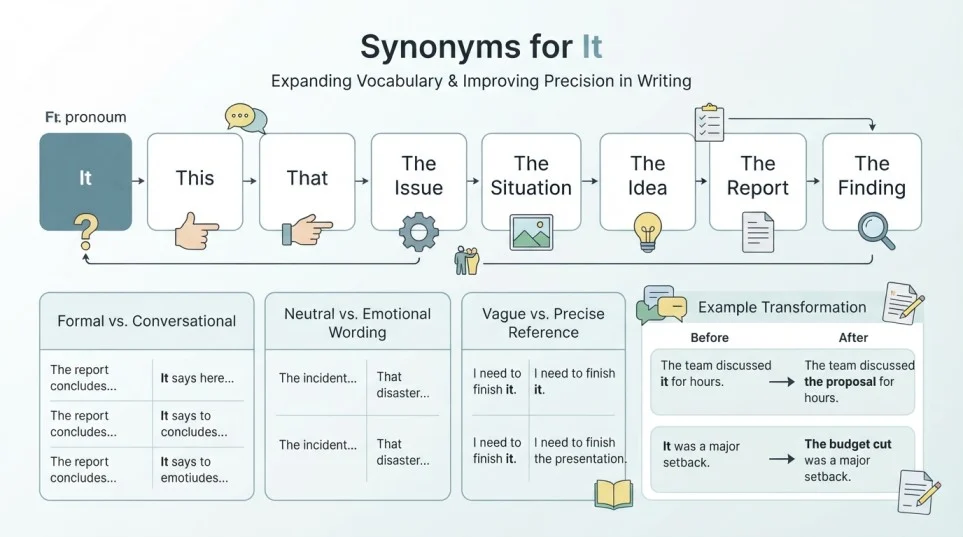
- For professional writing, consider “the matter,” “the issue,” “the proposal,” “the report,” or another precise noun when the reference could be unclear.
- For academic writing, “this,” “that,” “the finding,” “the result,” “the argument,” or “the study” may provide greater precision.
- For casual conversation, “this,” “that,” “the thing,” or “the situation” may work naturally.
- For emotional writing, “the feeling,” “the experience,” “the moment,” or “the situation” can make the sentence more expressive.
- For creative writing, replacing “it” with a specific noun can create stronger imagery and help readers visualize what you mean.
- For resumes and workplace writing, use the actual noun whenever possible. Specific wording usually communicates achievements more clearly than vague pronouns.
- For social media captions, “this,” “that,” “the moment,” “the experience,” or the specific subject can make the caption more engaging.
- For a stronger meaning, replace “it” with the exact noun or concept rather than choosing a more dramatic pronoun.
- For a softer meaning, “this” or “that” can sometimes provide a natural conversational reference.
When Not to Use “It”
You do not need to replace “it” simply because you are trying to avoid repetition.
“It” is one of the most useful pronouns in English, and natural writing often depends on it.
However, replacing “it” can help when the reader might not know what “it” refers to.
Consider:
“The manager spoke with the employee about the report, and it caused confusion.”
What caused confusion? The report or the conversation?
A clearer version is:
“The manager spoke with the employee about the report, and the conversation caused confusion.”
The problem was not the word “it” itself. The problem was an unclear reference.
Another example:
“The company introduced a new policy, and it affected employees.”
This is grammatically correct, but a more precise version may be:
“The new policy affected employees.”
Precision is especially important in reports, essays, workplace communication, and technical writing.
When “It” Is Better
Do not force a replacement when “it” is already clear.
“The book was expensive, but it was worth buying.”
Replacing “it” with “the book” would simply create unnecessary repetition.
Words Commonly Confused With “It”
It vs. This
“It” commonly refers to something already established.
“This” often points to something closer, more immediate, or newly emphasized.
“It was a useful meeting.”
“This was a useful meeting.”
The first sentence generally refers back to an established meeting. The second can emphasize the meeting as something currently being discussed.
It vs. That
“That” can refer back to something previously mentioned while also creating greater distance.
“I heard the announcement, and it surprised me.”
“I heard the announcement, and that surprised me.”
Both can work, but “that” often points more directly to the preceding event or statement.
It vs. Its
“It” is a pronoun.
“I saw it.”
“Its” is possessive.
“The company changed its logo.”
It vs. Itself
“Itself” is a reflexive or emphatic pronoun.
“The machine repaired itself.”
“The result itself was surprising.”
“It” cannot perform the same grammatical function in these sentences.
It vs. They
“They” is normally used for plural nouns and can also be used as a singular gender neutral pronoun for a person.
“It” is generally used for things, animals in suitable contexts, situations, ideas, and grammatical subjects.
“The books are on the desk. They are new.”
“The book is on the desk. It is new.”
Best Synonym by Context for “It”
Because “it” is a pronoun rather than a descriptive word, the best replacement is often a specific noun or demonstrative pronoun.
| Context | Best Synonym | Why It Works | Example |
|---|---|---|---|
| Formal writing | the matter | Clearly identifies an issue or subject | We discussed the matter yesterday. |
| Academic writing | this | Directly connects to a previous point | This suggests that the results are significant. |
| Professional or business use | the issue | Useful when referring to a specific problem | The issue requires further review. |
| Resume writing | the project | More specific than a vague pronoun | The project increased customer engagement. |
| Casual conversation | that | Natural for referring to something already mentioned | I heard that, and I agree. |
| Creative writing | the moment | Adds descriptive meaning | The moment changed everything. |
| Emotional writing | the experience | Gives an emotional event more definition | The experience taught her patience. |
| Strong intensity | the central problem | Adds precision and emphasis | The central problem needs immediate attention. |
| Soft or moderate tone | this | Sounds natural and relatively neutral | This may require another review. |
| Social media captions | this | Works well for immediate experiences and images | This is exactly what I needed today. |
| Business reports | the finding | Identifies a specific result | The finding supports the original hypothesis. |
| Academic essays | the argument | Clarifies the subject of discussion | The argument requires additional evidence. |
| Email communication | the document | Removes ambiguity | Please review the document before signing. |
| Storytelling | the event | Gives a past occurrence a clear identity | The event changed her perspective. |
| Problem solving | the issue | Makes the problem explicit | We need to address the issue. |
| Discussions | the point | Clarifies an idea being discussed | I understand the point now. |
| Reference to an idea | the idea | More precise than “it” | The idea deserves further consideration. |
| Reference to a situation | the situation | Identifies circumstances clearly | The situation became more complicated. |
Which Synonym Should You Choose?
Use this simple decision guide.
- If the reference is already obvious: use “it.”
- If you want to point to something specific: consider “this” or “that.”
- If “it” could refer to more than one thing: replace it with the exact noun.
- If you are writing academically: use a precise noun such as “the finding,” “the argument,” “the study,” or “the result” when needed.
- If you are writing professionally: name the document, project, issue, proposal, customer, or process instead of relying on a vague reference.
- If you are writing creatively: choose a noun that adds imagery, emotion, or atmosphere.
- If you are writing casually: “this,” “that,” and “it” are usually natural choices.
The key principle is simple: clarity matters more than avoiding repetition.
Real Life Examples of “It” in Sentences
School
“I finished the assignment and submitted it before class.”
Here, “it” clearly refers to the assignment.
Workplace
“The team reviewed the proposal and approved it.”
The proposal is already known, so “it” works naturally.
Writing
“The article explains the concept clearly, making it easier to understand.”
A later sentence could replace “it” with “the concept” if the reference becomes unclear.
Conversation
“I watched that new show last night. It was surprisingly good.”
“It” naturally refers to the show.
Social Media
“I finally visited the place I had been talking about. It was beautiful.”
For a caption, “this place” could add a stronger sense of immediacy.
Resume
Instead of writing:
“Managed a project and improved it.”
A more specific version is:
“Managed a customer service project and improved response times by 20 percent.”
The second sentence provides meaningful information instead of relying on a vague pronoun.
“I attached the revised contract. Please review it before our meeting.”
The reference is clear because the contract was just mentioned.
Storytelling
“She opened the old box and discovered a photograph inside it.”
“It” naturally refers to the box.
18 Synonyms for “It”
Strictly speaking, “it” does not have 18 universal synonyms. It is a pronoun whose replacement changes according to its grammatical role and what it refers to.
The following 18 alternatives are useful contextual replacements. They should not be treated as interchangeable in every sentence.
| Synonym | Simple Meaning | Best Used For | Example Sentence |
|---|---|---|---|
| this | something close or currently discussed | Immediate reference | This deserves another look. |
| that | something previously mentioned or more distant | Conversation and reference | That explains the problem. |
| the thing | an unspecified object or matter | Casual conversation | I forgot the thing we discussed. |
| the matter | a subject or issue under discussion | Formal writing | We need to resolve the matter soon. |
| the issue | a problem or topic | Professional communication | The issue requires careful attention. |
| the situation | a set of circumstances | Problems and events | The situation became more difficult. |
| the idea | a thought or concept | Academic and general writing | The idea deserves further discussion. |
| the point | the main idea or argument | Discussions and essays | I understand the point now. |
| the subject | the thing being discussed or studied | Academic and formal writing | The subject requires additional research. |
| the object | a physical thing | Technical or descriptive writing | The object was found near the entrance. |
| the item | an individual thing or product | Business and shopping contexts | The item arrived this morning. |
| the product | something manufactured or sold | Business contexts | The product received positive feedback. |
| the proposal | a suggested plan or idea | Workplace communication | The proposal needs further review. |
| the report | a written document | Academic and professional writing | The report explains the findings. |
| the result | an outcome or finding | Research and analysis | The result was unexpected. |
| the finding | information discovered through research | Academic writing | The finding supports the conclusion. |
| the experience | an event or situation personally encountered | Emotional and personal writing | The experience changed her perspective. |
| the event | something that happened | Storytelling and reporting | The event attracted widespread attention. |
Synonym Groups and Usage Differences
Professional vs. Personal Synonyms
Professional writing often benefits from naming the exact subject.
Instead of:
“We discussed it during the meeting.”
Consider:
“We discussed the proposal during the meeting.”
Personal communication usually allows more contextual shorthand.
“I bought the jacket yesterday, and I love it.”
Both versions are correct. The choice depends on whether the reader already understands the reference.
Formal vs. Conversational Synonyms
“It,” “this,” and “that” are natural across most situations.
Words such as “the matter,” “the issue,” “the subject,” and “the finding” provide more specific formal alternatives when appropriate.
In a text message, you might write:
“That makes sense.”
In a report, you might write:
“The finding supports the proposed explanation.”
Academic Synonyms
Academic writing should prioritize precision.
Instead of repeatedly writing:
“It shows that…”
Consider:
“The finding shows that…”
“The study demonstrates that…”
“The evidence suggests that…”
“The result indicates that…”
These alternatives identify exactly what is providing the information.
However, do not replace every occurrence of “it.” Natural academic writing still uses pronouns extensively.
Professional and Business Synonyms
Workplace communication benefits from specificity.
Instead of:
“Please review it.”
Use:
“Please review the proposal.”
If several documents have been mentioned, the second version is much clearer.
Useful professional alternatives include:
“The proposal”
“The report”
“The document”
“The issue”
“The project”
“The request”
“The finding”
“The result”
“The agreement”
“The process”
Creative or Literary Synonyms
Creative writing often uses specific nouns to create stronger imagery.
Compare:
“She remembered it.”
“She remembered the old house.”
The second sentence gives the reader something concrete to imagine.
Creative alternatives should therefore be selected for meaning rather than simply for variation.
Slang or Modern Synonyms
There are no universal slang synonyms for “it.”
Expressions such as “the thing” can sound casual, but they are not suitable replacements in every sentence.
For example:
“Where did I put the thing?”
This is natural when both speakers know what “the thing” means.
In professional writing, use the actual noun instead.
Strongest vs. Weaker Synonyms
Because “it” has no inherent intensity, the intensity comes from the replacement noun.
A useful scale is:
Mild: it
Neutral: this, that
More specific: the issue, the situation, the idea
More focused: the central issue, the main problem
Highly specific: the exact proposal, the underlying concern, the primary finding
The strongest choice is not always the best choice. Select the level of detail the reader needs.
Emotional vs. Neutral Synonyms
“It” is generally neutral.
“The experience” can suggest personal significance.
“The loss” can create emotional weight.
“The moment” can create a reflective tone.
“The problem” creates a negative interpretation.
“The achievement” creates a positive interpretation.
The replacement therefore changes not only clarity but also the emotional meaning of the sentence.
Antonyms of “It”
“It” does not have true antonyms because it is a grammatical pronoun rather than a word describing a quality, action, or concept.
For that reason, listing 15 supposed antonyms would be misleading.
Instead, the following 15 expressions represent useful contrasting reference choices. They show how English can shift from an unspecified reference to a specific or contrasting one.
| Contrasting Reference | Meaning | Example Sentence |
|---|---|---|
| this | A specific nearby or current reference | This is the document I meant. |
| that | A specific distant or previously mentioned reference | That is the problem we discussed. |
| these | Multiple nearby items | These are the results we need. |
| those | Multiple distant or previously mentioned items | Those are the files I requested. |
| he | A male person reference | He completed the report. |
| she | A female person reference | She reviewed the proposal. |
| they | A plural or suitable singular person reference | They approved the request. |
| someone | An unspecified person | Someone called earlier. |
| something | An unspecified thing | Something changed overnight. |
| nothing | The absence of a thing | Nothing happened after the meeting. |
| everything | All relevant things | Everything is ready. |
| everyone | All relevant people | Everyone agreed with the plan. |
| nobody | No person | Nobody responded to the email. |
| the specific item | A clearly identified object | The specific item was missing. |
| the exact subject | A clearly identified topic | The exact subject needs clarification. |
These are not dictionary antonyms of “it.” They are alternative reference structures that can help writers understand why a pronoun may or may not be appropriate.
Comparison: “It” vs. Similar Words
It vs. This
The main difference is reference and emphasis.
“This” often points toward something current or immediately relevant, while “it” commonly refers back to something already established.
Neither is inherently stronger or more formal.
Example:
“The report was helpful. It explained the issue clearly.”
“This report explains the issue clearly.”
It vs. That
“That” can create a sense of reference to something previously mentioned or somewhat distant.
“It was surprising.”
“That was surprising.”
Both can be natural, but “that” can more directly point to the preceding event or statement.
It vs. The Thing
“The thing” is much more conversational and less precise.
Use “it” when the reference is already clear.
Use “the thing” when the object is unnamed or the speakers share enough context to understand it.
It vs. The Matter
“The matter” is much more formal and specific.
“It” works in general conversation.
“The matter” can work in professional or formal communication when discussing a subject, concern, or issue.
Example:
“We need to discuss it.”
“We need to discuss the matter.”
The second sounds more formal.
It vs. The Situation
“The situation” specifically refers to circumstances or a developing state of affairs.
“It” is broader.
Example:
“The situation is becoming more complicated.”
This is clearer than using “it” when the subject is a complicated set of circumstances.
It vs. The Issue
“The issue” normally identifies a problem, concern, or topic requiring attention.
“It” does not automatically communicate that meaning.
Example:
“We need to address the issue.”
This is more precise than:
“We need to address it.”
when the reader does not know what “it” refers to.
Common Phrases and Expressions with “It”
1. Take It Seriously
Meaning:
To treat something as important or deserving attention.
Example sentence:
“You should take the warning seriously.”
2. Make It Clear
Meaning:
To explain something so that people understand it.
Example sentence:
“The teacher made it clear that the assignment was due Friday.”
3. Put It Simply
Meaning:
To explain something in an easier way.
Example sentence:
“To put it simply, we need more time.”
4. Keep It Simple
Meaning:
To avoid unnecessary complexity.
Example sentence:
“Keep it simple so that every reader can understand the instructions.”
5. Get It Done
Meaning:
To complete a task.
Example sentence:
“We have one hour left, so let’s get it done.”
6. Take It Easy
Meaning:
To relax or avoid unnecessary stress or effort.
Example sentence:
“You have worked hard today, so take it easy tonight.”
7. Leave It Alone
Meaning:
To stop interfering with something or someone.
Example sentence:
“If the machine is working properly, leave it alone.”
8. Make It Happen
Meaning:
To take action that causes a desired result.
Example sentence:
“We have a good plan, so now we need to make it happen.”
Common Mistakes to Avoid
1. Using “It” When a More Precise Noun Is Better
Vague:
“The manager discussed it with the team.”
Clearer:
“The manager discussed the hiring plan with the team.”
If the reader cannot identify “it” immediately, name the subject.
2. Confusing “It” With “Its”
“It” is a pronoun.
“I saw it.”
“Its” shows possession.
“The company changed its policy.”
This distinction is especially important in professional and academic writing.
3. Confusing “It’s” With “Its”
“It’s” means “it is” or “it has.”
“It’s important to check the data.”
“Its” indicates possession.
“The company changed its strategy.”
4. Using a Casual Expression in Formal Writing
“The thing” may work in conversation but can sound vague in an academic paper.
Instead of:
“The thing affects the results.”
Write:
“The variable affects the results.”
5. Using an Overly Dramatic Replacement
A simple situation does not need an exaggerated noun.
Instead of choosing a highly emotional word merely to avoid “it,” identify the actual subject.
Precision is more useful than drama.
6. Repeating “It” Too Often
A paragraph containing “it” in nearly every sentence can become difficult to follow.
Replace some instances with the exact noun when doing so improves clarity.
7. Choosing a Synonym With the Wrong Emotional Tone
“It” is neutral.
“The problem” is negative.
“The achievement” is positive.
“The tragedy” is strongly emotional.
Make sure the replacement accurately reflects the intended meaning.
FAQs
What is the best synonym for “it”?
There is no universal synonym. “This,” “that,” or a specific noun such as “the issue” or “the report” may be best depending on context.
What is a formal synonym for “it”?
Formal alternatives depend on meaning. “The matter,” “the issue,” “the subject,” “the finding,” and “the result” can provide greater precision.
What is an informal synonym for “it”?
In casual speech, “this,” “that,” and sometimes “the thing” can work. The exact choice depends on what “it” represents.
What is another word for “it” in professional writing?
Use the specific noun whenever possible. Depending on context, alternatives include “the proposal,” “the report,” “the project,” “the issue,” or “the document.”
What is the difference between “it” and “this”?
“It” commonly refers back to an established subject, while “this” often points to something current, nearby, or being emphasized.
What is the opposite of “it”?
“It” has no true opposite because it is a grammatical pronoun. You can use contrasting reference words such as “this,” “that,” “these,” or “those.”
Conclusion
“It” is one of the most useful pronouns in English, but it does not have a single replacement that works in every sentence.
The best alternative depends on what “it” represents. “This” and “that” can work for general reference, while “the issue,” “the situation,” “the idea,” “the report,” and “the finding” provide greater specificity.
For professional and academic writing, prioritize clarity over simply avoiding repetition. If the reader already knows what “it” means, keeping the pronoun is often the most natural choice.
If the reference is unclear, replace “it” with the exact noun or concept.
The most useful vocabulary habit is simple: do not replace “it” just to sound sophisticated. Replace it when a more precise word helps your reader understand your meaning faster.
Discover More Post:
25+ Synonyms for Frustrated | Meanings, Examples, and Best …
25+ Synonyms for Shadow | Meanings, Examples, and Best …
25+ Synonyms for Framework | Meanings, Examples, and Best …