Saying “hello” is simple, but repeating the same greeting in every email, conversation, caption, or story can make your language feel predictable. The right alternative can instantly make your message sound warmer, more professional, more casual, or more creative.
This guide to synonyms for hello explains which alternatives actually fit different situations. You will learn the meaning, tone, formality, usage, and practical differences between common greetings so you can choose words naturally and confidently.
What Does “Hello” Mean?
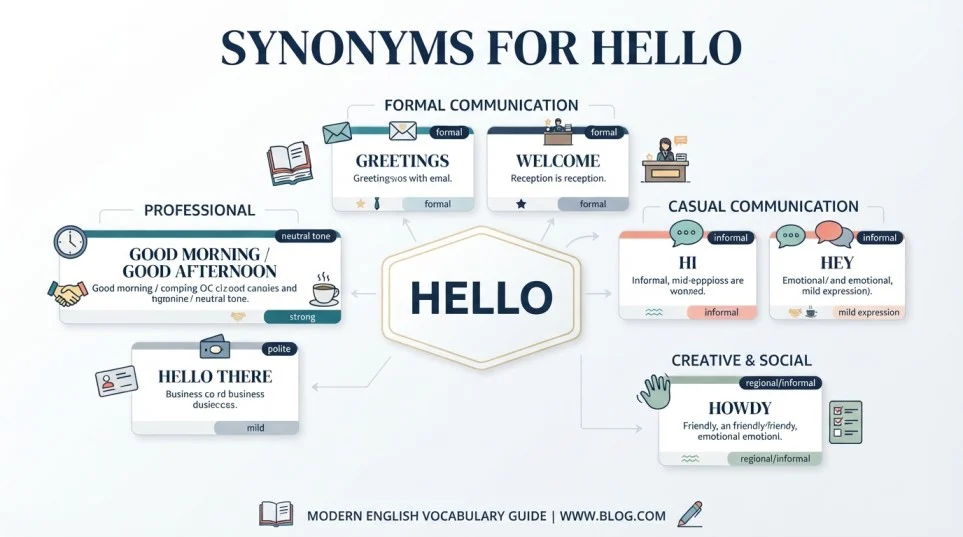
“Hello” is a common greeting used when meeting, addressing, or getting someone’s attention. Depending on context, alternatives include “hi” for casual situations, “greetings” for formal writing, “hey” for friendly conversation, and “welcome” for receiving someone.
Meaning, Tone and Context
Simple Definition
Hello is a word used to greet someone, begin a conversation, acknowledge their presence, or attract their attention.
For example:
Hello, Sarah. How have you been?
It can also be used when answering a telephone call or addressing an audience.
Hello, everyone. Thanks for joining us today.
Part of Speech
“Hello” is primarily an interjection and a noun.
As an interjection, it functions as a greeting.
Hello! Nice to meet you.
As a noun, it can refer to the act or expression of greeting someone.
She gave me a cheerful hello.
Tone
Hello is generally neutral and friendly.
It is not inherently formal or informal, which makes it useful in many situations. However, the surrounding words, punctuation, and setting can change how it feels.
“Hello, Mr. Carter” sounds polite and professional.
“Hey!” sounds more relaxed and conversational.
Formality Level
Hello sits near the middle of the formality scale.
It works in:
- Everyday conversation
- Professional communication
- Emails
- Customer service
- Speeches
- Introductions
- Social media
- Friendly messages
- Telephone conversations
- Creative writing
Common Use Cases
You can use hello when:
- Meeting someone for the first time
- Starting an email
- Beginning a conversation
- Answering a phone call
- Addressing a group
- Greeting a friend
- Getting someone’s attention
- Introducing yourself
- Opening a speech
- Welcoming someone into a conversation
Related Word Forms
The most closely related forms include:
Hello: A greeting.
Greeting: An expression used to acknowledge someone.
Greet: The verb meaning to address someone with a greeting.
Greeting someone: The act of acknowledging or welcoming someone.
When and How to Use “Hello”
Hello is useful when you want a greeting that feels friendly without sounding overly casual.
Professional
Hello, Ms. Johnson. Thank you for taking the time to speak with me.
This is appropriate for many workplace emails and professional conversations.
Personal
Hello! It is so good to see you again.
This sounds warm and natural among friends, relatives, or acquaintances.
Academic
Hello, everyone. Today, I will discuss the effects of social media on communication.
It can work as an opening for a classroom presentation or student speech.
Casual
Hello! What are you up to today?
Here, hello creates a friendly and relaxed opening.
Another Word for “Hello”
The best single replacement depends heavily on the situation.
- For professional writing, use greetings or a specific salutation such as “Good morning.”
- For academic writing, greetings or a specific time based greeting may work better than an overly casual expression.
- For casual conversation, hi is usually the simplest replacement.
- For emotional writing, hello there or dear friend can create a warmer feeling depending on the sentence.
- For creative writing, expressions such as howdy, well, hello, or greetings can establish personality or setting.
- For resume or workplace use, greetings are usually relevant to accompanying communication rather than the resume itself. “Hello” is appropriate in a cover letter or introductory message.
- For social media captions, hey, hi, hello there, and hiya can sound natural.
- For a stronger or more energetic greeting, “hey there” or “hello there” can feel more expressive.
- For a softer and more polite greeting, “good morning,” “good afternoon,” or “good evening” is often appropriate.
When Not to Use “Hello”
Hello is versatile, but it is not always the most precise choice.
If you are writing a highly formal letter, a specific salutation can sound more appropriate.
Instead of:
Hello, Hiring Manager.
You might write:
Dear Hiring Manager,
If you are greeting someone in person at a specific time, a time based greeting can sound more polished.
Instead of:
Hello, Professor.
You could say:
Good morning, Professor.
In a very casual conversation with a close friend, “hello” may sound slightly more deliberate than “hi” or “hey.”
Instead of:
Hello! What are you doing?
You might naturally say:
Hey! What are you doing?
The best word is not necessarily the most sophisticated one. It is the one that fits the relationship and situation.
Words Commonly Confused With “Hello”
Hello vs. Hi
Both are common greetings. “Hi” is usually shorter and more conversational, while “hello” has a slightly broader range of use.
Hello vs. Hey
“Hey” is generally more casual and expressive. It is common between friends, coworkers who know each other, and people communicating online.
Hello vs. Greetings
“Greetings” has a more formal or traditional feeling. It can work in formal messages, announcements, letters, and stylized writing.
Hello vs. Welcome
“Welcome” is not simply another word for hello. It communicates that someone is being received into a place, group, event, or situation.
Hello vs. Salutations
“Salutations” refers to greetings or greeting expressions and has a formal, old fashioned, or deliberately stylized tone.
Hello vs. Goodbye
Hello begins or marks an encounter, while goodbye normally marks its ending. They serve opposite conversational functions.
Best Synonym by Context for “Hello”
| Context | Best Synonym | Why It Works | Example |
|---|---|---|---|
| Formal writing | Greetings | Polite and appropriately formal | Greetings, members of the committee. |
| Academic writing | Good morning | Clear and respectful | Good morning, Professor Lee. |
| Professional or business use | Hello | Neutral and professional | Hello, Mr. Davis. |
| Resume communication | Greetings | Suitable for an accompanying message | Greetings, I am writing regarding the position. |
| Casual conversation | Hi | Simple and natural | Hi, Emma! |
| Creative writing | Howdy | Adds personality and character | Howdy, stranger! |
| Emotional tone | Hello there | Warm and personable | Hello there, old friend. |
| Strong intensity | Hey there | Energetic and attention grabbing | Hey there! Great to see you. |
| Soft or moderate tone | Good afternoon | Polite and composed | Good afternoon, everyone. |
| Social media | Hey | Friendly and contemporary | Hey, everyone! |
| Telephone | Hello | Conventional and immediately recognizable | Hello, may I speak with James? |
| Group setting | Hello, everyone | Clearly addresses multiple people | Hello, everyone. Thanks for coming. |
| Customer service | Hello | Friendly while remaining neutral | Hello, how may I help you? |
| Email opening | Hello | Safe and versatile | Hello, Dr. Smith. |
| Friendly text | Hi | Brief and natural | Hi! Are you free tonight? |
| Regional or traditional style | Howdy | Creates a distinctive regional flavor | Howdy, folks! |
Which Synonym Should You Choose?
Choosing another word for hello is mostly a matter of tone, relationship, and purpose.
- If you want something safe and neutral, use hello.
- If you want something short and casual, choose hi.
- If you are speaking casually with someone you know, hey works well.
- If you need a more formal greeting, choose greetings, good morning, good afternoon, or good evening.
- If you want a warm and personal expression, consider hello there or hey there.
- If you want a distinctive regional or playful voice, howdy can work.
Always consider the reader before choosing a replacement. A greeting that sounds friendly in a text message may sound too casual in a formal business letter.
Real Life Examples of “Hello” in Sentences
School
Hello, everyone. Please take your seats before the presentation begins.
Workplace
Hello, team. I have attached the updated schedule for review.
Writing
Hello, readers. In this article, we will explore several practical writing techniques.
Conversation
Hello! I have not seen you in ages.
Social Media
Hey, everyone! Here are five vocabulary tips for better writing.
Hello, Dr. Wilson. I am writing to follow up on our conversation.
Storytelling
“Hello,” she said quietly as she stepped through the open door.
Customer Service
Hello, how can I assist you today?
18 Synonyms for “Hello”
Some alternatives are direct synonyms, while others are established greeting expressions that perform the same conversational function. Their tone and appropriate context can differ significantly.
| Synonym | Simple Meaning | Best Used For | Example Sentence |
|---|---|---|---|
| Hi | A simple friendly greeting | Casual conversation | Hi, how are you doing? |
| Hey | A casual and energetic greeting | Friends and informal messages | Hey, what are you doing later? |
| Greetings | A formal expression of welcome or acknowledgment | Formal writing and announcements | Greetings, members of the audience. |
| Salutations | A formal way of expressing a greeting | Formal or stylized writing | Salutations to everyone attending today. |
| Howdy | A friendly regional greeting | Informal and playful situations | Howdy, folks! |
| Hiya | A cheerful informal greeting | Friendly conversation | Hiya, Sam! |
| Hey there | A warm casual greeting | Friendly messages | Hey there, nice to hear from you. |
| Hello there | A warm variation of hello | Friendly or expressive conversation | Hello there, old friend. |
| Good morning | A polite greeting used in the morning | Professional and polite situations | Good morning, everyone. |
| Good afternoon | A polite afternoon greeting | Professional and formal situations | Good afternoon, Ms. Brown. |
| Good evening | A polite evening greeting | Formal and social settings | Good evening, ladies and gentlemen. |
| Welcome | An expression of receiving someone | Events, places, and groups | Welcome to our annual meeting. |
| Well, hello | An expressive form of greeting | Friendly or dramatic conversation | Well, hello! What a surprise. |
| Hello everyone | A greeting directed at a group | Meetings and presentations | Hello everyone, thank you for joining us. |
| Hi everyone | A casual group greeting | Classes, meetings, and online posts | Hi everyone, I have an announcement. |
| Hey everyone | An informal group greeting | Social media and casual groups | Hey everyone, here is today’s update. |
| Hello friends | A warm greeting for a group | Blogs, posts, and community messages | Hello friends, I hope you are having a great day. |
| Good to see you | A greeting that emphasizes pleasure at meeting someone | Personal and professional conversation | Good to see you again, Mark. |
Synonym Groups and Usage Differences
Professional vs. Personal Synonyms
Professional communication generally benefits from neutral greetings.
“Hello,” “good morning,” “good afternoon,” and “greetings” can work well in professional settings.
Personal communication gives you more freedom.
“Hi,” “hey,” “hiya,” and “hey there” can sound more natural when speaking with friends or familiar coworkers.
Formal vs. Conversational Synonyms
Formal expressions include:
- Greetings
- Salutations
- Good morning
- Good afternoon
- Good evening
Conversational expressions include:
- Hi
- Hey
- Hiya
- Howdy
- Hey there
For an essay or formal report, greetings may be more appropriate than casual expressions. For a text message, “hi” or “hey” will usually sound more natural.
Academic Synonyms
Academic communication usually values clarity over novelty.
When addressing a class or audience, “good morning,” “hello everyone,” or “greetings” can work depending on the setting.
In formal academic correspondence, the recipient’s name and an appropriate salutation are usually more important than searching for an unusual synonym.
Professional and Business Synonyms
In workplace emails, “hello” remains one of the safest choices.
Hello, Jennifer.
“Good morning” can sound slightly more polished when the timing is appropriate.
Good morning, Jennifer.
“Hey” can also be perfectly acceptable in some workplaces, particularly where communication is informal, but workplace culture matters.
Creative or Literary Synonyms
Creative writing gives greetings an additional purpose. A character’s choice of greeting can reveal personality, background, age, mood, or relationship.
“How do you do?” can suggest a traditional or formal setting.
“Howdy” can create a regional or playful voice.
“Well, hello” can communicate surprise, confidence, amusement, or flirtatious energy depending on context.
Slang or Modern Synonyms
There are relatively few true slang equivalents of hello that work universally.
“Hey,” “hiya,” and “hey there” are common informal choices.
They work well in texts, casual conversations, social posts, and friendly messages. They may be inappropriate in highly formal correspondence.
Strongest vs. Weaker Synonyms
Because greetings do not have a strict intensity scale, their differences are better understood through expressiveness rather than strength.
Mild and neutral:
Hello
Hi
Good morning
Friendly and expressive:
Hey
Hey there
Hello there
Highly stylized or distinctive:
Howdy
Well, hello
Salutations
A stronger greeting is not necessarily better. The right level of expression depends on your relationship with the reader.
Emotional vs. Neutral Synonyms
Neutral greetings include:
- Hello
- Hi
- Good morning
- Good afternoon
More expressive greetings include:
- Hello there
- Hey there
- Well, hello
- Good to see you
The expressive choices can communicate warmth, surprise, enthusiasm, or familiarity.
Antonyms of “Hello”
“Hello” does not have 15 strict dictionary antonyms. It is a greeting, so its clearest functional opposite is a parting expression, especially “goodbye.”
The following expressions represent conversational contrasts rather than strict lexical antonyms.
| Antonym or Conversational Contrast | Meaning | Example Sentence |
|---|---|---|
| Goodbye | A conventional parting expression | Goodbye, and have a safe trip. |
| Farewell | A more formal parting expression | Farewell, my old friend. |
| Bye | A casual way to end an encounter | Bye, see you tomorrow. |
| Bye bye | An informal and often affectionate farewell | Bye bye, everyone. |
| See you | A casual expression suggesting another meeting | See you next week. |
| See you later | A casual expression for a future meeting | See you later, Sam. |
| See you soon | A farewell suggesting a near future meeting | See you soon. |
| Take care | A friendly parting expression | Take care and call me when you arrive. |
| Good night | A parting expression used at night | Good night, everyone. |
| Until later | An expression indicating temporary separation | Until later, my friend. |
| Until tomorrow | A parting expression referring to the next day | Until tomorrow, team. |
| Leave | To depart from a place or person | I need to leave now. |
| Depart | To go away from a place | The guests began to depart. |
| Silence | Absence of spoken communication | The room fell into silence. |
| Ignore | To deliberately give no acknowledgment | He chose to ignore the message. |
Comparison: “Hello” vs. Similar Words
Hello vs. Hi
Main difference: Both are greetings, but “hi” is usually shorter and more conversational.
Stronger: Neither is inherently stronger.
More formal: Hello is slightly more versatile.
Examples:
Hello, Professor Adams.
Hi, Jake!
Hello vs. Hey
Main difference: “Hey” is more casual and often more energetic.
Stronger: Hey can feel more expressive.
More formal: Hello.
Examples:
Hello, Mr. Clark. Thank you for meeting with me.
Hey, Alex! Long time no see.
Hello vs. Greetings
Main difference: “Greetings” has a more formal or stylized quality.
Stronger: Neither is inherently stronger.
More formal: Greetings.
Examples:
Hello, everyone.
Greetings, members of the committee.
Hello vs. Welcome
Main difference: Hello acknowledges someone, while welcome communicates that someone is being received into a place or group.
Stronger: Welcome can communicate a stronger sense of reception.
More formal: Either can be formal depending on the sentence.
Examples:
Hello, everyone.
Welcome to our conference.
Hello vs. Howdy
Main difference: Howdy is informal and has a distinctive regional or traditional American flavor.
Stronger: Howdy is more stylistically noticeable.
More formal: Hello.
Examples:
Hello, everyone.
Howdy, folks!
Hello vs. Salutations
Main difference: Salutations is more formal, traditional, and sometimes deliberately playful.
Stronger: Neither is stronger in meaning.
More formal: Salutations.
Examples:
Hello, readers.
Salutations, fellow travelers.
Common Phrases and Expressions with “Hello”
1. Hello there
Meaning: A warm or friendly version of hello.
Example sentence:
Hello there! It is great to see you.
2. Hello everyone
Meaning: A greeting directed toward a group.
Example sentence:
Hello everyone, thank you for joining today’s meeting.
3. Hello again
Meaning: A greeting used when meeting someone for a second or subsequent time.
Example sentence:
Hello again, Sarah. How did your presentation go?
4. Say hello
Meaning: To greet someone or encourage someone to greet another person.
Example sentence:
Be sure to say hello to your grandparents for me.
5. Hello and welcome
Meaning: A greeting combined with an expression of reception.
Example sentence:
Hello and welcome to today’s workshop.
6. Well, hello
Meaning: An expressive greeting that can communicate surprise or pleasure.
Example sentence:
Well, hello! I did not expect to see you here.
7. A friendly hello
Meaning: A warm and pleasant greeting.
Example sentence:
She gave her neighbor a friendly hello.
8. A quick hello
Meaning: A brief greeting without a long conversation.
Example sentence:
I stopped by just to say a quick hello.
Common Mistakes to Avoid
1. Using “hello” when a more precise greeting is better
Hello is useful, but a time based greeting can sound more polished in professional situations.
Good morning, Dr. Taylor.
This can be more specific than simply saying hello.
2. Confusing “hello” with “welcome”
Welcome is about receiving someone into a place, event, or group.
Welcome to our office.
This has a different function from simply saying hello.
3. Using a casual synonym in formal writing
“Hey” may sound friendly, but it can be too informal for certain professional or academic settings.
When in doubt, use hello or a suitable time based greeting.
4. Using an overly dramatic synonym
“Salutations” can sound unusual in an ordinary workplace email.
Choose language that fits the situation rather than trying to sound sophisticated.
5. Repeating the same greeting
Using hello repeatedly in an article, story, or series of messages can make your writing feel repetitive.
Vary your language only when the replacement preserves the intended tone.
6. Choosing the wrong emotional tone
“Hey” can feel energetic, while “good evening” feels more composed.
Consider how you want the reader to feel before selecting an alternative.
7. Using slang in academic or professional writing
Informal greetings can work in friendly environments but may weaken the tone of formal communication.
Always consider the expectations of your audience.
FAQs
What is the best synonym for “hello”?
“Hi” is the simplest casual synonym, while “greetings,” “good morning,” or “good afternoon” may work better in formal and professional situations.
What is a formal synonym for “hello”?
“Greetings” is a formal alternative, while “good morning,” “good afternoon,” “good evening,” and traditional salutations can suit formal communication.
What is an informal synonym for “hello”?
“Hi,” “hey,” “hiya,” and “howdy” are informal alternatives. The best choice depends on your relationship with the person and the setting.
What is another word for “hello” in professional writing?
“Hello” itself is professional and versatile. “Good morning” or “good afternoon” can add a polite, time specific quality.
What is the difference between “hello” and “hi”?
Both words function as greetings. “Hi” is generally shorter and more conversational, while “hello” works across a wider range of formal and informal situations.
What is the opposite of “hello”?
“Goodbye” is the clearest functional opposite because hello begins an interaction while goodbye normally marks its ending. Strict lexical antonyms are limited.
Conclusion
“Hello” is a versatile greeting that works in conversations, emails, presentations, customer service, social media, and many other situations. Its neutral tone makes it one of the safest ways to begin an interaction.
The best synonyms for hello depend on context. Use “hi” for casual communication, “hey” for friendly conversation, “greetings” for formal situations, and “good morning” or “good afternoon” when a polite time based greeting fits.
When choosing another word for hello, focus on audience, relationship, formality, and emotional tone rather than simply searching for a more unusual word.
The most useful vocabulary habit is simple: do not choose a synonym because it sounds impressive. Choose the word that communicates exactly the feeling and level of formality you intend.
Discover More Post:
- 25+ Synonyms for Frustrated | Meanings, Examples, and Best …
- 25+ Synonyms for Shadow | Meanings, Examples, and Best …
- 25+ Synonyms for Framework | Meanings, Examples, and Best …