Have you ever written “injustice” several times in an essay, email, social media post, or speech and felt that the word was becoming repetitive? Choosing a more precise alternative can make your writing clearer and more powerful.
The right synonym depends on what you mean. A workplace situation may involve unfairness, while a legal matter may involve inequity, discrimination, or a violation of rights. In emotional or creative writing, words such as wrongdoing, oppression, or mistreatment may communicate a stronger feeling.
This guide explains the meaning, tone, intensity, and practical use of synonyms for injustice so you can choose words that fit the situation naturally.
What Does “Injustice” Mean?
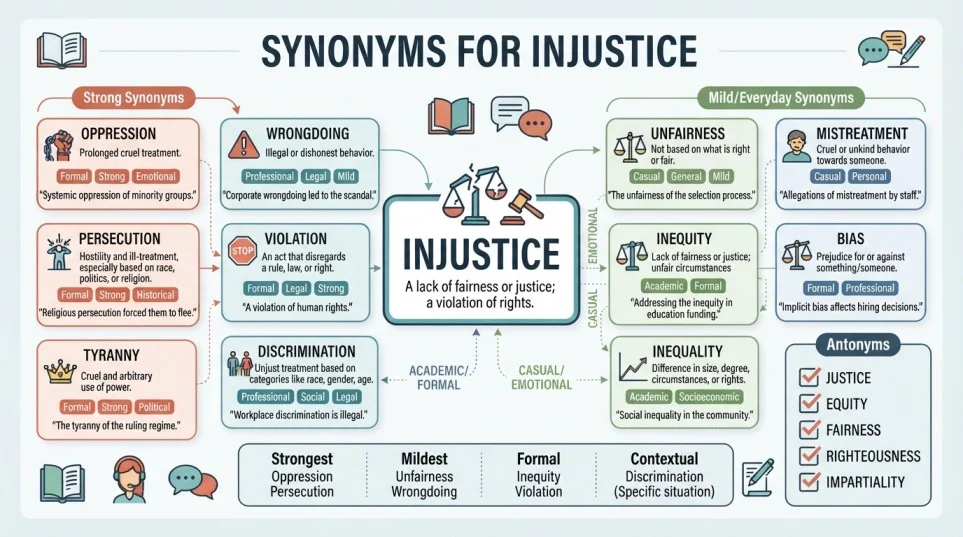
Injustice means unfair treatment, an unfair situation, or a violation of what is considered right or just. Formal choices include inequity and wrongdoing, while casual options include unfairness. Stronger choices include oppression, persecution, and discrimination.
Meaning, Tone and Context
Simple Definition
Injustice means a lack of fairness or justice. It can describe unfair treatment of a person, an unfair decision, unequal treatment, or a broader situation in which people do not receive fair treatment.
For example:
The employee believed the decision was an injustice.
The sentence suggests that the employee considers the decision unfair or wrong.
Part of Speech
Injustice is a noun.
Common forms and related words include:
| Word | Part of Speech | Meaning |
|---|---|---|
| Injustice | Noun | An unfair situation or action |
| Unjust | Adjective | Not fair or morally right |
| Unjustly | Adverb | In an unfair manner |
| Justice | Noun | Fair treatment according to accepted principles |
| Just | Adjective | Fair or morally right |
| Justly | Adverb | In a fair manner |
Tone
Injustice normally has a negative and serious tone because it describes unfairness or wrongdoing.
It can be neutral in factual reporting when the writer is describing a situation without adding personal emotion.
In persuasive, emotional, or literary writing, the word can carry considerable moral force.
Formality Level
Injustice is suitable for formal, academic, professional, journalistic, and everyday communication.
The best alternative depends on the exact situation. Unfairness sounds more conversational, while inequity can sound more formal and analytical.
Common Use Cases
You may use injustice when discussing:
- Unfair treatment
- Unequal opportunities
- Discrimination
- Legal or ethical concerns
- Social problems
- Workplace disputes
- Historical events
- Personal experiences
- Political or civic issues
- Moral wrongdoing
When and How to Use “Injustice”
Use injustice when you want to describe something that violates a sense of fairness, equality, rights, or moral responsibility.
Professional Example
The employee filed a complaint after believing that the promotion decision represented an injustice.
Here, injustice describes a perceived unfair workplace decision.
Personal Example
She felt a deep sense of injustice after being blamed for a mistake she did not make.
The word communicates both unfair treatment and emotional impact.
Academic Example
The essay examines how economic inequality can contribute to social injustice.
In academic writing, injustice works well when discussing fairness, society, law, ethics, or historical conditions.
Emotional Example
He struggled to accept the injustice of losing his home through an unfair decision.
The word emphasizes the person’s emotional response to unfair treatment.
Another Word for “Injustice”
There is no single perfect replacement for injustice in every sentence. The best choice depends on the type of unfairness being described.
| Situation | Useful Alternative |
|---|---|
| Professional writing | Unfairness |
| Academic writing | Inequity |
| Casual conversation | Unfairness |
| Emotional writing | Wrongdoing |
| Creative writing | Oppression |
| Resume or workplace use | Unfair treatment |
| Social media captions | Unfairness |
| Stronger meaning | Oppression |
| Softer meaning | Unfairness |
For professional and academic contexts, choose a word that identifies the specific problem instead of simply replacing injustice with another broad term.
For example, discrimination is more precise when unfair treatment is based on a protected characteristic. Inequality is appropriate when the focus is on unequal conditions or outcomes.
When Not to Use “Injustice”
Sometimes injustice is too broad.
Consider this sentence:
The company made an injustice.
This sounds unnatural because the sentence does not explain what happened. Better choices include:
The company treated the employee unfairly.
Or:
The company made an unfair decision.
Injustice can also sound too serious for a minor inconvenience.
Instead of:
It was an injustice that the restaurant ran out of my favorite dessert.
A more natural sentence is:
It was disappointing that the restaurant ran out of my favorite dessert.
The word should match the seriousness of the situation.
Words Commonly Confused With “Injustice”
Injustice vs. Inequality
Injustice focuses on unfairness or lack of justice.
Inequality focuses on differences in status, resources, opportunities, or outcomes.
Example:
The court decision was described as an injustice.
The study examined income inequality.
Injustice vs. Unfairness
These words are closely related.
Unfairness is broader and more conversational. Injustice often carries a stronger moral or social meaning.
Injustice vs. Discrimination
Discrimination refers to unfair treatment connected to a particular characteristic or category.
Injustice is broader and does not necessarily involve discrimination.
Injustice vs. Oppression
Oppression usually describes prolonged or systematic control and mistreatment of a person or group.
It is generally stronger than injustice.
Injustice vs. Wrongdoing
Wrongdoing emphasizes an improper, unethical, or harmful action.
Injustice emphasizes unfairness or the denial of justice.
Injustice vs. Misconduct
Misconduct usually refers to inappropriate or improper behavior, especially in professional, institutional, or legal contexts.
It does not automatically mean that the behavior was unfair.
Best Synonym by Context for “Injustice”
| Context | Best Synonym | Why It Works | Example |
|---|---|---|---|
| Formal writing | Inequity | Sounds precise and formal | The report discusses inequity in access to services. |
| Academic writing | Inequity | Works well for analytical discussions | Researchers examined educational inequity. |
| Professional or business use | Unfairness | Clear and understandable | The employee raised concerns about unfairness. |
| Resume | Unfair treatment | Clearly describes an experience | Addressed concerns about unfair treatment. |
| Casual conversation | Unfairness | Natural in everyday speech | That decision feels like unfairness to everyone involved. |
| Creative writing | Oppression | Adds emotional and dramatic force | The story portrays life under oppression. |
| Emotional tone | Wrongdoing | Highlights moral harm | She could not forget the wrongdoing. |
| Strong intensity | Persecution | Suggests severe, targeted mistreatment | The group reported years of persecution. |
| Soft or moderate tone | Unfairness | Less dramatic than injustice | He complained about unfairness in the process. |
| Social media captions | Unfairness | Short and accessible | Speaking up about unfairness matters. |
| Legal context | Violation | Useful when a right or rule has been breached | The complaint alleged a violation of rights. |
| Social issues | Inequity | Highlights structural or systemic differences | The article examines health inequity. |
| Human rights | Oppression | Describes severe and sustained control | The campaign focused on ending oppression. |
| Workplace conflict | Mistreatment | Focuses on harmful treatment | The employee reported mistreatment. |
| Ethical discussion | Wrongdoing | Focuses on improper conduct | The investigation examined alleged wrongdoing. |
| Historical writing | Persecution | Appropriate for targeted historical suffering | The museum documents religious persecution. |
| Everyday complaint | Wrong | Simple and conversational | She believed the decision was wrong. |
| US and UK usage | Injustice | Widely understood in both varieties | The author writes about social injustice. |
Which Synonym Should You Choose?
Start by asking what kind of unfairness you are describing.
- If you simply mean that something was not fair, use unfairness.
- If you are discussing unequal conditions or opportunities, inequity or inequality may be more precise.
- If a person or group is being treated unfairly because of a particular characteristic, discrimination may communicate the situation more accurately.
- If the situation involves sustained and severe control or mistreatment, oppression may be appropriate.
- If the focus is on unethical behavior, consider wrongdoing or misconduct.
For emotional writing, choose a stronger term only when the facts justify the intensity.
Real Life Examples of “Injustice” in Sentences
School
The student believed the grading decision was an injustice because the same standard had not been applied to everyone.
Workplace
The employee raised concerns about unfair treatment during the promotion process.
Writing
The novel explores injustice through the experiences of a family facing unequal treatment.
Conversation
It feels unfair that only one person is being blamed for the mistake.
Social Media
Speaking out against injustice can encourage people to think more carefully about fairness and equality.
Resume
Helped document employee concerns involving unfair treatment and workplace procedures.
I would appreciate an opportunity to discuss what I believe was an unfair decision.
Storytelling
The injustice changed how she viewed the town and the people who had remained silent.
18 Synonyms for “Injustice”
| Synonym | Simple Meaning | Best Used For | Example Sentence |
|---|---|---|---|
| Unfairness | Lack of fairness | Everyday speech and general writing | The employee spoke about the unfairness of the decision. |
| Inequity | Unfair difference or lack of equal treatment | Academic and formal writing | The study explored inequity in education. |
| Inequality | Unequal conditions or outcomes | Social and economic discussions | The report examines income inequality. |
| Wrongdoing | Improper or unethical action | Ethical and professional contexts | The investigation uncovered alleged wrongdoing. |
| Mistreatment | Treating someone badly or unfairly | Personal and workplace situations | She reported mistreatment by her supervisor. |
| Discrimination | Unfair treatment based on a particular characteristic | Workplace, legal, and social contexts | The organization has policies addressing discrimination. |
| Oppression | Severe and sustained unfair control | Social, historical, and literary writing | The novel describes life under oppression. |
| Persecution | Targeted and persistent hostile treatment | Historical, religious, and human rights contexts | The history book describes religious persecution. |
| Violation | Breaking or denying a right, rule, or principle | Legal and formal contexts | The complaint alleged a violation of basic rights. |
| Misconduct | Improper behavior | Workplace and institutional settings | The board investigated allegations of misconduct. |
| Wrong | Something morally or ethically incorrect | Casual conversation | She believed the decision was simply wrong. |
| Abuse | Harmful or improper treatment or use of power | Serious personal and institutional situations | The report documented abuse of authority. |
| Prejudice | Unfair judgment formed before knowing the facts | Social and interpersonal contexts | Prejudice can influence how people are treated. |
| Bias | A preference or tendency that can affect fair judgment | Academic, professional, and analytical writing | The researcher considered possible bias in the process. |
| Partiality | Favoring one person or side unfairly | Formal writing | The judge was criticized for apparent partiality. |
| Iniquity | Serious or morally wrong behavior | Formal and literary writing | The poem condemns the iniquity of corruption. |
| Tyranny | Cruel or oppressive exercise of power | Historical and political writing | The story describes life under tyranny. |
| Exploitation | Unfair use of someone for benefit or advantage | Labor, economic, and social contexts | The article examines worker exploitation. |
Synonym Groups and Usage Differences
Professional vs. Personal Synonyms
Professional writing usually benefits from precise and restrained language.
Unfair treatment, inequity, discrimination, and misconduct can work well when the situation calls for factual description.
Personal writing can use more emotional language.
For example:
I experienced unfair treatment at work.
This sounds measured and specific.
I felt a deep sense of injustice.
This communicates a stronger personal reaction.
Formal vs. Conversational Synonyms
For formal reports, essays, and research writing, consider inequity, partiality, discrimination, violation, or wrongdoing, depending on the meaning.
For conversations and informal emails, unfairness, wrong, and unfair treatment are generally more natural.
Academic Synonyms
Academic writing should prioritize precision over dramatic language.
Inequity, inequality, discrimination, bias, and exploitation can be useful when they accurately identify the issue being analyzed.
For example:
The research examines educational inequity among low income communities.
This is more specific than simply writing:
The research examines educational injustice.
Professional and Business Synonyms
In workplace communication, avoid emotionally loaded wording unless the situation genuinely requires it.
Compare:
I believe this decision represents a serious injustice.
with:
I believe the decision resulted in unfair treatment.
The second version may be more appropriate for a professional complaint because it states the concern more directly.
Creative or Literary Synonyms
Creative writing allows stronger vocabulary when the context supports it.
Oppression, iniquity, tyranny, and persecution can create greater emotional or historical weight.
For example:
The kingdom had lived beneath the shadow of tyranny for generations.
The stronger word creates a particular atmosphere that unfairness would not provide.
Slang or Modern Synonyms
There is no single slang equivalent for injustice that works naturally in every situation.
Words such as wrong or phrases such as not fair are common in casual speech.
They are appropriate for everyday conversation but may sound too simple for academic essays, formal reports, or professional complaints.
Strongest vs. Weaker Synonyms
A rough intensity scale can help you understand the differences:
Mild:
Unfairness, wrong
Moderate:
Inequity, mistreatment, wrongdoing
More specific or serious:
Discrimination, exploitation, violation
Strong:
Oppression, persecution, tyranny
Intensity should always follow the facts. A stronger word is not automatically a better word.
Emotional vs. Neutral Synonyms
Neutral or analytical:
Inequity, inequality, bias, violation
Moderately emotional:
Unfairness, mistreatment, wrongdoing
Highly emotional or forceful:
Oppression, persecution, tyranny
Choose neutral vocabulary when your primary goal is objective explanation. Choose stronger language when the context supports it and the emotional effect is intentional.
Antonyms of “Injustice”
Some antonyms describe direct opposites, while others describe conditions associated with fairness and justice.
| Antonym | Meaning | Example Sentence |
|---|---|---|
| Justice | Fair treatment according to accepted principles | The court sought justice for the victim. |
| Fairness | Treating people in an impartial way | Everyone deserves fairness in the process. |
| Equality | Equal status, rights, or treatment | The policy promotes equality. |
| Equity | Fairness that considers different needs or circumstances | The program aims to improve equity in education. |
| Impartiality | Lack of favoritism | The decision required complete impartiality. |
| Objectivity | Judging based on facts rather than personal preferences | The review should be based on objectivity. |
| Neutrality | Not favoring one side | The mediator maintained neutrality. |
| Honesty | Truthful and sincere behavior | Honesty helped resolve the dispute. |
| Integrity | Strong adherence to ethical principles | Her integrity earned the team’s trust. |
| Righteousness | Morally right behavior | The story presents his actions as righteousness. |
| Legitimacy | Being lawful, valid, or justified | The decision’s legitimacy was questioned. |
| Due process | Fair legal procedures | Everyone is entitled to due process. |
| Fair treatment | Treatment that respects fairness | Employees expect fair treatment. |
| Justness | The quality of being fair | The judge considered the justness of the decision. |
| Rectitude | Strong moral correctness | His actions were guided by rectitude. |
Comparison: “Injustice” vs. Similar Words
Injustice vs. Unfairness
Main difference: Injustice often has a stronger moral or social meaning, while unfairness is broader and more conversational.
Stronger: Injustice generally sounds stronger.
More formal: Injustice is somewhat more formal.
Examples:
The community protested against the injustice.
The customer complained about the unfairness of the policy.
Injustice vs. Inequity
Main difference: Injustice focuses on lack of justice, while inequity emphasizes an unfair difference or unequal condition.
Stronger: Injustice often carries more moral force.
More formal: Inequity often sounds more analytical and academic.
Examples:
The case raised concerns about injustice.
The research identifies inequity in access to education.
Injustice vs. Inequality
Main difference: Inequality means that people or conditions are unequal. Injustice suggests that the inequality or treatment is unfair.
Stronger: Injustice usually carries the stronger moral implication.
More formal: Both can be formal, depending on context.
Examples:
The organization works to address social injustice.
The study examines income inequality.
Injustice vs. Discrimination
Main difference: Discrimination involves unfair treatment connected to a particular characteristic or category. Injustice has a broader meaning.
Stronger: Discrimination can be more precise and serious when the relevant facts support it.
More formal: Both work in formal contexts.
Examples:
The article examines racial discrimination.
The article examines social injustice.
Injustice vs. Oppression
Main difference: Oppression usually involves sustained control, restriction, or mistreatment.
Stronger: Oppression is generally stronger.
More formal: Both can work in formal writing.
Examples:
The essay discusses economic injustice.
The novel portrays oppression under an authoritarian system.
Injustice vs. Wrongdoing
Main difference: Wrongdoing focuses on improper behavior, while injustice focuses on unfairness or denial of justice.
Stronger: The intensity depends on context.
More formal: Both can be used professionally and academically.
Examples:
The decision was described as an injustice.
The investigation focused on alleged wrongdoing.
Common Phrases and Expressions with “Injustice”
1. Social Injustice
Meaning: Unfair conditions or treatment affecting people within society.
Example sentence:
The documentary examines social injustice through personal stories.
2. Racial Injustice
Meaning: Unfair treatment connected to race or racial identity.
Example sentence:
The organization created a program focused on addressing racial injustice.
3. Economic Injustice
Meaning: Unfair economic conditions, opportunities, or outcomes.
Example sentence:
The article discusses economic injustice and access to employment.
4. Fight Against Injustice
Meaning: Efforts to challenge or reduce unfair treatment.
Example sentence:
The organization has spent years working against injustice.
5. Experience an Injustice
Meaning: To personally encounter unfair treatment.
Example sentence:
She described how she experienced an injustice at work.
6. Correct an Injustice
Meaning: To take action to resolve an unfair situation.
Example sentence:
The new review process was designed to correct the injustice.
7. Sense of Injustice
Meaning: A strong personal feeling that something is unfair or wrong.
Example sentence:
He developed a strong sense of injustice after the decision.
Common Mistakes to Avoid
1. Using “Injustice” When a More Precise Word Is Better
Instead of describing every unfair situation as an injustice, identify the exact issue.
Use discrimination, bias, inequality, mistreatment, or exploitation when those words accurately describe what happened.
2. Confusing Injustice With Inequality
Not every difference is necessarily an injustice.
Inequality describes a difference. Injustice adds the idea of unfairness or lack of justice.
3. Using a Casual Synonym in Formal Writing
Words such as wrong and not fair can sound too informal in academic or professional writing.
Choose a more precise term when the context requires formal language.
4. Using an Overly Dramatic Synonym
Calling a minor inconvenience oppression or persecution can make the writing sound exaggerated.
Reserve highly intense words for situations that genuinely justify them.
5. Repeating “Injustice” Too Often
Repetition can make an essay or article feel limited.
However, do not replace every occurrence mechanically. Sometimes repeating the central term provides better clarity than using an inaccurate synonym.
6. Choosing the Wrong Emotional Tone
Inequity sounds analytical.
Oppression sounds powerful and serious.
Unfairness sounds conversational.
Select the word that matches your intended tone.
FAQs
What is the best synonym for injustice?
The best synonym depends on context. Unfairness is broadly useful, while inequity, discrimination, mistreatment, and oppression offer more specific meanings.
What is a formal synonym for injustice?
Inequity is a useful formal synonym when discussing unfair conditions or unequal opportunities. Wrongdoing and violation may also fit specific situations.
What is an informal synonym for injustice?
Unfairness is the most natural everyday alternative. In casual conversation, people may also say something was wrong or not fair.
What is another word for injustice in professional writing?
Unfair treatment, inequity, misconduct, discrimination, or wrongdoing can work in professional writing, depending on what actually occurred.
What is the difference between injustice and unfairness?
Injustice often suggests a deeper moral or social problem, while unfairness is broader and more conversational. Both describe a lack of fairness.
What is the opposite of injustice?
The clearest opposite is justice. Other related opposites include fairness, equality, equity, impartiality, and fair treatment.
Conclusion
Injustice describes unfair treatment, an unfair condition, or a failure to uphold justice. Its best synonym depends on what you want to communicate and how serious or formal the situation is.
Use unfairness for everyday situations, inequity for formal or academic discussions, discrimination when unfair treatment is connected to a particular characteristic, and oppression or persecution when the situation involves sustained and severe mistreatment.
The most useful vocabulary tip is simple: do not choose a synonym only because it sounds stronger. Choose the word that describes the situation most accurately. Precise vocabulary makes your writing clearer, more credible, and easier to understand.
Discover More Post:
- 25+ Synonyms for Frustrated | Meanings, Examples, and Best …
- 25+ Synonyms for Shadow | Meanings, Examples, and Best …
- 25+ Synonyms for Framework | Meanings, Examples, and Best …