Have you ever used the word “authentic” several times in the same essay, caption, email, review, or professional message? The word is useful, but repeating it can make your writing feel less precise.
Finding the right synonym depends on what you actually mean. You might be describing something genuine, original, sincere, legitimate, truthful, traditional, or faithful to its source.
This guide explains synonyms for authentic with practical examples, tone differences, common mistakes, and context based recommendations. Whether you are writing an essay, resume, email, social media caption, review, or creative piece, you will learn how to choose the most accurate alternative.
What Does “Authentic” Mean?
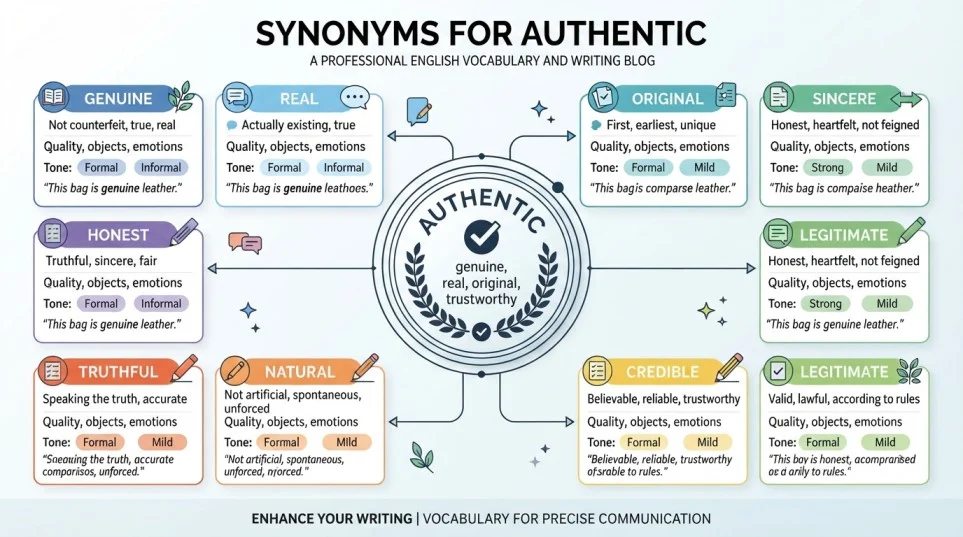
Authentic means genuine, real, trustworthy, or true to its original identity or source. Depending on context, useful synonyms include genuine, original, sincere, legitimate, truthful, credible, natural, and bona fide.
Meaning, Tone and Context
Simple Definition
Authentic describes something that is genuine, real, trustworthy, or faithful to its original nature.
For example, an authentic painting is genuinely created by the stated artist. An authentic apology expresses sincere regret rather than pretending to care.
The word can describe objects, experiences, people, emotions, statements, traditions, food, culture, documents, and personal behavior.
Part of Speech
“Authentic” is an adjective.
Examples include:
An authentic document.
An authentic experience.
An authentic person.
An authentic recipe.
An authentic response.
Related forms include “authenticity,” which is the noun, and “authentically,” which is the adverb.
Tone
Authentic usually has a positive or neutral tone.
When describing a person, it often suggests honesty, sincerity, and a lack of artificial behavior.
When describing an object, it can suggest that the item is genuine rather than copied or fake.
Formality Level
Authentic works in casual, professional, academic, creative, and business writing.
It is especially useful when discussing credibility, identity, originality, cultural traditions, products, experiences, or personal expression.
Common Use Cases
You can use authentic when discussing:
• Genuine products
• Original artwork
• Honest personalities
• Sincere emotions
• Traditional food
• Cultural experiences
• Reliable documents
• Accurate representations
• Personal identity
• Trustworthy communication
• Original sources
• Real experiences
When and How to Use “Authentic”
Use “authentic” when you want to emphasize that something is genuine rather than fake, copied, artificial, misleading, or artificially constructed.
Professional Example
The company wants to create an authentic relationship with its customers.
Personal Example
She has an authentic way of expressing her feelings.
Academic Example
The researchers examined whether the historical document was authentic.
Social Media Example
We enjoyed an authentic local food experience during our trip.
Email Example
Thank you for sharing such an authentic perspective during the meeting.
Another Word for “Authentic”
The best single replacement depends on the exact meaning.
For professional writing, “genuine” is often a natural choice.
For academic writing, “original,” “valid,” or “credible” may work when the context supports those meanings.
For casual conversation, “real” is simple and natural.
For emotional writing, “sincere” often works better.
For creative writing, “genuine,” “natural,” or “true” can create a more personal tone.
For resume or workplace writing, “genuine,” “credible,” “original,” or “verified” may be useful depending on what you are describing.
For social media captions, “real,” “genuine,” “natural,” and “true to myself” can sound conversational.
For a stronger meaning, consider “genuine,” “original,” “legitimate,” or “bona fide.”
For a softer meaning, “natural,” “honest,” or “sincere” may be more appropriate.
When Not to Use “Authentic”
“Authentic” is not always the most precise choice.
If you mean that a person is telling the truth, “truthful” may be clearer.
If you mean that an object is the original item, “original” may be more specific.
If you mean that an emotion is honestly expressed, “sincere” can communicate the idea better.
If you mean that a product has been confirmed as genuine, “verified” may be more precise.
Consider this example:
The company sells authentic products.
This sentence is understandable, but it may be vague.
A more precise version could be:
The company sells verified products from authorized manufacturers.
The second sentence gives the reader more information about what makes the products trustworthy.
Words Commonly Confused With “Authentic”
Authentic vs. Genuine
Both words can mean real or not fake. “Genuine” is often the more direct choice when discussing whether an object or feeling is real.
Authentic vs. Original
“Original” focuses on being the first or source version. “Authentic” focuses on being genuine or true to the claimed identity.
Authentic vs. Sincere
“Sincere” mainly describes honest feelings, intentions, words, or behavior. Authentic has a broader meaning.
Authentic vs. Real
“Real” is more general and conversational. Authentic often carries an additional idea of genuineness, legitimacy, or faithfulness to an original identity.
Authentic vs. Natural
“Natural” suggests something that is not forced, artificial, or manufactured. Authentic can include natural behavior, but it does not always mean natural.
Authentic vs. Legitimate
“Legitimate” usually means lawful, valid, or properly recognized. Authentic usually emphasizes genuineness.
Best Synonym by Context for “Authentic”
Which Synonym Should You Choose?
Start by asking what aspect of authenticity you want to communicate.
If you mean “not fake,” choose “genuine.”
If you mean “the first or source version,” choose “original.”
If you mean “honest feelings,” choose “sincere.”
If you mean “truthful information,” choose “truthful.”
If you mean “trustworthy information,” choose “credible.”
If you mean “legally or officially valid,” choose “legitimate.”
If you mean “not forced or artificial,” choose “natural.”
If you mean “genuinely qualified or recognized,” “bona fide” may fit.
The strongest word is not always the best word. Precision matters more than intensity.
Real Life Examples of “Authentic” in Sentences
School
The student used an authentic historical source for the research project.
Workplace
Our customers appreciate an authentic approach to communication.
Writing
The author created an authentic character with believable motivations.
Conversation
I appreciate how authentic you are when discussing difficult topics.
Social Media
Sharing authentic moments can make a personal page feel more relatable.
Resume
I bring an authentic interest in helping customers solve practical problems.
Your authentic feedback helped us understand the issue more clearly.
Storytelling
The writer gave the character an authentic voice that reflected her background.
18 Synonyms for “Authentic”
Synonym Groups and Usage Differences
Professional vs. Personal Synonyms
Professional writing often benefits from precise words such as genuine, credible, legitimate, verified, and trustworthy.
Personal communication can use real, honest, natural, and sincere because these words sound warmer and more conversational.
For example, a business report may discuss “credible information,” while a friend might describe someone as “a real person.”
Formal vs. Conversational Synonyms
Formal writing often favors genuine, legitimate, credible, valid, faithful, and bona fide.
Conversational English usually favors real, honest, natural, and genuine.
The simplest synonym is often the most effective when the audience is broad.
Academic Synonyms
Academic writing requires precision because “authentic” can have different meanings.
Use “original” when discussing a source or work. Use “credible” when discussing reliability. Use “valid” when discussing an argument or conclusion. Use “genuine” when discussing whether something is actually what it claims to be.
Professional and Business Synonyms
In workplace communication, choose the synonym based on the specific quality you want to highlight.
“Genuine” works well for customer relationships.
“Credible” works well for information and claims.
“Legitimate” works well for organizations and transactions.
“Verified” works well when something has been checked or confirmed.
Creative or Literary Synonyms
Creative writing often benefits from words such as genuine, sincere, natural, unfeigned, and faithful.
These choices can help describe a character, emotion, voice, setting, or adaptation without repeatedly using authentic.
Slang or Modern Synonyms
“Real” is the closest everyday alternative.
In casual online language, people may also say that someone is “being real” when they mean that the person is honest, open, or not pretending.
This expression is appropriate for casual communication but may be too informal for academic or corporate writing.
Strongest vs. Weaker Synonyms
A useful intensity scale can be understood this way:
Mild: natural
Moderate: honest, real
Clear: genuine, sincere
Strong: legitimate, verified, bona fide
Very specific: original, faithful, unfeigned
The best choice depends on the meaning rather than the apparent strength of the word.
Emotional vs. Neutral Synonyms
“Sincere,” “honest,” and “unfeigned” can carry emotional meaning.
“Genuine” is flexible and can remain relatively neutral.
“Verified,” “valid,” and “credible” are more factual and analytical.
Antonyms of “Authentic”
Comparison: “Authentic” vs. Similar Words
“Authentic” vs. “Genuine”
The main difference is small. Both words commonly mean real or not fake.
“Genuine” is often the more direct choice when discussing an object, feeling, or person.
Authentic: The museum confirmed that the artifact was authentic.
Genuine: The museum confirmed that the artifact was genuine.
Neither word is automatically stronger. “Authentic” can carry additional meaning related to originality, identity, or cultural faithfulness.
“Authentic” vs. “Original”
“Original” emphasizes source or first creation.
“Authentic” emphasizes genuineness or faithfulness to the claimed identity.
Authentic: The restaurant offers an authentic regional experience.
Original: The researcher examined the original document.
“Original” is more specific when the question concerns the source version.
“Authentic” vs. “Sincere”
“Sincere” is mainly about feelings, intentions, or communication.
Authentic: Her personality feels authentic.
Sincere: Her apology was sincere.
“Sincere” is more precise for emotional honesty.
“Authentic” vs. “Real”
“Real” is broader and more common in everyday English.
Authentic: The museum has an authentic historical artifact.
Real: The museum has a real historical artifact.
“Authentic” sounds more precise when distinguishing genuine items from copies.
“Authentic” vs. “Natural”
“Natural” emphasizes an absence of force or artificial behavior.
Authentic: His public image seems authentic.
Natural: His conversation style feels natural.
“Natural” is better when the main idea is ease or lack of artificial behavior.
“Authentic” vs. “Legitimate”
“Legitimate” emphasizes validity, legality, or accepted status.
Authentic: The painting is authentic.
Legitimate: The business is legitimate.
“Legitimate” is more formal and precise when discussing legal or officially recognized status.
Common Phrases and Expressions with “Authentic”
1. Authentic Experience
Meaning:
An experience that feels genuine, real, or closely connected to the actual culture, place, or situation.
Example sentence:
Visitors wanted an authentic experience rather than a highly commercialized tour.
2. Authentic Voice
Meaning:
A style of speaking or writing that feels natural and true to the person.
Example sentence:
The writer developed an authentic voice that connected with younger readers.
3. Authentic Self
Meaning:
A person’s genuine identity, personality, or way of behaving.
Example sentence:
The speaker encouraged the audience to express their authentic self.
4. Authentic Product
Meaning:
A genuine product rather than a counterfeit or imitation.
Example sentence:
The buyer wanted proof that the designer bag was an authentic product.
5. Authentic Food
Meaning:
Food prepared in a way that reflects its traditional ingredients, methods, or cultural roots.
Example sentence:
The restaurant is known for authentic regional dishes.
6. Authentic Connection
Meaning:
A relationship or interaction based on genuine communication and trust.
Example sentence:
Good communication can create an authentic connection with customers.
7. Authentic Expression
Meaning:
An honest and genuine way of communicating thoughts or feelings.
Example sentence:
Her painting became a form of authentic expression.
8. Authentic Leadership
Meaning:
Leadership that reflects genuine values, honesty, self awareness, and consistency.
Example sentence:
Authentic leadership can encourage employees to communicate openly.
Common Mistakes to Avoid
1. Using “Authentic” When a More Precise Word Is Better
“Authentic” can be broad.
If you specifically mean “truthful,” use “truthful.” If you mean “verified,” use “verified.”
2. Confusing “Authentic” With “Original”
An authentic item can be genuine, but “original” specifically emphasizes its relationship to the first or source version.
3. Using a Casual Synonym in Formal Writing
“Real” works well in everyday conversation but may sound too informal in an academic paper.
Consider “genuine,” “credible,” or “valid” when those meanings are accurate.
4. Using an Overly Dramatic Synonym
Words such as “unfeigned” may sound literary in a simple business message.
Choose the word that fits the audience rather than the most sophisticated sounding option.
5. Repeating “Authentic” Too Often
Repeated use can make your writing feel predictable.
Replace it with genuine, sincere, original, credible, natural, or legitimate when the meaning allows.
6. Choosing the Wrong Emotional Tone
“Authentic” and “sincere” overlap, but they are not identical.
Use “sincere” when you specifically want to emphasize honest emotion or intention.
FAQs
What is the best synonym for “authentic”?
“Genuine” is usually the best general synonym because it clearly communicates that something is real, sincere, or not fake.
What is a formal synonym for “authentic”?
“Genuine,” “legitimate,” “credible,” and “bona fide” can work as formal alternatives, depending on the specific meaning.
What is an informal synonym for “authentic”?
“Real” is the most natural informal alternative. It works especially well in conversations, texts, captions, and casual personal writing.
What is another word for “authentic” in professional writing?
“Genuine” is often effective in professional writing, while “credible,” “verified,” or “legitimate” may be more precise in specific situations.
What is the difference between “authentic” and “genuine”?
Both can mean real or not fake. “Authentic” can also suggest faithfulness to an original identity, source, culture, or tradition.
What is the opposite of “authentic”?
Common opposites include fake, counterfeit, false, artificial, imitation, forged, insincere, deceptive, bogus, and inauthentic.
Conclusion
“Authentic” means genuine, real, sincere, or true to an original identity or source. It is a flexible adjective that works across personal communication, academic writing, business, creative writing, social media, and everyday conversation.
The best synonym depends on the meaning you want. Choose “genuine” for something real, “sincere” for honest emotion, “original” for the source version, “credible” for trustworthy information, “legitimate” for valid status, and “real” for casual conversation.
The most useful vocabulary habit is to replace a word only when the alternative makes your meaning more precise. Do not choose a complicated synonym simply because it sounds impressive. Choose the word that communicates exactly what you mean.
Discover More Post:
- 25+ Synonyms for Frustrated | Meanings, Examples, and Best …
- 25+ Synonyms for Shadow | Meanings, Examples, and Best …
- 25+ Synonyms for Framework | Meanings, Examples, and Best …