Do you keep using the word “smile” in every caption, story, email, essay, or conversation? The word is simple and useful, but repeating it can make your writing feel predictable.
The good news is that English gives you many ways to describe a smile, depending on its emotion, intensity, purpose, and setting. You might grin with excitement, beam with happiness, smirk with confidence, or simply offer a warm smile.
This guide to synonyms for smile explains the differences between these choices so you can select words that actually fit your meaning. It also covers formal writing, academic language, professional communication, creative writing, social media captions, and everyday conversation.
A useful vocabulary tip is to avoid replacing “smile” automatically. Instead, ask what the expression communicates. Happiness, amusement, embarrassment, confidence, affection, politeness, and sarcasm can all produce very different smiles.
What Does “Smile” Mean?
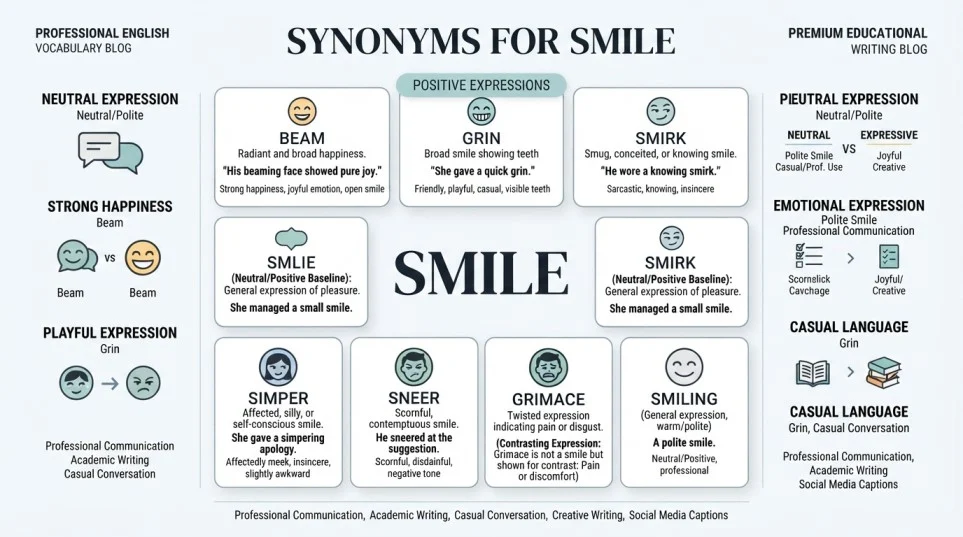
A smile is a facial expression usually involving an upward movement of the corners of the mouth, often showing happiness, friendliness, amusement, affection, or politeness. Depending on context, useful alternatives include grin, beam, smirk, simper, and sneer.
Meaning, Tone and Context
Simple Definition
A smile is a facial expression in which the corners of the mouth move upward. It commonly communicates happiness, pleasure, friendliness, amusement, affection, approval, or warmth.
However, a smile does not always mean someone is happy. People can smile when they feel nervous, embarrassed, uncomfortable, polite, sarcastic, or confident.
That is why choosing a synonym requires attention to context.
Part of Speech
“Smile” can function as both a noun and a verb.
As a noun:
“She gave me a friendly smile.”
As a verb:
“He smiled when he heard the good news.”
Tone
The word “smile” is usually positive or neutral.
A smile can suggest:
- Happiness
- Friendliness
- Affection
- Amusement
- Confidence
- Politeness
- Relief
- Nervousness
- Sarcasm
- Warmth
The emotional meaning depends heavily on the surrounding words.
Formality Level
“Smile” is a standard everyday word. It works naturally in casual conversation, academic writing, business communication, fiction, journalism, captions, emails, and professional writing.
More specific alternatives can change the tone.
“Smile” is neutral.
“Grin” is more casual and often suggests a broad or playful smile.
“Beam” emphasizes obvious happiness.
“Smirk” can suggest self satisfaction, irony, or arrogance.
“Simper” often suggests an affected or overly coy smile.
“Sneer” communicates contempt rather than simple happiness.
Common Use Cases
You can use “smile” when describing:
- A person’s facial expression
- Happiness or pleasure
- A friendly reaction
- A social interaction
- A romantic moment
- A humorous situation
- A polite response
- A character in a story
- A social media caption
- A professional interaction
Related Word Forms
Common forms and related words include:
Smile, noun
Smile, verb
Smiled, past tense
Smiling, present participle
Smiley, an informal adjective or noun related to a cheerful expression
Smilingly, an adverb used to describe an action performed with a smile
When and How to Use “Smile”
“Smile” is the safest general choice when you want to describe a pleasant facial expression without adding a very specific emotional interpretation.
Professional
“The customer smiled after the representative resolved the issue.”
This is appropriate because it describes a visible reaction without exaggerating the customer’s emotions.
Personal
“She smiled when she saw her old friend.”
Here, “smiled” naturally communicates warmth and happiness.
Academic
“Participants were more likely to smile when they viewed positive images.”
The neutral word works well in academic writing because it describes observable behavior without adding unnecessary emotion.
Emotional
“He smiled through his tears.”
This creates an emotional contrast between happiness and sadness.
Creative
“Her smile brightened the quiet room.”
The word “smile” works with descriptive language to create a warmer image.
Another Word for “Smile”
The best single replacement depends on what kind of smile you mean.
| Situation | Useful Alternative |
|---|---|
| Professional writing | smile |
| Academic writing | smile |
| Casual conversation | grin |
| Emotional writing | beam |
| Creative writing | beam |
| Resume or workplace use | friendly expression |
| Social media caption | grin |
| Strong happiness | beam |
| Softer expression | smile |
| Playful expression | grin |
| Sarcastic expression | smirk |
| Contemptuous expression | sneer |
| Coy expression | simper |
Professional Writing
In professional communication, “smile” is usually better than an overly dramatic alternative.
Example:
“She greeted the client with a warm smile.”
Academic Writing
Academic writing generally benefits from precise, neutral language.
Example:
“The participant smiled in response to the positive feedback.”
Casual Conversation
“Grin” is useful when the smile is broad, playful, excited, or obviously happy.
Example:
“He was grinning after hearing the news.”
Emotional Writing
“Beam” can communicate visible happiness more strongly than “smile.”
Example:
“She beamed when her daughter walked across the stage.”
Creative Writing
Creative writing gives you more freedom to describe the emotional quality of the expression.
Example:
“A quiet smile softened his tired face.”
Resume or Workplace Use
A resume rarely needs the word “smile” unless you are describing customer service or interpersonal qualities.
Instead of:
“Always smiles at customers.”
Consider:
“Creates a welcoming customer experience.”
This focuses on the professional value rather than the physical expression.
Social Media Captions
For captions, “grin,” “beam,” “happy expression,” and descriptive phrases can create more personality.
Example:
“Nothing but big grins today.”
Stronger Meaning
Use “beam” when someone is visibly delighted.
Example:
“She beamed with pride.”
Softer Meaning
Use “smile” when you want a gentle, neutral, or understated expression.
Example:
“He offered a small smile.”
When Not to Use “Smile”
“Smile” is useful, but it can become too general when your sentence needs emotional precision.
When the Smile Is Very Broad
Instead of:
“She smiled at the announcement.”
Use:
“She grinned at the announcement.”
“Grin” suggests a broader or more noticeable smile.
When the Person Is Extremely Happy
Instead of:
“He smiled when he won.”
Use:
“He beamed when he won.”
“Beam” communicates stronger happiness.
When the Expression Is Sarcastic
Instead of:
“She smiled after making the sarcastic comment.”
Use:
“She smirked after making the sarcastic comment.”
“Smirk” gives the reader a clearer sense of attitude.
When the Expression Shows Contempt
Instead of:
“He smiled at his opponent.”
Use:
“He sneered at his opponent.”
“Sneer” communicates contempt or disrespect.
When the Expression Is Coy or Affected
Instead of:
“She smiled shyly at him.”
Depending on the intended meaning, “simpered” may work if the expression feels overly coy or affected.
Words Commonly Confused With “Smile”
Smile vs. Grin
A smile is a general pleasant facial expression. A grin is usually broader, more obvious, or more playful.
Smile vs. Beam
A beam suggests strong, visible happiness or pride. A smile can be much more subtle.
Smile vs. Smirk
A smirk often suggests self satisfaction, irony, sarcasm, or superiority. It does not simply mean a happy smile.
Smile vs. Simper
A simper is usually a coy, affected, or overly self conscious smile. It has a more specific and sometimes negative tone.
Smile vs. Sneer
A sneer communicates contempt, disrespect, or scorn. It is not a positive synonym for an ordinary smile.
Smile vs. Laugh
A smile involves a facial expression. A laugh is a vocal or physical response to amusement. Someone can smile without laughing.
Best Synonym by Context for “Smile”
| Context | Best Synonym | Why It Works | Example |
|---|---|---|---|
| Formal writing | smile | Neutral and widely accepted | She responded with a polite smile. |
| Academic writing | smile | Precise and objective | The participants smiled after receiving positive feedback. |
| Professional or business use | smile | Natural and professional | The receptionist greeted visitors with a warm smile. |
| Resume | friendly expression | Focuses on interpersonal presentation | Maintained a friendly expression while assisting customers. |
| Casual conversation | grin | Sounds natural and expressive | He was grinning after the announcement. |
| Creative writing | beam | Adds emotional intensity | She beamed with pride. |
| Emotional tone | beam | Clearly communicates happiness | Her face beamed with relief. |
| Strong intensity | beam | Suggests obvious happiness | He beamed when his team won. |
| Soft or moderate tone | smile | Keeps the expression subtle | She gave him a small smile. |
| Social media captions | grin | Informal and energetic | Big grins and good memories. |
| Friendly interaction | smile warmly | Shows kindness and warmth | She smiled warmly at the new student. |
| Sarcastic context | smirk | Shows self satisfaction or irony | He smirked after making the remark. |
| Contemptuous context | sneer | Shows scorn | The critic sneered at the proposal. |
| Coy expression | simper | Indicates an affected or coy smile | She simpered at the compliment. |
| Playful situation | grin | Suggests fun or mischief | The children grinned at each other. |
| Romantic writing | smile warmly | Adds affection without exaggeration | He smiled warmly when she entered. |
| Storytelling | grin | Creates a vivid casual image | She grinned and opened the envelope. |
| US usage | smile | Common and natural in American English | She smiled for the photograph. |
| UK usage | smile | Equally natural in British English | He smiled politely at the guest. |
Which Synonym Should You Choose?
Choosing another word for smile is easier when you identify the emotion first.
- If the expression is neutral or friendly, use “smile.”
- If it is broad or playful, use “grin.”
- If it shows intense happiness or pride, use “beam.”
- If it suggests self satisfaction or sarcasm, use “smirk.”
- If it appears coy or affected, consider “simper.”
- If it communicates contempt, use “sneer.”
For formal and academic writing, neutral wording is usually safer. For creative writing, a more emotionally specific expression can make the scene more vivid.
A useful rule is simple: choose the word that tells the reader why the person is smiling, not just the fact that the person is smiling.
Real Life Examples of “Smile” in Sentences
School
“The student smiled when the teacher praised her presentation.”
Workplace
“The manager smiled and thanked the team for completing the project.”
Writing
“The author uses the character’s smile to show growing confidence.”
Conversation
“You should have seen him smile when he heard the news.”
Social Media
“Smiles, good friends, and a day worth remembering.”
Resume
“Provided friendly and professional customer service.”
“Thank you for your kind message. It brought a smile to my face.”
Storytelling
“She smiled quietly as she remembered the summer they spent together.”
Customer Service
“The employee greeted each visitor with a warm smile.”
Romantic Writing
“He smiled when he saw her waiting by the door.”
Emotional Writing
“She managed a small smile despite how difficult the day had been.”
Humor
“He grinned when everyone realized the joke had worked.”
18 Synonyms for “Smile”
The English language does not have 50 perfect one word synonyms for “smile.” Many lists inflate the number by including words that describe laughter, happiness, facial expressions, or emotions rather than actual synonyms.
The following 18 choices are useful direct alternatives, close substitutes, or descriptive expressions, with their differences clearly explained.
| Synonym | Simple Meaning | Best Used For | Example Sentence |
|---|---|---|---|
| Grin | A broad or obvious smile | Happiness, excitement, playfulness | He grinned when he opened the gift. |
| Beam | Smile with obvious happiness or pride | Strong positive emotion | She beamed with pride after the ceremony. |
| Smirk | A self satisfied or knowing smile | Sarcasm, confidence, irony | He smirked after correctly predicting the result. |
| Simper | A coy or affected smile | Coy or overly self conscious behavior | She simpered at the compliment. |
| Sneer | A contemptuous facial expression | Disapproval or scorn | He sneered at the suggestion. |
| Smile warmly | Show friendliness through a smile | Personal and professional warmth | She smiled warmly at the new employee. |
| Smile broadly | Smile in a noticeably wide way | Strong happiness | He smiled broadly for the photograph. |
| Smile gently | Give a soft and restrained smile | Calm or tender moments | She smiled gently at the child. |
| Smile faintly | Give a very subtle smile | Quiet or uncertain emotion | He smiled faintly at the memory. |
| Smile politely | Smile as part of courteous behavior | Professional or social situations | She smiled politely and thanked the guest. |
| Flash a smile | Give a quick, noticeable smile | Casual storytelling | He flashed a smile before leaving. |
| Give a smile | Smile toward someone | Everyday conversation | She gave me a reassuring smile. |
| Offer a smile | Present a friendly expression | Formal or descriptive writing | He offered a reassuring smile. |
| Crack a smile | Finally smile after staying serious | Casual conversation | The serious coach finally cracked a smile. |
| Break into a smile | Suddenly begin smiling | Emotional or narrative writing | She broke into a smile when she saw the puppy. |
| Light up | Become visibly happier | Strong emotional reaction | Her face lit up when she heard the news. |
| Glow | Show visible happiness or pleasure | Romantic and creative writing | He seemed to glow with happiness. |
| Radiate warmth | Give an impression of friendliness and kindness | Creative and descriptive writing | Her expression radiated warmth throughout the room. |
Important Accuracy Note
“Smile,” “grin,” “beam,” “smirk,” “simper,” and “sneer” are not interchangeable in every sentence.
Some are direct facial expressions, while others are descriptive expressions that communicate the manner or emotional effect of smiling. This distinction matters when writing naturally.
Synonym Groups and Usage Differences
Professional vs. Personal Synonyms
Professional writing usually favors neutral expressions.
“Smile,” “smile warmly,” and “friendly expression” work well when describing customer service, hospitality, communication, or interpersonal behavior.
Personal writing can be more expressive.
“Grin,” “beam,” and “light up” can add warmth and emotional detail.
Formal vs. Conversational Synonyms
“Smile” is suitable in both formal and conversational contexts.
“Grin” is more conversational.
“Crack a smile” is strongly conversational.
“Simper” and “sneer” are more descriptive and specific, so they should be used only when their emotional meaning fits.
Academic Synonyms
Academic writing generally benefits from “smile” because it is clear and neutral.
For example:
“The participants smiled after receiving positive feedback.”
If a research paper requires precision, describe the observable behavior rather than assuming the person’s emotional state.
Professional and Business Synonyms
Business writing should usually avoid overly dramatic alternatives.
Use:
“smile”
“friendly expression”
“warm smile”
“smile warmly”
These expressions can work in customer service, hospitality, interviews, presentations, and workplace descriptions.
For a resume, focus on the professional behavior rather than simply stating that someone smiles.
Instead of:
“Smiled at customers every day.”
A stronger professional description is:
“Created a welcoming experience for customers.”
Creative or Literary Synonyms
Creative writing benefits from expressions that reveal emotion.
“Beam” can show happiness.
“Grin” can suggest excitement or mischief.
“Smirk” can reveal confidence or sarcasm.
“Light up” can show sudden joy.
“Glow” can create a softer emotional image.
Slang or Modern Synonyms
There are many informal internet expressions for smiling, but most are better treated as casual expressions rather than formal synonyms.
Phrases such as “crack a smile” are acceptable in casual writing and conversation.
They should generally be avoided in academic papers, formal reports, and professional documents unless the context specifically calls for conversational language.
Strongest vs. Weaker Synonyms
A useful intensity scale is:
Mild: smile faintly
Soft: smile gently
Neutral: smile
Friendly: smile warmly
Noticeable: grin
Strong happiness: beam
Very expressive: light up
The exact intensity still depends on the surrounding sentence.
Emotional vs. Neutral Synonyms
Neutral:
- “Smile”
- “Smile politely”
- “Smile gently”
Emotional:
“Beam”
“Light up”
“Glow”
Playful:
“Grin”
“Crack a smile”
Sarcastic:
“Smirk”
Contemptuous:
“Sneer”
Coy:
“Simper”
Antonyms of “Smile”
There are not 15 perfect one word antonyms for “smile” in English. The most accurate approach is to include common contrasting facial expressions and emotional reactions.
| Antonym | Meaning | Example Sentence |
|---|---|---|
| Frown | Turn the corners of the mouth downward | She frowned when she heard the decision. |
| Scowl | Show anger or displeasure through the face | He scowled at the unexpected interruption. |
| Glower | Look angrily or intensely | She glowered at the person who interrupted her. |
| Grimace | Make a facial expression showing pain, discomfort, or dislike | He grimaced after tasting the bitter medicine. |
| Pout | Push out the lips to show displeasure | The child pouted when the game ended. |
| Sneer | Show contempt through a facial expression | He sneered at the suggestion. |
| Smolder | Show contained anger through an intense expression | She appeared to smolder with frustration. |
| Snarl | Show anger with an aggressive facial expression or voice | The character snarled at his opponent. |
| Glare | Look intensely and angrily | She glared at the broken screen. |
| Wince | Show pain or discomfort through the face | He winced when he heard the harsh criticism. |
| Cry | Produce tears because of sadness or distress | She began to cry after hearing the news. |
| Weep | Cry, often quietly or emotionally | He wept after saying goodbye. |
| Sob | Cry with audible, uncontrolled breathing | She sobbed after the difficult conversation. |
| Look unhappy | Appear visibly unhappy | He looked unhappy throughout the meeting. |
| Look displeased | Show dissatisfaction through facial expression | She looked displeased with the result. |
These words are best understood as contextual opposites rather than 15 strict dictionary antonyms.
Comparison: “Smile” vs. Similar Words
Smile vs. Grin
The main difference is intensity and shape.
A smile is general and can be subtle. A grin is usually broader and more noticeable.
“Smile” is more neutral and works in formal writing.
Example:
“She smiled at the visitor.”
“He grinned at his friend.”
Smile vs. Beam
A beam communicates stronger happiness, satisfaction, or pride.
“Smile” is more neutral.
“Beam” is more emotionally intense.
Example:
“She smiled when she heard the news.”
“She beamed when she heard the news.”
Smile vs. Smirk
A smirk often carries an attitude of self satisfaction, irony, superiority, or sarcasm.
A smile does not automatically carry that meaning.
Example:
“She smiled at her friend.”
“He smirked after proving his point.”
Smile vs. Simper
A simper is usually coy, affected, or overly self conscious.
A normal smile is much more natural and neutral.
Example:
“She smiled at the compliment.”
“She simpered at the compliment.”
Smile vs. Sneer
A sneer expresses contempt or scorn.
It is therefore very different from a friendly smile.
Example:
“She smiled at the suggestion.”
“He sneered at the suggestion.”
Smile vs. Laugh
A smile is primarily a facial expression.
A laugh is a vocal or physical response that often comes from amusement.
Example:
“She smiled at the joke.”
“She laughed at the joke.”
A person can smile without laughing, and someone can laugh without maintaining a visible smile.
Common Phrases and Expressions with “Smile”
1. Wear a Smile
Meaning:
To have a smile on your face.
Example sentence:
“She wore a smile throughout the celebration.”
2. Smile from Ear to Ear
Meaning:
To smile very broadly because you are extremely happy.
Example sentence:
“He was smiling from ear to ear after receiving the award.”
3. Crack a Smile
Meaning:
To finally smile after remaining serious.
Example sentence:
“The serious professor finally cracked a smile.”
4. Break Into a Smile
Meaning:
To suddenly begin smiling.
Example sentence:
“She broke into a smile when she saw her family.”
5. Put a Smile on Someone’s Face
Meaning:
To make someone feel happy.
Example sentence:
“Your message really put a smile on my face.”
6. Smile for the Camera
Meaning:
To smile while being photographed.
Example sentence:
“Everyone smiled for the camera before leaving.”
7. Keep Smiling
Meaning:
To remain positive or cheerful despite difficulties.
Example sentence:
“Keep smiling and focus on what you can control.”
8. Smile Through Something
Meaning:
To maintain a positive appearance during a difficult experience.
Example sentence:
“She smiled through the difficult conversation.”
Common Mistakes to Avoid
1. Using “Smile” When a More Precise Word Is Better
If a character is obviously delighted, “beam” may communicate the emotion more clearly.
Instead of:
“She smiled with pride.”
Consider:
“She beamed with pride.”
2. Confusing “Smile” With “Smirk”
A smirk often carries a negative or self satisfied meaning.
Do not use “smirk” simply because you want a stronger synonym for smile.
3. Using Casual Expressions in Formal Writing
“Crack a smile” sounds natural in conversation but may feel too informal in an academic report.
Use “smile” in formal contexts unless the writing intentionally has a conversational style.
4. Using an Overly Dramatic Expression
Not every small smile is a beam.
If the person gives only a subtle expression, “smile faintly” or “smile gently” may be more accurate.
5. Repeating “Smile” Too Often
Repeated use can make descriptive writing feel flat.
Instead of replacing every occurrence with another synonym, vary your sentence structure and describe the person’s reaction when appropriate.
6. Choosing the Wrong Emotional Tone
“Smirk” suggests a very different attitude from “beam.”
“Sneer” suggests contempt.
“Simper” can suggest affected behavior.
Always consider the emotional message before selecting a substitute.
7. Using Slang in Academic or Professional Writing
Informal expressions can make a formal document sound less polished.
For essays, reports, resumes, and business communication, neutral vocabulary is usually the safest choice.
FAQs
What Is the Best Synonym for “Smile”?
“Grin” is a useful casual synonym, while “beam” works for strong happiness. For neutral writing, “smile” itself is usually the most precise choice.
What Is a Formal Synonym for “Smile”?
“Smile” is already appropriate for formal writing. “Smile warmly” can add friendliness while remaining professional and natural.
What Is an Informal Synonym for “Smile”?
“Grin” is a common informal alternative. “Crack a smile” is also conversational and suggests that someone finally began smiling.
What Is Another Word for “Smile” in Professional Writing?
“Smile” is usually the best professional choice. “Friendly expression” can work when describing customer service or interpersonal presentation.
What Is the Difference Between “Smile” and “Grin”?
A smile is a general pleasant expression, while a grin is usually broader, more obvious, or more playful.
What Is the Opposite of “Smile”?
“Frown” is the clearest common opposite of smile. Other contrasting expressions include scowl, glower, grimace, pout, and glare.
Conclusion
“Smile” is a simple but flexible word that can communicate happiness, friendliness, affection, amusement, politeness, or even nervousness.
The best synonym depends on the emotion and situation. Use “grin” for a broad or playful expression, “beam” for strong happiness, “smirk” for self satisfaction or irony, “simper” for a coy expression, and “sneer” for contempt.
For academic and professional writing, the neutral word “smile” is often the strongest choice because it is clear and widely understood.
The most useful vocabulary habit is not to replace a word simply to avoid repetition. Choose a synonym because it communicates a more precise meaning.
If you are looking for synonyms for smile, start by asking one question: what does the smile reveal about the person? Once you know the emotion, choosing the right word becomes much easier.
Discover More Post:
- 25+ Synonyms for Kids | Meanings, Examples, and Best …
- 25+ Synonyms for Found | Meanings, Examples, and Best …
- 25+ Synonyms for Frustrated | Meanings, Examples, and Best …