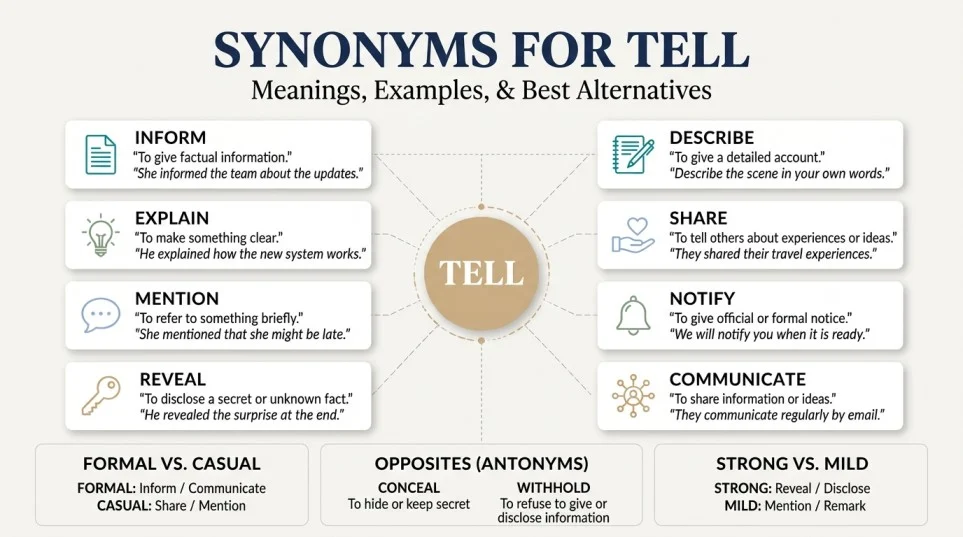
Using the word tell repeatedly can make your writing sound predictable, whether you are drafting an email, writing a school essay, sharing a story, or preparing a professional presentation. Although tell is a common and useful verb, the right alternative can make your message clearer, more engaging, and more precise.
Learning synonyms for tell is not simply about replacing one word with another. It means understanding the difference between explaining information, revealing a secret, informing a colleague, describing an experience, and instructing someone to act. Each situation calls for a slightly different word. This guide explores practical alternatives, their meanings, natural examples, and differences in tone so you can choose vocabulary that fits your audience and purpose.
What Does “Tell” Mean?
To tell means to communicate information, share something with another person, give instructions, or reveal a fact. Common synonyms include inform, explain, say, describe, reveal, notify, mention, and advise, depending on the context and intended meaning.
Meaning, Tone and Context
The verb tell is one of the most frequently used words in everyday English. It generally describes communicating information to someone, but it can also refer to giving directions, sharing a story, or revealing something previously unknown.
Simple definition
Tell means to communicate facts, information, instructions, or experiences to another person through speech or writing.
For example, “Please tell me the truth” asks someone to communicate honest information.
Part of speech
Tell is primarily a verb. Its main forms are:
| Word form | Example |
|---|---|
| Base form | Tell me what happened. |
| Third person | She tells interesting stories. |
| Past tense | He told us the news. |
| Present participle | I am telling you the truth. |
| Past participle | I have told them everything. |
Tone and formality
The word tell is neutral and suitable for casual conversations, stories, emails, and many workplace situations. However, a more specific verb can sound more polished in formal or academic writing.
For example, “The manager told employees about the change” is clear. “The manager notified employees about the change” emphasizes an official announcement.
Common uses of tell
- Tell someone information: She told me the answer.
- Give an instruction: The coach told us to practice.
- Share a story: My grandfather told us a story.
- Reveal a secret: He told everyone the truth.
- Express a distinction: I can tell the difference between the two designs.
The best synonym depends on which meaning of tell you intend to express.
When and How to Use “Tell”
Use tell when you want to communicate something directly and naturally. Choose a more precise alternative when the situation requires a particular tone, level of detail, or purpose.
1. Professional: The supervisor told the team about the new schedule. This is appropriate for everyday workplace communication.
2. Personal: She told her friend how she really felt. The word expresses a direct personal exchange.
3. Academic: The results tell us something important about student performance. In a formal research paper, indicate or suggest may be more precise.
4. Emotional: He finally told his parents the truth. The word communicates honesty and disclosure.
5. Creative writing: The storyteller told a fascinating tale about an ancient kingdom. Recounted or narrated could add a more literary tone.
6. Email: Please tell me if you need additional information. For a more polished email, consider “Please let me know if you need additional information.”
7. Casual conversation: Can you tell me where the nearest coffee shop is? The verb sounds natural and friendly in everyday speech.
Another Word for “Tell”
The best single replacement for tell is usually inform when communicating facts, explain when making something understandable, or reveal when sharing previously hidden information. The right choice depends on what the sentence needs to communicate.
| Situation | Best alternative | Example |
|---|---|---|
| Professional writing | Inform | Please inform the department about the update. |
| Academic writing | Indicate | The findings indicate a significant change. |
| Casual conversation | Say | What did she say about the meeting? |
| Emotional writing | Confess | He confessed that he had made a mistake. |
| Creative writing | Narrate | She narrated the events of that memorable night. |
| Resume or workplace | Communicate | Communicated project updates to team members. |
| Social media captions | Share | Sharing a little news from my latest adventure. |
| Stronger meaning | Disclose | The company disclosed previously unreported information. |
| Softer meaning | Mention | She mentioned the event during lunch. |
Remember that these alternatives are not interchangeable in every sentence. Confess suggests an admission, while mention usually refers to bringing something up briefly.
When Not to Use “Tell”
Although tell works in many situations, it can be too general when your reader needs to understand exactly what happened.
Consider these examples:
* Too vague: The report tells us about the problem.
More precise: The report identifies the main cause of the problem.
* Too casual: The director told the public about the policy.
More formal: The director announced the policy to the public.
* Too general: She told her experience to the class.
More natural: She described her experience to the class.
* Too weak: The witness told the police what happened.
More precise: The witness recounted the events to the police.
* Too informal for some academic contexts: The data tells us that the method works.
More cautious: The data suggest that the method may work.
The goal is not to eliminate tell. It is to use it when it communicates your intended meaning clearly.
Words Commonly Confused With “Tell”
Several related words describe communication, but their meanings differ in important ways.
| Word | Main difference | Best use |
|---|---|---|
| Say | Focuses on the words spoken, not necessarily the listener. | Quoting or reporting speech |
| Speak | Focuses on the act of speaking or addressing someone. | Conversations, presentations, languages |
| Inform | Emphasizes giving someone relevant information. | Official notices and professional communication |
| Explain | Makes a fact, process, or idea easier to understand. | Instructions, lessons, complex topics |
| Mention | Refers to something briefly without extensive detail. | Short references or passing comments |
| Reveal | Makes previously unknown or hidden information known. | Secrets, discoveries, important facts |
For example, you say a sentence, tell someone something, explain a difficult concept, and reveal a secret. The verb you select changes the focus of the sentence.
Best Synonym by Context for “Tell”
The most effective alternative depends on your audience, purpose, and the information being communicated.
| Context | Best synonym | Why it works | Example |
|---|---|---|---|
| Formal writing | Inform | Sounds professional and direct. | Please inform the committee of the decision. |
| Academic writing | Indicate | Describes what evidence or results suggest. | The findings indicate a possible trend. |
| Professional communication | Notify | Emphasizes an official update. | Notify the staff about the revised policy. |
| Resume writing | Communicate | Highlights a workplace skill. | Communicated project requirements to stakeholders. |
| Casual conversation | Say | Sounds natural when discussing speech. | What did he say? |
| Creative writing | Narrate | Emphasizes telling a story. | She narrated the journey in vivid detail. |
| Emotional writing | Confess | Suggests a personal admission. | He confessed his mistake to his friend. |
| Strong disclosure | Disclose | Emphasizes sharing restricted or sensitive information. | The company disclosed its financial results. |
| Gentle communication | Mention | Introduces information without emphasis. | She mentioned a possible change. |
| Social media captions | Share | Feels conversational and inviting. | Sharing a small update from today. |
| Giving instructions | Direct | Emphasizes guiding someone’s actions. | The supervisor directed the team to begin. |
| Giving advice | Advise | Communicates a recommendation. | The counselor advised students to plan ahead. |
| Public announcement | Announce | Makes information known to an audience. | The school announced the winners. |
| Explaining a process | Describe | Communicates details or characteristics. | He described how the machine works. |
| Reporting events | Recount | Retells events in sequence. | She recounted what happened that evening. |
| Sharing an opinion | Express | Emphasizes communicating thoughts or feelings. | He expressed his concerns clearly. |
Which Synonym Should You Choose?
Use this decision guide to find the most suitable word.
1. Identify your meaning. Choose inform for facts, explain for understanding, reveal for hidden information, and narrate for storytelling.
2. Consider formality. Use tell or say in everyday conversation. Choose notify, inform, or disclose when the situation calls for more formal language.
3. Check emotional intensity. Mention sounds mild, admit suggests acknowledging something, and confess often implies a more personal or serious admission.
4. Think about professional value. In a resume, words such as communicated, presented, reported, and advised can describe specific responsibilities more effectively than told.
5. Read the complete sentence. Some verbs require different grammatical structures. You can say “tell someone something,” “inform someone of something,” and “explain something to someone.”
6. Avoid replacing words mechanically. A synonym should preserve the original meaning, not merely make the sentence sound more sophisticated.
Real Life Examples of “Tell” in Sentences
These examples show how different synonyms can make everyday communication more specific.
| Situation | Original sentence | Improved alternative |
|---|---|---|
| School | The teacher told us how the experiment worked. | The teacher explained how the experiment worked. |
| Workplace | I told the team about the deadline. | I informed the team of the deadline. |
| Writing | The article tells readers about the issue. | The article examines the issue. |
| Conversation | She told me her opinion. | She shared her opinion with me. |
| Social media | I want to tell everyone my news. | I want to share my news with everyone. |
| Resume | I told customers about new products. | I informed customers about new products. |
| Tell me when you are available. | Please let me know when you are available. | |
| Storytelling | He told the events of his childhood. | He recounted the events of his childhood. |
Notice that some improvements involve changing the sentence structure as well as the verb. This is often the most natural way to strengthen your writing.
25 Synonyms for “Tell”
The following table includes 25 useful alternatives. Each word has a distinct purpose, so choose according to meaning rather than treating the words as exact replacements.
| Synonym | Simple meaning | Best used for | Example sentence |
|---|---|---|---|
| 1. Inform | Give someone information | Formal and professional writing | Please inform the manager about the delay. |
| 2. Explain | Make something understandable | Teaching and clarification | Can you explain the final step? |
| 3. Say | Express something in words | Everyday speech | She said she would arrive early. |
| 4. Speak | Talk or address someone | Conversation and presentations | He spoke to the class about safety. |
| 5. Mention | Refer to something briefly | Casual and professional conversation | Maya mentioned your suggestion yesterday. |
| 6. Notify | Give an official notice | Workplace updates | We will notify applicants of the results. |
| 7. Announce | Make information public | News and public statements | The school announced its new schedule. |
| 8. Reveal | Make hidden information known | Secrets and discoveries | The investigation revealed new evidence. |
| 9. Disclose | Make specific information known | Legal, financial, and official contexts | The company disclosed the relevant figures. |
| 10. Describe | Explain what something is like | Experiences and details | She described the scene beautifully. |
| 11. Narrate | Tell a story or sequence of events | Literature and storytelling | He narrated the adventure with enthusiasm. |
| 12. Recount | Retell events or experiences | Reports and personal accounts | They recounted their trip to the mountains. |
| 13. Report | Present information or findings | Journalism and business | The analyst reported the latest figures. |
| 14. Advise | Recommend a course of action | Guidance and professional communication | The lawyer advised her to review the contract. |
| 15. Recommend | Suggest a suitable option | Advice and reviews | I recommend this book to new writers. |
| 16. Express | Communicate thoughts or feelings | Emotional and formal writing | She expressed her gratitude in a letter. |
| 17. Share | Give information or experiences to others | Personal communication and social media | He shared his plans with his family. |
| 18. Confess | Admit something personal or troubling | Emotional or serious admissions | She confessed that she had forgotten the appointment. |
| 19. Admit | Acknowledge a fact or mistake | Discussions and disagreements | He admitted that his answer was incorrect. |
| 20. Declare | State something clearly or formally | Official statements | The candidate declared her intention to run. |
| 21. Communicate | Convey information, ideas, or feelings | Business and general communication | They communicated the changes to every department. |
| 22. Convey | Get a message or feeling across | Formal and expressive writing | His tone conveyed genuine concern. |
| 23. Brief | Give someone essential information | Meetings and workplace tasks | The coordinator briefed the team before the event. |
| 24. Instruct | Tell someone how to do something | Teaching and directions | The technician instructed us to restart the device. |
| 25. Direct | Guide someone toward an action | Management and instructions | The supervisor directed the workers to the correct entrance. |
Best overall choices: Inform is useful for sharing facts, explain for clarifying ideas, mention for brief references, share for personal communication, and reveal for previously hidden information.
Synonym Groups and Usage Differences
Professional vs. Personal Synonyms
Professional communication benefits from precise verbs that explain the purpose of a message. Inform, notify, brief, and communicate are useful when discussing updates, instructions, or business decisions.
Personal communication often sounds more natural with tell, share, say, admit, or confess. For example, “She shared her worries with her sister” sounds warmer than “She communicated her worries to her sister.”
Formal vs. Conversational Synonyms
Formal alternatives include inform, notify, disclose, declare, and convey. They are useful in reports, official announcements, business correspondence, and carefully written essays.
Conversational choices include say, tell, mention, and share. These words are appropriate for texts, everyday discussions, and informal emails.
Compare these sentences:
- Conversational: “Tell me when the meeting starts.”
- Professional: “Please notify me when the meeting is scheduled to begin.”
- Concise and polite: “Please let me know when the meeting starts.”
The third sentence is often the best option because it sounds professional without being unnecessarily formal.
Academic Synonyms
Academic writing benefits from verbs that identify exactly what the evidence, author, or researcher communicates.
- Indicate: Use when evidence points toward a conclusion.
- Suggest: Use when findings support a possibility without proving it.
- Demonstrate: Use when evidence establishes or illustrates a point.
- Describe: Use when explaining characteristics or procedures.
- Report: Use when presenting research findings or observations.
- Explain: Use when clarifying a concept, method, or relationship.
For example, instead of writing “The study tells us that sleep affects memory,” write “The study suggests that sleep affects memory” when the evidence supports a conclusion but does not establish certainty.
Professional and Business Synonyms
In workplace communication, the best alternative depends on what you actually did.
| Workplace task | Strong verb | Example |
|---|---|---|
| Giving a colleague an update | Informed | Informed colleagues about project changes. |
| Preparing a team for a task | Briefed | Briefed team members before client meetings. |
| Presenting results | Reported | Reported monthly performance figures. |
| Explaining a process | Explained | Explained procedures to new employees. |
| Sharing a proposal | Presented | Presented recommendations to department leaders. |
| Giving direction | Instructed | Instructed staff on updated procedures. |
For resumes, avoid choosing a stronger sounding verb unless it accurately describes your responsibility. Led, presented, and advised communicate different activities and should not be used interchangeably.
Creative or Literary Synonyms
Creative writing can become more engaging when the verb reflects the way information is communicated.
- Narrate: Emphasizes storytelling.
- Recount: Retells events that happened.
- Reveal: Uncovers a secret or surprising fact.
- Whisper: Describes speaking very quietly.
- Confess: Adds the sense of admitting something personal.
- Convey: Communicates a mood, meaning, or feeling.
Compare “She told him the secret” with “She whispered the secret” or “She finally revealed the secret.” Each version creates a different impression of the moment.
Slang or Modern Synonyms
There is no single slang replacement for tell that works in every situation. Informal expressions depend on the meaning and the audience.
- Fill someone in: Give someone information they missed.
- Let someone know: Inform someone in a friendly, natural way.
- Spill the beans: Reveal a secret, often unintentionally or playfully.
- Give someone a heads up: Warn someone about something in advance.
- Fill someone in on the details: Explain what happened or provide missing information.
For example, “Can you fill me in on what happened?” is natural in conversation. In an academic paper, “Please provide a summary of the events” would be more appropriate.
Strongest vs. Weaker Synonyms
The strength of a synonym depends on the message, not simply the word itself. The following scale shows increasing emphasis on disclosure or admission.
Mild
Mention, note
Refer to information briefly.
Moderate
Tell, inform, explain
Communicate facts or clarify a message.
Emphatic
Reveal, disclose, declare
Make important information known or state something firmly.
Personal
Confess, admit
Acknowledge something, often a mistake or difficult truth.
This is a contextual guide rather than a universal ranking. For example, declare can be forceful without revealing a secret, while confess carries a particular sense of admission.
Emotional vs. Neutral Synonyms
Neutral words communicate information without adding much emotional meaning. Examples include inform, report, say, and mention.
Emotionally marked words communicate more than facts. Confess suggests personal admission, reveal can create suspense, and share can imply openness or connection.
Choose the emotional tone that fits the situation. “He mentioned his concerns” sounds restrained, while “He confessed his fears” suggests a more personal disclosure.
Antonyms of “Tell”
There is no single direct antonym for every meaning of tell. When tell means communicating information, its opposite often involves hiding, withholding, or preventing communication. When it means giving instructions, the opposite may involve leaving someone without guidance.
The following 15 words and expressions are contextual opposites rather than exact antonyms in every sentence.
| Antonym | Meaning | Example sentence |
|---|---|---|
| 1. Conceal | Keep information hidden | She concealed the details of the agreement. |
| 2. Withhold | Refuse to provide information | The agency withheld the report. |
| 3. Hide | Keep something from being discovered | He hid the truth from his family. |
| 4. Suppress | Prevent information from being shared or known | The organization tried to suppress the findings. |
| 5. Silence | Prevent someone from speaking | The interruption silenced the speaker. |
| 6. Mislead | Give someone a false impression | The advertisement misled potential customers. |
| 7. Deceive | Make someone believe something untrue | He deceived his colleagues about the results. |
| 8. Disguise | Make something appear different | The report disguised the seriousness of the problem. |
| 9. Omit | Leave information out | She omitted an important detail from her account. |
| 10. Obscure | Make information difficult to understand | The technical language obscured the main point. |
| 11. Deny | State that something is untrue or did not happen | He denied making the statement. |
| 12. Keep secret | Prevent information from becoming known | They kept the decision secret until Friday. |
| 13. Mute | Reduce or eliminate sound | She muted the microphone during the break. |
| 14. Falsify | Deliberately alter information to make it false | The employee falsified the records. |
| 15. Evade | Avoid giving a direct answer | The spokesperson evaded the question. |
Use conceal, withhold, or keep secret when the intended opposite is not revealing information. Use mislead or deceive only when someone is being given a false impression, not merely when information is left unsaid.
Comparison: “Tell” vs. Similar Words
Tell vs. Say
Main difference: Tell usually identifies the person receiving information, while say focuses on the words spoken.
Which is stronger? Neither is inherently stronger.
Which is more formal? Both are neutral and common in everyday English.
Examples:
- Tell: She told me the answer.
- Say: She said the answer was correct.
Tell vs. Inform
Main difference: Tell is broad and conversational. Inform emphasizes communicating relevant facts.
Which is stronger? Inform can sound more official.
Which is more formal? Inform is generally more formal.
Examples:
- Tell: He told us about the schedule change.
- Inform: He informed us of the schedule change.
Tell vs. Explain
Main difference: Tell communicates information, while explain helps someone understand it.
Which is stronger? Explain provides greater emphasis on clarity and understanding.
Which is more formal? Both work in formal writing, depending on context.
Examples:
- Tell: She told me how the system works.
- Explain: She explained how the system works.
Tell vs. Mention
Main difference: Tell can communicate a complete message, while mention usually refers to something briefly.
Which is stronger? Tell can be more direct; mention is generally lighter.
Which is more formal? Both are suitable for most everyday and workplace contexts.
Examples:
- Tell: He told me about the new project.
- Mention: He mentioned the new project during lunch.
Tell vs. Reveal
Main difference: Tell is a general communication verb. Reveal emphasizes making something previously unknown or hidden known.
Which is stronger? Reveal often creates greater emphasis or suspense.
Which is more formal? Both can be used formally, although reveal adds a sense of disclosure.
Examples:
- Tell: The detective told the team what he found.
- Reveal: The detective revealed a crucial piece of evidence.
Tell vs. Describe
Main difference: Tell can communicate any type of information. Describe focuses on details, qualities, or what something was like.
Which is stronger? Neither is universally stronger. Describe is more specific when details matter.
Which is more formal? Both are appropriate for academic and professional writing.
Examples:
- Tell: She told us about her trip.
- Describe: She described the places she visited.
Common Phrases and Expressions with “Tell”
These expressions are widely used in American English. Their meanings sometimes differ from the literal meaning of tell.
1. Tell the truth
Meaning: Communicate what is true rather than lying or hiding facts.
Example sentence: Please tell the truth about what happened during the meeting.
2. Tell a story
Meaning: Describe a series of events, whether real or imaginary.
Example sentence: My uncle loves to tell stories about his childhood.
3. Tell the difference
Meaning: Recognize how two or more things are different.
Example sentence: It is difficult to tell the difference between these two versions.
4. Tell someone off
Meaning: Scold someone or speak angrily to them because of their behavior.
Example sentence: The coach told the players off for ignoring the instructions.
5. Tell someone apart
Meaning: Recognize which person or thing is which.
Example sentence: The twins look so similar that their classmates struggle to tell them apart.
6. Tell someone what to do
Meaning: Give someone instructions or attempt to control their actions.
Example sentence: My manager does not need to tell me what to do every morning because I understand my responsibilities.
7. Tell it like it is
Meaning: Speak honestly and directly, even when the truth is uncomfortable.
Example sentence: Our teacher tells it like it is and gives us honest feedback.
8. Tell the whole story
Meaning: Explain all the important details of a situation.
Example sentence: Before making a decision, let both people tell the whole story.
Common Mistakes to Avoid
1. Using tell when a more precise verb is available
Incorrect choice for a formal report: The researcher told the results.
Better: The researcher reported the results.
Use report when presenting findings, explain when clarifying ideas, and describe when providing details.
2. Confusing tell with say
In standard English, tell usually takes a person as its object, while say does not require one.
Correct: She told me the answer.
Correct: She said the answer was correct.
Incorrect: She told that the answer was correct.
A natural correction is “She said that the answer was correct” or “She told me that the answer was correct.”
3. Using a casual expression in formal writing
Expressions such as spill the beans may work in conversation, but they can sound inappropriate in a research paper or official report.
Use disclose, reveal, or make information public when the context requires a more formal expression.
4. Choosing an overly dramatic synonym
Not every piece of information is a secret or a major discovery.
For example, “She revealed that lunch was at noon” sounds unnecessarily dramatic in most situations. “She mentioned that lunch was at noon” is more natural.
5. Repeating tell too frequently
Repeated use can make writing monotonous.
Instead of writing “She told her team, told her manager, and told her clients,” consider “She informed her team, updated her manager, and notified her clients.”
Choose each verb according to what actually happened.
6. Choosing the wrong emotional tone
Confess suggests an admission, while mention suggests a brief reference. Replacing one with the other can change the meaning.
Use admit or confess when acknowledging something, and mention when simply referring to it.
7. Using slang in academic or professional writing
“Fill me in” is suitable for a casual conversation. In formal correspondence, “Please provide an update” may be more appropriate.
Always consider your audience before selecting an informal expression.
FAQs
1. What is the best synonym for tell?
The best synonym depends on context. Inform works for facts, explain for clarification, mention for brief references, and reveal for previously hidden information.
2. What is a formal synonym for tell?
Inform, notify, disclose, and communicate are useful formal alternatives. Select the verb that accurately describes the information and the purpose of the message.
3. What is an informal synonym for tell?
Say, share, mention, and let someone know are natural informal alternatives. They work well in conversations, personal messages, and friendly emails.
4. What is another word for tell in professional writing?
Inform, notify, brief, and communicate are useful workplace alternatives. For reports, report or present may be more accurate when describing specific responsibilities.
5. What is the difference between tell and inform?
Tell is a general verb used in everyday communication. Inform emphasizes providing information and often sounds more official or professional.
6. What is the opposite of tell?
There is no universal antonym for tell. Depending on the meaning, useful opposites include conceal, withhold, hide, and keep secret.
Conclusion
The word tell is versatile, natural, and useful in everyday English, but choosing a more precise synonym can improve clarity and tone. Inform works well for professional communication, explain clarifies ideas, mention introduces details briefly, and reveal emphasizes previously hidden information.
The most effective vocabulary choice depends on your purpose, audience, and intended meaning. Instead of replacing tell simply to sound sophisticated, ask yourself what you are communicating and how you want the reader to understand it.
Practical tip: When editing your next email, essay, or social media caption, look for repeated uses of tell. Replace only those that would benefit from a more specific verb, and keep the original whenever it communicates your meaning naturally.
Discover More Post:
- 50+ Synonyms for Snow | From Gentle Flurries to a Winter …
- 50+ Synonyms for Impressive | Powerful Alternatives to …
- 50+ Synonyms for Opinion | Meanings, Examples, and Best …