Have you ever used the word moment several times in an essay, email, social media caption, or everyday conversation? Although it is a simple and familiar word, repeating it can make your writing feel less expressive. Choosing a more precise alternative can help you communicate timing, emotion, urgency, or significance more clearly.
Understanding synonyms for moment involves more than finding words with similar meanings. A word such as instant emphasizes speed, occasion describes an event, and phase refers to a period within a larger process. The best choice depends on what you want readers to understand. This guide explores practical alternatives, explains their differences, and provides natural examples for academic writing, professional communication, creative work, and everyday speech.
What Does “Moment” Mean?
A moment is a brief period of time or a particular point when something happens. Common synonyms include instant, second, minute, occasion, point, juncture, and instance. The best alternative depends on whether you mean a short duration, an important event, or a specific time.
Meaning, Tone and Context
The word moment has several related meanings. It can describe a short amount of time, a particular point in time, or an experience that carries personal or historical significance.
- Simple definition: A brief period or a specific point in time.
- Part of speech: Primarily a noun.
- Tone: Usually neutral, although it can sound emotional or dramatic in certain expressions.
- Formality: Suitable for casual conversation, academic writing, creative storytelling, and professional communication.
- Common uses: Describing brief pauses, memorable experiences, important decisions, sudden events, and opportunities.
Important word forms and related expressions
The word moment is a noun. Its plural form is moments. Related expressions include momentary, an adjective meaning brief, and momentarily, an adverb whose interpretation can vary by context and regional usage.
For example, “a momentary pause” describes a short interruption, while “a memorable moment” describes an experience worth remembering.
When and How to Use “Moment”
Use moment when you want to describe a short period, identify a particular point in time, or emphasize an experience. It is flexible enough for formal and informal situations.
Here are seven realistic examples showing how the word works in different contexts.
- Professional: Please give me a moment to review the report before the meeting.
- Personal: That moment with my grandparents remains one of my favorite memories.
- Academic: The experiment reached a critical moment when the temperature began to rise.
- Emotional: She paused for a moment before sharing the difficult news.
- Creative: For one beautiful moment, the entire valley glowed beneath the sunset.
- Social media: Collecting little moments that make life special.
- Email: I would appreciate a moment of your time to discuss the proposal.
The word fits all seven examples, but a more specific alternative may improve some sentences. For instance, instant could emphasize speed, while milestone could highlight an important achievement.
Another Word for “Moment”
The best single replacement for moment is usually instant when describing a very brief period. However, occasion, point, period, or milestone may be more accurate when the sentence refers to an event, time, or important achievement.
Choose an alternative according to your intended meaning.
| Context | Best alternative | Example |
|---|---|---|
| Professional writing | Point | At this point, we need additional information. |
| Academic writing | Instance | This instance demonstrates the pattern. |
| Casual conversation | Second | Give me a second to grab my keys. |
| Emotional writing | Memory | That memory still brings me joy. |
| Creative writing | Instant | The instant felt suspended in time. |
| Resume or workplace | Milestone | Leading the project was a major milestone. |
| Social media captions | Memory | A memory worth keeping forever. |
| Stronger significance | Turning point | The decision became a turning point in her career. |
| Softer or neutral meaning | While | Stay here for a while. |
| Specific event | Occasion | The award ceremony was a special occasion. |
Practical recommendation: Use instant for brevity, occasion for an event, juncture for a significant decision point, and milestone for a meaningful achievement.
When Not to Use “Moment”
Although moment is versatile, it can be too general when readers need precise information.
Consider these examples.
– Too vague: We reached an important moment in the project.
More precise: We reached a critical milestone in the project.
– Unclear timing: I will finish it in a moment.
More precise: I will finish it in two minutes.
– Weak description: That was a special moment in my career.
More precise: Receiving my first promotion was a career milestone.
– Overly repetitive: Every moment of the trip created another wonderful moment.
More natural: Every hour of the trip brought another memorable experience.
– Wrong emphasis: The moment lasted three months.
More precise: The phase lasted three months.
The key is not to replace moment every time it appears. Use it when the meaning is clear, and choose a more specific word when duration, timing, or significance matters.
Words Commonly Confused With “Moment”
Several words overlap with moment, but they are not interchangeable in every sentence.
| Word | Main difference | Best use |
|---|---|---|
| Instant | Emphasizes an extremely brief period or immediate occurrence | Sudden changes and rapid reactions |
| Second | A specific unit of time or a casual request for a short wait | Conversation and precise timing |
| Minute | A unit of time or an informal reference to a short wait | Everyday speech and schedules |
| Occasion | An event or particular circumstance | Celebrations, meetings, and formal events |
| Period | A span of time, often with a defined beginning or end | History, education, work, and research |
| Phase | One stage in a longer process | Projects, development, and transitions |
Remember: An instant is usually shorter than a period, an occasion involves an event, and a phase belongs to a larger process.
Best Synonym by Context for “Moment”
The most useful synonym depends on the situation, the level of formality, and the meaning you want to communicate.
| Context | Best synonym | Why it works | Example |
|---|---|---|---|
| Formal writing | Juncture | Highlights a particular point in a process | At this juncture, further review is necessary. |
| Academic writing | Instance | Identifies a specific occurrence or example | This instance supports the hypothesis. |
| Professional communication | Point | Clearly identifies a stage or time | At this point, we should confirm the budget. |
| Resume or workplace | Milestone | Emphasizes meaningful progress | Completing the launch was a major milestone. |
| Casual conversation | Second | Sounds natural and conversational | Give me a second to check. |
| Creative writing | Instant | Creates a sense of immediacy | In an instant, the room fell silent. |
| Emotional writing | Memory | Emphasizes an experience worth remembering | That memory still makes me smile. |
| Strong significance | Turning point | Communicates a major change | The new role was a turning point in her career. |
| Mild or moderate tone | While | Describes a short period without dramatic emphasis | Rest here for a while. |
| Social media captions | Memory | Connects an experience with nostalgia | One memory, a thousand smiles. |
| Business decisions | Decision point | Highlights a time when a choice is required | We have reached a decision point. |
| Historical writing | Era | Describes a much longer historical period | The invention transformed an entire era. |
| Storytelling | Beat | Describes a short pause or unit of dramatic action | She waited a beat before answering. |
| Event planning | Occasion | Refers to a particular event | It was an occasion worth celebrating. |
Note that era and while are context dependent alternatives, not direct replacements in every sentence. An era is much longer than a moment, while while usually describes a period of time.
Which Synonym Should You Choose?
Use these five questions to select the most appropriate word.
1. Are you describing a short duration?
Choose instant, second, or minute. Use a specific time measurement when accuracy matters.
2. Are you referring to an event?
Choose occasion or instance, depending on whether you mean an event or a particular occurrence.
3. Is the context professional?
Choose point, juncture, milestone, or decision point when each accurately expresses the intended meaning.
4. Do you want emotional impact?
Choose memory, turning point, or highlight when you want to emphasize personal meaning or importance.
5. Does the sentence need more precision?
Replace vague timing with a duration, a specific date, a stage, or a clearly identified event whenever possible.
A useful rule is to prioritize accuracy before variety. A synonym should make your meaning clearer, not simply make the sentence sound different.
Real Life Examples of “Moment” in Sentences
These examples demonstrate how alternative words can improve everyday communication.
| Situation | Original sentence | Improved sentence |
|---|---|---|
| School | This is an important moment in the lesson. | This is a critical point in the lesson. |
| Workplace | We are at an important moment in the project. | We have reached a major project milestone. |
| Writing | At that moment, the lights went out. | In an instant, the lights went out. |
| Conversation | Wait a moment, please. | Give me a second, please. |
| Social media | A beautiful moment with friends. | A beautiful memory with friends. |
| Resume | This was an important moment in my career. | This achievement marked a career milestone. |
| Can I have a moment of your time? | Could I have a minute of your time? | |
| Storytelling | There was a moment of silence. | A brief pause filled the room. |
These alternatives are not all exact substitutions. The improved sentence may change the emphasis from time to achievement, memory, or atmosphere. That change is useful when it reflects what you actually intend to say.
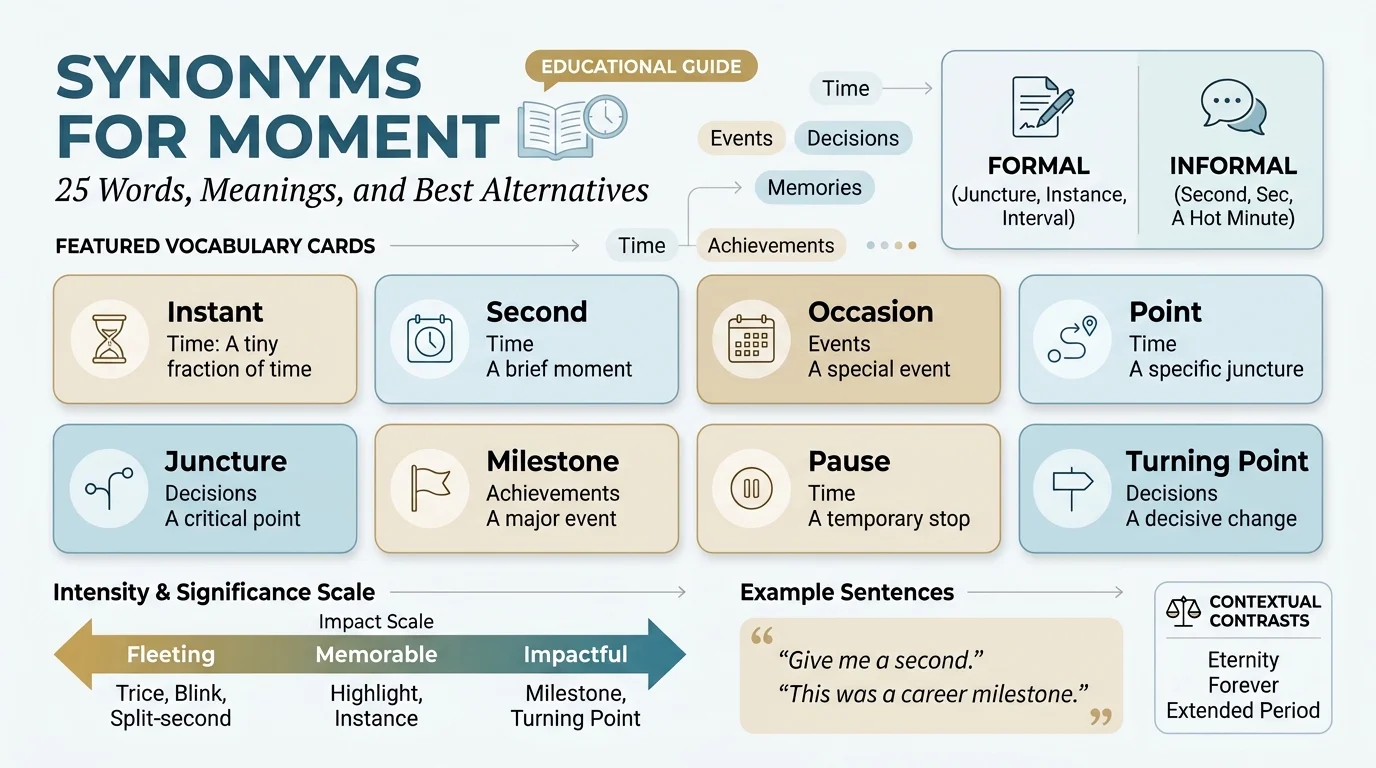
25 Synonyms for “Moment”
The following table includes 25 alternatives with distinct meanings and natural example sentences. Some are direct synonyms, while others work only in specific contexts.
| Synonym | Simple meaning | Best used for | Example sentence |
|---|---|---|---|
| 1. Instant | An extremely brief period | Sudden actions | The screen went dark in an instant. |
| 2. Second | A unit of time or a short wait | Casual conversation | Give me a second to respond. |
| 3. Minute | A unit of time or a short interval | Everyday requests | I will be ready in a minute. |
| 4. Occasion | A particular event or circumstance | Celebrations and events | The reunion was a joyful occasion. |
| 5. Instance | A particular occurrence or example | Academic and formal writing | This instance reveals a recurring problem. |
| 6. Point | A specific time or stage | Business and explanations | At this point, we need a decision. |
| 7. Juncture | A particular stage, especially a critical one | Formal communication | At this juncture, patience is essential. |
| 8. Period | A span of time | Reports and history | The recovery period lasted several weeks. |
| 9. Interval | A space of time between events | Schedules and measurements | An interval of ten minutes separated the sessions. |
| 10. While | A period of time | Casual and general writing | We chatted for a while after dinner. |
| 11. Spell | A relatively short period of activity or condition | Conversational English | She spent a spell working abroad. |
| 12. Phase | A stage within a larger process | Projects and development | The testing phase begins tomorrow. |
| 13. Stage | A particular step in a process | Education and work | The project reached its final stage. |
| 14. Episode | An event or distinct occurrence | Narratives and experiences | The episode changed their relationship. |
| 15. Occurrence | Something that happens | Reports and factual writing | The occurrence was recorded by the team. |
| 16. Event | Something that happens, often notable | General and professional writing | The event attracted considerable attention. |
| 17. Highlight | The most memorable or important part | Reviews and personal stories | Meeting the author was the highlight of my day. |
| 18. Milestone | An important achievement or stage | Careers and projects | Her promotion was a career milestone. |
| 19. Turning point | A time when circumstances change significantly | Personal stories and history | The scholarship became a turning point in his life. |
| 20. Break | A short pause from an activity | Work and study | Let’s take a short break before continuing. |
| 21. Pause | A temporary stop | Speeches and writing | He took a pause before answering. |
| 22. Beat | A brief pause or unit of dramatic action | Fiction and dialogue | She waited a beat, then smiled. |
| 23. Flash | A very brief occurrence or glimpse | Creative writing | For a flash, the entire landscape lit up. |
| 24. Memory | An experience remembered from the past | Emotional and personal writing | That memory still makes her laugh. |
| 25. Highlighting point | A point of particular emphasis | Explanatory writing, when rephrased naturally | The final result became the highlight of the presentation. |
Usage note: Highlighting point is an awkward and uncommon replacement for moment in ordinary English. For a natural 25th option, use opportune time when referring to a suitable moment to act. For example, “This is an opportune time to discuss the proposal.” This is a context specific alternative, not a synonym for every meaning of moment.
Synonym Groups and Usage Differences
Professional vs. Personal Synonyms
Professional writing benefits from words that communicate timing, progress, and decisions accurately. Juncture, milestone, point, and decision point are useful when their meanings match the situation.
Personal writing often benefits from more expressive language. Memory, instant, highlight, and turning point can convey nostalgia, excitement, or lasting significance.
Compare these sentences:
- Professional: We have reached a critical decision point.
- Personal: That instant changed how I viewed the world.
Both communicate importance, but the first emphasizes a decision while the second emphasizes a personal experience.
Formal vs. Conversational Synonyms
Formal language is useful in reports, essays, presentations, and official communication. Conversational language is generally better for texts, informal emails, and everyday discussions.
| Formal alternative | Conversational alternative |
|---|---|
| At this juncture | At this point |
| A brief interval | A short break |
| At a critical point | At that moment |
| On this occasion | This time |
| A particular instance | One example |
Formal does not automatically mean better. Choose the version that suits your audience and the purpose of your message.
Academic Synonyms
Academic writing benefits from precision and clear relationships between events. Depending on the sentence, instance, point, period, phase, and interval may communicate more accurately than moment.
For example:
- General: At this moment in the experiment, the results changed.
- More precise: At this stage of the experiment, the results changed.
Use instance when identifying an occurrence, interval when measuring time between events, and phase when discussing a defined part of a process.
Professional and Business Synonyms
In workplace communication, the best alternative depends on whether you mean a brief wait, a decision, or an achievement.
- Point: At this point, we need approval.
- Milestone: Completing the rollout was a major milestone.
- Decision point: Friday is our final decision point.
- Minute: Could I have a minute to explain the proposal?
- Juncture: At this juncture, we should reconsider our options.
For resumes, focus on achievements rather than vague descriptions of important moments. Instead of writing “I experienced an important moment in my career,” describe the promotion, project launch, award, or measurable result.
Creative or Literary Synonyms
Creative writing often uses alternatives that help readers picture a scene or feel its emotional significance.
- Instant: In an instant, the peaceful garden became chaotic.
- Beat: He hesitated for a beat before opening the letter.
- Flash: A flash of lightning illuminated the empty road.
- Pause: A long pause followed her final words.
- Turning point: The unexpected letter marked a turning point in the story.
These words create different effects. Flash suggests something brief and vivid, while pause slows the scene and turning point signals a meaningful change.
Slang or Modern Synonyms
There is no single modern slang word that replaces moment in every context. Informal expressions are often useful in conversation and social media, but they can sound unnatural in formal writing.
| Expression | Meaning | Appropriate use |
|---|---|---|
| Sec | Short for second | Texts and casual requests |
| A hot minute | An informal expression for a while, often implying a surprisingly long time | Friendly conversation |
| My moment | A time when someone gets attention or succeeds | Informal storytelling and social media |
| Main character moment | A memorable experience in which someone feels central to the story | Casual online captions |
Examples:
- “Be there in a sec.”
- “I haven’t seen you in a hot minute.”
- “Finally having my moment.”
- “A main character moment at sunset.”
These expressions are informal. Avoid them in academic papers, formal reports, or professional documents unless the context specifically calls for conversational language.
Strongest vs. Weaker Synonyms
There is no universal scale of intensity because the alternatives describe different things. However, the following guide shows how strongly they can communicate significance.
| Level | Word or expression | Effect |
|---|---|---|
| 1. Brief and neutral | Second | A short amount of time |
| 2. Very brief | Instant | Emphasizes speed |
| 3. Neutral and specific | Point | Identifies timing or position |
| 4. Meaningful | Highlight | Emphasizes a memorable part |
| 5. Significant | Milestone | Signals important progress |
| 6. Life changing | Turning point | Suggests a major change in direction |
A turning point is not necessarily longer than a moment. It is stronger in significance, not duration.
Emotional vs. Neutral Synonyms
Neutral alternatives describe timing or occurrence without adding much emotion. Emotional alternatives draw attention to the personal meaning of an experience.
| Neutral word | More expressive alternative | Difference |
|---|---|---|
| Point | Turning point | Adds a sense of significant change |
| Instance | Memory | Emphasizes an experience remembered |
| Period | Special occasion | Adds event related significance |
| Instant | Unforgettable moment | Emphasizes lasting emotional impact |
| Pause | Heartfelt pause | Adds an emotional quality |
For factual reports, neutral wording is often best. For personal essays, stories, and captions, expressive wording can help communicate how an experience felt.
Antonyms of “Moment”
The word moment does not have one exact opposite in every context. The most appropriate antonym depends on whether you mean a short duration, a specific point in time, or an important event.
The following 15 words and expressions represent contextual contrasts rather than universal antonyms.
| Antonym or contrast | Meaning | Example sentence |
|---|---|---|
| 1. Eternity | An endless or apparently endless duration | The wait felt like an eternity. |
| 2. Forever | For all time or an extremely long time | We cannot wait forever. |
| 3. Permanence | The quality of lasting indefinitely | The arrangement was designed for permanence. |
| 4. Continuity | An uninterrupted state or sequence | The service maintained continuity throughout the year. |
| 5. Duration | The full length of time something lasts | The duration of the course is six months. |
| 6. Lifetime | The period during which someone lives | She spent a lifetime studying music. |
| 7. Long term | Extending over a lengthy period | We need a long term solution. |
| 8. Endless period | A period perceived as having no end | The endless period of uncertainty exhausted the team. |
| 9. Timelessness | The quality of seeming unaffected by time | The painting has a sense of timelessness. |
| 10. Permanently | In a way that is intended to last | The office was permanently relocated. |
| 11. Ongoing state | A condition that continues | The investigation remains in an ongoing state. |
| 12. Extended period | A lengthy stretch of time | The road remained closed for an extended period. |
| 13. Long interval | A considerable gap between events | A long interval separated the two performances. |
| 14. Steadiness | A state of consistency or stability | The team’s steadiness helped maintain progress. |
| 15. Uninterrupted duration | Time that continues without a break | The machine operated for an uninterrupted duration of eight hours. |
For everyday vocabulary, eternity, forever, extended period, and long interval are often the most useful contrasts when moment means a brief amount of time.
Comparison: “Moment” vs. Similar Words
Moment vs. Instant
A moment can mean a brief period or a particular point in time. An instant generally emphasizes extreme brevity or something happening immediately.
- Stronger: Instant, when speed or suddenness is the focus.
- More formal: Both work in formal writing, depending on context.
- Moment: Wait a moment before entering.
- Instant: The screen changed in an instant.
Moment vs. Second
A moment is flexible and does not specify an exact duration. A second is a defined unit of time, although it can be used informally to mean a short wait.
- Stronger: Neither is universally stronger. Second is more precise when used literally.
- More formal: Moment is often more natural in polite requests.
- Moment: May I have a moment to explain?
- Second: Give me a second to find the file.
Moment vs. Occasion
A moment can be a point in time or a brief experience. An occasion is an event or circumstance, often one that has particular significance.
- Stronger: Occasion often emphasizes the event itself.
- More formal: Occasion is frequently suitable for formal event descriptions.
- Moment: It was a memorable moment for our family.
- Occasion: The award ceremony was a memorable occasion.
Moment vs. Period
A moment usually refers to a brief interval or specific point. A period refers to a span of time that may last minutes, months, or years.
- Stronger: Period emphasizes duration.
- More formal: Period is especially useful in academic and technical writing.
- Moment: She paused for a moment.
- Period: She worked there for a period of six months.
Moment vs. Phase
A moment can identify a particular point or short experience. A phase describes a stage within a larger process.
- Stronger: Phase is more precise when discussing stages of development.
- More formal: Phase is common in scientific, academic, and business writing.
- Moment: This is an important moment in the discussion.
- Phase: This is an important phase of the research.
Moment vs. Milestone
A moment can be ordinary or memorable. A milestone specifically highlights an important achievement or stage of progress.
- Stronger: Milestone communicates achievement more clearly.
- More formal: Milestone works well in workplace reports and professional biographies.
- Moment: Winning the award was a special moment.
- Milestone: Winning the award was a major career milestone.
Common Phrases and Expressions with “Moment”
These expressions are common in everyday English, professional communication, and storytelling.
1. Just a moment
Meaning: A polite way to ask someone to wait briefly.
Example sentence: Just a moment while I check your appointment.
2. At the moment
Meaning: At the present time.
Example sentence: I am working on the final section at the moment.
3. For a moment
Meaning: For a short period.
Example sentence: She closed her eyes for a moment and took a deep breath.
4. In a moment
Meaning: Very soon or after a short wait.
Example sentence: The presentation will begin in a moment.
5. At that moment
Meaning: At a particular point in a past event or story.
Example sentence: At that moment, he realized he had forgotten his passport.
6. A moment of truth
Meaning: A critical time when the actual result or reality becomes clear.
Example sentence: The final interview was her moment of truth.
7. Seize the moment
Meaning: Take advantage of an opportunity while it is available.
Example sentence: He decided to seize the moment and ask for the promotion.
8. A moment to remember
Meaning: An experience that is especially memorable.
Example sentence: Watching the fireworks with my family was a moment to remember.
Common Mistakes to Avoid
Choosing the right synonym involves understanding both meaning and tone. These are seven common mistakes worth avoiding.
1. Using a vague word when a precise one is available. Instead of “an important moment in the project,” write “a major project milestone” if you mean meaningful progress.
2. Confusing a moment with a period. A moment usually suggests brevity, while a period can refer to a much longer span. Use period when duration matters.
3. Using casual language in formal writing. Expressions such as “give me a sec” are suitable for friendly conversation but may not suit a formal request. Prefer “Please allow me a moment.”
4. Making an ordinary event sound dramatic. Calling a routine meeting a “turning point” may exaggerate its importance. Use meeting, occasion, or point when appropriate.
5. Repeating the same word unnecessarily. Instead of “It was a great moment, and that moment became a special moment,” write “It was a wonderful experience that became a cherished memory.”
6. Choosing a synonym with the wrong emotional tone. A milestone suggests progress, while a memory emphasizes recollection. Select the word that matches the intended message.
7. Using slang in academic or professional writing. Expressions such as “a hot minute” are conversational. Use a short while, a brief interval, or a precise time measurement in formal contexts.
FAQs
1. What is the best synonym for moment?
The best synonym is instant when describing a brief period. Use occasion for an event, point for timing, or milestone for an important achievement.
2. What is a formal synonym for moment?
Juncture is a formal alternative when referring to a particular stage or critical point. Instance and interval work better in other contexts.
3. What is an informal synonym for moment?
Second and sec are common informal alternatives when asking someone to wait. For example, “Give me a second” sounds natural in everyday conversation.
4. What is another word for moment in professional writing?
Use point for timing, milestone for achievements, and decision point for choices. The best option depends on the purpose of the sentence.
5. What is the difference between moment and instant?
A moment can refer to a short period or a significant point in time. An instant emphasizes extreme brevity or immediate occurrence.
6. What is the opposite of moment?
There is no universal opposite. Eternity, forever, and an extended period can contrast with moment when it refers to a brief amount of time.
Conclusion
The word moment can describe a brief interval, a particular point in time, or an experience with personal significance. Its best synonyms include instant, second, occasion, point, juncture, milestone, and turning point, depending on the intended meaning.
For professional writing, choose precise terms such as milestone or decision point when appropriate. For everyday conversation, second and instant often sound natural. Emotional and creative writing, memory, highlight, and turning point can express greater significance.
Your vocabulary tip: Before replacing moment, ask whether you are describing time, an event, or an achievement. Identifying that distinction will help you choose a word that sounds natural, communicates clearly, and gives your writing greater precision.
Discover More Post:
- 50+ Synonyms for Snow | From Gentle Flurries to a Winter …
- 50+ Synonyms for Impressive | Powerful Alternatives to …
- 50+ Synonyms for Opinion | Meanings, Examples, and Best …