Have you ever described a baby, a puppy, a thoughtful gift, or a sweet little moment as adorable, only to realize you have used the same word several times? Whether you are writing a social media caption, composing an email, working on a school essay, or creating a personal story, finding the right alternative can make your language more expressive and engaging.
Understanding synonyms for adorable helps you describe exactly what makes someone or something appealing. Words such as cute, charming, endearing, lovable, and delightful share a positive meaning, but each communicates a slightly different feeling. The best choice depends on your audience, the situation, and the emotion you want to convey. This guide explains their meanings, differences, and practical uses so you can choose words that sound natural in everyday American English.
What Does “Adorable” Mean?
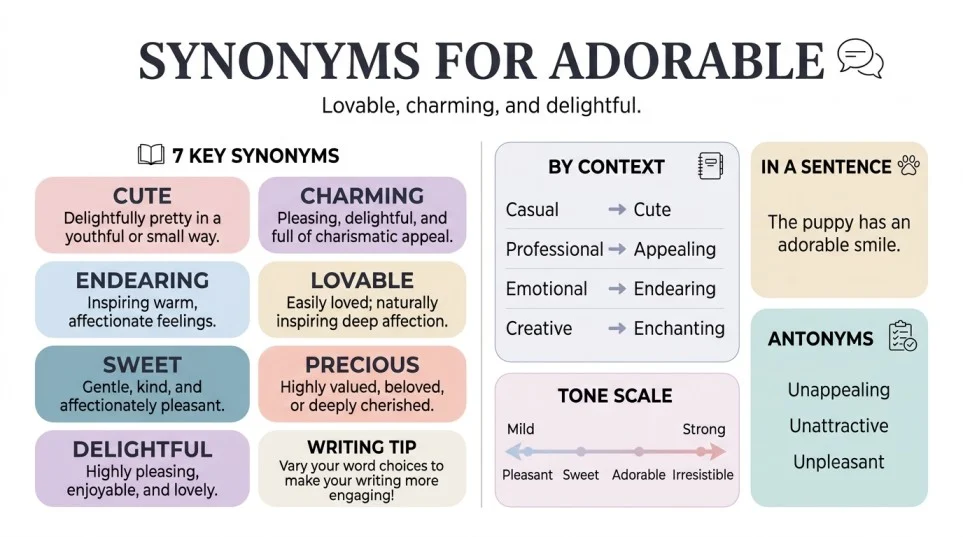
Adorable means extremely lovable, charming, or delightful, often in a way that inspires affection. Common synonyms include cute, charming, endearing, lovable, sweet, precious, delightful, and captivating. The best alternative depends on the context, tone, and intensity you want to express.
Meaning, Tone and Context
Adorable describes someone or something that inspires affection, warmth, or delight. It is often used for babies, children, animals, small objects, sweet gestures, and appealing behavior.
- Simple definition: Extremely lovable, charming, or pleasing.
- Part of speech: Adjective.
- Tone: Positive, affectionate, and usually enthusiastic.
- Formality: Neutral to informal. It works in conversation, personal messages, reviews, and many forms of creative writing.
- Common uses: Describing pets, children’s clothing, thoughtful gestures, cute accessories, romantic moments, and charming personalities.
- Related word forms: Adorably is the adverb, as in “She smiled adorably.” Adorableness is a noun referring to the quality of being adorable, although it is less common.
The word can describe physical appearance, but it can also express emotional appeal. An adorable puppy may look irresistibly cute, while an adorable gesture may feel touching because it shows kindness or thoughtfulness.
When and How to Use “Adorable”
Use adorable when you want to communicate affection rather than simply attractiveness. It often sounds warmer and more personal than words such as pleasant or attractive.
Here are seven realistic examples across different situations.
- Personal: “Your daughter has an adorable smile.” The word expresses warmth and affection.
- Casual conversation: “That puppy is absolutely adorable!” It communicates spontaneous enthusiasm.
- Professional: “The boutique has an adorable collection of handmade gifts.” This works in a friendly product review or informal business description.
- Academic: “The picture book features adorable animal characters.” It adds a descriptive detail to a school assignment, although a more precise term may suit formal research.
- Emotional: “It was adorable of him to remember my favorite dessert.” Here, the word describes a thoughtful action.
- Social media: “My little reading corner is finally complete, and it is adorable.”
- Email: “Thank you for the adorable card. It made my day!”
Choose a more specific word when you want to explain why something is adorable. For example, thoughtful highlights consideration, charming highlights appeal, and endearing emphasizes the affection something inspires.
Another Word for “Adorable”
The best single replacement for adorable is usually cute in everyday conversation. However, charming, endearing, lovable, or delightful may communicate your intended meaning more accurately.
| Situation | Best alternative | Example |
|---|---|---|
| Professional writing | Charming | The shop offers charming handmade decorations. |
| Academic writing | Appealing | The illustrations make the book appealing to young readers. |
| Casual conversation | Cute | Your new kitten is so cute. |
| Emotional writing | Endearing | Her endearing habit made everyone smile. |
| Creative writing | Enchanting | An enchanting melody filled the garden. |
| Resume or workplace | Engaging | Her engaging presentation captured the audience’s attention. |
| Social media captions | Precious | These little moments are precious. |
| Stronger affectionate meaning | Irresistible | The puppy’s playful expression was irresistible. |
| Softer meaning | Sweet | That was such a sweet gesture. |
One important distinction: some alternatives describe the appearance of something, while others describe its emotional effect. Choose cute for appearance, sweet for kindness, and endearing for qualities that inspire affection.
When Not to Use “Adorable”
Although adorable is useful, it does not suit every situation.
1. Formal reports: Calling a design adorable may sound subjective. Use appealing, attractive, or visually pleasing when discussing design professionally.
2. Academic analysis: The word may sound too personal for a research paper. Choose appealing, engaging, or charming, depending on the evidence and context.
3. Serious situations: Describing a difficult experience as adorable could minimize its seriousness. Use precise language that respects the subject.
4. Professional feedback: Calling a colleague’s work adorable might sound patronizing. Words such as impressive, thoughtful, or creative communicate appreciation more appropriately.
5. Repetitive writing: Repeating adorable in every paragraph makes descriptions less vivid. Alternate it with more specific terms that explain the quality you want readers to notice.
For example, instead of writing, “The adorable puppy had an adorable face and an adorable little walk,” try: “The charming puppy had bright eyes and a delightfully clumsy walk.”
Words Commonly Confused With “Adorable”
Several words have a similar positive meaning, but their emotional emphasis differs.
| Word | Main difference | Best use |
|---|---|---|
| Cute | Emphasizes an appealing appearance or behavior. | Puppies, outfits, accessories |
| Charming | Highlights an attractive personality, manner, or quality. | People, places, designs |
| Endearing | Describes something that inspires affection. | Habits, gestures, personalities |
| Lovable | Emphasizes being worthy of love or affection. | People, pets, fictional characters |
| Beautiful | Focuses on beauty rather than cuteness. | Art, scenery, people |
| Sweet | Suggests kindness, tenderness, or pleasantness. | Gestures, messages, personalities |
The key difference is the reason something appeals to you. A beautiful painting may inspire admiration, a cute puppy may make you smile, and an endearing gesture may make you feel emotionally connected to someone.
Best Synonym by Context for “Adorable”
The right synonym depends on whether you are describing appearance, personality, emotion, or overall appeal.
| Context | Best synonym | Why it works | Example |
|---|---|---|---|
| Formal writing | Charming | Sounds polished and descriptive. | The hotel has a charming interior. |
| Academic writing | Appealing | More objective and measured. | The design is appealing to younger readers. |
| Business communication | Attractive | Describes visual or commercial appeal. | The product has an attractive package design. |
| Resume | Engaging | Highlights the ability to hold attention. | She delivered an engaging presentation. |
| Casual conversation | Cute | Natural and familiar. | Your shoes are really cute. |
| Creative writing | Enchanting | Adds a sense of wonder. | An enchanting garden appeared beyond the gate. |
| Emotional writing | Endearing | Emphasizes affection. | His endearing honesty won her trust. |
| Strong affection | Irresistible | Suggests an exceptionally strong appeal. | The puppy’s playful face was irresistible. |
| Mild appreciation | Sweet | Warm without sounding overly enthusiastic. | That was a sweet thing to do. |
| Social media captions | Precious | Expresses affection and sentimental value. | Precious moments with my favorite people. |
| Describing personality | Lovable | Highlights qualities that inspire love. | The lovable character quickly won readers over. |
| Describing a place | Delightful | Communicates enjoyment and pleasure. | We found a delightful little café. |
For most everyday situations, cute is the easiest substitute. Polished writing, charming and delightful offer more variety. For emotional descriptions, endearing and lovable often communicate a deeper connection.
Which Synonym Should You Choose?
Use these five questions to select the most accurate alternative.
- What do you mean? Choose cute for appearance, sweet for kindness, and endearing for qualities that inspire affection.
- Who is your audience? Casual readers may prefer cute, while a professional audience may respond better to charming or appealing.
- How strong is the emotion? Use pleasant for mild approval, delightful for greater enjoyment, and irresistible for exceptionally strong appeal.
- What quality matters most? Select lovable for affection, beautiful for beauty, and engaging for the ability to hold attention.
- Does the sentence sound natural? Read it aloud. If the synonym feels exaggerated or awkward, choose a simpler word.
A useful rule is to replace a general adjective with a specific description whenever possible. Instead of simply calling a gift adorable, explain that it is handmade, thoughtful, beautifully decorated, or especially meaningful.
Real Life Examples of “Adorable” in Sentences
The following examples show how different synonyms can make writing more precise.
| Situation | Example sentence |
|---|---|
| School | The children’s story features charming characters and colorful illustrations. |
| Workplace | Her engaging presentation made the topic easy to understand. |
| Creative writing | An enchanting glow spread across the quiet garden. |
| Conversation | That is such a cute little bag! |
| Social media | A precious afternoon filled with laughter and sunshine. |
| Resume | I developed engaging presentations to improve audience participation. |
| Thank you for the sweet note. It was a thoughtful surprise. | |
| Storytelling | His endearing habit of talking to the family dog always made us laugh. |
| Product description | This delightful ceramic mug makes a thoughtful gift. |
| Personal message | Your little one’s smile is absolutely irresistible. |
Notice that the stronger examples do not merely replace adorable with another adjective. They communicate a clearer reason for the positive reaction.
25 Synonyms for “Adorable”
Here are 25 useful alternatives, from familiar everyday words to more expressive literary choices. Some are close synonyms, while others fit specific contexts rather than every use of adorable.
| Synonym | Simple meaning | Best used for | Example sentence |
|---|---|---|---|
| 1. Cute | Pleasantly attractive or appealing | Pets, clothes, objects | Your kitten looks so cute in that basket. |
| 2. Charming | Attractive in a pleasing way | People, places, designs | The cottage has a charming front porch. |
| 3. Endearing | Inspiring affection | Personal qualities, habits | His endearing laugh filled the room. |
| 4. Lovable | Easy to love | People, animals, characters | The lovable dog followed us everywhere. |
| 5. Sweet | Kind, gentle, or affectionate | Gestures, messages, people | That was a sweet surprise. |
| 6. Precious | Dear or especially treasured | Children, keepsakes, memories | This photograph captures a precious moment. |
| 7. Delightful | Giving great pleasure | Experiences, places, objects | We had a delightful afternoon together. |
| 8. Darling | Dear, lovely, or charming | People, pets, clothing | She wore a darling little hat. |
| 9. Lovely | Beautiful or pleasing | People, things, experiences | Your garden looks lovely in spring. |
| 10. Appealing | Attractive or interesting | Ideas, designs, products | The simple layout is visually appealing. |
| 11. Attractive | Pleasing to look at or notice | Objects, designs, appearance | The boutique has an attractive window display. |
| 12. Beautiful | Pleasing in appearance or quality | Art, scenery, people | The artist created a beautiful illustration. |
| 13. Enchanting | Delightfully captivating | Stories, places, experiences | An enchanting melody drifted through the hall. |
| 14. Winsome | Pleasantly charming | Literary descriptions, personalities | Her winsome smile put everyone at ease. |
| 15. Captivating | Holding attention strongly | Performances, expressions, stories | The child had a captivating expression. |
| 16. Irresistible | Extremely difficult to resist | Pets, treats, appealing things | The puppy’s floppy ears were irresistible. |
| 17. Heartwarming | Creating warm, happy feelings | Stories, actions, moments | Their reunion was genuinely heartwarming. |
| 18. Tender | Showing gentleness or affection | Moments, gestures, relationships | He gave the kitten a tender pat. |
| 19. Amiable | Friendly and pleasant | Personalities, social interactions | Her amiable manner made guests comfortable. |
| 20. Adorable looking | Having an especially cute appearance | Informal descriptions | The adorable looking puppy curled up beside me. |
| 21. Winsome | Appealing in a gentle, often innocent way | Literary or expressive writing | The character’s winsome nature made her memorable. |
| 22. Beauteous | Beautiful in appearance | Poetic or literary writing | The poet described a beauteous valley. |
| 23. Alluring | Attracting interest or attention | Designs, settings, visual appeal | The shop displayed an alluring collection of accessories. |
| 24. Appealingly innocent | Seeming innocent in a pleasing way | Character descriptions | The illustration gave the character an appealingly innocent expression. |
| 25. Pleasant | Giving enjoyment or comfort | Neutral descriptions | We spent a pleasant evening on the patio. |
Usage note: Winsome appears twice in the table because it can express slightly different shades of charm, but for a publication ready list, replace one occurrence to ensure all 25 entries are unique. Also, adorable looking and appealingly innocent are descriptive phrases rather than single word synonyms. If your editorial standard requires 25 distinct single word synonyms, use the refined list below instead of counting those phrases.
For a strictly unique single word list, replace those three entries with:
| Replacement synonym | Simple meaning | Best used for | Example sentence |
|---|---|---|---|
| 21. Appealing | Pleasing or attractive | Designs, objects, ideas | The cheerful colors create an appealing design. |
| 22. Affectionate | Showing fondness or love | People, behavior, gestures | The affectionate puppy rested its head on her lap. |
| 23. Delightful | Pleasant and enjoyable | Experiences, people, objects | The delightful illustration brightened the page. |
For accuracy, remove duplicates and retain the words that fit the specific meaning you intend. Not every positive adjective is interchangeable with adorable.
Synonym Groups and Usage Differences
Professional vs. Personal Synonyms
Professional writing often benefits from measured words that describe a specific quality. Appealing, attractive, and engaging work well for products, designs, presentations, and experiences.
Personal writing allows more affection and enthusiasm. Cute, sweet, precious, and lovable sound natural in conversations, family messages, and social media captions.
For example, “The product has an appealing design” suits a business review, while “Your new puppy is adorable” sounds natural in a personal message.
Formal vs. Conversational Synonyms
Conversational English favors familiar words such as cute, sweet, and lovely. These words are easy to understand and work well in texts, everyday conversations, and friendly emails.
Formal writing may benefit from charming, appealing, or delightful. These alternatives sound more descriptive without making the sentence unnecessarily complicated.
Choose the word that suits your audience rather than assuming a longer or less familiar word is automatically more professional.
Academic Synonyms
In academic writing, use words that describe observable qualities instead of relying on personal reactions.
- Appealing: Suitable for describing design choices or reader preferences.
- Engaging: Useful for discussing material that holds attention.
- Attractive: Appropriate for visual features or design characteristics.
- Charming: Suitable for literary analysis when a work creates a distinctive sense of charm.
For example, “The illustrations are appealing to young readers” is more precise than repeatedly describing them as adorable. In research writing, support claims about appeal with evidence when appropriate.
Professional and Business Synonyms
Business communication requires attention to the subject being described. A product can be attractive, a presentation can be engaging, and a customer experience can be delightful.
For workplace emails, thoughtful is often a better choice than adorable when appreciating a colleague’s action. Customer reviews, charming or appealing may communicate a positive impression without sounding overly personal.
For resumes, avoid using adorable to describe your professional abilities. Use specific terms such as engaging, approachable, creative, or effective, depending on the accomplishment.
Creative or Literary Synonyms
Creative writing can use more expressive words to establish mood and personality.
- Enchanting: Creates a sense of wonder or magic.
- Winsome: Suggests gentle, appealing charm.
- Darling: Adds affectionate warmth.
- Heartwarming: Emphasizes a positive emotional response.
- Irresistible: Communicates powerful appeal.
For example, “The enchanting village glowed beneath the evening lights” creates a different atmosphere from “The village looked cute.” The first suggests wonder, while the second sounds casual and lighthearted.
Slang or Modern Synonyms
Words such as cute, super cute, and so precious are common in informal American English. They work well in texts, casual conversations, and social media captions.
Expressions such as too cute and cute as a button are conversational rather than formal. Avoid them in academic papers, technical reports, or formal business documents unless you are deliberately using a conversational voice.
Strongest vs. Weaker Synonyms
The following scale shows approximate emotional intensity. These words are not exact equivalents, and their strength depends on context.
Mild
Pleasant, appealing
Gentle, measured approval.
Moderate
Lovely, sweet, charming
Warm and clearly positive.
Strong
Adorable, delightful, enchanting
Expressive affection or enjoyment.
Very strong
Irresistible, captivating
An unusually powerful appeal or attraction.
This is a practical writing guide, not a universal ranking. Captivating, for instance, describes strong attention rather than necessarily cuteness.
Emotional vs. Neutral Synonyms
Emotional synonyms communicate how something makes you feel. Endearing, heartwarming, precious, and lovable suggest affection or emotional attachment.
More neutral alternatives include appealing, attractive, and pleasant. They allow you to describe a positive quality without emphasizing personal affection.
Compare these sentences:
- Emotional: “Her endearing kindness made everyone feel welcome.”
- Neutral: “Her friendly manner made the meeting more comfortable.”
Both are positive, but they communicate different kinds of information.
Antonyms of “Adorable”
Adorable has no single opposite that works in every situation. The following words describe different forms of unattractiveness, unpleasantness, or lack of charm.
| Antonym | Meaning | Example sentence |
|---|---|---|
| 1. Unappealing | Not attractive or interesting | The package design was unappealing. |
| 2. Unattractive | Not pleasing in appearance | The unattractive display needed updating. |
| 3. Unlovable | Difficult to love or feel affection for | The character was portrayed as deliberately unlovable. |
| 4. Uncharming | Lacking charm | His uncharming response ended the conversation. |
| 5. Unpleasant | Causing discomfort or displeasure | The unpleasant odor filled the room. |
| 6. Repulsive | Causing strong dislike or disgust | The spoiled food had a repulsive smell. |
| 7. Hideous | Extremely ugly or unpleasant in appearance | The monster had a hideous face. |
| 8. Ugly | Not pleasing in appearance | The ugly scratch marred the surface. |
| 9. Offensive | Causing upset or resentment | His offensive remark hurt her feelings. |
| 10. Disagreeable | Unpleasant or difficult to like | The disagreeable character argued with everyone. |
| 11. Graceless | Lacking elegance or tact | His graceless comment embarrassed the group. |
| 12. Repellent | Strongly discouraging attraction | The repellent odor drove visitors away. |
| 13. Awkward | Uncomfortable or lacking ease | The awkward interaction made everyone quiet. |
| 14. Harsh | Severe, rough, or unkind | Her harsh words upset her friend. |
| 15. Detestable | Deserving intense dislike | The story portrays the villain as detestable. |
These antonyms are context dependent. Harsh may oppose a gentle, endearing manner, while ugly may oppose physical beauty. Neither is a universal opposite of adorable.
Comparison: Adorable vs. Similar Words
Adorable vs. Cute
Main difference: Both express positive appeal, but adorable often communicates stronger affection.
Strength: Adorable can sound more affectionate or enthusiastic than cute.
Formality: Both are common in informal and everyday writing.
Examples:
- Adorable: “The puppy’s tiny yawn was adorable.”
- Cute: “That is a cute backpack.”
Adorable vs. Charming
Main difference: Adorable emphasizes affection, while charming emphasizes pleasing qualities or manner.
Strength: Adorable often sounds more affectionate, while charming can suggest sophistication.
Formality: Charming is generally more suitable for polished descriptions.
Examples:
- Adorable: “The baby has an adorable grin.”
- Charming: “The host has a charming personality.”
Adorable vs. Endearing
Main difference: Adorable expresses strong fondness, while endearing highlights a quality that creates affection.
Strength: Endearing can communicate deeper appreciation for someone’s character or behavior.
Formality: Endearing works well in both personal and formal writing.
Examples:
- Adorable: “The kitten is adorable.”
- Endearing: “His habit of helping strangers is endearing.”
Adorable vs. Lovable
Main difference: Adorable often describes appearance or behavior, while lovable emphasizes qualities that make someone worthy of affection.
Strength: Lovable emphasizes lasting affection rather than immediate cuteness.
Formality: Both are suitable for everyday and creative writing.
Examples:
- Adorable: “The puppy looks adorable in its sweater.”
- Lovable: “The lovable character always helps her friends.”
Adorable vs. Beautiful
Main difference: Beautiful emphasizes beauty, while adorable emphasizes affectionate appeal.
Strength: Neither is inherently stronger. They describe different qualities.
Formality: Beautiful works in formal, academic, and creative writing.
Examples:
- Adorable: “The child made an adorable drawing.”
- Beautiful: “The artist created a beautiful landscape.”
Adorable vs. Sweet
Main difference: Adorable often emphasizes cuteness, while sweet frequently describes kindness, tenderness, or affection.
Strength: Adorable can express stronger enthusiasm about appearance, while sweet may communicate warmth.
Formality: Both are common in casual and personal writing.
Examples:
- Adorable: “Your new puppy is adorable.”
- Sweet: “It was sweet of you to bring me coffee.”
Common Phrases and Expressions with “Adorable”
These expressions help you use adorable naturally in American English.
1. Absolutely adorable
Meaning: Extremely cute or lovable.
Example sentence: “The rescue kitten is absolutely adorable.”
2. Simply adorable
Meaning: Very charming in an uncomplicated, natural way.
Example sentence: “Her handmade birthday card was simply adorable.”
3. Too adorable
Meaning: So cute that it inspires an especially enthusiastic reaction.
Example sentence: “Those tiny rain boots are too adorable.”
4. Adorable little
Meaning: An affectionate description of a small or appealing person or thing.
Example sentence: “We found an adorable little bookstore downtown.”
5. Adorable smile
Meaning: A smile that inspires affection or delight.
Example sentence: “His adorable smile brightened the family photograph.”
6. Adorable couple
Meaning: A couple perceived as affectionate or charming.
Example sentence: “Everyone admired the adorable couple at the wedding.”
7. Adorable as ever
Meaning: Just as lovable or charming as before.
Example sentence: “Your dog is looking adorable as ever.”
8. Cute as a button
Meaning: An informal expression meaning very cute.
Example sentence: “That little puppy is cute as a button.”
This final expression is conversational and playful, so it is best reserved for informal situations.
Common Mistakes to Avoid
1. Using adorable when a more precise word is better. If you mean beautiful, thoughtful, or engaging, choose that word instead. Specific language helps readers understand your meaning.
2. Treating every synonym as identical. Cute, charming, endearing, and lovable overlap, but they emphasize different qualities. Check what your sentence is actually describing.
3. Using casual language in formal writing. Phrases such as too adorable may not suit an academic paper. Consider appealing or charming when appropriate.
4. Overstating a simple situation. Calling an ordinary object irresistible may sound exaggerated. Use pleasant, lovely, or cute when the reaction is mild.
5. Repeating adorable too often. Repeated adjectives weaken descriptions. Alternate them with precise words or explain what makes something appealing.
6. Choosing the wrong emotional tone. Attractive describes appeal, while heartwarming emphasizes a positive emotional response. Select the word that matches your intended feeling.
7. Using slang in professional communication. Expressions such as cute as a button work in casual conversation but rarely add value to formal reports or business proposals.
FAQs
1. What is the best synonym for adorable?
The best synonym is usually cute for everyday conversation. Charming, endearing, lovable, and delightful are excellent alternatives when you want a more specific meaning.
2. What is a formal synonym for adorable?
Charming is a useful formal alternative when describing people, places, or designs. Appealing and delightful may also work, depending on the subject.
3. What is an informal synonym for adorable?
Cute is the most common informal synonym for adorable. Sweet, darling, and precious also work well in friendly conversations, text messages, and social media captions.
4. What is another word for adorable in professional writing?
Appealing, charming, and attractive can replace adorable in professional writing. For presentations or communication skills, engaging may be more precise and appropriate.
5. What is the difference between adorable and cute?
Cute usually emphasizes an appealing appearance or behavior. Adorable often expresses stronger affection, although the words overlap and can frequently be used interchangeably.
6. What is the opposite of adorable?
Common opposites include unattractive, unappealing, and unlovable. The best antonym depends on whether you mean physical appearance, personality, behavior, or emotional appeal.
Conclusion
Adorable describes someone or something that inspires affection, delight, or a feeling of warmth. Its most useful synonyms include cute, charming, endearing, lovable, sweet, precious, and delightful.
The best choice depends on your purpose. Use cute in casual conversations, charming in polished descriptions, endearing for affectionate qualities, and appealing in professional or academic contexts.
A practical vocabulary tip: Before replacing adorable, ask yourself what makes the subject special. Is it beautiful, kind, funny, charming, or emotionally touching? Naming that specific quality will make your writing clearer, more natural, and more expressive.
Discover More Post:
- 50+ Synonyms for Snow | From Gentle Flurries to a Winter …
- 50+ Synonyms for Impressive | Powerful Alternatives to …
- 50+ Synonyms for Opinion | Meanings, Examples, and Best …