Have you ever used the word meaning repeatedly in an essay, email, presentation, or social media caption? Although it is a useful word, repeating it can make your writing feel less precise. Choosing a suitable alternative helps you explain ideas clearly, express emotions, and communicate with greater confidence.
The best synonym depends on what you want to describe. You might use definition to explain a word, significance to highlight importance, purpose to explain a goal, or interpretation to describe how someone understands a message. As a practical vocabulary guide, this article explores the differences between these alternatives, explains when they work best, and provides examples for academic, professional, casual, and creative writing.
What Does “Meaning” Mean?
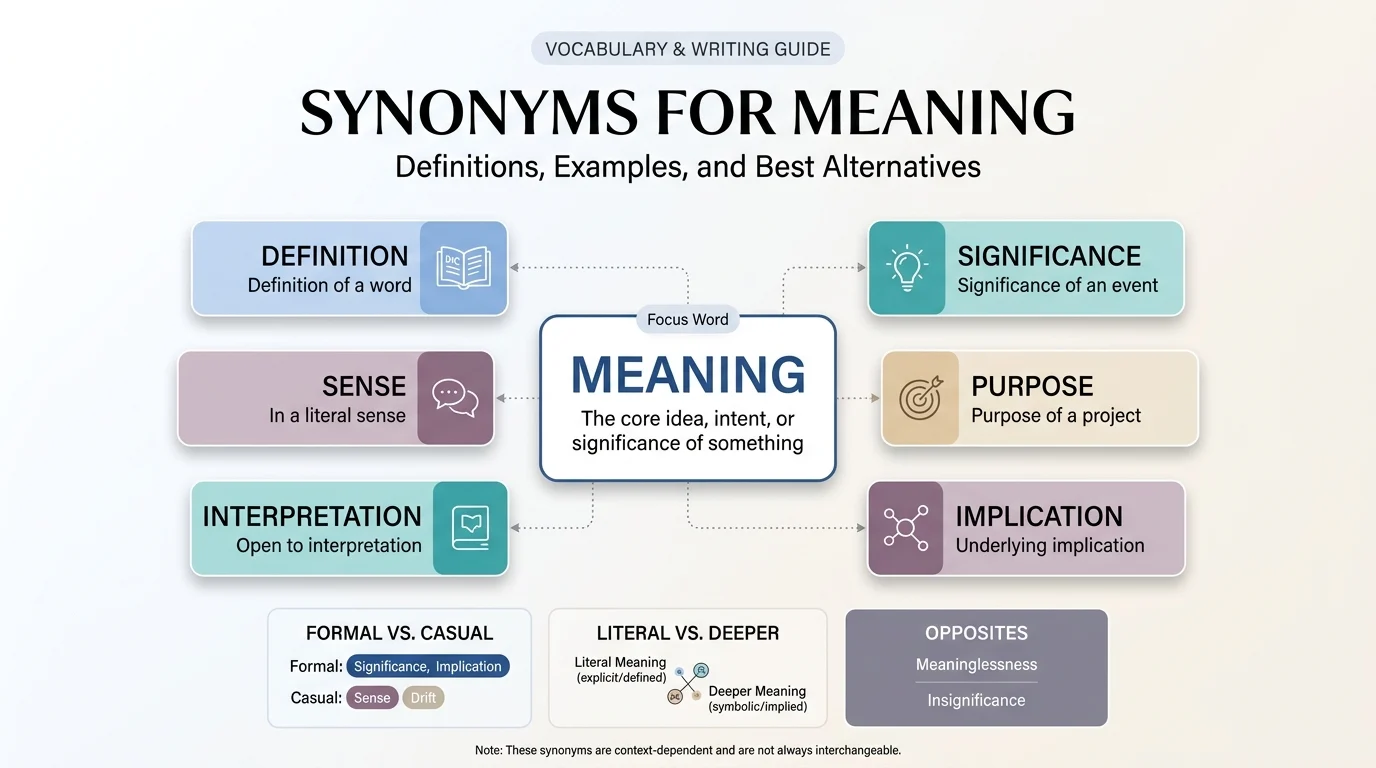
Meaning refers to what a word, statement, action, symbol, or experience communicates or represents. Common synonyms include definition, significance, sense, interpretation, implication, and purpose, depending on the context, tone, and intended message.
Meaning, Tone and Context
The word meaning describes the idea, message, intention, or importance associated with something. It helps explain what language communicates and what an experience or action represents.
Simple definition
Meaning is the idea or significance that someone understands from a word, statement, symbol, event, or experience.
For example, the meaning of a word explains what it expresses, while the meaning of a personal experience may refer to the importance it holds in someone’s life.
Part of speech
Meaning can function as a noun or as part of a verb phrase.
As a noun: “The meaning of this expression is easy to understand.”
As part of a verb phrase: “What are you meaning to say?” This construction is less common in everyday American English than “What do you mean?”
The word also functions as a present participle of mean, as in “She is meaning to call you,” although this usage is uncommon and often sounds unnatural. “She intends to call you” is generally more idiomatic.
Tone and formality
Meaning is generally neutral and works in everyday conversations, academic assignments, business communication, and creative writing.
Its tone changes according to the context. Significance sounds more analytical, sense is often conversational, and implication can suggest an indirect or unstated message.
Common use cases
Use meaning when explaining vocabulary, interpreting literature, discussing someone’s intentions, understanding a message, or exploring the importance of an experience.
Important word forms
| Word form | Meaning | Example |
|---|---|---|
| Mean | To express or intend something | What does this phrase mean? |
| Meaning | An idea, message, or significance | The meaning is clear. |
| Meaningful | Having importance or value | We had a meaningful conversation. |
| Meaningfully | In a way that conveys significance | She smiled meaningfully. |
| Meaningless | Having no clear purpose or significance | The argument felt meaningless. |
When and How to Use “Meaning”
The word is useful whenever you need to explain what something communicates, represents, or contributes. However, identifying the specific context helps you choose the most accurate expression.
1. Academic: The meaning of the poem becomes clearer after studying its imagery.
2. Professional: Could you clarify the meaning of this clause in the agreement?
3. Personal: Our friendship has a special meaning to me.
4. Emotional: Her unexpected visit held great significance for the family.
5. Creative writing: The recurring symbol represents hope throughout the novel.
6. Social media: This photograph captures the true spirit of our friendship.
7. Casual conversation: What do you mean by that comment?
Each example communicates a slightly different idea. Meaning works well as a general term, while alternatives can emphasize a definition, intention, emotion, or deeper importance.
Another Word for “Meaning”
The best single replacement for meaning is usually sense when discussing what a word or statement communicates. However, definition is more precise for vocabulary, while significance works better when discussing importance.
Here are useful choices for different situations.
| Context | Recommended synonym | Example |
|---|---|---|
| Professional writing | Significance | We discussed the significance of the findings. |
| Academic writing | Interpretation | The author’s interpretation differs from the common reading. |
| Casual conversation | Sense | That explanation makes sense. |
| Emotional writing | Significance | The gift holds special significance for her. |
| Creative writing | Symbolism | The bird’s symbolism becomes clear at the end. |
| Resume or workplace | Impact | The project had a measurable impact on efficiency. |
| Social media captions | Message | The message behind this photograph is simple. |
| Stronger meaning | Implication | The statement carries a serious implication. |
| Softer meaning | Sense | I understand your sense of the situation. |
Remember that these words are related, but they are not interchangeable in every sentence. The surrounding words and the intended message determine which alternative sounds natural.
When Not to Use “Meaning”
Although meaning is versatile, it can sound vague when a sentence requires a more specific word. A precise synonym tells readers whether you are discussing a definition, a goal, an interpretation, or an important consequence.
Consider these examples.
| Vague sentence | More precise sentence | Why it improves the writing |
|---|---|---|
| The meaning of the research is important. | The significance of the research is important. | Highlights the value of the findings. |
| What is the meaning of this word? | What is the definition of this word? | Focuses directly on vocabulary. |
| I do not understand the meaning of his words. | I do not understand his intention. | Emphasizes what he wanted to communicate. |
| The meaning of this project is to help students. | The purpose of this project is to help students. | Identifies the project’s goal. |
| The meaning of the poem is unclear. | The poem’s interpretation remains uncertain. | Emphasizes how the poem can be understood. |
Avoid replacing meaning simply to make your writing sound sophisticated. The best alternative is the word that expresses your intended idea most accurately.
Words Commonly Confused With “Meaning”
Several words overlap with meaning, but each emphasizes a different aspect of communication.
| Word | Main difference | When to use it |
|---|---|---|
| Definition | Gives an explanation of what a word or concept is | Vocabulary and reference materials |
| Sense | Describes an understandable idea or interpretation | Conversation and ordinary writing |
| Significance | Emphasizes importance or value | Research, history, and personal experiences |
| Purpose | Explains the reason for doing something | Goals, projects, and decisions |
| Intention | Describes what someone plans or wants to do | Personal communication and behavior |
| Interpretation | Explains how someone understands information | Literature, research, and discussion |
For example, a dictionary gives a word’s definition, a researcher explains a finding’s significance, and a manager clarifies a project’s purpose. Using the right word makes the distinction clear.
Best Synonym by Context for “Meaning”
The best synonym depends on the type of meaning you want to communicate. Use this table as a practical reference when writing essays, reports, emails, captions, or personal messages.
| Context | Best synonym | Why it works | Example |
|---|---|---|---|
| Formal writing | Significance | Emphasizes importance | The significance of the decision cannot be ignored. |
| Academic writing | Interpretation | Expresses an analytical understanding | The interpretation of the results requires further study. |
| Professional communication | Implication | Identifies a possible consequence | We discussed the implications of the new policy. |
| Resume writing | Impact | Highlights measurable value | My work had a positive impact on customer retention. |
| Casual conversation | Sense | Sounds natural and familiar | I see what you mean now. |
| Creative writing | Symbolism | Connects an image with a deeper idea | The ocean’s symbolism suggests freedom. |
| Emotional writing | Significance | Expresses personal importance | The letter holds special significance for me. |
| Stronger emphasis | Importance | Directly highlights value | The importance of trust cannot be overstated. |
| Softer, everyday tone | Sense | Keeps the expression simple | I understand your sense of the situation. |
| Social media captions | Message | Communicates the central idea | A simple message about kindness. |
| Word definitions | Definition | Gives a precise explanation | Check the definition before using the term. |
| Hidden or indirect meaning | Implication | Highlights what is suggested | His silence carried an uncomfortable implication. |
| Business strategy | Purpose | Identifies an intended objective | The purpose of the meeting is to review progress. |
| Literary analysis | Theme | Identifies a central idea in a work | The theme of forgiveness shapes the story. |
| Interpreting a conversation | Intention | Focuses on what someone meant to do | Her intention was to offer support. |
Which Synonym Should You Choose?
Use these five checks to select the right word.
1. Identify the idea. If you are explaining a word, choose definition. You are explaining a goal, choose purpose. If you are discussing importance, choose significance.
2. Match the formality. Use sense in everyday conversation and interpretation in analytical writing when it accurately describes the intended idea.
3. Consider emotional intensity. Use importance for direct emphasis and personal significance when describing something that matters deeply to an individual.
4. Think about professional value. In a resume or performance review, impact, outcome, or effect may communicate results more clearly than meaning.
5. Read the complete sentence. A synonym that works in isolation may sound awkward in context. Check grammar, intended meaning, and natural phrasing before publishing.
Real Life Examples of “Meaning” in Sentences
The following examples show how related words can improve everyday communication.
| Situation | Example sentence |
|---|---|
| School | The definition of the term helped me answer the question. |
| Workplace | The significance of the report became clear during the meeting. |
| Academic writing | The author’s interpretation is supported by textual evidence. |
| Conversation | I finally understand the sense of your explanation. |
| Social media | A photograph can communicate a powerful message without words. |
| Resume | I improved the hiring process and made a measurable impact on efficiency. |
| Could you clarify the purpose of the proposed change? | |
| Storytelling | The key symbol represents hope and renewal. |
Notice how each alternative identifies a particular function. This is more effective than replacing meaning with a different word without considering the sentence.
25 Synonyms for “Meaning”
The word meaning has several related synonyms, but no single list applies to every context. The following 25 alternatives cover definitions, intentions, interpretations, importance, consequences, and literary ideas.
| Synonym | Simple meaning | Best used for | Example sentence |
|---|---|---|---|
| 1. Sense | An understandable idea | Everyday language | I understand the sense of your argument. |
| 2. Definition | An explanation of a word or concept | Dictionaries and education | The definition helped clarify the term. |
| 3. Significance | Importance or value | Research and personal experiences | The discovery has scientific significance. |
| 4. Interpretation | An explanation of what something means | Literature and analysis | Her interpretation of the passage was persuasive. |
| 5. Implication | An indirect suggestion or possible consequence | Business and reasoning | The decision has serious implications. |
| 6. Intention | What someone plans or wants to communicate | Personal communication | His intention was to reassure the team. |
| 7. Purpose | The reason something exists or is done | Goals and projects | The purpose of the exercise is to build confidence. |
| 8. Message | The idea communicated to an audience | Speeches and media | The film delivers a message of hope. |
| 9. Import | Importance or significance | Formal and literary writing | The import of her discovery became apparent later. |
| 10. Substance | The essential content or central idea | Arguments and discussions | The report contains little substance. |
| 11. Essence | The fundamental nature of something | Philosophy and descriptive writing | Curiosity is the essence of scientific discovery. |
| 12. Connotation | An associated or suggested idea | Language and literary analysis | The word carries a negative connotation. |
| 13. Denotation | The direct or literal meaning of a word | Linguistics and education | The denotation of the term is straightforward. |
| 14. Definition in context | The sense established by surrounding language | Reading comprehension | The definition in context differs from its usual use. |
| 15. Explanation | A statement that makes something understandable | Teaching and communication | Her explanation resolved the confusion. |
| 16. Signification | The act or process of conveying meaning | Linguistics and formal analysis | The study explores the signification of visual symbols. |
| 17. Reference | The person, object, or idea being referred to | Writing and communication | The reference is to an earlier passage. |
| 18. Indication | A sign or suggestion of something | Evidence and observation | The result is an indication of progress. |
| 19. Inference | A conclusion drawn from evidence | Academic reasoning | The inference follows from the available data. |
| 20. Suggestion | An idea conveyed indirectly | Conversation and interpretation | Her expression offered a suggestion of doubt. |
| 21. Theme | A central idea explored in a work | Literature and film | Freedom is a recurring theme in the novel. |
| 22. Symbolism | The use of symbols to represent ideas | Creative writing and art | The writer uses symbolism to explore loss. |
| 23. Message conveyed | The idea communicated by words or actions | Media and interpersonal communication | The message conveyed by the speech was reassuring. |
| 24. Import of a statement | The importance or implication of a statement | Formal discussion | We considered the import of the announcement. |
| 25. Interpretation of a sign | The understanding assigned to a symbol or signal | Visual communication | Her interpretation of the sign was incorrect. |
Some entries in this table are phrases or closely related concepts rather than direct, interchangeable synonyms. In particular, connotation, denotation, inference, and symbolism describe specific aspects of meaning, so use them only when the context supports that distinction.
Synonym Groups and Usage Differences
Grouping synonyms by purpose makes it easier to choose words that sound natural and communicate the right idea.
Professional vs. Personal Synonyms
Professional writing often emphasizes clarity, evidence, and outcomes. Personal writing may focus more on feelings, memories, and relationships.
| Professional synonym | Personal synonym | Difference |
|---|---|---|
| Significance | Personal importance | General value versus individual value |
| Impact | Emotional effect | Measurable results versus personal response |
| Purpose | Intention | An objective versus what someone wants to do |
| Implication | Suggestion | A possible consequence versus an indirectly communicated idea |
| Interpretation | Personal understanding | Analytical explanation versus individual perception |
Example: “The report demonstrates the significance of the findings” suits professional writing. “That day holds special importance for me” is more appropriate for a personal reflection.
Formal vs. Conversational Synonyms
Formal language is useful when precision and professional credibility matter. Conversational language works better when communicating quickly and naturally.
| Formal expression | Conversational alternative | Typical use |
|---|---|---|
| Significance | Importance | Reports and discussions |
| Interpretation | Understanding | Essays and conversations |
| Intention | What someone means | Formal explanations and everyday speech |
| Implication | What it suggests | Analysis and discussion |
| Definition | What a word means | Reference materials and casual questions |
In an academic essay, write, “The significance of the results warrants further examination.” In a casual conversation, “These results are important” may communicate the same general idea more naturally.
Academic Synonyms
Academic writing benefits from precise terminology rather than complicated vocabulary for its own sake.
- Definition: Explains a term or concept.
- Interpretation: Describes how evidence or information is understood.
- Significance: Explains the importance of a finding.
- Connotation: Identifies an association beyond a word’s literal definition.
- Denotation: Refers to a word’s direct, literal meaning.
- Inference: Describes a conclusion reached through reasoning.
- Implication: Explores a potential consequence or suggested conclusion.
For example, a literature essay might examine a word’s denotation and connotation before explaining the author’s intended message.
Professional and Business Synonyms
Business communication usually benefits from words that identify a clear objective, result, or consequence.
| Word | Best application | Example |
|---|---|---|
| Purpose | Project goals | The purpose of this meeting is to review the schedule. |
| Impact | Measurable results | The redesign had a positive impact on sales. |
| Implication | Possible consequences | We assessed the implications of the proposed changes. |
| Significance | Business importance | The significance of customer feedback is clear. |
| Outcome | Final result | The outcome exceeded our expectations. |
| Objective | Intended target | Our primary objective is to improve retention. |
For resumes, replace vague statements about the meaning of your work with specific achievements. For instance, “My work improved response times by 20 percent” communicates a concrete impact.
Creative or Literary Synonyms
Creative writing often explores meaning through symbolism, themes, images, and emotional associations.
- Essence: The core nature of a person, place, or idea.
- Symbolism: The use of objects or images to represent larger ideas.
- Theme: A central idea explored in a story or poem.
- Significance: The importance of an event or detail.
- Undercurrent: An underlying feeling or idea that is not directly expressed.
- Message: The central idea communicated to readers.
For example, a locked door might symbolize isolation, while a character’s journey may explore the theme of belonging. The object and the theme contribute to the story’s meaning in different ways.
Slang or Modern Synonyms
There is no single slang word that replaces meaning accurately in every situation. Casual expressions often explain an idea rather than directly replace the noun.
| Casual expression | What it communicates | Best context |
|---|---|---|
| What do you mean? | Requests clarification | Everyday conversation |
| What is the point? | Questions the purpose or value | Informal discussion |
| What is the idea? | Requests the main concept | Casual explanations |
| What are you getting at? | Asks about an indirect message | Informal conversations |
| What is the takeaway? | Requests the main lesson | Meetings and discussions |
These expressions can sound natural in conversation, texts, and casual online posts. In research papers or formal business documents, choose more precise language.
Strongest vs. Weaker Synonyms
The following scale reflects emphasis and specificity rather than a universal ranking of synonyms.
| Level | Word or phrase | Emphasis |
|---|---|---|
| Mild | Sense | A general idea |
| Mild | Suggestion | An idea that may be indirect |
| Moderate | Definition | A clear explanation of a term |
| Moderate | Purpose | An intended goal |
| Strong | Importance | Direct emphasis on value |
| Strong | Significance | Considerable relevance or importance |
| Strong | Implications | Potential consequences that deserve attention |
The strongest choice depends on what you want to emphasize. Significance may highlight importance, while implications can draw attention to consequences that readers should consider carefully.
Emotional vs. Neutral Synonyms
Some alternatives emphasize facts, while others highlight personal value or emotional associations.
| Neutral word | More emotionally expressive choice | Difference |
|---|---|---|
| Definition | Personal significance | Factual explanation versus personal importance |
| Effect | Emotional impact | General result versus a feeling or response |
| Purpose | Calling | An objective versus a deeply personal sense of direction |
| Message | Sentiment | Communicated idea versus expressed feeling |
| Interpretation | Personal perception | Analytical understanding versus subjective experience |
For factual reports, prefer neutral words such as definition, effect, and interpretation. For memoirs, personal essays, and emotional storytelling, significance, sentiment, and personal importance may convey more depth.
Antonyms of “Meaning”
The noun meaning does not have 15 exact antonyms that work in every context. Instead, the following table provides 15 contrasting words and expressions for situations involving clarity, significance, purpose, or interpretation.
| Antonym or contrasting expression | Meaning | Example sentence |
|---|---|---|
| 1. Meaninglessness | Lack of meaning or significance | He struggled with a feeling of meaninglessness. |
| 2. Nonsense | Language or ideas that lack reasonable sense | The claim was complete nonsense. |
| 3. Absurdity | A quality of being unreasonable or illogical | The absurdity of the argument became obvious. |
| 4. Insignificance | Lack of importance | The detail was insignificant to the final decision. |
| 5. Triviality | Lack of seriousness or importance | The discussion focused on trivialities. |
| 6. Pointlessness | Lack of purpose or value | They questioned the pointlessness of the exercise. |
| 7. Futility | The quality of being unable to achieve a desired result | She recognized the futility of arguing without evidence. |
| 8. Emptiness | Lack of substance, fulfillment, or content | The promise left him with a sense of emptiness. |
| 9. Vagueness | Lack of clarity or precision | The vagueness of the instructions caused confusion. |
| 10. Ambiguity | The quality of allowing multiple interpretations | The ambiguity of the statement created disagreement. |
| 11. Obscurity | A state of being unclear or difficult to understand | The obscurity of the passage frustrated readers. |
| 12. Confusion | A lack of clear understanding | Confusion surrounded the announcement. |
| 13. Misinterpretation | An incorrect understanding of something | The joke resulted in a misinterpretation of his intentions. |
| 14. Misunderstanding | A failure to understand correctly | A misunderstanding delayed the project. |
| 15. Aimlessness | Lack of direction or a clear objective | The team struggled with aimlessness after the reorganization. |
Important distinction: These are contextual opposites, not interchangeable dictionary antonyms. For example, vagueness contrasts with a clear meaning, while insignificance contrasts with important meaning. Choose the opposite according to the intended sense.
Comparison: Meaning vs. Similar Words
Understanding the differences between related terms helps prevent inaccurate word choices.
Meaning vs. Definition
- Main difference: Meaning is the idea communicated or represented, while a definition explains what a word or concept is.
- Which is stronger? Neither is inherently stronger. A definition is more specific when discussing vocabulary.
- Which is more formal? Both are suitable for formal writing.
- Examples: “The meaning of the poem is open to interpretation.” “The dictionary provides a definition of the term.”
Meaning vs. Significance
- Main difference: Meaning describes what something communicates or represents. Significance emphasizes why it matters.
- Which is stronger? Significance often adds emphasis to importance.
- Which is more formal? Significance often sounds more analytical.
- Examples: “I understand the meaning of the message.” “I understand the significance of the discovery.”
Meaning vs. Purpose
- Main difference: Meaning concerns an idea or interpretation, while purpose concerns a goal or reason for action.
- Which is stronger? Neither is universally stronger.
- Which is more formal? Both work in professional and academic writing.
- Examples: “The meaning of the statement was unclear.” “The purpose of the statement was to reassure employees.”
Meaning vs. Sense
- Main difference: Sense often refers to an understandable idea, while meaning is the broader term.
- Which is stronger? Neither is inherently stronger.
- Which is more formal? Meaning is more neutral, although both can be formal.
- Examples: “What is the meaning of this expression?” “I see the sense in your suggestion.”
Common Phrases and Expressions With “Meaning”
These expressions appear frequently in conversation, education, workplace communication, and writing.
1. Meaning of life
Meaning: The purpose, value, or deeper significance of human existence.
Example sentence: The philosopher spent decades exploring the meaning of life.
2. Hidden meaning
Meaning: An idea that is implied rather than directly expressed.
Example sentence: The final scene contains a hidden meaning that becomes clear after a second viewing.
3. Double meaning
Meaning: A word, statement, or expression that can be understood in two different ways.
Example sentence: The comedian used a phrase with a double meaning to make the audience laugh.
4. Literal meaning
Meaning: The direct interpretation of words without figurative or symbolic associations.
Example sentence: The literal meaning of the expression differs from how people use it in everyday conversation.
5. Deeper meaning
Meaning: An underlying idea or significance beyond the obvious interpretation.
Example sentence: The novel explores the deeper meaning of forgiveness and personal growth.
6. Lose meaning
Meaning: To lose significance, clarity, or intended effect.
Example sentence: A message can lose meaning when it is translated without considering cultural context.
7. Meaning behind something
Meaning: The idea, reason, or intention underlying a statement, action, or event.
Example sentence: The teacher explained the meaning behind the historical monument.
8. For the sake of meaning
Meaning: An expression used when prioritizing clarity or intended understanding, although it is less established than phrases such as “for clarity” or “to preserve the meaning.”
Example sentence: The editor revised the sentence to preserve its meaning without making it unnecessarily complicated.
Common Mistakes to Avoid
Choosing a synonym requires more than finding a word with a similar dictionary definition. These common mistakes can make writing confusing or unnatural.
1. Using a general word when a precise alternative is available. Instead of “the meaning of the meeting,” write “the purpose of the meeting” when referring to its objective.
2. Confusing meaning with definition. A definition explains a term, while meaning can refer to a broader message or interpretation.
3. Using overly formal language in casual conversation. “What is the significance of your comment?” may sound unnecessarily formal when “What do you mean?” is more natural.
4. Using dramatic language for ordinary situations. Words such as essence and profound significance can feel exaggerated when discussing a simple instruction.
5. Repeating meaning throughout a paragraph. Replace repeated instances with suitable alternatives such as sense, purpose, or significance when the context supports them.
6. Choosing a word with the wrong emotional tone. Impact emphasizes an effect, while personal significance emphasizes individual importance. They do not always communicate the same idea.
7. Using casual expressions in academic or professional writing. Replace phrases such as “What’s the point?” with “What is the objective?” when writing a formal report.
FAQs
1. What is the best synonym for meaning?
The best synonym depends on context. Sense works for general communication, definition suits vocabulary, and significance emphasizes importance or value.
2. What is a formal synonym for meaning?
Significance, interpretation, and implication are useful formal alternatives. Choose significance for importance, interpretation for understanding, and implication for suggested consequences.
3. What is an informal synonym for meaning?
Sense is a natural informal alternative when discussing what words or statements communicate. In everyday conversation, “What do you mean?” is also widely used.
4. What is another word for meaning in professional writing?
Purpose, significance, impact, and implication work well in professional writing. Use purpose for objectives and impact for measurable results or effects.
5. What is the difference between meaning and significance?
Meaning refers to what something communicates or represents. Significance emphasizes why something matters, whether intellectually, historically, professionally, or personally.
6. What is the opposite of meaning?
There is no single opposite that fits every context. Meaninglessness contrasts with meaningfulness, nonsense contrasts with sensible communication, and insignificance contrasts with importance.
Conclusion
Understanding synonyms for meaning helps you communicate with greater accuracy in academic, professional, personal, and creative writing. Words such as sense, definition, significance, purpose, and interpretation offer different shades of meaning, making each suitable for particular situations.
The most effective word choice depends on what you want to explain, how formal your writing should sound, and what you want readers to understand. Rather than replacing meaning automatically, identify the idea behind your sentence and select the word that expresses it most clearly.
A useful vocabulary tip is to ask yourself one question before choosing a synonym: Am I explaining what something says, why it matters, or what someone intends? Answering that question will usually lead you to a more precise word.
Discover More Post:
- 50+ Synonyms for Snow | From Gentle Flurries to a Winter …
- 50+ Synonyms for Impressive | Powerful Alternatives to …
- 50+ Synonyms for Opinion | Meanings, Examples, and Best …