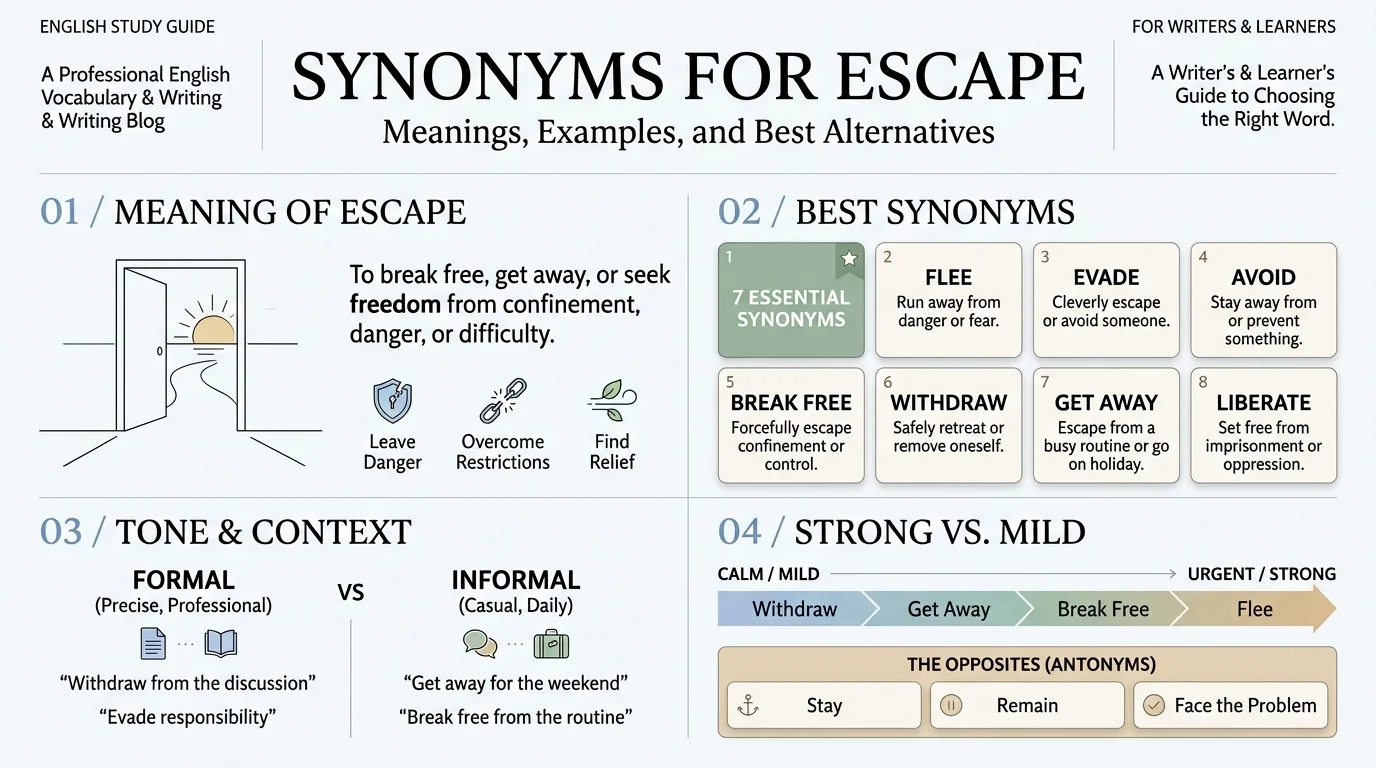
Have you ever used the word escape repeatedly in a story, email, essay, or social media caption? Perhaps you want to describe leaving a dangerous situation, taking a break from everyday stress, avoiding responsibility, or breaking free from something that holds you back. Although escape works in all these situations, choosing a more precise word can make your writing clearer and more engaging.
Understanding synonyms for escape helps you express different meanings, emotions, and levels of urgency. Words such as flee, evade, avoid, break free, and withdraw are related, but each communicates something different. This guide explains their meanings, natural usage, and differences so you can choose confidently. Whether you are an English learner, student, writer, or professional, you will discover practical alternatives for everyday conversations and formal communication.
What Does “Escape” Mean?
Escape means to get away from danger, confinement, control, responsibility, or an unpleasant situation. The best synonyms include flee for urgent departure, evade for avoiding capture, avoid for staying away, and break free for overcoming restrictions.
Meaning, Tone and Context
The word escape describes getting away from something that threatens, confines, restricts, or troubles a person or thing. It can also describe avoiding an unwanted experience or finding temporary relief from everyday pressures.
Simple definition
To escape means to get away from a place, situation, person, or condition that someone wants to leave behind.
For example, a prisoner might escape from custody, a traveler might escape the city for a weekend, and a student might escape distractions by studying in a quiet room.
Part of speech
Escape can function as both a verb and a noun.
| Form | Meaning | Example |
|---|---|---|
| Verb | To get away or avoid something | The hikers escaped the storm. |
| Noun | An act or means of getting away | Reading became her escape from stress. |
| Escaped | Past tense or past participle | The bird escaped from its cage. |
| Escaping | Present participle or gerund | Escaping danger required quick thinking. |
| Escapee | A person who has escaped confinement | The escapee was found nearby. |
| Escapable | Possible to escape from or avoid | The situation was difficult but escapable. |
Tone and formality
Escape is generally neutral. Its emotional effect depends on the situation.
In a dangerous situation, it can suggest urgency or fear. A personal context, it may communicate relief, freedom, or a desire for peace. In a legal or professional context, it can suggest avoiding an obligation or escaping accountability.
The word is suitable for everyday conversation, academic writing, creative storytelling, and professional communication. More precise alternatives can make your intended meaning easier to understand.
Common uses
- Escape from physical danger or confinement.
- Flee from a threat or approaching danger.
- Evade capture, detection, or responsibility.
- Avoid an unpleasant task or experience.
- Break free from restrictions or controlling circumstances.
- Find relief from stress through travel, hobbies, or entertainment.
- Slip away from an uncomfortable conversation or crowded gathering.
When and How to Use “Escape”
The best way to use escape depends on what someone is leaving and why they want to leave.
1. Professional: The company needs a plan to prevent sensitive information from escaping its secure systems.
2. Personal: I want to escape the city for a quiet weekend in the mountains.
3. Academic: The main character attempts to escape the social expectations imposed on her.
4. Emotional: He reads before bed to escape the pressure of a demanding day.
5. Creative writing: The prisoner searched for a way to escape the ancient fortress.
6. Social media: Sometimes, the best escape is a peaceful walk along the beach.
7. Email: We should address the issue directly rather than allowing responsibility to escape our attention.
Notice how the meaning changes with the context. Escape can describe a physical action, an emotional need, an intellectual idea, or something that goes unnoticed.
Another Word for “Escape”
The best single replacement for escape is usually get away, flee, or break free, depending on the intended meaning. There is no single synonym that fits every situation.
| Context | Best alternative | Why it works |
|---|---|---|
| Professional writing | Avoid | Clearly describes preventing an unwanted outcome. |
| Academic writing | Evade | Emphasizes avoiding a consequence, obligation, or detection. |
| Casual conversation | Get away | Sounds natural and conversational. |
| Emotional writing | Find relief | Emphasizes comfort rather than physical departure. |
| Creative writing | Break free | Suggests overcoming control or confinement. |
| Resume or workplace use | Overcome | Highlights solving a problem instead of simply leaving it. |
| Social media captions | Get away | Fits travel, relaxation, and personal freedom. |
| Stronger meaning | Flee | Suggests urgent departure from danger. |
| Softer meaning | Withdraw | Describes leaving a situation calmly or deliberately. |
For professional writing, choose a synonym that explains the action precisely. For example, avoid a delay is clearer than escape a delay, while break free from outdated practices emphasizes meaningful change.
When Not to Use “Escape”
Although escape is versatile, it can sound vague or inappropriate when the situation requires a more specific verb.
| Situation | Less precise sentence | Better sentence | Why |
|---|---|---|---|
| Leaving danger | The residents escaped quickly. | The residents fled the burning building. | Fled communicates urgency. |
| Avoiding responsibility | He escaped his duties. | He evaded his responsibilities. | Evaded emphasizes avoidance. |
| Taking a vacation | I escaped for two days. | I got away for two days. | Got away sounds natural in conversation. |
| Solving a problem | We escaped the problem. | We resolved the problem. | Resolved means the issue was addressed. |
| Leaving a controlling situation | She escaped the restrictions. | She broke free from the restrictions. | Broke free emphasizes regained freedom. |
| Missing a detail | The error escaped us. | We overlooked the error. | Overlooked clearly identifies the mistake. |
Do not automatically replace escape with a more dramatic word. If someone simply leaves a party early, depart or leave may be more accurate than flee.
Words Commonly Confused With “Escape”
Several words overlap with escape but have different implications.
| Word | Main difference | When to use it |
|---|---|---|
| Flee | Emphasizes urgent departure from danger or threat. | Emergencies, threats, dangerous situations. |
| Evade | Focuses on avoiding capture, detection, or an obligation. | Legal, strategic, or accountability contexts. |
| Avoid | Means keeping away from something unwanted. | Problems, delays, conflict, or risks. |
| Elude | Suggests successfully avoiding capture, detection, or understanding. | Pursuits, investigations, difficult questions. |
| Withdraw | Means pulling back or leaving a situation. | Meetings, negotiations, social settings. |
| Break free | Emphasizes overcoming restraint or control. | Personal growth, freedom, restrictive conditions. |
The key distinction is intention. Someone may flee because danger is immediate, evade because they do not want to be caught, or withdraw because they deliberately choose to leave.
Best Synonym by Context for “Escape”
The following recommendations show how to select the most suitable word for different writing situations.
| Context | Best synonym | Why it works | Example |
|---|---|---|---|
| Formal writing | Depart | Communicates leaving in a restrained tone. | The visitors departed before the meeting ended. |
| Academic writing | Evade | Describes avoiding a question or obligation. | The argument evades the central research question. |
| Business communication | Avoid | Clearly identifies a preventable issue. | We should avoid unnecessary delays. |
| Resume writing | Overcome | Highlights achievement and problem solving. | Overcame technical barriers to complete the project. |
| Casual conversation | Get away | Sounds relaxed and familiar. | I need to get away this weekend. |
| Creative writing | Break free | Suggests freedom from confinement or control. | She broke free from the spell. |
| Emotional writing | Find relief | Focuses on reducing emotional pressure. | Music helped him find relief from stress. |
| Strong intensity | Flee | Suggests urgent movement away from danger. | The villagers fled the approaching wildfire. |
| Gentle or moderate tone | Withdraw | Suggests a deliberate, less dramatic departure. | She withdrew from the discussion. |
| Social media captions | Unwind | Emphasizes relaxation rather than escape from danger. | A quiet beach day to unwind. |
| Travel writing | Retreat | Suggests a peaceful place away from everyday demands. | The cabin became our favorite retreat. |
| Legal context | Evade | Highlights avoiding a legal duty or detection. | The defendant attempted to evade questioning. |
| Security context | Breach containment | Describes getting beyond a security boundary. | The malware breached containment. |
| Personal development | Liberate | Emphasizes gaining freedom from restrictions. | Education can liberate people from limiting beliefs. |
| Everyday problem solving | Resolve | Focuses on fixing a problem instead of leaving it. | The team resolved the issue before launch. |
US and UK usage
Most common synonyms for escape are used in both American and British English. Words such as flee, evade, avoid, withdraw, and break free are not restricted to one variety.
The bigger difference is often the situation and tone. In American workplace writing, get away is common in casual speech, while depart or withdraw may sound more formal. These are stylistic preferences, not strict regional rules.
Which Synonym Should You Choose?
Use this simple decision guide to find a word that matches your intended meaning.
If danger is immediate, choose flee.
Example: The residents fled the wildfire.
If someone avoids detection, choose evade or elude.
Example: The suspect tried to evade capture.
If someone gains freedom, choose break free or liberate.
Example: She broke free from controlling expectations.
If someone needs relaxation, choose unwind or get away.
Example: We got away for a peaceful weekend.
If someone needs to fix a problem, choose resolve or overcome.
Example: The team overcame several technical challenges.
Before selecting a synonym, ask yourself five questions:
- Meaning: Is the person leaving, avoiding, hiding, or overcoming something?
- Formality: Does the sentence belong in a text message, essay, report, or business email?
- Emotional intensity: Should the word communicate calmness, urgency, fear, or relief?
- Professional value: Would a more action focused verb show a result more clearly?
- Sentence context: Does the replacement preserve the original meaning and grammar?
Real Life Examples of “Escape” in Sentences
Different situations call for different alternatives. These examples show how word choice can make everyday writing more precise.
| Situation | Example sentence |
|---|---|
| School | The student avoided distractions by studying in the library. |
| Workplace | Our team overcame the obstacles that delayed the launch. |
| Essay | The protagonist struggles to break free from social expectations. |
| Conversation | I need to get away from my desk for a while. |
| Social media | A little sunshine and a peaceful place to unwind. |
| Resume | Overcame complex technical challenges while meeting project deadlines. |
| Please address the outstanding issue so we can avoid further delays. | |
| Storytelling | At midnight, the prisoner slipped out of the fortress. |
| Travel | We retreated to a quiet mountain village for the weekend. |
| Emotional writing | Painting offered her relief from the pressures of daily life. |
These examples also show why synonyms should be chosen according to purpose. A resume benefits from overcame, while a travel caption may sound more natural with get away or unwind.
25 Synonyms for “Escape”
The table below includes 25 useful alternatives. Some are direct synonyms, while others work only in specific contexts. The best choice depends on whether escape refers to danger, avoidance, freedom, or relief.
| Synonym | Simple meaning | Best used for | Example sentence |
|---|---|---|---|
| 1. Flee | Leave danger quickly | Emergencies and threats | Families fled the approaching wildfire. |
| 2. Evade | Avoid capture or an obligation | Legal and formal contexts | The company must not evade its legal duties. |
| 3. Avoid | Keep away from something unwanted | Everyday and professional writing | We avoided a costly mistake. |
| 4. Elude | Escape capture or detection | Investigations and storytelling | The clever fox eluded its pursuers. |
| 5. Depart | Leave a place | Formal communication | The guests departed after dinner. |
| 6. Withdraw | Pull back or leave | Meetings and social situations | He withdrew from the debate. |
| 7. Retreat | Move away to a safer or quieter place | Military, personal, and travel contexts | The hikers retreated to shelter. |
| 8. Break free | Gain freedom from restraint | Emotional and creative writing | She broke free from an unhealthy pattern. |
| 9. Get away | Leave or take a break | Casual conversation | We got away for the holiday weekend. |
| 10. Slip away | Leave quietly or unnoticed | Social situations and fiction | He slipped away before the speeches began. |
| 11. Sneak out | Leave secretly | Informal conversation and stories | The teenagers tried to sneak out after midnight. |
| 12. Abscond | Leave secretly to avoid the law or responsibility | Legal reporting | The employee absconded with the stolen funds. |
| 13. Extricate | Free someone or something from difficulty | Formal and technical writing | The rescuers extricated the driver from the wreckage. |
| 14. Liberate | Set free from control or confinement | Historical and political contexts | The movement sought to liberate the prisoners. |
| 15. Escape captivity | Get out of confinement | News and storytelling | The animal escaped captivity during transport. |
| 16. Shake off | Get rid of something unwanted | Casual speech and figurative writing | She tried to shake off her worries. |
| 17. Sidestep | Avoid an issue or obstacle | Business and discussion | The manager sidestepped the difficult question. |
| 18. Dodge | Avoid something quickly or deliberately | Casual speech and physical action | He dodged the flying ball. |
| 19. Eliminate | Remove a problem or obstacle | Professional problem solving | We eliminated the source of repeated errors. |
| 20. Overcome | Succeed despite a difficulty | Resumes and personal growth | She overcame her fear of public speaking. |
| 21. Unwind | Relax and release tension | Personal and lifestyle writing | I unwind by reading after work. |
| 22. Find relief | Experience reduced stress or discomfort | Emotional writing | He found relief in talking to a friend. |
| 23. Disengage | Separate from an activity or interaction | Professional and personal contexts | She disengaged from the heated argument. |
| 24. Extricate oneself | Free oneself from a difficult situation | Formal and reflective writing | He worked to extricate himself from the agreement. |
| 25. Run away | Leave a place or situation, often suddenly | Everyday speech and storytelling | The frightened dog ran away from the noise. |
Important distinction: Words such as eliminate, overcome, and unwind are context dependent alternatives rather than universal replacements. Eliminating a problem means removing it, overcoming a problem means succeeding despite it, and unwinding means relaxing. None automatically means physically escaping.
Synonym Groups and Usage Differences
Professional vs. Personal Synonyms
Professional writing benefits from precise, action oriented vocabulary. Words such as avoid, overcome, withdraw, and resolve help communicate decisions, challenges, and outcomes without unnecessary drama.
Personal writing can be more expressive. Get away, unwind, slip away, and break free can communicate the desire for relaxation, privacy, independence, or emotional relief.
Compare these sentences:
Professional: The team overcame the technical barriers that threatened the project.
Personal: I got away from my usual routine and spent the afternoon by the lake.
Both sentences describe moving beyond an unwanted situation, but their purposes and tones differ.
Formal vs. Conversational Synonyms
| Setting | Suitable words | Example |
|---|---|---|
| Formal report | Depart, evade, withdraw | The organization withdrew from the agreement. |
| Academic essay | Evade, overcome, break free | The novel explores how people break free from social constraints. |
| Business email | Avoid, resolve, overcome | We resolved the issue before the deadline. |
| Casual conversation | Get away, dodge, run away | I need to get away for a few days. |
| Text message | Slip away, get away | I might slip away before the party ends. |
| Formal speech | Liberate, overcome, retreat | The community worked to overcome longstanding barriers. |
In formal writing, select words that describe observable actions or outcomes. In conversation, familiar expressions often sound warmer and more natural.
Academic Synonyms
Academic writing requires accuracy rather than unnecessarily complicated vocabulary.
Consider these useful alternatives:
- Evade: Use when an argument avoids addressing a question or objection.
- Overcome: Use when a person or study successfully addresses an obstacle.
- Withdraw: Use when a participant leaves a study or a researcher removes a submission.
- Avoid: Use when describing steps taken to prevent bias, error, or risk.
- Break free: Use when discussing liberation from social, cultural, or psychological constraints.
Example: Rather than writing, “The author escapes the main issue,” write, “The author evades the central question.”
The second sentence makes the criticism more precise.
Professional and Business Synonyms
In workplace communication, the best synonym depends on the action you want to describe.
| Purpose | Recommended word | Example |
|---|---|---|
| Prevent a problem | Avoid | We should avoid unnecessary expenses. |
| Address a challenge successfully | Overcome | The team overcame staffing difficulties. |
| Fix an existing issue | Resolve | The support team resolved the access problem. |
| Leave a discussion or commitment | Withdraw | The supplier withdrew its proposal. |
| Free something from a difficult position | Extricate | The team extricated the project from a funding dispute. |
For resumes, overcame is particularly useful when supported by a measurable result. For emails, avoid and resolve usually communicate practical next steps more clearly than escape.
Creative or Literary Synonyms
Creative writing often benefits from synonyms that create a clear mental picture or emotional response.
- Flee: Creates urgency and danger.
- Slip away: Suggests secrecy or a quiet departure.
- Break free: Communicates independence and transformation.
- Retreat: Suggests seeking safety, solitude, or protection.
- Liberate: Emphasizes release from control.
- Elude: Creates suspense by suggesting that someone remains difficult to catch.
Example: “She escaped the castle” communicates the basic action. “She slipped through the forgotten passage and fled into the forest” adds movement, secrecy, and atmosphere.
Slang or Modern Synonyms
There is no single modern slang term that replaces escape in every situation. Informal expressions work best when their meanings match the intended context.
| Expression | Meaning | Appropriate context |
|---|---|---|
| Get out of here | Leave a place, sometimes urgently | Casual conversation |
| Dip out | Leave, often quickly or without much notice | Informal speech and texts |
| Bounce | Leave a place | Casual conversation |
| Peace out | Say goodbye while leaving | Friendly or playful situations |
| Check out | Disengage mentally or leave, depending on context | Informal conversation |
These expressions are highly conversational. Avoid them in academic essays, formal reports, and professional documents unless you are deliberately representing informal speech.
Strongest vs. Weaker Synonyms
The intensity of a synonym depends on the situation, but the following guide offers a useful general comparison.
Mild
Withdraw, depart
A deliberate or relatively calm departure.
Moderate
Get away, retreat
Leaving a situation or seeking distance and safety.
Strong
Break free, extricate oneself
Overcoming a restriction or difficult entanglement.
Urgent
Flee, run away
Leaving quickly, often because of danger or fear.
This is a contextual guide, not a universal ranking. For example, flee is stronger than depart in a dangerous situation, but extricate may be more appropriate when someone is trapped in a complicated legal or financial problem.
Emotional vs. Neutral Synonyms
Neutral synonyms describe an action without adding much emotion. Emotional alternatives communicate fear, relief, determination, or a desire for independence.
| Neutral or factual | More emotional or expressive |
|---|---|
| Depart | Flee |
| Withdraw | Break free |
| Avoid | Dodge |
| Leave | Slip away |
| Rest | Unwind |
| Release | Liberate |
For factual reports, prefer neutral language unless urgency is part of the evidence. For personal essays, fiction, or reflective writing, emotional alternatives can make the intended feeling clearer.
Antonyms of “Escape”
An antonym is a word with an opposite or contrasting meaning. Because escape can refer to leaving, avoiding, or becoming free, its opposites depend on the context.
The following table includes 15 useful contrasting words and expressions. Some are direct opposites in particular contexts, while others describe remaining, entering, or accepting the situation someone might otherwise escape.
| Antonym | Meaning | Example sentence |
|---|---|---|
| 1. Remain | Stay in the same place | The visitors remained inside during the storm. |
| 2. Stay | Continue being in a place | We decided to stay at the hotel. |
| 3. Remain trapped | Continue to be confined | The hikers remained trapped until rescuers arrived. |
| 4. Surrender | Give oneself up or stop resisting | The fugitive surrendered to the authorities. |
| 5. Submit | Yield to authority or control | He submitted to the court’s decision. |
| 6. Confront | Face a problem directly | She confronted the issue instead of avoiding it. |
| 7. Face | Deal with something directly | We must face the consequences of our actions. |
| 8. Accept | Acknowledge or agree to something | He accepted responsibility for the mistake. |
| 9. Endure | Continue through a difficult experience | The residents endured the harsh winter. |
| 10. Approach | Move closer to something | The rescue team approached the damaged building. |
| 11. Enter | Go into a place | The firefighters entered the burning structure. |
| 12. Return | Go back to a previous place | The hikers returned to the campsite. |
| 13. Confrontation | A direct encounter with a problem or opponent | The meeting led to a confrontation over the budget. |
| 14. Involve oneself | Become actively engaged | She chose to involve herself in the discussion. |
| 15. Remain exposed | Continue to face a threat or condition | The equipment remained exposed to the elements. |
Choosing the right opposite: If escape means leaving a location, stay or remain may work. If it means avoiding responsibility, accept responsibility or face the consequences is more accurate. If it means becoming free, remain trapped expresses the opposite more directly.
Comparison: Escape vs. Similar Words
These six comparisons explain subtle differences that matter in everyday and professional writing.
Escape vs. Flee
Main difference: Escape means getting away from something, while flee emphasizes leaving quickly because of danger or fear.
Which is stronger: Flee usually communicates greater urgency.
Which is more formal: Both work in formal writing, but flee is more specific when danger motivates the departure.
Examples:
Escape: The hikers escaped the storm by finding shelter.
Flee: The hikers fled when the wildfire approached.
Escape vs. Evade
Main difference: Escape focuses on getting away. Evade focuses on avoiding capture, detection, or an obligation.
Which is stronger: Neither is universally stronger. Evade is more specific about avoidance.
Which is more formal: Evade is often especially useful in legal, academic, and professional contexts.
Examples:
Escape: The prisoner escaped from custody.
Evade: The witness tried to evade the question.
Escape vs. Avoid
Main difference: Escape usually describes getting away from an existing situation, while avoid often describes preventing contact with something unwanted.
Which is stronger: Escape often suggests a more significant departure or release.
Which is more formal: Both are suitable for formal and informal communication.
Examples:
Escape: She escaped the flooded building.
Avoid: She avoided the flooded road.
Escape vs. Elude
Main difference: Escape emphasizes getting away, while elude emphasizes successfully avoiding capture, detection, or comprehension.
Which is stronger: Elude can add a sense of difficulty or cleverness.
Which is more formal: Both are appropriate in formal writing, although elude is more specialized.
Examples:
Escape: The suspect escaped from custody.
Elude: The suspect eluded investigators for several weeks.
Escape vs. Withdraw
Main difference: Escape suggests getting away from something restrictive or unpleasant. Withdraw suggests deliberately pulling back from a place, activity, or commitment.
Which is stronger: Escape generally suggests a greater need for freedom or relief.
Which is more formal: Withdraw is often more suitable for official decisions and professional communication.
Examples:
Escape: The family escaped the dangerous area.
Withdraw: The company withdrew its application.
Escape vs. Break Free
Main difference: Escape means getting away, while break free emphasizes overcoming restraints, control, or limitations.
Which is stronger: Break free often communicates a stronger sense of determination or personal liberation.
Which is more formal: Escape is more neutral. Break free is widely understood but can sound more expressive.
Examples:
Escape: The animal escaped from its enclosure.
Break free: The animal broke free from the damaged chain.
Common Phrases and Expressions with “Escape”
These expressions are useful in conversations, storytelling, essays, and everyday writing.
1. Escape from danger
Meaning: Get away from a threatening or unsafe situation.
Example sentence: The residents escaped from the building before the fire spread.
2. Escape responsibility
Meaning: Avoid being held accountable for an action or obligation.
Example sentence: A responsible leader should not escape responsibility for a failed project.
3. Escape notice
Meaning: Go unnoticed or fail to attract attention.
Example sentence: The small error did not escape the editor’s notice.
4. A means of escape
Meaning: A way to leave a difficult or confined situation.
Example sentence: The emergency exit provided a means of escape.
5. Escape the ordinary
Meaning: Experience something different from everyday routines.
Example sentence: We traveled to a remote village to escape the ordinary.
6. Escape reality
Meaning: Temporarily turn attention away from real life and its pressures.
Example sentence: She enjoys reading fantasy novels to escape reality after a stressful day.
7. Make an escape
Meaning: Get away from a place or situation, sometimes secretly or urgently.
Example sentence: The characters made an escape through a hidden tunnel.
8. Narrow escape
Meaning: A situation in which someone nearly experiences harm or serious trouble but avoids it.
Example sentence: The driver had a narrow escape when the tree fell across the road.
Common Mistakes to Avoid
1. Using escape when avoid is more accurate
Incorrect: We escaped unnecessary expenses.
Better: We avoided unnecessary expenses.
Use avoid when the goal is to prevent an unwanted outcome rather than get away from an existing situation.
2. Confusing escape with evade
Incorrect: The student escaped the teacher’s question.
Better: The student evaded the teacher’s question.
Use evade when someone deliberately avoids answering a question or fulfilling an obligation. Use escape when someone gets away from a place or situation.
3. Choosing a casual expression for formal writing
Too casual: We need to get away from this problem.
More professional: We need to resolve this problem.
In business communication, explain the action required instead of relying on a broad expression.
4. Using an overly dramatic synonym
Unnatural: I fled the office because the meeting was boring.
More natural: I left the office after the meeting.
Reserve flee for situations involving urgency, danger, or a compelling need to get away.
5. Repeating escape too frequently
Repetitive: She escaped the room, escaped the guards, and escaped the danger.
Improved: She slipped out of the room, evaded the guards, and fled the danger.
Vary your vocabulary only when each replacement accurately describes the action.
6. Choosing the wrong emotional tone
Unclear: He withdrew from the burning building.
Better: He fled the burning building.
Withdraw can sound deliberate and controlled. Flee more clearly communicates an urgent response to danger.
7. Using slang in academic or professional writing
Too informal: The employee dipped out of the meeting.
More professional: The employee left the meeting early.
Expressions such as dip out and bounce are suitable for some informal conversations, but they can weaken the tone of formal writing.
FAQs
1. What is the best synonym for escape?
The best synonym depends on context. Use flee for danger, evade for avoiding capture, avoid for preventing problems, and break free for overcoming restrictions.
2. What is a formal synonym for escape?
Depart, withdraw, and evade are useful formal alternatives. Choose depart for leaving, withdraw for pulling back, and evade for avoiding an obligation.
3. What is an informal synonym for escape?
Get away, slip away, and run away are common informal alternatives. Use get away for a break, slip away for leaving quietly, and run away for sudden departure.
4. What is another word for escape in professional writing?
Use avoid when preventing problems, overcome when addressing challenges, resolve when fixing issues, and withdraw when leaving a commitment or discussion.
5. What is the difference between escape and evade?
Escape means getting away from a place or situation. Evade means avoiding capture, detection, a question, or an obligation, often deliberately.
6. What is the opposite of escape?
Common opposites include remain, stay, and remain trapped. When escape means avoiding accountability, accept responsibility or face the consequences expresses the opposite more precisely.
Conclusion
Escape means getting away from danger, confinement, responsibility, or an unwanted situation. Its best synonyms depend on what someone is leaving and why. Flee communicates urgency, evade emphasizes avoidance, break free highlights independence, and get away suits everyday conversation.
The most effective vocabulary choice is not always the most sophisticated word. It is the word that communicates your meaning accurately, matches your audience, and fits the emotional tone of the sentence.
A practical tip is to identify the action before choosing a synonym. Ask whether someone is leaving, avoiding, overcoming, or seeking relief. That simple habit will help you use escape and its alternatives more naturally in essays, emails, stories, conversations, and professional writing.
Discover More Post:
- 50+ Synonyms for Snow | From Gentle Flurries to a Winter …
- 50+ Synonyms for Impressive | Powerful Alternatives to …
- 50+ Synonyms for Opinion | Meanings, Examples, and Best …