Have you ever used the word ridiculous repeatedly in a conversation, essay, social media caption, or email because you could not find a better way to express your thoughts? Although it is a familiar word, repeating it can make your writing sound less precise. Choosing the right alternative helps you communicate whether something is absurd, unreasonable, laughable, unbelievable, or simply silly.
Understanding synonyms for ridiculous is about more than expanding your vocabulary. It means recognizing differences in tone, intensity, and context. A word that works in a casual conversation may sound inappropriate in a business report or academic essay. This guide explores practical alternatives, explains how they differ, and provides natural examples to help you choose words confidently in American English.
What Does “Ridiculous” Mean?
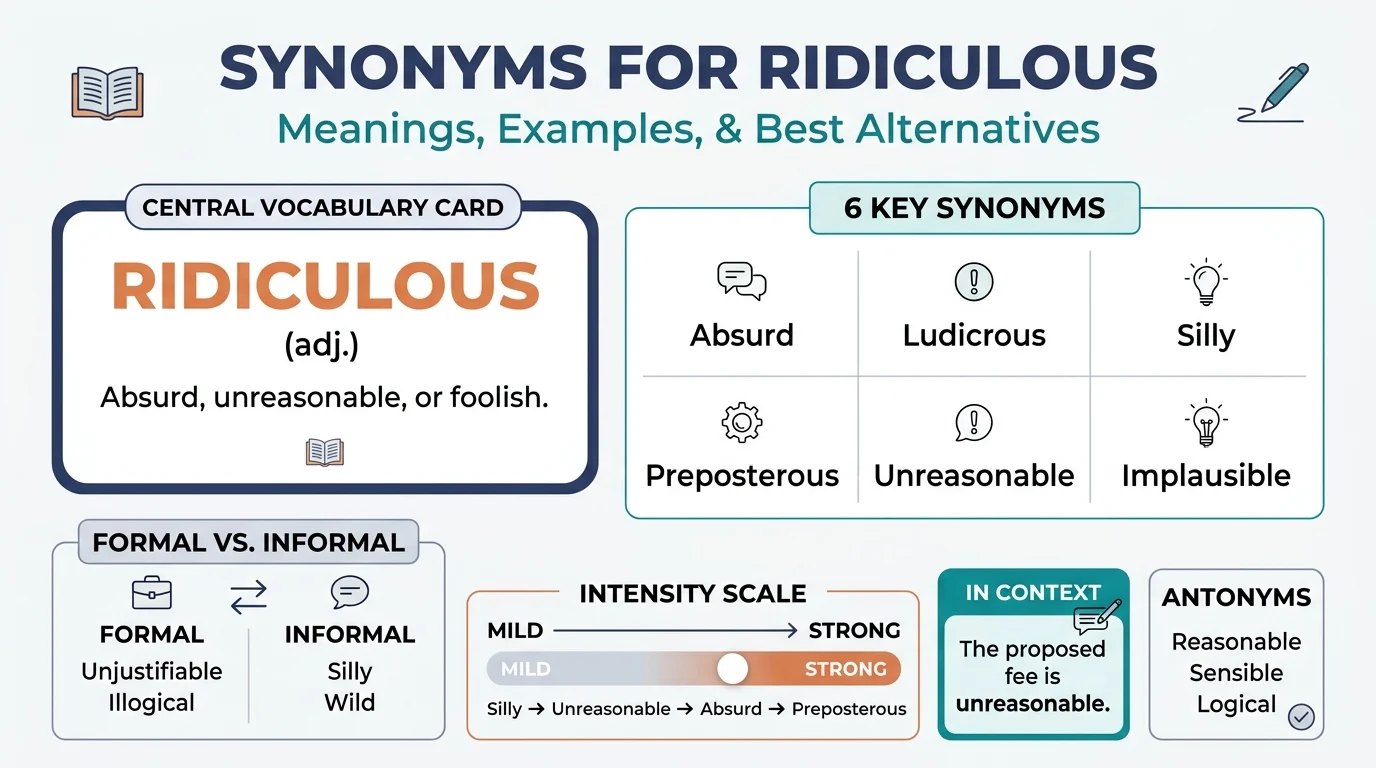
Ridiculous means extremely unreasonable, absurd, foolish, or deserving of laughter. Common synonyms include absurd, ludicrous, silly, preposterous, outrageous, laughable, and nonsensical. Choose formal alternatives for professional writing, milder words for casual conversations, and stronger expressions when emphasizing disbelief or unreasonable behavior.
Meaning, Tone and Context
The word ridiculous describes something so unreasonable, foolish, exaggerated, or illogical that it seems difficult to take seriously.
For example, calling a $500 charge for a basic service ridiculous suggests that the price is unreasonable. Describing an exaggerated movie scene as ridiculous may instead suggest that it is funny or unbelievable.
Key characteristics
- Simple definition: Extremely unreasonable, absurd, or foolish.
- Part of speech: Adjective.
- Tone: Usually negative or critical, although it can be playful or humorous.
- Formality: Neutral to conversational, depending on the sentence.
- Common uses: Criticizing unfair prices, questioning illogical ideas, describing silly behavior, and expressing disbelief.
- Related forms: Ridiculously is an adverb, as in “ridiculously expensive.” Ridiculousness is a noun referring to the quality of being ridiculous.
The intended meaning matters. Absurd often emphasizes a lack of logic, outrageous highlights something shocking or unacceptable, and silly usually sounds less severe.
When and How to Use “Ridiculous”
Use ridiculous when something seems unreasonable, illogical, excessively exaggerated, or so foolish that it invites laughter or disbelief.
Here are six realistic examples showing how the word works in different situations.
1. Professional: “The proposed deadline is ridiculous because the team needs at least two weeks to finish the project.”
2. Personal: “It is ridiculous to argue over something so small.”
3. Academic: “The claim that one study proves every case is ridiculous without additional evidence.”
4. Emotional: “I think it is ridiculous that customers must pay extra for a service that was advertised as free.”
5. Creative: “The character wore a ridiculous hat that made everyone in the room laugh.”
6. Social media: “These prices are ridiculous. How is anyone supposed to afford this?”
The word is useful when expressing a strong reaction, but more precise language can make the criticism clearer and more persuasive.
Another Word for “Ridiculous”
The best single replacement for ridiculous is usually absurd when describing something illogical or unreasonable. However, the most effective synonym depends on what you want to communicate.
Professional writing
Use unreasonable, unjustifiable, or untenable when criticizing a policy, expense, or argument. These words sound more measured than ridiculous.
Academic writing
Choose illogical, incoherent, or implausible when evaluating reasoning or claims. These alternatives identify specific weaknesses.
Casual conversation
Use silly, crazy, absurd, or insane in informal contexts. Remember that crazy and insane can sound insensitive or overly dramatic.
Emotional writing
Try outrageous, appalling, or infuriating when the situation causes anger or strong disapproval.
Creative writing
Choose ludicrous, preposterous, or preposterously exaggerated descriptions to create humor, drama, or disbelief.
Resume or workplace use
Avoid describing a workplace decision as ridiculous on a resume. Use measurable language such as inefficient, unreasonable, or unsupported when appropriate.
Social media captions
Words such as wild, hilarious, absurd, and unbelievable can express surprise or humor, depending on the situation.
Stronger meaning
Use preposterous, ludicrous, or outrageous when you want to emphasize the severity of an unreasonable situation.
Softer meaning
Use silly, odd, unusual, or questionable when you want to criticize something gently without sounding harsh.
When Not to Use “Ridiculous”
Although ridiculous is versatile, it is not always the most effective word. Its critical tone can make a reasonable disagreement sound personal or dismissive.
| Situation | Less effective sentence | More precise alternative |
|---|---|---|
| Academic argument | The theory is ridiculous. | The theory is implausible because the evidence is limited. |
| Workplace feedback | Your plan is ridiculous. | The plan appears impractical given our current resources. |
| Customer complaint | This fee is ridiculous. | This fee seems excessive for the service provided. |
| Friendly conversation | Your question is ridiculous. | That is an unusual question. |
| Creative description | The scene was ridiculous. | The scene was hilariously exaggerated. |
| Formal report | The decision was ridiculous. | The decision was difficult to justify based on the available evidence. |
The best replacement explains why something is ridiculous. For example, illogical points to faulty reasoning, while excessive identifies something that goes beyond a reasonable amount.
Words Commonly Confused With “Ridiculous”
These related words overlap with ridiculous, but they do not always mean the same thing.
| Word | Main difference | When it works best |
|---|---|---|
| Absurd | Emphasizes extreme illogic or unreasonableness. | An impossible or contradictory argument. |
| Ludicrous | Suggests something is so unreasonable that it seems laughable. | Exaggerated claims or unbelievable situations. |
| Silly | Usually mild and often playful. | Minor mistakes or harmless behavior. |
| Outrageous | Emphasizes shock, offense, or unacceptable behavior. | Unfair treatment or excessive charges. |
| Implausible | Means difficult to believe, not necessarily foolish. | Stories, explanations, and claims. |
| Nonsensical | Suggests that something lacks understandable logic or meaning. | Confusing statements or incoherent reasoning. |
For example, an implausible explanation may simply lack credibility. A nonsensical explanation goes further by seeming to lack coherent meaning.
Best Synonym by Context for “Ridiculous”
The following table matches common writing situations with a suitable alternative.
| Context | Best synonym | Why it works | Example |
|---|---|---|---|
| Formal writing | Unreasonable | Sounds measured and clear. | The proposed conditions are unreasonable. |
| Academic writing | Illogical | Focuses on faulty reasoning. | The conclusion is illogical. |
| Professional communication | Unjustifiable | Questions whether a decision can be defended. | The additional cost is unjustifiable. |
| Resume or workplace review | Inefficient | Identifies wasted time or resources. | The previous process was inefficient. |
| Casual conversation | Silly | Sounds informal and relatively gentle. | That argument sounds silly. |
| Creative writing | Preposterous | Adds dramatic emphasis. | He offered a preposterous excuse. |
| Emotional writing | Infuriating | Expresses anger. | The unfair rule was infuriating. |
| Strong criticism | Ludicrous | Highlights extreme unreasonableness. | The suggested price is ludicrous. |
| Mild criticism | Questionable | Expresses doubt without a harsh judgment. | That decision seems questionable. |
| Social media captions | Wild | Communicates surprise in casual language. | These ticket prices are wild. |
| Business reporting | Excessive | Emphasizes an amount beyond what is appropriate. | The fee was excessive. |
| Evaluating a claim | Implausible | Indicates that a claim is difficult to believe. | The explanation seems implausible. |
These choices are useful in American English. Most have the same basic meaning in British English, although informal expressions and their perceived intensity can vary by audience.
Which Synonym Should You Choose?
Choose your synonym by considering five factors.
1. Meaning: If something lacks logic, choose absurd or illogical. If it costs too much, choose excessive or unreasonable.
2. Formality: Use silly in relaxed conversations, unreasonable in professional emails, and implausible in evidence based discussions.
3. Emotional intensity: Choose questionable for mild doubt, ludicrous for strong disbelief, and outrageous when expressing shock or disapproval.
4. Professional value: Describe the specific problem instead of simply labeling something ridiculous. Words such as inefficient, unsupported, and unjustifiable communicate actionable criticism.
5. Sentence context: Read the full sentence after replacing the original word. A synonym should preserve the intended meaning, grammar, and tone.
A useful vocabulary habit is to ask yourself whether you mean funny, illogical, unfair, unbelievable, or excessive. Identifying the exact meaning usually reveals the strongest word choice.
Real Life Examples of “Ridiculous” in Sentences
Here are examples from everyday situations, with more precise synonyms where they improve clarity.
- School: The teacher explained why the student’s conclusion was illogical rather than simply calling it ridiculous.
- Workplace: The manager considered the proposed deadline unreasonable because several essential tasks remained unfinished.
- Writing: The author used a preposterous plot twist to make the comedy more entertaining.
- Conversation: “It is silly to argue about who gets the last cookie,” Mia said.
- Social media: “The price of concert tickets is outrageous this year.”
- Resume: “Improved an inefficient reporting process, reducing unnecessary administrative work.”
- Email: “Could we review this fee? The amount appears excessive compared with the original estimate.”
- Storytelling: The salesman made a ludicrous promise that nobody in the audience believed.
Notice that the alternatives do more than replace a word. They clarify the problem, communicate the right emotional tone, and make the sentence more useful to its reader.
25 Synonyms for “Ridiculous”
These 25 alternatives cover several shades of meaning. Some are close synonyms, while others work only in particular contexts.
| Synonym | Simple meaning | Best used for | Example sentence |
|---|---|---|---|
| 1. Absurd | Completely unreasonable or illogical | Arguments and situations | The proposal was absurd from the beginning. |
| 2. Ludicrous | So unreasonable that it seems laughable | Strong criticism | Paying that much for a broken chair is ludicrous. |
| 3. Silly | Foolish or lacking good judgment | Casual conversation | It was silly to leave the umbrella at home. |
| 4. Preposterous | Extremely unreasonable or unbelievable | Dramatic writing | She rejected the preposterous accusation. |
| 5. Outrageous | Shockingly unfair or unacceptable | Complaints and criticism | The airline charged an outrageous baggage fee. |
| 6. Laughable | Deserving laughter because it lacks credibility | Weak claims | His excuse was laughable. |
| 7. Nonsensical | Lacking coherent meaning or logic | Confusing statements | The instructions became nonsensical halfway through. |
| 8. Illogical | Not following sound reasoning | Academic analysis | That conclusion is illogical. |
| 9. Unreasonable | Not fair, sensible, or appropriate | Workplace discussions | The requested changes were unreasonable. |
| 10. Implausible | Difficult to believe | Claims and explanations | The witness offered an implausible explanation. |
| 11. Absurdist | Relating to a style that explores absurdity | Literature and theater | The play uses absurdist humor to challenge expectations. |
| 12. Foolish | Lacking good sense or judgment | Decisions and behavior | It was foolish to ignore the warning. |
| 13. Preposterous | Contrary to reason or expectation | Emphatic criticism | The suggestion that nobody noticed was preposterous. |
| 14. Ridiculousness | The quality of being ridiculous | Discussions of a situation | Everyone eventually recognized the ridiculousness of the demand. |
| 15. Inane | Silly, empty, or lacking substance | Formal criticism | The meeting was interrupted by inane comments. |
| 16. Irrational | Not guided by reason | Decisions and reactions | The fear was irrational given the available evidence. |
| 17. Bizarre | Very strange or unexpected | Unusual situations | We received a bizarre request from a stranger. |
| 18. Eccentric | Unconventional or unusual | People and personal styles | His eccentric costume attracted attention. |
| 19. Farcical | So exaggerated that it resembles farce | Comedic or chaotic events | The negotiations turned into a farcical spectacle. |
| 20. Absurdly | In an extremely unreasonable or excessive way | Modifying an adjective | The hotel room was absurdly expensive. |
| 21. Unjustifiable | Impossible or difficult to defend reasonably | Decisions and expenses | The additional charge was unjustifiable. |
| 22. Excessive | More than is appropriate or necessary | Prices and amounts | The repair estimate seemed excessive. |
| 23. Questionable | Open to doubt or criticism | Cautious evaluation | The timing of the announcement was questionable. |
| 24. Preposterously | In an extremely unreasonable or unbelievable manner | Creative emphasis | The character was preposterously confident. |
| 25. Comical | Funny or amusing | Humor and entertainment | His comical attempt to dance made everyone smile. |
Accuracy note: The list includes different grammatical forms and related expressions because they are useful alternatives in actual sentences. Ridiculousness is a noun, absurdly and preposterously are adverbs, and absurdist describes a literary or artistic style. They are not direct adjective replacements in every sentence. The repeated entry preposterous also shows why an editor should distinguish unique vocabulary from related word forms. For a strict list of 25 unique, direct adjective synonyms, replace those entries with words such as preposterous only once, and use incredible, unbelievable, and preposterous carefully according to context.
Synonym Groups and Usage Differences
Professional vs. Personal Synonyms
Professional writing benefits from precise, evidence based language. Use unjustifiable for an indefensible expense, inefficient for wasted resources, and unreasonable for an excessive demand.
In personal conversations, silly, absurd, and outrageous can communicate reactions more naturally. The right choice depends on whether you want to explain a problem or express how you feel about it.
Formal vs. Conversational Synonyms
Formal alternatives include implausible, untenable, unjustifiable, and incoherent. They work well in reports, essays, presentations, and carefully written emails.
Conversational alternatives include silly, wild, crazy, and ridiculous itself. These are suitable for informal exchanges, although crazy may sound insensitive in some contexts.
Academic Synonyms
Academic writing should identify the exact weakness in an argument rather than rely on general criticism.
- Illogical: The conclusion does not follow from the evidence.
- Implausible: The claim is difficult to believe.
- Incoherent: The argument lacks clear connections or consistency.
- Untenable: The position cannot be reasonably defended.
- Unsubstantiated: The claim lacks sufficient supporting evidence.
For example, “The hypothesis is unsubstantiated by the available data” communicates a specific limitation more effectively than “The hypothesis is ridiculous.”
Professional and Business Synonyms
In business communication, the goal is usually to solve a problem without unnecessarily offending the reader.
- Use excessive for an unusually high price or fee.
- Use unreasonable for unrealistic demands or expectations.
- Use inefficient for processes that waste time or resources.
- Use unjustifiable when a decision lacks a convincing rationale.
- Use impractical when a plan is difficult to implement.
These words help readers understand what needs to change.
Creative or Literary Synonyms
Creative writing allows more expressive vocabulary. Ludicrous can make a situation seem laughably unreasonable, farcical can describe chaotic events that resemble a comedy, and preposterous can make a character’s excuse sound exaggerated.
For a gentler comic effect, comical or silly may be enough. Stronger language works best when the scene genuinely supports it.
Slang or Modern Synonyms
Informal American English offers alternatives such as wild, crazy, and insane.
- Wild: “That concert ticket price is wild.”
- Crazy: “That is a crazy amount to spend on a sandwich.”
- Insane: “The traffic was insane this morning.”
These expressions are common in casual speech and social media. They can sound exaggerated in professional or academic writing, so choose more precise alternatives for formal audiences.
Strongest vs. Weaker Synonyms
The intensity of a synonym depends on the situation, but this scale offers a practical starting point.
Mild
Questionable, silly
Express doubt or gentle criticism.
Moderate
Unreasonable, illogical
Identify a clear problem with a decision or argument.
Strong
Absurd, ludicrous
Express strong disbelief or criticism.
Intense
Outrageous, preposterous
Emphasize shock, indignation, or extreme unreasonableness.
This is a general guide, not a universal ranking. Outrageous often expresses anger, while ludicrous emphasizes how laughably unreasonable something seems.
Emotional vs. Neutral Synonyms
Some synonyms communicate a strong emotional reaction, while others describe a problem more objectively.
| Emotional or expressive | More neutral or analytical |
|---|---|
| Outrageous | Excessive |
| Infuriating | Unreasonable |
| Laughable | Implausible |
| Ludicrous | Illogical |
| Preposterous | Unjustifiable |
| Hilarious | Amusing |
Use emotional alternatives when the reaction matters. Use neutral terms when you want your reasoning or evidence to remain the main focus.
Antonyms of “Ridiculous”
Antonyms describe qualities that are sensible, reasonable, logical, credible, or appropriate. The following 15 words are useful opposites in different contexts.
| Antonym | Meaning | Example sentence |
|---|---|---|
| 1. Reasonable | Fair and sensible | Her request was reasonable. |
| 2. Sensible | Showing good judgment | They made a sensible choice. |
| 3. Logical | Following sound reasoning | His explanation was logical. |
| 4. Rational | Based on reason | We reached a rational decision. |
| 5. Plausible | Seemingly believable | The witness provided a plausible account. |
| 6. Credible | Worthy of belief | The researcher presented credible evidence. |
| 7. Appropriate | Suitable for the situation | Her response was appropriate. |
| 8. Justifiable | Capable of being defended with reasons | The additional expense was justifiable. |
| 9. Practical | Suitable for real conditions | They developed a practical solution. |
| 10. Coherent | Clear and logically connected | The essay presented a coherent argument. |
| 11. Meaningful | Having value or significance | Their discussion produced meaningful results. |
| 12. Serious | Deserving careful consideration | The committee considered a serious proposal. |
| 13. Sound | Based on reliable reasoning | The manager made a sound decision. |
| 14. Valid | Supported by acceptable reasoning or evidence | The student raised a valid concern. |
| 15. Well founded | Supported by good reasons or evidence | Her criticism was well founded. |
Not every antonym fits every use of ridiculous. For example, credible is an opposite when ridiculous means unbelievable, while reasonable is a better opposite when it means unreasonable.
Comparison: Ridiculous vs. Similar Words
Ridiculous vs. Absurd
Main difference: Ridiculous can mean foolish, laughable, or unreasonable. Absurd emphasizes extreme illogic.
Strength: Both can be strong. Absurd often highlights a contradiction or lack of reason.
Formality: Both work in formal and informal writing.
Examples:
- “The price is ridiculous.”
- “The argument that two contradictory answers are both correct is absurd.”
Ridiculous vs. Ludicrous
Main difference: Ludicrous often suggests something so unreasonable that it becomes laughable.
Strength: Ludicrous can sound more emphatic or theatrical.
Formality: Both are acceptable in general writing, but ludicrous can sound more literary.
Examples:
- “The proposed rule is ridiculous.”
- “The idea that one person can finish the entire project in an hour is ludicrous.”
Ridiculous vs. Silly
Main difference: Silly usually describes harmless foolishness, while ridiculous can convey stronger criticism.
Strength: Ridiculous is generally stronger.
Formality: Both are conversational, although either can appear in formal writing when appropriate.
Examples:
- “The demand was ridiculous.”
- “It was silly to forget the invitation at home.”
Ridiculous vs. Outrageous
Main difference: Outrageous emphasizes something shocking, offensive, or unacceptable. Ridiculous emphasizes unreasonableness or foolishness.
Strength: Outrageous can convey stronger anger.
Formality: Both are widely understood in professional and casual contexts.
Examples:
- “The explanation was ridiculous.”
- “The company charged an outrageous cancellation fee.”
Ridiculous vs. Implausible
Main difference: Implausible means difficult to believe. Ridiculous may also suggest foolishness or absurdity.
Strength: Ridiculous is often more judgmental, while implausible can be more restrained.
Formality: Implausible is particularly useful in academic and professional writing.
Examples:
- “The excuse was ridiculous.”
- “The explanation was implausible because the dates did not match.”
Ridiculous vs. Nonsensical
Main difference: Nonsensical describes something that lacks coherent meaning or logic. Ridiculous describes something unreasonable or laughable.
Strength: Both can be emphatic, depending on context.
Formality: Both can work in everyday and formal writing.
Examples:
- “The demand was ridiculous.”
- “The instructions were nonsensical and impossible to follow.”
Common Phrases and Expressions With “Ridiculous”
1. Absolutely ridiculous
Meaning: Extremely unreasonable or foolish.
Example sentence: The delivery charge was absolutely ridiculous for such a small package.
2. Ridiculously expensive
Meaning: Much more expensive than expected or considered reasonable.
Example sentence: The beachfront hotel was ridiculously expensive during the holiday weekend.
3. Ridiculous amount
Meaning: An unusually large or unreasonable quantity.
Example sentence: We spent a ridiculous amount of time waiting for approval.
4. Ridiculous idea
Meaning: An idea considered impractical, foolish, or illogical.
Example sentence: At first, everyone thought the ridiculous idea would fail, but it eventually worked.
5. Ridiculous excuse
Meaning: An explanation that seems unconvincing or unreasonable.
Example sentence: He offered a ridiculous excuse for missing the appointment.
6. Ridiculous situation
Meaning: Circumstances that seem absurd, confusing, or unreasonable.
Example sentence: The paperwork created a ridiculous situation in which nobody knew who was responsible.
7. Make a fool of yourself
Meaning: Behave in a way that makes you appear foolish or causes embarrassment. This expression is related to ridiculous situations, but it is not a direct synonym.
Example sentence: She worried that she would make a fool of herself during the presentation.
8. Beyond belief
Meaning: So surprising, extreme, or unbelievable that it is difficult to accept.
Example sentence: The amount of damage caused by the storm was beyond belief.
Common Mistakes to Avoid
1. Using ridiculous when a specific criticism is needed. Instead of “The report is ridiculous,” write “The report contains unsupported conclusions” when that is the actual problem.
2. Confusing absurd with implausible. Absurd emphasizes illogic, while implausible means difficult to believe. A claim can be implausible without being completely illogical.
3. Using casual expressions in formal writing. Words such as wild and crazy may work in a text message but sound imprecise in a research paper.
4. Overusing dramatic synonyms. Calling every inconvenience outrageous or preposterous weakens the impact of those words when a genuinely serious situation arises.
5. Repeating ridiculous too often. Alternate with accurate words such as unreasonable, illogical, excessive, or implausible.
6. Choosing the wrong emotional tone. Use outrageous when emphasizing offense or anger, and comical when emphasizing humor.
7. Treating every related word as interchangeable. Check grammatical form and meaning. For example, ridiculousness is a noun, whereas ridiculous is an adjective.
Editorially Refined List of 25 Unique Synonyms
For a cleaner vocabulary reference, use this revised table in place of the earlier 25 item table. Each entry is a distinct adjective or a context dependent alternative, with its limitations explained.
| Synonym | Simple meaning | Best used for | Example sentence |
|---|---|---|---|
| Absurd | Completely unreasonable | Illogical situations | The proposed solution was absurd. |
| Ludicrous | Laughably unreasonable | Strong criticism | The price was ludicrous. |
| Silly | Mildly foolish | Casual conversation | It was a silly mistake. |
| Preposterous | Extremely unreasonable | Dramatic criticism | The accusation was preposterous. |
| Outrageous | Shockingly unacceptable | Unfair treatment | The fee was outrageous. |
| Laughable | Deserving ridicule | Weak arguments | The defense was laughable. |
| Nonsensical | Lacking coherent meaning | Confusing statements | His explanation was nonsensical. |
| Illogical | Not based on sound reasoning | Academic arguments | The conclusion was illogical. |
| Unreasonable | Not sensible or fair | Requests and demands | The deadline was unreasonable. |
| Implausible | Difficult to believe | Claims and stories | Her account was implausible. |
| Foolish | Lacking good judgment | Poor decisions | That was a foolish decision. |
| Inane | Empty or pointless | Shallow remarks | The discussion included inane comments. |
| Irrational | Not guided by reason | Reactions and decisions | The fear seemed irrational. |
| Asinine | Extremely foolish | Harsh criticism | The proposal was asinine. |
| Idiotic | Extremely stupid or foolish | Very strong informal criticism | That was an idiotic suggestion. |
| Stupid | Lacking good sense | Informal criticism | It was a stupid mistake. |
| Risible | So unreasonable as to invite laughter | Formal or literary criticism | The claim was risible. |
| Farcical | Absurdly exaggerated or chaotic | Comic situations | The meeting became farcical. |
| Comical | Funny or amusing | Humorous descriptions | His comical performance entertained everyone. |
| Unbelievable | Difficult to accept as true | Surprising claims | The excuse was unbelievable. |
| Incredible | Extraordinary or hard to believe | Surprise or emphasis | The story sounded incredible. |
| Daft | Foolish or silly, especially in British usage | Informal British English | It was a daft idea. |
| Impractical | Difficult to carry out effectively | Plans and proposals | The schedule was impractical. |
| Unjustifiable | Not reasonably defensible | Decisions and expenses | The charge was unjustifiable. |
| Untenable | Impossible to defend convincingly | Formal arguments | The position became untenable. |
Some alternatives are stronger or more specific than ridiculous. Words such as asinine, idiotic, and stupid can insult people, while impractical and untenable are more useful when evaluating plans or arguments.
FAQs
1. What is the best synonym for ridiculous?
Absurd is often the best general synonym for ridiculous. Use silly for mild situations, ludicrous for stronger criticism, and unreasonable for professional communication.
2. What is a formal synonym for ridiculous?
Unjustifiable, implausible, and untenable are useful formal alternatives. Choose the word that accurately describes the problem rather than relying on general criticism.
3. What is an informal synonym for ridiculous?
Silly, crazy, and wild are common informal alternatives. Their tone varies, so use gentler words when criticizing someone’s behavior could cause offense.
4. What is another word for ridiculous in professional writing?
Unreasonable is a useful professional alternative. Inefficient, excessive, and unjustifiable may be more precise when discussing processes, expenses, or business decisions.
5. What is the difference between ridiculous and absurd?
Ridiculous can describe something foolish, laughable, or unreasonable. Absurd places more emphasis on extreme illogic or a situation that makes little sense.
6. What is the opposite of ridiculous?
Common antonyms include reasonable, sensible, logical, rational, and plausible. The best opposite depends on whether ridiculous means foolish, illogical, or unbelievable.
Conclusion
The word ridiculous describes something foolish, absurd, illogical, or extremely unreasonable. Its best alternatives include absurd, ludicrous, silly, preposterous, unreasonable, and implausible, depending on the intended meaning and tone.
For professional writing, choose precise words such as unjustifiable or inefficient. For casual conversations, silly may communicate the same idea more gently. Creative writing, ludicrous and preposterous can add dramatic emphasis.
The most useful vocabulary tip is simple: identify what makes something ridiculous before choosing a synonym. Is it unfair, illogical, unbelievable, excessive, or funny? Selecting a word that expresses that exact quality makes your writing clearer, more natural, and more persuasive.
Discover More Post:
- 50+ Synonyms for Snow | From Gentle Flurries to a Winter …
- 50+ Synonyms for Impressive | Powerful Alternatives to …
- 50+ Synonyms for Opinion | Meanings, Examples, and Best …