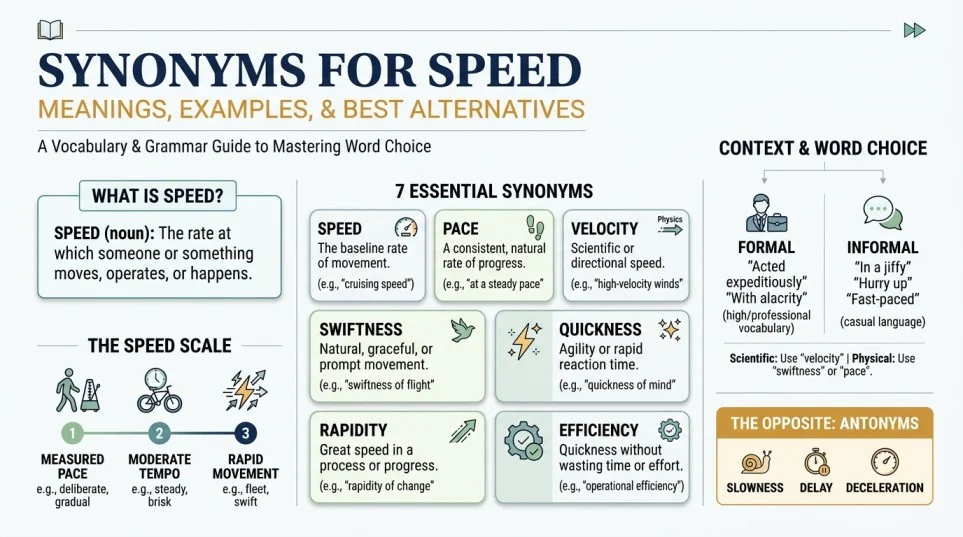
Do you often use the word speed in emails, essays, social media captions, or workplace reports? Repeating the same word can make your writing feel plain. Choosing the right alternative helps you express how fast something happens, how quickly someone acts, or how efficiently a task gets done.
Learning synonyms for speed can improve your vocabulary and make your communication more precise. Words such as pace, velocity, rapidity, and swiftness are related, but they do not always fit the same sentence. Some work best in scientific writing, while others sound natural in everyday conversation. This guide explains their meanings, examples, differences, and practical uses so you can choose the right word for each situation.
What Does Speed Mean?
Speed means how fast someone or something moves or how quickly an action happens. Common synonyms include pace, velocity, swiftness, rapidity, and quickness. Use velocity in scientific contexts, pace for work or activities, and swiftness or rapidity in formal writing.
Meaning, Tone and Context
The word speed describes how quickly something moves, happens, develops, or gets completed. It can refer to physical movement, mental responses, business operations, internet connections, or the progress of an activity.
Simple definition: Speed is the rate at which someone or something moves or an action takes place.
Part of speech: Speed is both a noun and a verb.
Tone: Usually neutral. It can sound positive when describing quick service or efficient work, or negative when describing dangerous driving or rushed decisions.
Formality: Speed works in formal, academic, professional, and casual communication.
Common uses include:
- Physical movement, such as the speed of a car.
- Work performance, such as the speed of a team.
- Technology, such as internet speed.
- Learning, such as the speed at which a student understands a topic.
- Change and development, such as the speed of economic growth.
Important Word Forms
| Word Form | Meaning | Example |
|---|---|---|
| Speed | The rate of movement or action | The speed of the train impressed us. |
| Speeds | Moves or operates quickly, or plural noun | The car speeds along the highway. |
| Sped | Past tense of speed | She sped through the final section. |
| Speeding | Moving too quickly | Speeding can cause serious accidents. |
| Speedy | Happening or completed quickly | Thank you for your speedy response. |
| Speedily | In a quick manner | The issue was resolved speedily. |
When and How to Use Speed
Use speed when you want to describe how quickly something moves or happens. Choose a more specific synonym when you need to highlight movement, progress, efficiency, or urgency.
1. Professional context
The support team improved the speed of its response to customer questions.
2. Academic context
The researcher measured the speed at which sound traveled through different materials.
3. Personal context
I increased my reading speed by practicing for fifteen minutes every day.
4. Social media context
Life moves at a different speed when you finally take time to enjoy the moment.
Another Word for Speed
The best alternative depends on what you mean. There is no single synonym that fits every use of speed.
| Context | Best Alternative | Example |
|---|---|---|
| Professional writing | Efficiency | The new process improved efficiency. |
| Academic writing | Velocity | The experiment measured the object’s velocity. |
| Casual conversation | Pace | I like the pace of this neighborhood. |
| Emotional writing | Swiftness | She admired the swiftness of his response. |
| Creative writing | Fleetness | The horse was known for its fleetness. |
| Resume or workplace | Productivity | The software increased team productivity. |
| Social media captions | Quickness | The quickness of that finish was amazing. |
| Stronger emphasis | Rapidity | The rapidity of the change surprised everyone. |
| Softer or more measured meaning | Pace | We need a comfortable pace for this project. |
Best overall choice: Pace is a versatile alternative when you mean the rate at which an activity progresses. For physical movement, velocity or swiftness may be more suitable. For workplace results, efficiency is often more precise.
When Not to Use Speed
Although speed is useful, it can be too general when the reader needs a specific meaning.
1. When scientific precision matters
Instead of saying, The object moved at a high speed, use The object traveled at a high velocity when the scientific context requires velocity as a vector quantity.
2. When describing work quality
Instead of saying, The employee improved speed, write The employee improved efficiency if the goal was to complete work with less wasted time or effort.
3. When describing the rhythm of an activity
Instead of saying, The meeting had a good speed, write The meeting had a comfortable pace.
4. When emphasizing urgency
Instead of saying, We need speed, write We need an immediate response if the situation requires action without delay.
5. When describing rapid change
Instead of saying, The city changed speedily, write The city changed rapidly. This sounds more natural when discussing social, economic, or technological change.
Words Commonly Confused With Speed
Several related words overlap with speed, but each has a distinct use.
| Word | Main Difference | Best Use |
|---|---|---|
| Velocity | Includes direction as well as rate of movement | Physics and engineering |
| Pace | The rate or rhythm of an activity | Work, walking, learning, and storytelling |
| Acceleration | The rate at which velocity changes | Vehicles and scientific measurements |
| Momentum | The force or progress that helps something continue | Business growth and developing trends |
| Efficiency | Achieving results with minimal wasted time or resources | Work and business processes |
| Quickness | The quality of acting or responding quickly | Reactions and everyday activities |
Remember that a related word is not always a direct replacement. Acceleration describes a change in velocity, while efficiency focuses on how well resources are used. Momentum describes continuing progress rather than simply being fast.
Best Synonym by Context for Speed
The most useful synonym for speed depends on the activity, the audience, and the result you want to describe. Use this table to find a natural alternative.
| Context | Best Synonym | Why It Works | Example |
|---|---|---|---|
| Formal writing | Rapidity | Emphasizes a high rate of change or action | The rapidity of the response was remarkable. |
| Academic writing | Velocity | Describes movement with direction in scientific contexts | The particle reached a high velocity. |
| Business communication | Efficiency | Highlights productive use of time and resources | Automation improved operational efficiency. |
| Resume writing | Productivity | Shows useful work completed | Increased productivity by improving daily workflows. |
| Casual conversation | Pace | Describes how quickly life or an activity moves | I enjoy the relaxed pace of small town life. |
| Creative writing | Swiftness | Adds a descriptive quality to rapid movement or action | The swiftness of the bird caught my attention. |
| Emotional writing | Quickness | Emphasizes a fast reaction or response | Her quickness to help meant everything to me. |
| Strong intensity | Rapidity | Highlights how quickly something develops | The rapidity of the changes shocked the team. |
| Moderate or measured activity | Pace | Suggests a manageable rate of progress | We worked at a steady pace. |
| Social media captions | Quickness | Sounds natural for a fast action or result | The quickness of that move was unreal. |
| Physics | Velocity | Includes the direction of movement | The vehicle maintained a constant velocity. |
| Customer service | Promptness | Highlights a timely response | We appreciate the promptness of your reply. |
| Sports | Quickness | Emphasizes fast reactions and movement | Her quickness helped her avoid the defender. |
| Technology | Processing speed | Specifies how quickly a system handles tasks | The new computer offers better processing speed. |
| Storytelling | Pace | Describes the rhythm of a story | The novel has a slow, thoughtful pace. |
| Transportation | Velocity | Fits technical discussions of motion | The train reached its target velocity. |
US and UK English generally use the same core synonyms for speed. The main differences usually come from context, not regional spelling. For example, rapidity and swiftness are understood in both varieties, while pace is common in everyday speech across both.
Which Synonym Should You Choose?
Use these practical rules to select the best word.
1. Consider the meaning. If you mean physical movement, use speed, velocity, or swiftness. If you mean progress through a task, pace may be better.
2. Match the level of formality. Use rapidity or promptness in suitable formal contexts. Use quickness or pace in everyday conversation.
3. Check the intensity. Swiftness suggests fast movement or action. Rapidity often emphasizes how quickly a process unfolds. Neither automatically means the highest possible speed.
4. Focus on the desired result. Choose efficiency when you mean less wasted effort, and productivity when you mean useful output.
5. Read the whole sentence. A synonym can be accurate in meaning but awkward in grammar. For example, we usually say a response was prompt, a process was efficient, and a vehicle had high speed.
Real Life Examples of Speed in Sentences
Here are practical examples showing how synonyms for speed work in different situations.
| Situation | Example Sentence |
|---|---|
| School | I improved my reading pace by practicing every evening. |
| Workplace | The new system increased the speed of daily operations. |
| Writing | The rapidity of the plot keeps readers interested. |
| Conversation | I cannot keep up with the pace of this class. |
| Social media | The quickness of that finish was incredible. |
| Resume | Improved team productivity by organizing recurring tasks. |
| Thank you for your prompt response to my request. | |
| Storytelling | With remarkable swiftness, the fox disappeared into the woods. |
| Technology | Faster processing speed makes large files easier to manage. |
| Sports | Her quickness gave her an advantage on the court. |
18 Synonyms for Speed
These 18 alternatives cover movement, reactions, progress, and timely action. Some are close synonyms, while others are appropriate only in specific contexts.
| Synonym | Simple Meaning | Best Used For | Example Sentence |
|---|---|---|---|
| 1. Quickness | The quality of being quick | Reactions and actions | His quickness helped him catch the ball. |
| 2. Swiftness | Fast movement or action | Descriptive and formal writing | The swiftness of the rescue saved valuable time. |
| 3. Rapidity | A high rate of action or change | Formal and academic writing | The rapidity of the growth surprised investors. |
| 4. Velocity | Speed in a particular direction | Physics and engineering | The object gained velocity as it moved downhill. |
| 5. Pace | The rate at which something progresses | Work, exercise, and storytelling | She maintained a steady pace throughout the race. |
| 6. Haste | Acting quickly, often with limited care | Urgent or rushed actions | In his haste, he forgot to lock the door. |
| 7. Celerity | Great speed or promptness | Literary and formal writing | The team acted with impressive celerity. |
| 8. Fleetness | The ability to move quickly | Literature and animal movement | The deer escaped through its fleetness. |
| 9. Briskness | A lively, energetic rate | Walking and activity | We enjoyed a brisk walk before breakfast. |
| 10. Promptness | Acting without unnecessary delay | Emails and customer service | Her promptness made the process easier. |
| 11. Alacrity | Cheerful willingness to act promptly | Positive professional communication | He accepted the new responsibility with alacrity. |
| 12. Dispatch | Speed and efficiency in completing a task | Formal work and operations | The staff handled the request with dispatch. |
| 13. Rapidity of movement | How quickly something moves | Descriptive explanation | The rapidity of movement made the object hard to track. |
| 14. Acceleration | An increase in velocity over time | Science and transportation | The car’s acceleration was smooth. |
| 15. Efficiency | Achieving results with little wasted effort | Business and productivity | Better planning improved the team’s efficiency. |
| 16. Quick pace | A fast rate of progress | Work and daily activities | The project moved forward at a quick pace. |
| 17. Fastness | The quality of being fast, although uncommon in this sense | Limited descriptive contexts | The fastness of the runner impressed the spectators. |
| 18. Expediency | Suitability for achieving an immediate practical result | Decisions and formal discussion | The manager considered the expediency of acting immediately. |
A note on precision: acceleration, efficiency, and expediency are related concepts rather than exact substitutes for speed. Use them only when their specific meanings fit the sentence. Fastness is uncommon when describing speed, so quickness or swiftness is usually more natural.
Synonym Groups and Usage Differences
Professional vs. Personal Synonyms
Professional writing often needs words that show results, timing, or process quality. Efficiency, promptness, and productivity are useful when describing work performance.
Personal writing usually benefits from natural words such as pace, quickness, and swiftness. These work well when describing habits, movement, reactions, or daily experiences.
Formal vs. Conversational Synonyms
Formal alternatives include rapidity, celerity, and dispatch. They may suit reports, academic discussions, and polished business writing, although simpler wording is often clearer.
Conversational alternatives include pace, quickness, and speed itself. For example, saying the pace of the meeting was fast sounds more natural than saying the rapidity of the meeting was high.
Academic Synonyms
In academic writing, choose the word that describes the exact concept.
Velocity is appropriate when direction matters in physics. Rapidity can describe the rate of change in a process. Pace works for learning, reading, or the progression of a study. Avoid using efficiency as a direct replacement when you are measuring movement alone.
Professional and Business Synonyms
In business communication, the right word depends on the performance measure.
- Use promptness for timely replies or service.
- Use efficiency for completing work with less waste.
- Use productivity for the amount of useful work completed.
- Use pace for the rate of project progress.
- Use dispatch for quick and effective handling of a task in a suitably formal sentence.
For a resume, a specific result is usually stronger than a general claim about speed. For example, describe how you reduced processing time or improved the number of customer requests handled.
Creative or Literary Synonyms
Creative writing can benefit from words that add movement or mood.
Swiftness can suggest graceful, rapid movement. Fleetness often suits animals, athletes, or literary descriptions. Rapidity can create a more formal tone when describing sudden change.
Choose a word that supports the image you want readers to imagine rather than selecting an unusual term simply to sound sophisticated.
Slang or Modern Synonyms
There is no single slang word that replaces speed in every situation. In casual American English, people may say fast, quick, or at full throttle, depending on the context.
For example, That player is lightning fast sounds natural in conversation. In an academic paper, use a more precise expression such as high running speed or rapid movement.
Strongest vs. Weaker Synonyms
The following scale shows differences in emphasis, not an exact scientific ranking. The meaning of each word depends on the sentence.
Mild
Measured pace
A controlled or comfortable rate of progress.
Moderate
Briskness
An energetic and noticeably quick rate.
High
Swiftness
Fast movement or action.
Emphatic
Rapidity
Emphasizes how quickly an action or change occurs.
Use haste when you want to suggest that speed may have come at the expense of care. A rushed decision is not necessarily a good or efficient one.
Emotional vs. Neutral Synonyms
Neutral words such as speed, pace, and velocity focus mainly on the rate of movement or action.
Words such as haste and alacrity add an extra meaning. Haste can suggest carelessness or pressure, while alacrity suggests eagerness and willingness. Swiftness can sound admiring when describing a skillful action.
Choose these words carefully because their emotional meaning can change how readers interpret a sentence.
Antonyms of Speed
Antonyms describe the opposite of speed or a related idea, such as slow movement, delayed action, or a lack of progress. Some words in this table are contextual opposites rather than exact dictionary antonyms.
| Antonym | Meaning | Example Sentence |
|---|---|---|
| 1. Slowness | The quality of moving or acting slowly | The slowness of the connection frustrated users. |
| 2. Delay | A wait before something happens | The delay affected the delivery schedule. |
| 3. Lateness | The state of arriving or happening late | Her lateness disrupted the meeting. |
| 4. Tardiness | Being late or taking longer than expected | Repeated tardiness concerned the supervisor. |
| 5. Sluggishness | Lack of energy or quick movement | The computer’s sluggishness made work difficult. |
| 6. Leisureliness | A relaxed, unhurried pace | We enjoyed the leisureliness of the afternoon. |
| 7. Gradualness | The quality of happening in small stages | The gradualness of the change made it easier to accept. |
| 8. Deceleration | A decrease in velocity | The vehicle showed steady deceleration. |
| 9. Retardation | Slowing or delayed development in a technical sense | The report examined the retardation of the chemical reaction. |
| 10. Stagnation | A lack of progress or development | Business stagnation reduced the company’s growth. |
| 11. Inactivity | A state of not doing much or taking action | Long periods of inactivity affected the project. |
| 12. Procrastination | Delaying tasks that need attention | Procrastination prevented him from finishing on time. |
| 13. Hesitation | A pause caused by uncertainty | Her hesitation slowed the decision making process. |
| 14. Lag | A delay between an action and a response | Network lag interrupted the video call. |
| 15. Inertia | Resistance to change or movement | The team’s inertia delayed the adoption of new methods. |
For everyday writing, slowness is the closest general opposite of speed. Use delay for waiting, deceleration for decreasing velocity, and stagnation for a lack of progress.
Comparison: Speed vs. Similar Words
Speed vs. Velocity
Main difference: Speed measures how fast something moves. Velocity includes both speed and direction.
Which is stronger? Neither is inherently stronger. They describe different physical quantities.
Which is more formal? Velocity is more technical in scientific contexts.
Examples:
Speed: The car traveled at 60 miles per hour.
Velocity: The car traveled north at 60 miles per hour.
Speed vs. Pace
Main difference: Speed focuses on how fast something moves or happens. Pace often describes the rate or rhythm of an ongoing activity.
Which is stronger? Neither is automatically stronger.
Which is more formal? Both work in formal and casual writing.
Examples:
Speed: The internet speed improved after the upgrade.
Pace: The team maintained a steady pace throughout the project.
Speed vs. Quickness
Main difference: Speed often refers to a rate of movement or action. Quickness can emphasize the ability to react or act promptly.
Which is stronger? It depends on the situation.
Which is more formal? Speed is more versatile in technical writing, while quickness is natural in general descriptions.
Examples:
Speed: The train reached a high speed.
Quickness: Her quickness helped her respond to the unexpected question.
Speed vs. Rapidity
Main difference: Both can describe how quickly something happens, but rapidity often emphasizes the rate of change or action.
Which is stronger? Neither has a fixed intensity advantage.
Which is more formal? Rapidity is generally more formal.
Examples:
Speed: The company increased the speed of production.
Rapidity: The rapidity of the company’s expansion surprised analysts.
Speed vs. Acceleration
Main difference: Speed describes how fast something moves. Acceleration describes how quickly its velocity changes.
Which is stronger? Acceleration does not mean greater speed by itself.
Which is more formal? Acceleration is a technical term in physics and engineering.
Examples:
Speed: The vehicle maintained a speed of 40 miles per hour.
Acceleration: The vehicle accelerated from 20 to 40 miles per hour.
Speed vs. Efficiency
Main difference: Speed concerns how quickly something happens. Efficiency concerns how effectively time, effort, or resources are used.
Which is stronger? Neither. They measure different things.
Which is more formal? Both suit professional communication, but efficiency is especially useful in business.
Examples:
Speed: The employee completed the task quickly.
Efficiency: The employee completed the task quickly without wasting materials.
Common Phrases and Expressions with Speed
1. At full speed
Meaning: Moving or operating as fast as possible.
Example sentence: The train traveled at full speed along the open track.
2. Speed up
Meaning: To move or happen faster.
Example sentence: We need to speed up the review process before Friday.
3. Pick up speed
Meaning: To become faster or make progress more quickly.
Example sentence: Sales began to pick up speed during the holiday season.
4. In the blink of an eye
Meaning: Extremely quickly, almost instantly.
Example sentence: The opportunity disappeared in the blink of an eye.
5. At lightning speed
Meaning: Extremely fast.
Example sentence: News of the announcement spread at lightning speed.
6. A matter of time
Meaning: Something expected to happen eventually, although the exact time may be unknown.
Example sentence: With consistent practice, improving your typing speed is only a matter of time.
7. Speed limit
Meaning: The maximum legal driving speed on a road.
Example sentence: Always follow the posted speed limit.
8. Make haste
Meaning: To act or move quickly, usually because time is limited.
Example sentence: We must make haste if we want to catch the last train.
Common Mistakes to Avoid
1. Treating every synonym as interchangeable.
Velocity, pace, and efficiency have different meanings. Choose the word that describes the actual measurement or activity.
2. Using acceleration when you mean speed.
A vehicle can accelerate while still moving slowly. Use acceleration when its velocity changes, not simply when it is moving fast.
3. Choosing overly formal language.
Rapidity and celerity may sound unnatural in a casual text. Use quickness or speed when simpler wording works better.
4. Confusing speed with efficiency.
Finishing a task quickly does not always mean doing it well. Use efficiency when you want to emphasize good use of time and resources.
5. Using dramatic expressions in formal reports.
At lightning speed can work in an informal article, but a report may be clearer with rapidly or within seconds.
6. Repeating speed too often.
Replace repeated uses with accurate alternatives such as pace, velocity, promptness, or processing speed. Do not change the word if doing so makes the sentence less clear.
FAQs About Synonyms for Speed
1. What is the best synonym for speed?
Pace is a versatile alternative for activities and progress. Velocity suits scientific movement, while quickness and swiftness work well for rapid actions or reactions.
2. What is a formal synonym for speed?
Rapidity is a formal synonym that emphasizes how quickly an action or change occurs. Velocity is more suitable when discussing physical motion scientifically.
3. What is an informal synonym for speed?
Quickness is a natural informal alternative, especially when describing reactions or actions. Pace also works well when discussing work, exercise, or everyday life.
4. What is another word for speed in professional writing?
Promptness suits timely responses, efficiency describes effective use of resources, and productivity refers to useful output. Choose according to the result you want to emphasize.
5. What is the difference between speed and velocity?
Speed measures how fast an object moves. Velocity measures its speed in a particular direction, making velocity more precise in many physics problems.
6. What is the opposite of speed?
Slowness is the closest general opposite of speed. Delay, deceleration, and stagnation can express related opposite ideas when discussing waiting, motion, or progress.
Conclusion
Speed describes how quickly something moves or happens, but the best alternative depends on your meaning and audience. Pace works well for activities and progress, velocity suits scientific discussions, and swiftness or quickness can make descriptions more engaging.
In professional writing, promptness, efficiency, and productivity communicate different benefits. For academic work, choose precise terms that match the subject rather than using complex vocabulary unnecessarily.
The best way to improve your writing is to check the full sentence before replacing a word. A clear, accurate synonym will always be more useful than an unusual word that changes your intended meaning.
Discover More Post:
- 50+ Synonyms for Before | Meanings, Examples, and Best …
- 50+ Synonyms for Other | Meanings, Examples, and Best …
- 50+ Synonyms for Other | Meanings, Examples, and Best …