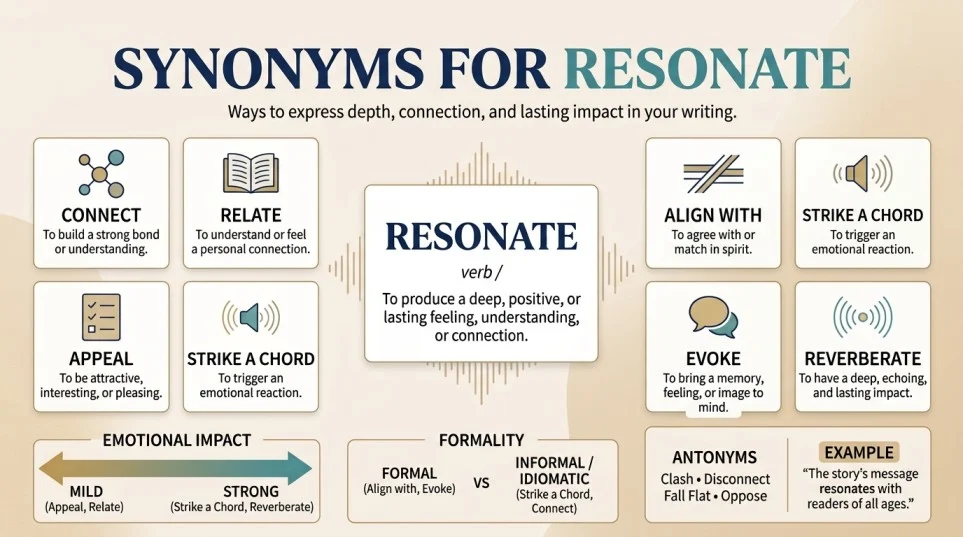
Have you ever used the word resonate several times in an essay, email, presentation, or social media caption? It is a useful word, but repeating it can make your writing feel less engaging. Learning synonyms for resonate helps you express ideas more clearly, describe emotional connections, and explain why a message matters to someone.
The best replacement depends on what you want to say. You might mean that an idea connects with people, a song stirs emotions, a message feels familiar, or a statement has a lasting impact. This guide explores the meaning of resonate, its closest alternatives, and practical examples for everyday communication. You will learn how to choose words that sound natural in academic writing, professional communication, creative work, and casual conversation.
What Does Resonate Mean?
Resonate means to connect deeply with someone, create an emotional response, or have a strong and lasting effect. The best synonyms include connect, strike a chord, relate to, appeal to, ring true, evoke, and reverberate, depending on the context.
Meaning, Tone and Context
What Does Resonate Mean?
Resonate means to produce a sound that continues or becomes stronger through vibration. In everyday language, it often means that an idea, message, experience, or feeling connects with someone in a meaningful way.
For example, a speech can resonate with an audience because its message reflects their experiences. A song can resonate with listeners because it reminds them of someone they love.
Part of Speech
Resonate is a verb. It describes an action or effect, either physical or emotional.
Examples:
- The sound of the bell resonated through the hall.
- Her message resonated with young professionals.
- His advice continues to resonate with me.
Tone and Formality
Resonate usually has a neutral to positive tone. It often suggests a meaningful connection, emotional response, or lasting influence.
The word is suitable for professional communication, academic discussion, personal writing, marketing, storytelling, and everyday conversation.
Common Uses of Resonate
| Context | Meaning | Example |
|---|---|---|
| Emotional | To touch someone’s feelings | Her story resonated with me. |
| Professional | To connect with an audience | The proposal resonated with the client. |
| Academic | To reflect an idea or experience | The findings resonated with earlier research. |
| Creative | To create a lasting impression | The final scene resonated with viewers. |
| Musical | To produce or sustain sound | The instrument resonated throughout the room. |
| Personal | To feel familiar or meaningful | His experience resonated with mine. |
Related Word Forms
| Word | Part of Speech | Meaning |
|---|---|---|
| Resonate | Verb | To connect deeply or produce vibrations |
| Resonates | Verb | Present tense form used with he, she, or it |
| Resonated | Verb | Past tense form |
| Resonating | Verb form | Connecting deeply or producing vibrations |
| Resonance | Noun | The quality of creating a strong response or sound |
| Resonant | Adjective | Deep, rich, meaningful, or strongly affecting |
When and How to Use Resonate
Use resonate when you want to describe a connection that goes beyond simple understanding. It works especially well when a message reflects someone’s beliefs, experiences, emotions, or needs.
Here are four realistic examples.
Professional context: The new company vision resonated with employees because it focused on meaningful work.
Academic context: The author’s argument resonates with current discussions about education and technology.
Personal context: Her advice about setting boundaries really resonated with me.
Social media context: This song resonates with anyone who has experienced a difficult breakup.
In each example, resonate suggests more than hearing or understanding something. It communicates a sense of connection or significance.
Another Word for Resonate
The best single replacement for resonate is usually connect when describing a meaningful relationship between an idea and an audience. However, more specific alternatives can communicate emotion, agreement, familiarity, or lasting influence.
| Situation | Best Alternative | Example |
|---|---|---|
| Professional writing | Appeal to | The proposal appeals to our target audience. |
| Academic writing | Align with | The findings align with previous research. |
| Casual conversation | Relate to | I can relate to your experience. |
| Emotional writing | Strike a chord | Her story struck a chord with readers. |
| Creative writing | Evoke | The painting evokes a feeling of nostalgia. |
| Resume or workplace use | Demonstrate relevance | My experience demonstrates relevance to the role. |
| Social media captions | Hit home | That message really hit home. |
| Stronger meaning | Profoundly affect | The documentary profoundly affected its viewers. |
| Softer meaning | Appeal to | The idea may appeal to some readers. |
Professional Writing
Choose appeal to, align with, or connect with when discussing clients, customers, colleagues, or business audiences.
Example: The campaign connects with customers who value sustainable products.
Academic Writing
Use align with, reflect, correspond with, or support when describing research, arguments, or established findings. These words are often more precise than resonate.
Example: The results align with the study’s original hypothesis.
Casual Conversation
Choose relate to, understand, or connect with when talking about personal experiences.
Example: I really relate to what you are going through.
Emotional Writing
Use strike a chord, touch, move, or speak to when describing a strong emotional response.
Example: Her honest words touched everyone in the room.
Creative Writing
Choose evoke, stir, linger, or reverberate when describing images, memories, sounds, or lasting impressions.
Example: The final scene evokes a quiet sense of loss.
Resume and Workplace Use
Resonate is not usually the strongest choice for a resume because it can be vague. Use demonstrated relevance, aligned with, addressed, or engaged, depending on the achievement you want to describe.
Example: Developed a customer focused campaign that addressed the needs of three key audience groups.
Social Media Captions
For a relaxed caption, relate to, hit home, or speak to can sound more natural.
Example: For everyone who needed this reminder today, I hope it hits home.
When Not to Use Resonate
Resonate is useful, but it does not fit every situation. A more precise word can make your message clearer.
| Situation | Less Precise Sentence | Better Sentence |
|---|---|---|
| Simple agreement | I resonate with your answer. | I agree with your answer. |
| Personal experience | I resonate with your situation. | I relate to your situation. |
| Research evidence | The results resonate with the data. | The results align with the data. |
| Physical sound | The music resonates in the room. | The music reverberates through the room. |
| Emotional response | The movie resonated with me. | The movie moved me deeply. |
| Business relevance | The service resonates with our needs. | The service meets our needs. |
Avoid using resonate simply because it sounds sophisticated. Choose a different word when you mean agreement, factual consistency, direct emotional impact, or practical usefulness.
Words Commonly Confused With Resonate
Several words are close to resonate, but their meanings are not identical.
| Word | Main Difference | When to Use It |
|---|---|---|
| Relate | Suggests understanding or sharing an experience | Personal stories and conversations |
| Connect | Describes a relationship or bond | People, ideas, and audiences |
| Appeal | Suggests attraction or interest | Products, ideas, and preferences |
| Reflect | Shows or represents something | Research, feelings, and experiences |
| Reverberate | Often describes sound or an effect that continues | Music, speeches, and lasting consequences |
| Evoke | Means to bring a feeling, memory, or image to mind | Art, writing, and emotional descriptions |
For example, you can relate to a friend’s experience, connect with an audience, appeal to a customer, or evoke a memory. Each verb describes a different kind of relationship.
Best Synonym by Context for Resonate
Choosing the right synonym depends on your purpose, audience, and intended tone.
| Context | Best Synonym | Why It Works | Example |
|---|---|---|---|
| Formal writing | Correspond with | Shows a clear relationship | The results correspond with earlier observations. |
| Academic writing | Align with | Connects ideas or evidence | The findings align with existing research. |
| Business communication | Appeal to | Highlights audience interest | The message appeals to new customers. |
| Resume writing | Address | Focuses on meeting a need | The project addressed customer concerns. |
| Casual conversation | Relate to | Expresses shared understanding | I relate to your experience. |
| Creative writing | Evoke | Creates an emotional or sensory response | The poem evokes childhood memories. |
| Emotional expression | Move | Emphasizes a strong feeling | Her story moved the audience. |
| Strong impact | Profoundly affect | Highlights a deep effect | The speech profoundly affected the team. |
| Mild connection | Appeal to | Suggests interest without a deep emotional claim | The idea may appeal to some readers. |
| Social media captions | Hit home | Sounds conversational and memorable | That quote really hit home. |
| Music and sound | Reverberate | Describes continuing sound | The notes reverberated through the theater. |
| Shared experiences | Strike a chord | Highlights emotional recognition | The film struck a chord with parents. |
| Audience engagement | Engage | Focuses on attracting attention or involvement | The opening question engaged the audience. |
| Similar opinions | Agree with | Expresses direct agreement | I agree with your conclusion. |
US and UK Usage
Resonate is widely understood in both American and British English. There is no major difference in its basic meaning.
American writers may use hit home in conversational contexts, while British writers may also use phrases such as strike a chord. Both expressions are understood across the two varieties of English.
Which Synonym Should You Choose?
Use these practical rules to find the best synonym for resonate.
1. Check the meaning. If you mean emotional understanding, choose relate to or strike a chord. If you mean agreement, choose agree with or align with.
2. Consider formality. Use correspond with or align with in formal writing. Choose hit home or relate to for casual communication.
3. Measure emotional intensity. Use appeal to for a mild connection, strike a chord for emotional recognition, and profoundly affect for a deep impact.
4. Think about your audience. Business readers often need clear, direct language. Creative readers may appreciate evocative or expressive wording.
5. Read the whole sentence. A synonym should preserve the original meaning and sound natural with the surrounding words.
The best synonym is not always the most impressive word. It is the word that communicates your intended meaning with the least confusion.
Real Life Examples of Resonate in Sentences
Here are examples of how to replace resonate in common situations.
School: The teacher’s explanation connected with students who struggled with the topic.
Workplace: The new strategy aligned with the company’s long term goals.
Writing: The author’s description evoked memories of childhood.
Conversation: I can relate to how you feel about starting a new job.
Social media: That quote really hit home after a difficult week.
Resume: Created customer focused materials that addressed common client concerns.
Email: Your recommendation aligns with the goals we discussed.
Storytelling: The character’s final words lingered in the reader’s mind.
Marketing: The advertisement appealed to people seeking affordable solutions.
Public speaking: The speaker’s personal story struck a chord with the audience.
Music: The final notes reverberated through the concert hall.
Personal reflection: Her message continues to speak to me long after our conversation.
These examples show why context matters. A word that works well in a personal story may not be appropriate for a research paper or resume.
18 Synonyms for Resonate
The following 18 alternatives cover emotional connection, agreement, audience appeal, physical sound, and lasting influence.
| Synonym | Simple Meaning | Best Used For | Example Sentence |
|---|---|---|---|
| 1. Connect | Form a meaningful relationship | General communication | Her message connected with the audience. |
| 2. Relate to | Understand through shared experience | Personal conversations | I relate to his concerns about change. |
| 3. Appeal to | Attract interest or attention | Business and marketing | The design appeals to younger customers. |
| 4. Strike a chord | Create a strong emotional response | Speeches and stories | The documentary struck a chord with viewers. |
| 5. Ring true | Feel honest or believable | Opinions and experiences | Her explanation rings true to me. |
| 6. Align with | Match an idea, goal, or belief | Business and academics | The proposal aligns with our priorities. |
| 7. Reflect | Represent an idea or feeling | Writing and research | The poem reflects the author’s experience. |
| 8. Evoke | Bring a feeling or memory to mind | Creative writing | The photograph evokes a sense of peace. |
| 9. Move | Create a strong emotional response | Personal and artistic contexts | His speech moved the entire audience. |
| 10. Touch | Affect someone’s feelings | Emotional writing | Her kindness touched my heart. |
| 11. Affect | Have an influence on someone or something | General and professional writing | The decision affected every department. |
| 12. Influence | Change someone’s thinking or actions | Professional and social contexts | The campaign influenced public opinion. |
| 13. Engage | Attract interest or involvement | Presentations and marketing | The opening story engaged the listeners. |
| 14. Correspond with | Have a close relationship or match | Formal and academic writing | The observations correspond with the theory. |
| 15. Reverberate | Continue as sound or an effect | Music and lasting impact | The announcement reverberated throughout the community. |
| 16. Linger | Remain in the mind or feelings | Stories and memories | The ending lingered in my thoughts. |
| 17. Speak to | Feel relevant or meaningful to someone | Creative and professional writing | The book speaks to young entrepreneurs. |
| 18. Hit home | Feel personally relevant or powerful | Casual speech and captions | His advice about patience hit home. |
Usage tip: These words are related to resonate, but they are not interchangeable in every sentence. Choose the alternative that matches the exact meaning you intend.
Synonym Groups and Usage Differences
Professional vs. Personal Synonyms
Professional writing often benefits from direct, precise language. Words such as align with, correspond with, appeal to, and address help explain relationships between ideas, goals, and needs.
Personal writing allows more emotional expression. Relate to, touch, move, and strike a chord are useful when discussing feelings, memories, or shared experiences.
Formal vs. Conversational Synonyms
Formal alternatives include correspond with, align with, reflect, and influence. These work well in essays, reports, research summaries, and business documents.
Conversational alternatives include relate to, hit home, connect with, and strike a chord. They sound natural in texts, informal emails, speeches, and everyday discussions.
Academic Synonyms
Academic writing requires accuracy. Use align with when comparing findings, correspond with when describing a relationship, reflect when discussing representation, and support when evidence strengthens an argument.
For example, instead of writing that the results resonate with previous research, explain that the results align with earlier findings. This makes the relationship clearer.
Professional and Business Synonyms
In business communication, the intended meaning should guide your word choice.
Use appeal to when describing customer preferences. Engage when discussing audience participation. Use address when explaining how a product or strategy meets a need. Align with when comparing plans or values.
For example, the proposal addresses customer concerns is clearer than the proposal resonates with customers if you mean that it solves specific problems.
Creative or Literary Synonyms
Creative writing often benefits from words that describe feelings, memories, and sensory experiences.
Evokes works well for memories and images. Moves emphasizes emotion. Lingers describes an impression that remains. Reverberates can suggest a continuing sound or a lasting effect.
Example: The final paragraph lingers in the reader’s mind.
Slang or Modern Synonyms
There is no single slang word that replaces resonate in every situation. However, hit home is a common conversational expression that communicates personal relevance.
You may also hear connect with or vibe with in informal speech. Vibe with is very casual, so it is better suited to conversations and social media than academic papers or formal business reports.
Example: I really vibe with this artist’s message.
Strongest vs. Weaker Synonyms
The following scale shows a general progression from mild interest to a deep emotional effect. The strength of each word still depends on the sentence.
| Intensity | Word or Phrase | Example |
|---|---|---|
| Mild | Appeal to | The idea appeals to some readers. |
| Mild to moderate | Connect with | The message connects with the audience. |
| Moderate | Relate to | Many students relate to her story. |
| Moderate to strong | Strike a chord | His speech struck a chord with parents. |
| Strong | Move | The story moved the audience. |
| Very strong | Profoundly affect | The experience profoundly affected her life. |
Use stronger wording only when the situation supports it. A small preference does not necessarily mean that something deeply affected a person.
Emotional vs. Neutral Synonyms
Emotional synonyms include move, touch, strike a chord, and hit home. They highlight feelings or personal recognition.
Neutral alternatives include align with, correspond with, reflect, and address. They describe a relationship, similarity, or practical result without suggesting a strong emotional response.
For factual reports, neutral words are often safer. For personal stories and creative writing, emotional alternatives may communicate more effectively.
Antonyms of Resonate
Resonate has different meanings, so it does not have one perfect opposite. The following words and phrases express a lack of connection, agreement, emotional effect, or sound. Choose an antonym according to the meaning you want to reverse.
| Antonym | Meaning | Example Sentence |
|---|---|---|
| 1. Disconnect | Fail to form a connection | The message disconnected the speaker from the audience. |
| 2. Alienate | Make someone feel excluded | The harsh tone alienated potential supporters. |
| 3. Repel | Cause dislike or rejection | The aggressive advertisement repelled customers. |
| 4. Disinterest | Lack interest | The topic seemed to disinterest the audience. |
| 5. Bore | Fail to hold someone’s attention | The repetitive presentation bored the students. |
| 6. Misalign | Fail to match or agree | The proposal misaligns with company goals. |
| 7. Contradict | Conflict with a statement or idea | The new evidence contradicts the original claim. |
| 8. Disagree | Hold a different opinion | I disagree with the speaker’s conclusion. |
| 9. Dissonate | Produce discord or a lack of harmony | The conflicting notes dissonate within the arrangement. |
| 10. Muffle | Reduce or soften sound | The thick curtains muffled the music. |
| 11. Silence | Stop or prevent sound | The sudden announcement silenced the room. |
| 12. Fade | Become weaker or less noticeable | The sound faded before reaching the audience. |
| 13. Diminish | Reduce in strength or importance | Repeated criticism diminished her confidence. |
| 14. Repudiate | Reject an idea or claim | The committee repudiated the proposal. |
| 15. Ignore | Pay no attention to something | Readers ignored the message because it lacked relevance. |
Some entries are opposites of a particular sense of resonate rather than exact dictionary antonyms. For example, muffle relates to sound, while alienate relates to human connection.
Comparison: Resonate vs. Similar Words
Resonate vs. Relate
Main difference: Resonate suggests a meaningful or emotional effect. Relate usually means understanding something through a shared experience.
Stronger word: Resonate can suggest a deeper impact, although context matters.
More formal: Resonate is common in formal and informal writing. Relate is also widely accepted.
Examples:
Resonate: Her message resonates with young parents.
Relate: Many young parents relate to her experience.
Resonate vs. Connect
Main difference: Connect is broad and describes forming a relationship. Resonate suggests that something feels meaningful or has a lasting effect.
Stronger word: Resonate often conveys a more specific emotional connection.
More formal: Both work in professional communication.
Examples:
Resonate: The story resonated with the audience.
Connect: The speaker connected with the audience.
Resonate vs. Appeal
Main difference: Resonate suggests personal significance. Appeal means attracting someone’s interest or preference.
Stronger word: Resonate usually suggests a deeper connection.
More formal: Both are suitable for business writing.
Examples:
Resonate: The message resonated with loyal customers.
Appeal: The product appeals to budget conscious shoppers.
Resonate vs. Reflect
Main difference: Resonate describes a response or connection. Reflect means to represent, show, or mirror something.
Stronger word: Resonate is generally more emotional. Reflect is more descriptive.
More formal: Reflect is especially useful in academic writing.
Examples:
Resonate: Her speech resonated with the audience.
Reflect: Her speech reflects the community’s concerns.
Resonate vs. Evoke
Main difference: Resonate suggests meaningful connection or continuing impact. Evoke means to bring a feeling, image, or memory to mind.
Stronger word: Either can be stronger depending on the situation.
More formal: Both are suitable for creative and formal writing.
Examples:
Resonate: The novel resonated with readers.
Evoke: The novel evokes memories of childhood.
Resonate vs. Reverberate
Main difference: Reverberate often describes sound that continues after its source stops. It can also describe an effect that spreads or lasts. Resonate can describe sound, but its everyday use often focuses on emotional connection.
Stronger word: Reverberate can emphasize continuation or a spreading effect.
More formal: Both can work in formal writing.
Examples:
Resonate: The message resonated with the community.
Reverberate: The announcement reverberated throughout the industry.
Common Phrases and Expressions with Resonate
1. Resonate With Someone
Meaning: To create a meaningful connection with a person.
Example sentence: Her advice about confidence resonated with me.
2. Resonate With an Audience
Meaning: To connect with the interests, needs, or experiences of a group.
Example sentence: The speaker’s honest approach resonated with the audience.
3. Resonate Deeply
Meaning: To create a strong emotional or personal response.
Example sentence: The story resonated deeply with readers who had faced similar challenges.
4. Continue to Resonate
Meaning: To remain meaningful or influential over time.
Example sentence: The author’s message continues to resonate with new generations.
5. Resonate on a Personal Level
Meaning: To feel especially relevant to someone’s own life.
Example sentence: The film resonated on a personal level because it explored family relationships.
6. Resonate Across Generations
Meaning: To connect with people of different ages.
Example sentence: The song resonates across generations because its themes are universal.
7. Resonate With Shared Values
Meaning: To reflect beliefs that people have in common.
Example sentence: The campaign resonates with shared values of fairness and respect.
8. Resonate Emotionally
Meaning: To create a meaningful emotional response.
Example sentence: The final scene resonates emotionally without relying on dramatic dialogue.
Common Mistakes to Avoid
1. Using Resonate When You Mean Agree
Resonate and agree do not mean exactly the same thing. Use agree when you support an opinion. Use resonate when the idea feels meaningful or personally relevant.
Incorrect: I resonate with your answer because it is correct.
Better: I agree with your answer because it is correct.
2. Using Resonate for Every Emotional Response
Resonate can describe emotional impact, but move or touch may be more precise when someone experiences a strong feeling.
Instead of saying the story resonated with me, you could say the story moved me to tears if that is what happened.
3. Using Casual Phrases in Formal Writing
Expressions such as hit home and vibe with work well in casual conversation. In research papers or formal reports, prefer align with, reflect, or correspond with when appropriate.
4. Making a Simple Connection Sound Too Dramatic
Do not use deeply resonated or profoundly affected for a minor preference. Appeal to or connect with may describe the situation more accurately.
5. Repeating Resonate Too Often
Repeated use can make writing feel vague. Replace some instances with specific verbs such as engage, reflect, appeal to, or address.
6. Choosing a Synonym Without Checking Its Meaning
A synonym should preserve the original sentence’s meaning. Evoke, for example, means to bring a feeling or memory to mind, not simply to agree with an idea.
FAQs
1. What Is the Best Synonym for Resonate?
Connect is a useful general synonym for resonate. Relate to works for shared experiences, strike a chord emphasizes emotion, and align with suits comparisons between ideas.
2. What Is a Formal Synonym for Resonate?
Align with, correspond with, and reflect are useful formal alternatives. Choose the one that best describes the relationship between ideas, findings, values, or experiences.
3. What Is an Informal Synonym for Resonate?
Relate to, connect with, hit home, and vibe with are conversational alternatives. Vibe with is especially casual and is best for informal communication.
4. What Is Another Word for Resonate in Professional Writing?
Appeal to, align with, engage, and address are useful workplace alternatives. The best choice depends on whether you mean audience interest, shared goals, participation, or problem solving.
5. What Is the Difference Between Resonate and Relate?
Resonate suggests a meaningful or lasting connection. Relate usually means understanding someone or something through a similar experience. Both words can describe personal connections.
6. What Is the Opposite of Resonate?
There is no single opposite in every context. Disconnect, alienate, and fail to connect describe a lack of connection, while muffle or silence relates to sound.
Conclusion
Resonate means to create a meaningful connection, produce an emotional response, or continue to have an effect. The best synonyms for resonate include connect, relate to, strike a chord, appeal to, align with, evoke, and reverberate.
Your choice should depend on the message you want to communicate. Professional writing often needs precise terms, while personal and creative writing may benefit from emotional language.
A simple vocabulary tip can improve your writing immediately. Before replacing a word, ask yourself whether you mean agreement, emotional impact, shared experience, audience interest, or physical sound. That small step helps you choose a clearer, more natural synonym.
Discover More Post:
- 50+ Synonyms for Before | Meanings, Examples, and Best …
- 50+ Synonyms for Other | Meanings, Examples, and Best …
- 50+ Synonyms for Other | Meanings, Examples, and Best …