Choosing the right words can make the difference between writing that sounds ordinary and writing that communicates with confidence. If you keep using precise in emails, essays, reports, captions, or professional documents, exploring suitable alternatives can help you express your meaning more clearly.
The best synonym depends on what you want to emphasize. A measurement may be exact, an explanation may be specific, and a person who pays close attention to small details may be meticulous. Understanding these differences helps you improve your vocabulary without changing the meaning of your sentence.
What Does “Precise” Mean?
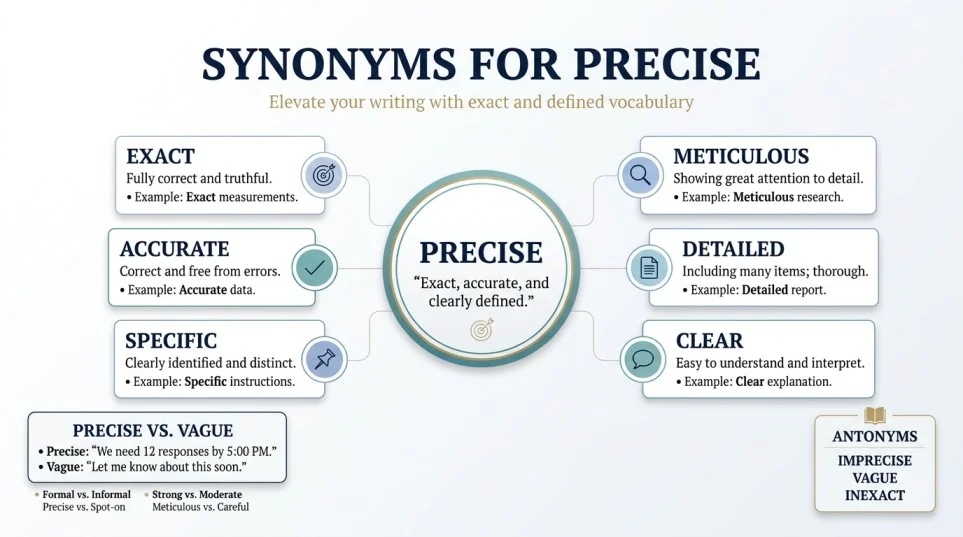
Precise means exact, accurate, or clearly defined, with little room for error or confusion. Common synonyms include exact, accurate, specific, detailed, meticulous, and explicit. Choose the word that best fits your context, whether you are writing academically, communicating professionally, or speaking casually.
Meaning, Tone and Context
The word precise describes something expressed, measured, or performed with a high degree of exactness. It can refer to information, measurements, instructions, language, timing, or a person’s attention to detail.
Simple definition
Precise means exact and clearly defined, without unnecessary vagueness or unwanted variation.
For example, saying “The meeting begins at 9:15 a.m.” is more precise than saying “The meeting starts sometime in the morning.”
Part of speech
Precise is an adjective. It describes a noun by explaining how exact, specific, or carefully defined something is.
Examples:
- The scientist recorded a precise measurement.
- Please provide a precise explanation.
- Her instructions were precise and easy to follow.
Tone and formality
Precise generally has a neutral to positive tone. In professional and academic contexts, it suggests clarity, reliability, and careful communication.
In some situations, it can also suggest strict attention to detail. The related word pedantic, however, carries a more negative implication because it describes excessive concern with minor rules or details.
Common use cases
Use precise when discussing:
- Measurements, calculations, and scientific observations.
- Clear instructions, explanations, and definitions.
- Specific dates, times, locations, and requirements.
- Professional communication and technical documents.
- Careful movements, procedures, or descriptions.
Important word forms
| Word form | Meaning | Example |
|---|---|---|
| Precise | Exact or clearly defined | We need a precise answer. |
| Precisely | In an exact or specific manner | The device measures temperature precisely. |
| Precision | The quality of being exact | Precision matters in laboratory work. |
| Imprecise | Not sufficiently exact | The report contains imprecise language. |
| Preciseness | The quality of being precise | The preciseness of the instructions was helpful. |
In everyday writing, precision is usually the more natural noun than preciseness.
When and How to Use “Precise”
Use precise when accuracy, specificity, or clearly defined details matter. The examples below show how the word works across different situations.
1. Professional: Please provide a precise estimate of the project’s total cost.
2. Academic: The researcher used precise terminology to explain the results.
3. Personal: I cannot remember the precise date of our first meeting.
4. Email: Could you share the precise location of the conference room?
5. Creative writing: Every precise detail made the fictional city feel more realistic.
6. Social media: A precise caption can communicate the entire message in just a few words.
7. Workplace: The technician followed precise instructions to install the equipment safely.
These examples demonstrate that precise works best when the reader needs clearly defined information rather than a general impression.
Another Word for “Precise”
The best single replacement for precise is often exact, especially when a statement, number, measurement, or time must match a specific value.
However, specific is better when you want to identify particular details, while accurate emphasizes correctness.
| Situation | Best alternative | Example |
|---|---|---|
| Professional writing | Exact | We need the exact delivery date. |
| Academic writing | Accurate | The study provides accurate measurements. |
| Casual conversation | Specific | Can you give me a specific example? |
| Emotional writing | Meticulous | She kept meticulous records of their memories. |
| Creative writing | Detailed | The author created a detailed description of the setting. |
| Resume or workplace | Accurate | Maintained accurate customer records. |
| Social media captions | Clear | Keep your message clear and concise. |
| Stronger emphasis on detail | Meticulous | The editor conducted a meticulous review. |
| Softer, more general meaning | Specific | Please share some specific information. |
Practical tip: Do not replace precise automatically. First identify whether the sentence emphasizes correctness, exactness, detail, or clarity.
When Not to Use “Precise”
Although precise is useful, it is not the best choice for every situation.
- When you mean correct: Use accurate if the main concern is whether information is true or correct. A statement can be precise but still incorrect.
- When you mean detailed: Use detailed if you want to emphasize how much information something contains.
- When you mean easy to understand: Use clear when readability matters more than exactness.
- When you mean a particular item: Use specific to identify one person, example, requirement, or situation.
- When you mean careful work: Use meticulous to emphasize thorough attention to small details.
Compare these examples:
| Less suitable sentence | Improved sentence | Why it improves the meaning |
|---|---|---|
| Her answer was precise and easy to understand. | Her answer was clear and easy to understand. | Clear emphasizes readability. |
| The article is precise and contains many examples. | The article is detailed and contains many examples. | Detailed emphasizes the amount of information. |
| His calculation was precise but incorrect. | His calculation was incorrect. | Accuracy, not precision alone, determines correctness. |
| Give me a precise example of your experience. | Give me a specific example of your experience. | Specific sounds natural when requesting an example. |
Words Commonly Confused With “Precise”
Several similar words overlap with precise, but their meanings are not identical.
| Word | Main difference | When to use it |
|---|---|---|
| Accurate | Correct or close to the truth | Facts, measurements, reports |
| Exact | Matching a particular value or detail | Numbers, dates, quotations |
| Specific | Clearly identified rather than general | Requests, examples, instructions |
| Detailed | Containing plenty of information | Reports, descriptions, explanations |
| Clear | Easy to understand | Communication, writing, teaching |
| Meticulous | Extremely careful about details | Editing, research, inspections |
For example, an answer can be clear without being detailed, and a measurement can be precise without being accurate. Choosing the right word helps readers understand exactly what you intend to communicate.
Best Synonym by Context for “Precise”
The best synonym changes according to the situation, audience, and intended meaning.
| Context | Best synonym | Why it works | Example |
|---|---|---|---|
| Formal writing | Exact | Emphasizes definite information | The exact terms are listed below. |
| Academic writing | Accurate | Highlights correctness | The paper presents accurate findings. |
| Professional communication | Specific | Removes uncertainty | Please provide specific requirements. |
| Resume writing | Accurate | Emphasizes dependable work | Maintained accurate inventory records. |
| Casual conversation | Exact | Sounds natural and direct | What is the exact address? |
| Creative writing | Vivid | Adds descriptive impact when imagery is intended | The author used vivid details. |
| Emotional writing | Deliberate | Suggests intentional care | She chose each word deliberately. |
| Strong emphasis on detail | Meticulous | Highlights thoroughness | He completed a meticulous inspection. |
| Moderate emphasis | Clear | Prioritizes understanding | We need a clear explanation. |
| Social media captions | Concise | Communicates a message briefly | Keep the caption concise. |
| Technical documentation | Exact | Identifies specific values or specifications | Enter the exact dimensions. |
| Scientific research | Reproducible | Emphasizes results that can be repeated under the same conditions | The team documented a reproducible procedure. |
Notice that some words in this table are contextual alternatives rather than direct synonyms. For example, vivid adds descriptive intensity, while concise emphasizes brevity. Neither automatically means precise.
Which Synonym Should You Choose?
Use this decision guide to find the best alternative for your sentence.
If you mean exactness
Choose exact for a number, date, time, location, or specific value.
If you mean correctness
Choose accurate for facts, calculations, measurements, or records.
If you mean clearly identified information
Choose specific for examples, requests, instructions, or requirements.
If you mean thorough attention
Choose meticulous for detailed work, careful editing, or thorough inspections.
If you mean easy to understand
Choose clear for explanations, messages, presentations, and instructions.
Before replacing a word, read the complete sentence. A synonym that looks correct in isolation may change the intended meaning when used in context.
Real Life Examples of “Precise” in Sentences
These examples show how synonyms for precise can improve everyday communication.
| Situation | Example sentence |
|---|---|
| School | The teacher asked us to provide an exact definition of the term. |
| Workplace | Please send a specific list of the required materials. |
| Academic writing | The researchers collected accurate measurements. |
| Conversation | Can you tell me the exact time you arrived? |
| Social media | A concise caption makes the main message easier to remember. |
| Resume | Recorded accurate sales figures and maintained organized reports. |
| Could you confirm the specific deadline for the assignment? | |
| Storytelling | The author included vivid details that brought the scene to life. |
| Technical work | The engineer followed meticulous inspection procedures. |
| Business presentation | The speaker provided a clear explanation of the proposed changes. |
The key lesson is to match the replacement to the job the word performs in the sentence.
25 Synonyms for “Precise”
The following table contains 25 useful alternatives. Some are direct synonyms, while others fit particular meanings or contexts.
| Synonym | Simple meaning | Best used for | Example sentence |
|---|---|---|---|
| 1. Exact | Matching a definite value or detail | Numbers and dates | Please enter the exact amount. |
| 2. Accurate | Correct and free from significant errors | Facts and measurements | The report contains accurate figures. |
| 3. Specific | Clearly identified and not general | Requests and examples | She gave a specific reason for leaving. |
| 4. Particular | Referring to one distinct thing | Individual items or cases | Is there a particular chapter you need? |
| 5. Detailed | Including substantial information | Descriptions and reports | He submitted a detailed proposal. |
| 6. Explicit | Stated clearly and directly | Rules and instructions | The contract provides explicit guidance. |
| 7. Definite | Clearly established or decided | Plans and decisions | We need a definite answer today. |
| 8. Clear | Easy to understand | Explanations and communication | Her directions were clear. |
| 9. Unambiguous | Having only one reasonable interpretation | Legal or technical language | The policy uses unambiguous wording. |
| 10. Meticulous | Extremely careful with details | Editing and inspections | The editor made a meticulous review. |
| 11. Exacting | Demanding great care or high standards | Work and performance | The job requires exacting standards. |
| 12. Punctilious | Strictly attentive to rules or formal details | Etiquette and formal conduct | He was punctilious about meeting protocol. |
| 13. Rigorous | Thorough and demanding | Research and testing | The team followed a rigorous testing process. |
| 14. Definitive | Authoritative or conclusive | Findings and decisions | The study offered a definitive answer to the question. |
| 15. Faithful | Closely representing the original | Copies and representations | The translation is faithful to the original text. |
| 16. Correct | In accordance with the facts or rules | Answers and calculations | Your answer is correct. |
| 17. True | In agreement with reality | Statements and descriptions | The account gives a true picture of events. |
| 18. Well defined | Clearly described or bounded | Goals and concepts | The project has well defined objectives. |
| 19. Measured | Carefully controlled or considered | Speech and responses | She gave a measured response. |
| 20. Careful | Showing attention and caution | Actions and decisions | He made a careful assessment. |
| 21. Thorough | Covering all important aspects | Reviews and investigations | We conducted a thorough review. |
| 22. Pinpoint | Identifying something with great specificity | Causes and locations | The test helped pinpoint the problem. |
| 23. Granular | Examining information in fine detail | Data and analysis | The dashboard provides granular sales data. |
| 24. Close | Near a target or reference value | Estimates and approximations | The estimate was close to the final cost. |
| 25. Faithful to detail | Preserving small details carefully | Reproductions and descriptions | The artist created a reproduction faithful to detail. |
Usage note: Exact, accurate, and specific are among the most practical alternatives. Words such as punctilious, granular, and exacting are more specialized, so use them only when their particular meaning fits.
Synonym Groups and Usage Differences
Understanding synonym groups helps you choose words that fit your audience, purpose, and tone.
Professional vs. Personal Synonyms
Professional communication often benefits from accurate, specific, exact, and clear. These words help people communicate requirements, expectations, and results without confusion.
Personal writing may call for careful, thoughtful, or detailed, depending on whether you want to emphasize attention, consideration, or description.
Examples:
- Professional: Please provide an accurate summary of the results.
- Personal: She remembered the smallest details of their conversation.
Formal vs. Conversational Synonyms
Formal writing favors words that communicate a specific meaning without sounding exaggerated. Conversational language usually benefits from simpler alternatives.
| Formal choice | Conversational choice | Example |
|---|---|---|
| Unambiguous | Clear | The instructions are clear. |
| Explicit | Specific | Be specific about what you need. |
| Definitive | Final | We need a final decision. |
| Meticulous | Very careful | She was very careful with the details. |
| Exact | Exact | Tell me the exact time. |
Use familiar language in everyday emails and conversations unless a technical or formal context calls for a specialized term.
Academic Synonyms
Academic writing requires words that communicate the intended claim accurately. The best alternatives depend on the subject and evidence.
- Accurate: Suitable for measurements, records, and factual descriptions.
- Specific: Useful when defining a research question, population, or variable.
- Rigorous: Appropriate for methods that follow demanding standards.
- Explicit: Useful when assumptions or conditions are clearly stated.
- Unambiguous: Helpful when a definition or instruction has only one intended interpretation.
Example: “The researchers used a rigorous method and reported accurate results.”
Remember that a rigorous method does not automatically guarantee an accurate result. The terms describe different qualities.
Professional and Business Synonyms
Workplace writing benefits from vocabulary that makes responsibilities and expectations easy to understand.
| Situation | Recommended word | Example |
|---|---|---|
| Project deadline | Exact | Confirm the exact delivery date. |
| Client requirements | Specific | Document the client’s specific needs. |
| Financial reporting | Accurate | Maintain accurate financial records. |
| Quality inspection | Meticulous | Conduct a meticulous inspection. |
| Presentation | Clear | Provide a clear explanation of the findings. |
| Performance standards | Exacting | The role requires exacting standards. |
On a resume, focus on what you accomplished rather than simply describing yourself as precise. For example, “Maintained accurate inventory records and reduced reporting errors” communicates a concrete contribution, provided it reflects your actual experience.
Creative or Literary Synonyms
Creative writing sometimes needs more than factual exactness. A writer may want to emphasize sensory detail, deliberate choices, or a faithful portrayal of a scene.
- Detailed: Adds information about people, places, and events.
- Vivid: Creates a strong mental picture.
- Meticulous: Highlights careful construction or observation.
- Faithful: Suggests loyalty to an original source or experience.
- Deliberate: Emphasizes intentional choices.
Example: “With meticulous attention to detail, the novelist recreated the atmosphere of the old neighborhood.”
Vivid is a related descriptive choice, not a direct substitute in every sentence. It emphasizes the strength of an impression rather than exactness itself.
Slang or Modern Synonyms
There is no single modern slang word that universally means precise. In casual American English, people often say spot on, right on the money, or dead on when they mean that something is exactly right.
Examples:
- “Your prediction was spot on.”
- “That estimate was right on the money.”
- “Her description was dead on.”
These expressions are informal and often emphasize correctness rather than the careful definition of details. In academic papers, formal reports, and professional documentation, accurate or exact is usually more appropriate.
Strongest vs. Weaker Synonyms
Synonyms do not form one universal scale of precision. Their strength depends on what they describe. The following is a practical scale of emphasis on attention to detail.
| Level | Word or phrase | Emphasis |
|---|---|---|
| 1. Moderate | Clear | Easy to understand |
| 2. Moderate | Specific | Identifies particular details |
| 3. Strong | Exact | Matches a definite value or detail |
| 4. Strong | Meticulous | Shows exceptional care with details |
| 5. Strong | Punctilious | Shows strict attention to rules and formal details |
| 6. Very demanding | Exacting | Emphasizes demanding standards |
Do not treat the final words as automatically better. Punctilious can sound overly formal, and exacting often describes standards rather than the accuracy of a statement.
Emotional vs. Neutral Synonyms
Neutral synonyms describe a quality without adding much emotional judgment. Emotional or evaluative words introduce an attitude toward the person or action.
| Neutral word | Emotional or evaluative word | Difference |
|---|---|---|
| Accurate | Meticulous | Meticulous praises exceptional care. |
| Specific | Punctilious | Punctilious may suggest excessive formality. |
| Detailed | Exacting | Exacting implies demanding standards. |
| Clear | Pedantic | Pedantic often criticizes excessive concern with minor details. |
| Careful | Obsessive | Obsessive can suggest excessive or unhealthy preoccupation. |
Choose neutral words when reporting facts. Use evaluative language only when the intended judgment is appropriate and supported by the situation.
Antonyms of “Precise”
An antonym describes the opposite or a contrasting quality. The most suitable opposite of precise is often imprecise, vague, or inexact, depending on the sentence.
| Antonym | Meaning | Example sentence |
|---|---|---|
| 1. Imprecise | Not sufficiently exact | The instructions were imprecise. |
| 2. Inexact | Not completely exact | The calculation was inexact. |
| 3. Vague | Lacking clear details | She gave a vague explanation. |
| 4. Ambiguous | Open to more than one interpretation | The statement was ambiguous. |
| 5. Unclear | Difficult to understand | The directions were unclear. |
| 6. Approximate | Close to a value but not exact | We used an approximate figure. |
| 7. Indefinite | Not clearly established | The deadline remains indefinite. |
| 8. General | Not limited to particular details | He provided a general overview. |
| 9. Broad | Covering a wide area or subject | The proposal makes a broad claim. |
| 10. Inaccurate | Incorrect or not sufficiently correct | The report contained inaccurate figures. |
| 11. Sloppy | Careless in execution | Sloppy calculations weakened the report. |
| 12. Careless | Showing insufficient attention | A careless entry caused confusion. |
| 13. Loose | Not strict or tightly defined | The policy uses a loose definition. |
| 14. Confused | Lacking logical clarity | The explanation was confused. |
| 15. Erroneous | Containing an error | The document included an erroneous value. |
Important distinction: Approximate is not always a true opposite of precise. Approximate values can be useful and accurate enough for a particular purpose, even when they are not exact.
Comparison: Precise vs. Similar Words
These six comparisons explain when to choose precise and when another word communicates your meaning more effectively.
Precise vs. Accurate
Main difference: Precise emphasizes exactness or consistency, while accurate emphasizes correctness.
Which is stronger? Neither is universally stronger. They describe different qualities.
Which is more formal? Both are appropriate for formal, academic, and professional writing.
Examples:
- Precise: The instrument records temperatures to two decimal places.
- Accurate: The instrument correctly measures the sample’s temperature.
A measurement can be precise without being accurate if the instrument consistently produces the wrong value.
Precise vs. Exact
Main difference: Both emphasize exactness, but exact often identifies a particular value, time, or detail, while precise can also describe careful expression or execution.
Which is stronger? Exact is often more direct when a specific value is required.
Which is more formal? Both work in formal and informal contexts.
Examples:
- Precise: The report provides a precise description of the process.
- Exact: What is the exact amount we need to pay?
Precise vs. Specific
Main difference: Specific identifies a particular thing rather than something general. Precise emphasizes exactness or carefully defined details.
Which is stronger? Precise can imply greater exactness, but the words are not interchangeable in every sentence.
Which is more formal? Both are common in academic and workplace writing.
Examples:
- Precise: The technician recorded a precise measurement.
- Specific: The manager requested a specific example.
Precise vs. Detailed
Main difference: Precise emphasizes exactness. Detailed emphasizes the amount and depth of information provided.
Which is stronger? Neither is universally stronger.
Which is more formal? Both are suitable for formal writing.
Examples:
- Precise: The instructions specify the exact temperature.
- Detailed: The instructions explain every stage of the process.
A detailed explanation can contain errors, and a precise explanation can be brief.
Precise vs. Clear
Main difference: Clear means easy to understand, while precise means exact or clearly defined.
Which is stronger? Precise emphasizes specificity. Clear emphasizes comprehension.
Which is more formal? Both work across different levels of formality.
Examples:
- Precise: The contract specifies the precise payment date.
- Clear: The contract explains the payment process clearly.
The best writing is often both clear and precise.
Precise vs. Meticulous
Main difference: Precise describes exactness. Meticulous describes exceptional care and attention to detail.
Which is stronger? Meticulous generally conveys stronger emphasis on careful effort.
Which is more formal? Both are suitable for professional contexts, although meticulous is more descriptive.
Examples:
- Precise: She provided a precise account of the incident.
- Meticulous: She conducted a meticulous review of every document.
Use precise for the quality of the account and meticulous for the care taken during the review.
Common Phrases and Expressions with “Precise”
Learning common phrases helps you use precise naturally in writing and conversation.
1. To Be Precise
Meaning: To give an exact or more specific explanation.
Example sentence: We need three volunteers, to be precise, three people who can work on Saturday.
2. Precise Measurements
Meaning: Measurements recorded or expressed with a high degree of exactness.
Example sentence: The laboratory requires precise measurements for the experiment.
3. Precise Instructions
Meaning: Directions that explain exactly what someone should do.
Example sentence: The supervisor provided precise instructions for assembling the equipment.
4. Precise Details
Meaning: Particular facts or pieces of information rather than general descriptions.
Example sentence: Please include the precise details of the appointment in your email.
5. Precise Timing
Meaning: Timing that follows a specific schedule or moment.
Example sentence: Precise timing is essential during the final stage of the performance.
6. Precise Language
Meaning: Words chosen to communicate a meaning accurately and unambiguously.
Example sentence: Precise language helps legal writers avoid unnecessary confusion.
7. Precise Definition
Meaning: A clearly stated explanation that establishes the meaning of a term.
Example sentence: The textbook provides a precise definition of the scientific concept.
8. Precise Control
Meaning: The ability to regulate an action, movement, or process accurately.
Example sentence: The machine gives the operator precise control over the cutting speed.
Common Mistakes to Avoid
Even experienced writers sometimes choose a synonym that changes the intended meaning. Avoid these common mistakes when using precise and related words.
1. Using precise when accurate is intended. A statement may contain exact details but still be wrong. Use accurate when correctness is the main concern.
2. Treating specific and precise as identical. Specific identifies a particular thing, while precise emphasizes exactness. Choose based on the information you want to convey.
3. Using specialized vocabulary unnecessarily. Words such as punctilious and unambiguous may sound unnatural in a casual message. Prefer familiar words when they communicate the same idea.
4. Confusing detail with exactness. A lengthy description is not automatically precise. Use detailed for depth and precise for exactness.
5. Choosing an overly dramatic synonym. Calling a simple review meticulous may exaggerate the level of care involved. Match the word to the actual situation.
6. Repeating precise in every paragraph. Vary your vocabulary with exact, accurate, specific, or clear when the meaning fits. Do not substitute words merely for variety.
7. Using slang in formal writing. Expressions such as spot on are natural in conversation but may not suit a research paper or formal business report.
FAQs About Synonyms for Precise
1. What is the best synonym for precise?
Exact is often the best synonym when a particular value or detail matters. Accurate, specific, and clear may be better for other meanings.
2. What is a formal synonym for precise?
Exact, accurate, unambiguous, and meticulous are useful formal alternatives. Choose according to whether you mean correctness, clarity, or attention to detail.
3. What is an informal synonym for precise?
Exact and spot on work in casual conversation, although spot on usually means correct rather than carefully defined.
4. What is another word for precise in professional writing?
Accurate works well for records and reports, while specific suits requests and requirements. Meticulous emphasizes careful work and thorough attention to detail.
5. What is the difference between precise and accurate?
Precise describes exactness or consistency, while accurate describes correctness. A result can be precise but inaccurate if repeated measurements consistently miss the true value.
6. What is the opposite of precise?
Common opposites include imprecise, inexact, vague, and ambiguous. Use inaccurate when you specifically mean incorrect rather than insufficiently exact.
Conclusion
Precise means exact, clearly defined, or expressed with little room for uncertainty. The best synonyms depend on the situation. Use exact for specific values, accurate for correctness, specific for particular details, clear for easy understanding, and meticulous for exceptional attention to detail.
The most effective vocabulary choice is not always the most sophisticated word. It is the word that communicates your intended meaning naturally and accurately.
Vocabulary tip: Before replacing precise, ask yourself one question: Am I emphasizing correctness, exactness, detail, or clarity? Your answer will usually lead you to the right synonym.an existing or planned relevant article.
Discover More Post:
- 50+ Synonyms for Snow | From Gentle Flurries to a Winter …
- 50+ Synonyms for Snow | From Gentle Flurries to a Winter …
- 50+ Synonyms for Impressive | Powerful Alternatives to …