The word fundamental appears frequently in essays, business reports, professional emails, and everyday conversations. However, repeating it can make your writing sound predictable, especially when you want to explain importance, describe essential skills, or discuss the basic principles of a subject.
Choosing the right alternative depends on what you mean. Essential emphasizes necessity, foundational highlights what supports further development, and core identifies the central part of something. This guide explains how to choose accurate synonyms for fundamental, with practical examples for students, writers, and professionals.
What Does “Fundamental” Mean?
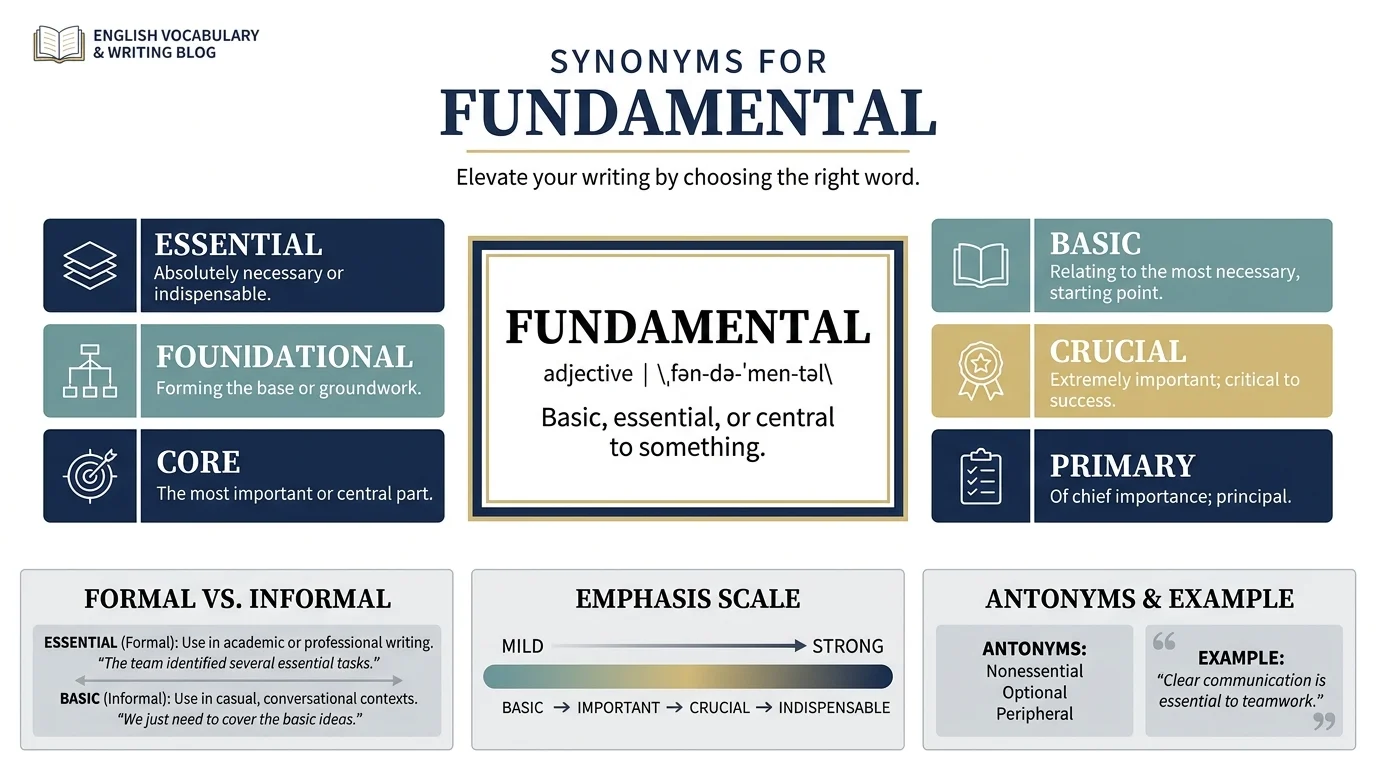
Fundamental means basic, essential, or central to understanding, developing, or maintaining something. Common synonyms include essential, basic, foundational, core, primary, and crucial. Use essential for necessity, foundational for underlying principles, and crucial when emphasizing importance in academic, professional, or everyday writing.
Meaning, Tone and Context
What does fundamental mean?
Fundamental describes something that forms the basis of a subject, system, belief, process, or activity. It can refer to a necessary element, a basic principle, or an important underlying idea.
For example, reading comprehension is fundamental to academic success because it supports learning across many subjects.
Part of speech
Fundamental is primarily an adjective. It describes the importance or basic nature of a person, idea, skill, principle, or component.
Examples:
- Adjective: Clear communication is fundamental to effective teamwork.
- Plural noun: The course introduces students to the fundamentals of economics.
- Related noun: Fundamentality is a specialized term for the quality of being fundamental, although it is uncommon in everyday writing.
Tone and formality
Fundamental generally has a neutral, informative, and professional tone. It works well in academic essays, technical explanations, business documents, educational materials, and everyday discussions.
Its exact meaning depends on context. In one sentence, it may mean basic. In another, it may mean indispensable or critically important.
Common use cases
Use fundamental when discussing:
- Basic principles of a subject
- Essential skills and knowledge
- Core values and beliefs
- Underlying structures or systems
- Conditions necessary for success
- Rules that support a process
The key is to identify whether you mean something is basic, central, necessary, or especially important before selecting a replacement.
When and How to Use “Fundamental”
Use fundamental when you want to explain that something forms the basis of a subject or plays an important role in making a system, skill, or process work.
Here are seven realistic examples showing how the word fits different situations.
1. Professional: Trust is fundamental to building strong relationships with clients.
2. Academic: Understanding fractions is fundamental to learning more advanced mathematics.
3. Personal: Respect is fundamental to a healthy friendship.
4. Business: Accurate financial records are fundamental to responsible decision making.
5. Email: A clear project timeline is fundamental to meeting our shared goals.
6. Resume: Strong analytical skills provide a fundamental basis for evaluating complex information.
7. Social media: Good habits are fundamental to lasting personal growth.
In each example, the word describes something basic or important to a larger outcome. However, essential, necessary, or foundational may communicate the intended meaning more precisely in certain sentences.
Another Word for “Fundamental”
The best single replacement for fundamental is usually essential when you mean something is necessary or extremely important. However, foundational is often better for underlying principles, while core works well when describing the central part of a subject or system.
Choose an alternative according to your purpose.
| Situation | Recommended synonym | Example |
|---|---|---|
| Professional writing | Essential | Clear documentation is essential for quality control. |
| Academic writing | Foundational | The course introduces foundational research methods. |
| Casual conversation | Basic | We need to understand the basic rules first. |
| Emotional writing | Indispensable | Her encouragement was indispensable during a difficult period. |
| Creative writing | Underlying | An underlying fear shaped his decisions. |
| Resume or workplace | Core | Data analysis is a core competency for this position. |
| Social media captions | Key | Consistency is key to personal growth. |
| Stronger meaning | Crucial | Reliable evidence is crucial to the investigation. |
| Softer meaning | Basic | The workshop covers basic communication techniques. |
Choosing the right replacement
- Essential means something is needed.
- Foundational means something supports further learning or development.
- Core means something belongs at the center of a subject or system.
- Crucial means something has a particularly important effect on the outcome.
- Basic means something concerns the simplest or introductory level.
These words overlap, but they are not interchangeable in every sentence.
When Not to Use “Fundamental”
Although fundamental works in many contexts, it can sound too broad when a sentence needs a more specific description.
| Situation | Less precise sentence | Better alternative |
|---|---|---|
| Expressing necessity | Water is fundamental for survival. | Water is essential for survival. |
| Describing the beginning of learning | She studied fundamental Spanish. | She studied basic Spanish. |
| Identifying central values | Honesty is a fundamental company value. | Honesty is a core company value. |
| Emphasizing urgency or importance | Accurate measurements are fundamental to the experiment. | Accurate measurements are crucial to the experiment. |
| Describing an underlying structure | The course teaches fundamental principles. | The course teaches foundational principles. |
Fundamental is not incorrect in these examples. The alternatives simply emphasize different aspects of the meaning.
Avoid replacing it with a stronger word merely to make your writing sound impressive. Precision is more valuable than intensity.
Words Commonly Confused With “Fundamental”
Several related words describe importance or basic knowledge, but their meanings differ slightly.
| Word | Main difference | Best use |
|---|---|---|
| Essential | Emphasizes necessity | Requirements, resources, and skills |
| Important | Emphasizes significance without necessarily implying necessity | General explanations and everyday writing |
| Basic | Emphasizes introductory knowledge or a simple level | Beginner lessons and instructions |
| Foundational | Emphasizes support for later learning or development | Education, research, and systems |
| Primary | Identifies the first, main, or leading item | Priorities, objectives, and causes |
| Crucial | Emphasizes a decisive effect on an outcome | Decisions, risks, and time sensitive situations |
For example, a basic skill may be easy to learn, but a crucial skill may determine whether a project succeeds. A foundational principle supports later understanding, while an essential requirement must be met.
Best Synonym by Context for “Fundamental”
The best synonym depends on what the sentence emphasizes. Use this table to choose a natural alternative for different writing situations.
| Context | Best synonym | Why it works | Example |
|---|---|---|---|
| Formal writing | Essential | Communicates necessity clearly | Transparency is essential to responsible leadership. |
| Academic writing | Foundational | Highlights the basis of further learning | The theory provides foundational concepts for the study. |
| Business communication | Core | Identifies a central element | Customer satisfaction is a core business objective. |
| Resume | Key | Highlights a relevant qualification | Demonstrated key skills in project coordination. |
| Casual conversation | Basic | Sounds straightforward and natural | Let’s review the basic rules. |
| Creative writing | Underlying | Suggests a deeper cause or idea | An underlying tension changed the mood of the story. |
| Emotional writing | Indispensable | Expresses exceptional personal value | Her friendship was indispensable to my recovery. |
| Strong emphasis | Crucial | Highlights a decisive factor | Timing is crucial to the operation. |
| Moderate emphasis | Important | Avoids overstating necessity | Regular practice is important for improvement. |
| Social media captions | Key | Creates concise, accessible wording | Patience is key to progress. |
| Technical documentation | Primary | Identifies a principal component or purpose | The primary function is to protect user data. |
| Instructions | Basic | Focuses on introductory knowledge | Learn the basic steps before proceeding. |
| Research writing | Underlying | Describes a supporting principle or cause | The study examines underlying assumptions. |
| Leadership | Central | Highlights a main value or concern | Accountability is central to effective leadership. |
| Public speaking | Vital | Adds emphasis and urgency | Public trust is vital to democratic institutions. |
For US English, these choices are natural and widely understood. The main distinction is not American versus British usage, but the meaning and level of emphasis required by the sentence.
Which Synonym Should You Choose?
Use these five questions to select the most accurate alternative.
1. Are you describing necessity? Choose essential, necessary, or indispensable.
2. Are you describing a basis for further development? Choose foundational, underlying, or basic, depending on the intended meaning.
3. Are you identifying the central part of something? Choose core, central, or primary.
4. Are you emphasizing a decisive outcome? Choose crucial, critical, or vital.
5. Are you writing for a specific audience? Use straightforward language in casual conversation, precise terminology in academic work, and relevant competency language in professional documents.
A useful editing technique is to replace fundamental with your preferred synonym and read the sentence again. If the replacement changes the meaning, it is not the right choice.
Real Life Examples of “Fundamental” in Sentences
The following examples show how alternatives can make writing more specific and natural.
| Situation | Example sentence |
|---|---|
| School | A solid understanding of grammar is essential for clear writing. |
| Workplace | Communication is a core part of successful collaboration. |
| Academic writing | The research establishes foundational principles for future studies. |
| Conversation | Learning the basics makes the rest much easier. |
| Social media | Discipline is key to reaching your goals. |
| Resume | Applied core analytical skills to improve reporting accuracy. |
| Accurate figures are essential before we finalize the proposal. | |
| Storytelling | An underlying promise influenced every decision she made. |
| Business presentation | Customer feedback is crucial to improving the product. |
| Personal development | Self awareness is central to meaningful growth. |
Notice how each replacement reflects the purpose of the sentence. Strong vocabulary is not about using complicated words. It is about choosing the word that expresses your intended meaning accurately.
25 Synonyms for “Fundamental”
The following table includes exactly 25 alternatives. Some are close synonyms, while others work only in particular contexts.
| Synonym | Simple meaning | Best used for | Example sentence |
|---|---|---|---|
| 1. Essential | Absolutely necessary | Requirements and survival | Clean water is essential for human health. |
| 2. Basic | Simple or introductory | Beginner knowledge | The guide explains basic accounting principles. |
| 3. Foundational | Providing a basis for growth | Education and development | Reading is a foundational academic skill. |
| 4. Core | Central or most important | Values and competencies | Integrity is a core leadership quality. |
| 5. Primary | Main or first in importance | Objectives and priorities | Safety is our primary concern. |
| 6. Crucial | Extremely important to success | Decisions and outcomes | Accurate data is crucial to the analysis. |
| 7. Critical | Essential to a result or judgment | Evaluation and risk | Timing is critical to the launch. |
| 8. Vital | Necessary for continued function or success | Health and survival | Sleep is vital to concentration. |
| 9. Necessary | Required or needed | Rules and conditions | Approval is necessary before publication. |
| 10. Indispensable | Impossible or very difficult to do without | Resources and relationships | Her expertise was indispensable to the team. |
| 11. Central | At the center of an issue | Arguments and themes | Fairness is central to the discussion. |
| 12. Underlying | Existing beneath or supporting the surface | Causes and assumptions | The report identifies underlying problems. |
| 13. Intrinsic | Belonging naturally to something | Qualities and values | Curiosity has intrinsic value in learning. |
| 14. Integral | Forming an essential part of a whole | Processes and systems | Testing is integral to software development. |
| 15. Key | Particularly important | Summaries and presentations | Planning is a key part of the process. |
| 16. Principal | Chief or leading | Formal documents and roles | The principal objective is to reduce waste. |
| 17. Elementary | Basic or introductory | Introductory education | The textbook introduces elementary scientific concepts. |
| 18. Rudimentary | Developed only to a basic level | Early skills or systems | The prototype has rudimentary safety features. |
| 19. Bedrock | The underlying support or basis | Values and beliefs | Trust is the bedrock of a lasting partnership. |
| 20. Cornerstone | A central supporting element | Principles and institutions | Education is a cornerstone of social progress. |
| 21. Pivotal | Critically influential in a change or outcome | Turning points | Her research played a pivotal role in the discovery. |
| 22. Imperative | Absolutely necessary or urgent | Instructions and formal arguments | Immediate action is imperative. |
| 23. Fundamental to | Forming a necessary basis for something | Formal explanations | Evidence is fundamental to sound research. |
| 24. Constitutive | Helping form the nature or identity of something | Specialized academic writing | Shared rules are constitutive of the institution’s structure. |
| 25. Structural | Relating to the basic arrangement of a system | Engineering and organization | The review identified structural weaknesses in the framework. |
Important distinction: These alternatives do not all fit every use of fundamental. For example, rudimentary describes a limited level of development, while pivotal describes decisive influence. Constitutive and structural are more specialized terms and should be used only when their meanings fit the sentence.
Synonym Groups and Usage Differences
Professional vs. Personal Synonyms
Professional writing benefits from words that communicate a specific role or requirement. Essential, core, critical, and integral are useful in business reports, performance reviews, and project discussions.
Personal writing often sounds more natural with important, key, central, or indispensable. For example, “Your support was indispensable to me” communicates a stronger personal attachment than “Your support was important to me.”
Formal vs. Conversational Synonyms
Formal writing often requires precise descriptions of necessity, structure, or significance. Conversational writing usually benefits from simpler words.
| Formal choice | Conversational choice | Example |
|---|---|---|
| Indispensable | Necessary | Reliable information is necessary for the task. |
| Foundational | Basic | These are the basic skills you need. |
| Integral | Important | Practice is important when learning an instrument. |
| Imperative | Necessary | It is necessary to address the issue now. |
| Principal | Main | Our main goal is to improve service. |
Use formal language when precision matters, not simply because a longer word sounds more sophisticated.
Academic Synonyms
In academic writing, the most suitable synonym depends on the claim you are making.
- Foundational: A concept that supports later theories or learning.
- Essential: A condition or element that is necessary.
- Underlying: A principle, assumption, or cause that operates beneath the surface.
- Integral: A component that forms part of a larger system.
- Central: An idea that occupies a leading position in an argument.
- Intrinsic: A quality or value that belongs to something in itself.
Example: “The study examines the underlying assumptions behind the model.”
This is more precise than saying the study examines the fundamental assumptions when the emphasis is specifically on assumptions that shape the model.
Professional and Business Synonyms
In business communication, choose alternatives that make responsibilities, requirements, and objectives clear.
| Business purpose | Recommended word | Example |
|---|---|---|
| Required qualification | Essential | Technical knowledge is essential for this role. |
| Main responsibility | Primary | My primary responsibility is quality assurance. |
| Important competency | Core | Problem solving is a core competency. |
| Major risk factor | Critical | System reliability is critical to operations. |
| Necessary process | Integral | Verification is integral to our review process. |
| Key company principle | Cornerstone | Accountability is a cornerstone of our culture. |
For resumes, describe actual skills and responsibilities rather than relying on vague claims. “Applied essential safety procedures” communicates more when accompanied by a specific achievement or measurable result.
Creative or Literary Synonyms
Creative writing often needs words that communicate structure, depth, influence, or symbolism.
- Bedrock suggests a stable underlying support.
- Cornerstone suggests a central pillar or guiding principle.
- Underlying hints at an unseen motive or hidden cause.
- Pivotal highlights a turning point.
- Intrinsic emphasizes a quality that belongs naturally to something.
Example: “An underlying grief shaped every letter she wrote.”
This sentence offers a more specific emotional implication than saying grief was fundamental to her writing.
Slang or Modern Synonyms
Fundamental does not have a widely accepted slang equivalent that preserves all its meanings. However, some informal expressions work in particular situations.
- Key: “Consistency is key.”
- Must have: “A reliable charger is a must have for long trips.”
- The basics: “Let’s get the basics right first.”
- A big deal: “Trust is a big deal in any relationship.”
These expressions suit casual conversations, texts, and social media captions. Avoid using them as automatic replacements in research papers, formal proposals, or technical documentation.
Strongest vs. Weaker Synonyms
There is no universal intensity scale because necessity, importance, and influence are different concepts. Still, the following groups help distinguish emphasis.
A practical emphasis scale
Mild
Basic, important
Describes introductory knowledge or general significance.
Moderate
Key, central, core
Highlights a main part or leading consideration.
Strong
Crucial, critical, vital
Emphasizes a major effect on an outcome.
Highest
Indispensable, imperative
Conveys that something cannot reasonably be dispensed with, or that action is urgently required.
This is a practical writing guide, not a strict ranking. An indispensable resource expresses necessity, while an imperative action emphasizes urgency.
Emotional vs. Neutral Synonyms
Neutral words explain a situation without adding much emotion. Emotional or emphatic alternatives communicate stronger feelings, urgency, or personal value.
| Neutral wording | More expressive wording | Difference |
|---|---|---|
| Important | Indispensable | Suggests something cannot be done without. |
| Central | Bedrock | Adds an image of stability and support. |
| Main | Pivotal | Suggests a decisive influence on an outcome. |
| Necessary | Vital | Adds a stronger sense of importance. |
| Basic | Foundational | Emphasizes support for further development. |
Choose a neutral word for objective explanations and a more expressive alternative when the intended meaning genuinely calls for greater emphasis.
Antonyms of “Fundamental”
Fundamental has several possible meanings, so its opposites depend on context. The following 15 words contrast with its meanings of basic, central, necessary, or foundational. Some are contextual opposites rather than exact dictionary antonyms.
| Antonym | Meaning | Example sentence |
|---|---|---|
| 1. Nonessential | Not necessary | The extra decoration is nonessential to the design. |
| 2. Unnecessary | Not needed | The report contains unnecessary details. |
| 3. Optional | Left to personal choice | Attendance at the workshop is optional. |
| 4. Incidental | Secondary or occurring as a side effect | The additional expense was incidental to the main project. |
| 5. Peripheral | Outside the central focus | The discussion moved toward peripheral issues. |
| 6. Secondary | Less important than the main concern | Cost became a secondary consideration. |
| 7. Superficial | Concerned with surface appearance rather than depth | The review offered only a superficial explanation. |
| 8. Trivial | Of little importance | The committee resolved a trivial disagreement. |
| 9. Minor | Relatively unimportant or small | The change had only a minor effect. |
| 10. Advanced | Beyond the basic or introductory level | Students moved on to advanced mathematics. |
| 11. Complex | Made up of many connected or difficult parts | The team developed a complex solution. |
| 12. Elaborate | Detailed or highly developed | The proposal included an elaborate implementation plan. |
| 13. Derivative | Based on something already established rather than original | Critics described the design as derivative. |
| 14. Tertiary | Third in order or rank | The report discusses tertiary effects after the primary and secondary effects. |
| 15. Supplementary | Added to support or complete something else | Supplementary notes provide additional background information. |
Not every antonym works in every sentence. For example, advanced contrasts with fundamental when fundamental means introductory, while nonessential is a better opposite when fundamental means necessary.
Comparison: Fundamental vs. Similar Words
Fundamental vs. Essential
Main difference: Fundamental describes something basic or central to a system or subject. Essential emphasizes that something is necessary.
Which is stronger? Essential more directly communicates necessity, while fundamental can describe either a basic principle or an important element.
Which is more formal? Both work well in formal writing.
Examples:
- Fundamental: Understanding sentence structure is fundamental to learning grammar.
- Essential: Regular practice is essential for improving grammar.
Fundamental vs. Basic
Main difference: Basic usually refers to an introductory level or a simple form. Fundamental often emphasizes the underlying principles of a subject.
Which is stronger? Fundamental often conveys greater conceptual importance, although context determines the emphasis.
Which is more formal? Fundamental often sounds more academic, but both are appropriate in professional communication.
Examples:
- Fundamental: Ethics is fundamental to responsible research.
- Basic: The course covers basic research techniques.
Fundamental vs. Foundational
Main difference: Fundamental describes something basic or central. Foundational specifically emphasizes a basis on which further learning, development, or structure depends.
Which is stronger? Neither is universally stronger. Foundational is more specific when describing support for later development.
Which is more formal? Both are common in academic and professional writing.
Examples:
- Fundamental: Critical thinking is fundamental to good decision making.
- Foundational: The workshop teaches foundational analytical skills.
Fundamental vs. Crucial
Main difference: Fundamental can describe a basic principle or essential component. Crucial emphasizes the decisive importance of something in a particular outcome.
Which is stronger? Crucial generally creates a stronger sense of urgency or consequence.
Which is more formal? Both are suitable for formal communication.
Examples:
- Fundamental: Accurate records are fundamental to sound accounting.
- Crucial: Accurate records are crucial during a financial audit.
Fundamental vs. Core
Main difference: Fundamental often describes underlying principles or necessary elements. Core identifies the central part of a subject, system, or set of values.
Which is stronger? Neither is inherently stronger. Core is often more concise when identifying central competencies or priorities.
Which is more formal? Both work in formal writing, although core can sound more direct in business communication.
Examples:
- Fundamental: Clear communication is fundamental to collaboration.
- Core: Clear communication is a core team competency.
Fundamental vs. Primary
Main difference: Fundamental describes something basic or essential. Primary identifies what comes first in importance, order, or priority.
Which is stronger? Neither is universally stronger. Primary establishes rank or priority, while fundamental emphasizes a basis or essential role.
Which is more formal? Both are appropriate in academic and professional writing.
Examples:
- Fundamental: Trust is fundamental to a successful partnership.
- Primary: Trust is the primary concern in this negotiation.
Common Phrases and Expressions with “Fundamental”
These phrases are useful in academic writing, professional communication, and everyday explanations.
1. Fundamental principles
Meaning: The basic rules or ideas that guide a subject or activity.
Example sentence: The course introduces the fundamental principles of economics.
2. Fundamental rights
Meaning: Basic rights regarded as essential to individual freedom or legal protection.
Example sentence: The constitution protects fundamental rights and liberties.
3. Fundamental change
Meaning: A major change that affects the basic nature or structure of something.
Example sentence: The organization needs a fundamental change in how it evaluates performance.
4. Fundamental difference
Meaning: A major distinction between two ideas, systems, or approaches.
Example sentence: There is a fundamental difference between saving money and investing it.
5. Fundamental question
Meaning: A basic or central question that needs to be answered.
Example sentence: The researchers began with a fundamental question about human behavior.
6. Fundamental role
Meaning: A central or essential function in a process or system.
Example sentence: Teachers play a fundamental role in supporting student development.
7. Fundamental to success
Meaning: Necessary or central to achieving a desired outcome.
Example sentence: Consistent preparation is fundamental to success in competitive examinations.
8. Fundamental understanding
Meaning: Basic knowledge of a subject or its underlying principles.
Example sentence: A fundamental understanding of statistics helps readers interpret research findings.
Common Mistakes to Avoid
1. Using fundamental when essential is more precise
Fundamental may suggest that something forms a basis, but essential clearly communicates necessity.
Less precise: A password is fundamental to accessing the account.
More precise: A valid password is necessary to access the account.
2. Confusing basic with foundational
Basic often describes introductory knowledge, while foundational emphasizes support for further learning.
Use basic for beginner instructions and foundational for principles that support more advanced understanding.
3. Using crucial for every important point
Crucial implies that something has a major effect on an outcome. Using it for minor details can exaggerate their importance.
Choose important or relevant when the situation does not justify stronger emphasis.
4. Making simple writing unnecessarily formal
Words such as indispensable, imperative, and constitutive may make a sentence harder to read when a simpler alternative works.
Prefer clear language over impressive sounding vocabulary.
5. Repeating fundamental too often
Repeating the same adjective can make an essay or report feel monotonous.
Instead, identify whether the next sentence describes necessity, a central component, a basic level, or a decisive factor. Choose the corresponding synonym.
6. Choosing a synonym with the wrong meaning
A pivotal event changes an outcome, while a foundational principle supports further development. These words are not interchangeable in every context.
Check the exact meaning before making a replacement.
7. Using casual expressions in academic writing
Expressions such as “a big deal” and “is key” can work in conversations and informal posts, but may be unsuitable for formal research writing.
Use essential, central, or crucial when these words accurately express your point.
FAQs
1. What is the best synonym for fundamental?
Essential is often the best synonym when fundamental means necessary. Foundational works better for underlying principles, while core describes the central part of a system or subject.
2. What is a formal synonym for fundamental?
Foundational, essential, integral, and indispensable are formal alternatives. Choose foundational for underlying support and integral when describing a necessary component of a larger system.
3. What is an informal synonym for fundamental?
Basic, important, and key are natural alternatives in everyday conversations. For example, “Let’s review the basics” sounds more conversational than “Let’s review the fundamental principles.”
4. What is another word for fundamental in professional writing?
Essential, core, primary, and critical work well in professional writing. Use essential for requirements, core for central competencies, and critical when emphasizing an important outcome.
5. What is the difference between fundamental and foundational?
Fundamental describes something basic, central, or essential. Foundational specifically emphasizes the basis that supports further learning, development, or structure.
6. What is the opposite of fundamental?
The opposite depends on the intended meaning. Nonessential is appropriate when fundamental means necessary, while peripheral contrasts with central and advanced contrasts with basic.
Conclusion
Fundamental describes something basic, essential, or central to a subject, process, or outcome. The best synonyms depend on the meaning you want to communicate. Use essential for necessity, foundational for underlying support, core for central elements, and crucial for decisive importance.
In academic writing, precision matters more than complexity. Professional communication, choose words that clearly express requirements, priorities, and responsibilities. In everyday conversation, simpler alternatives such as basic, important, and key often sound more natural.
A practical vocabulary tip: Before replacing fundamental, ask yourself whether you mean basic, necessary, central, or decisive. Identifying that distinction will help you choose a synonym that improves clarity without changing your intended meaning.list above can also be used to review formatting and editorial consistency before the article goes live.
Discover More Post:
- 50+ Synonyms for Snow | From Gentle Flurries to a Winter …
- 50+ Synonyms for Snow | From Gentle Flurries to a Winter …
- 50+ Synonyms for Impressive | Powerful Alternatives to …