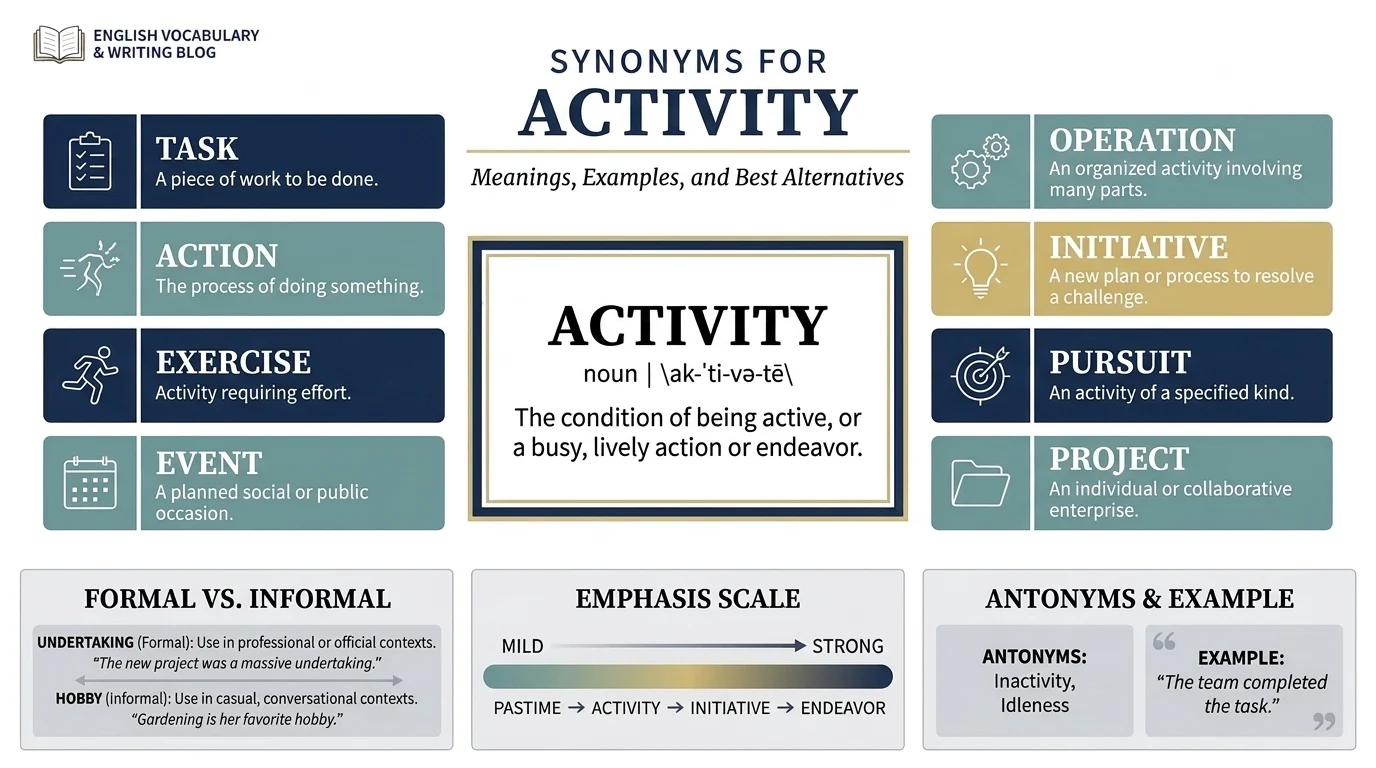
The word activity appears everywhere, from school assignments and workplace reports to social media captions and everyday conversations. However, repeating it in every sentence can make your writing sound vague or predictable.
Learning the best synonyms for activity helps you communicate more precisely. Depending on your meaning, you might choose task, action, exercise, operation, event, or engagement. This guide explains their differences, provides natural examples, and helps you select the right word for each situation.
What Does “Activity” Mean?
Activity means an action, task, process, or instance of doing something. Common synonyms include task, action, exercise, operation, undertaking, event, and pursuit. Formal writing may favor operation or undertaking, while casual conversation often uses task, exercise, or something to do.
Meaning, Tone and Context
What does activity mean?
Activity refers to the state of being active or something a person, group, or organization does. It can describe physical movement, a planned task, a social event, or a process intended to achieve a particular goal.
For example, a classroom activity might help students practice vocabulary, while business activity could describe a company’s daily operations.
Grammar and word usage
| Feature | Explanation |
|---|---|
| Part of speech | Noun |
| Plural form | Activities |
| General tone | Neutral |
| Formality | Suitable for casual, academic, and professional writing |
| Common contexts | Education, business, fitness, hobbies, science, and social events |
| Related adjective | Active |
| Related verb | Activate, although it has a more specific meaning |
| Opposite concepts | Inactivity, idleness, stillness |
Is activity positive, negative, or neutral?
The word is usually neutral. Its emotional meaning depends on the situation.
- Positive: Community activities bring neighbors together.
- Neutral: The report summarizes business activity.
- Negative: Suspicious activity was detected near the entrance.
This flexibility makes activity useful, but it can also make the word less precise than a suitable alternative.
Common meanings of activity
1. Something a person does: A task, action, or undertaking.
2. Physical movement: Exercise, motion, or physical exertion.
3. An organized occasion: An event, program, or group exercise.
4. Work or business operations: Operations, transactions, or professional tasks.
5. A process or observable change: Movement, functioning, or measurable activity within a system.
Choosing a synonym starts with identifying which meaning you intend to communicate.
When and How to Use “Activity”
Use activity when referring to an action, experience, or process without needing to specify every detail. Replace it with a more precise term when the exact purpose or type of action matters.
Here are seven realistic examples.
1. Professional: The manager reviewed the team’s daily activities.
More precise: The manager reviewed the team’s daily tasks.
2. Academic: The teacher planned an activity to improve reading comprehension.
More precise: The teacher planned a reading exercise.
3. Personal: Gardening is my favorite weekend activity.
Alternative: Gardening is my favorite weekend pursuit.
4. Fitness: Regular physical activity supports general well being.
Alternative: Regular exercise supports general well being.
5. Social media: Looking for fun activities this weekend.
Alternative: Looking for fun things to do this weekend.
6. Business: Online activity increased during the promotion.
More precise: Website engagement increased during the promotion, if visitor interaction is what you measured.
7. Creative writing: Activity filled the quiet streets before sunrise.
More vivid: Movement filled the quiet streets before sunrise.
The best replacement depends on what the sentence actually describes. A task is something to complete, an exercise is something to practice, and an event is something that happens at a particular time.
Another Word for “Activity”
There is no single synonym that fits every use of activity. The best alternative depends on the action, setting, and intended meaning.
| Situation | Best alternative | Why it works |
|---|---|---|
| Professional writing | Task | Identifies work that needs to be completed |
| Academic writing | Exercise | Emphasizes practice or learning |
| Casual conversation | Thing to do | Sounds natural and approachable |
| Emotional writing | Pursuit | Can suggest personal passion or commitment |
| Creative writing | Movement | Adds a sense of motion |
| Resume writing | Initiative | Highlights proactive effort when appropriate |
| Business reporting | Operation | Describes an organized business process |
| Social media captions | Adventure | Adds excitement to an enjoyable experience |
| Stronger meaning | Undertaking | Suggests a substantial or purposeful effort |
| Softer meaning | Pastime | Suggests a relaxed leisure activity |
Choosing by tone
- For professional writing: Use task, operation, initiative, or undertaking when the specific meaning fits.
- For academic writing: Choose exercise, experiment, procedure, or assignment according to the educational purpose.
- For casual conversation: Use thing to do, game, outing, or hobby when that is what you mean.
- For emotional writing: Words such as passion, pursuit, and commitment can express personal meaning, but they are not interchangeable with activity in every sentence.
- For creative writing: Consider movement, action, adventure, or endeavor to create a more specific impression.
- For resumes: Replace vague descriptions of activities with concrete terms such as projects, initiatives, responsibilities, or contributions. Use only terms that accurately describe your work.
When Not to Use “Activity”
Although activity is versatile, it can become vague when readers need specific information.
1. When describing a task with a clear outcome
Vague: I completed several activities for the department.
Clearer: I completed three customer research reports for the department.
2. When describing physical fitness
Vague: I do activity every morning.
Natural: I exercise every morning.
3. When describing an organized occasion
Vague: We attended an activity on Saturday.
Clearer: We attended a community festival on Saturday.
4. When reporting measurable business results
Vague: Customer activity improved.
Clearer: Customer engagement increased, if the data measures customer interactions.
5. When explaining a scientific process
Vague: The activity changed after treatment.
More precise: The enzyme activity decreased after treatment, if that is what the measurements show.
6. When emphasizing achievement
Vague: I participated in many activities at work.
Stronger: I coordinated team projects and organized employee training sessions.
Practical tip: Use activity as a general category, but name the exact task, event, process, or result whenever that information helps the reader.
Words Commonly Confused With “Activity”
Several words overlap with activity, but each emphasizes a different aspect of doing something.
| Word | Main difference | Best use |
|---|---|---|
| Action | A specific act or step taken | Decisions and responses |
| Task | Work that needs to be completed | School and workplace responsibilities |
| Event | Something organized or occurring at a particular time | Meetings, festivals, and celebrations |
| Exercise | Physical practice or an activity designed to develop a skill | Fitness and education |
| Operation | An organized process or functioning system | Business, technology, and medicine |
| Engagement | Involvement or participation | Education, marketing, and relationships |
For example, a school may organize an event that includes several activities. One activity might be a writing exercise, which consists of individual tasks. Each term identifies a different part of the experience.
Best Synonym by Context for “Activity”
The following table helps you choose the most accurate alternative for different writing situations.
| Context | Best synonym | Why it works | Example |
|---|---|---|---|
| Formal writing | Undertaking | Suggests a purposeful effort | The undertaking required careful planning. |
| Academic writing | Exercise | Emphasizes practice or learning | Students completed a grammar exercise. |
| Professional communication | Task | Clearly identifies assigned work | Please finish the task by noon. |
| Business operations | Operation | Refers to an organized process | The operation runs around the clock. |
| Resume | Initiative | Highlights proactive contribution | Led an initiative to improve onboarding. |
| Casual conversation | Thing to do | Sounds natural and friendly | We need something fun to do. |
| Creative writing | Movement | Creates a sense of motion | Movement returned to the empty square. |
| Emotional writing | Pursuit | Suggests a personally meaningful goal | Music became her lifelong pursuit. |
| Stronger meaning | Endeavor | Highlights effort toward a goal | The endeavor took months of preparation. |
| Softer meaning | Pastime | Suggests relaxed leisure | Reading is his favorite pastime. |
| Social media captions | Adventure | Adds excitement to an experience | A weekend adventure with friends. |
| Physical fitness | Exercise | Specifically describes physical training | Daily exercise helps build endurance. |
| School activities | Assignment | Identifies work given to learners | The assignment helped students practice writing. |
| Community programs | Event | Identifies an organized occasion | The charity event welcomed local families. |
| Digital marketing | Engagement | Emphasizes audience interaction | Audience engagement increased this month. |
What about US and UK usage?
Activity is standard in both American and British English. Most of the synonyms in this guide are also used in both varieties.
The difference often comes from context rather than geography. American schools commonly use assignment for work given to students, while task and exercise are also widely understood in both countries.
Which Synonym Should You Choose?
Follow these practical steps before replacing activity.
1. Identify the meaning. Is it work, exercise, an event, participation, or a personal interest? Choose a word that names that specific idea.
2. Consider formality. Use task or operation in suitable workplace contexts. Choose thing to do in relaxed conversation.
3. Check emotional intensity. Pastime sounds relaxed, while endeavor suggests purposeful effort. Avoid making an ordinary task sound unusually dramatic.
4. Think about professional value. In resumes and reports, name the responsibility or result instead of using a broad word. Coordinated training sessions tells readers more than handled activities.
5. Read the whole sentence. A synonym should preserve the original meaning and fit naturally with the surrounding words.
6. Avoid forced substitutions. Some words are related to activity without being direct replacements. Participation, for example, emphasizes taking part rather than the action itself.
Real Life Examples of “Activity” in Sentences
These examples show how choosing a more precise word can improve everyday communication.
| Situation | General sentence | More precise sentence |
|---|---|---|
| School | The activity helped us learn grammar. | The grammar exercise helped us practice sentence structure. |
| Workplace | I managed several activities. | I coordinated several team projects. |
| Writing | The activity continued throughout the night. | The operation continued throughout the night. |
| Conversation | What activity should we do today? | What should we do today? |
| Social media | A fun activity with my friends. | A fun outing with my friends. |
| Resume | Participated in office activities. | Contributed to employee training and team projects. |
| Please complete the activity soon. | Please complete the assigned task by Friday. | |
| Storytelling | There was activity in the forest. | Movement rustled through the forest. |
Notice that some improved sentences remove the word entirely. Good editing is not always about finding a synonym. Sometimes a clearer sentence is the better solution.
25 Synonyms for “Activity”
The following 25 alternatives cover everyday, academic, professional, creative, and leisure related meanings. They are related words with overlapping meanings, not perfect substitutes in every context.
| Synonym | Simple meaning | Best used for | Example sentence |
|---|---|---|---|
| 1. Action | Something someone does | Decisions and responses | Her quick action prevented further damage. |
| 2. Task | A piece of work to complete | Work and school | I finished the final task before lunch. |
| 3. Exercise | Practice or physical exertion | Learning and fitness | The exercise improved our writing skills. |
| 4. Operation | An organized process | Business and systems | The operation resumed after repairs. |
| 5. Undertaking | A purposeful project or effort | Formal writing | The undertaking required additional funding. |
| 6. Endeavor | A serious effort toward a goal | Formal and motivational writing | Their endeavor brought clean water to the village. |
| 7. Pursuit | An ongoing interest or goal | Hobbies and ambitions | Photography became her favorite pursuit. |
| 8. Event | An occasion or happening | Social and public settings | The annual event attracted hundreds of visitors. |
| 9. Engagement | Involvement or participation | Education and business | Student engagement improved during group work. |
| 10. Initiative | A proactive plan or action | Workplace and leadership | He launched an initiative to reduce waste. |
| 11. Project | Planned work with a defined objective | School and business | Our project focuses on renewable energy. |
| 12. Assignment | Work given to someone | Education and employment | The assignment is due next Monday. |
| 13. Procedure | An established sequence of steps | Technical and professional settings | Follow the procedure carefully. |
| 14. Process | A series of connected steps | Research and operations | The process takes approximately two hours. |
| 15. Practice | Repeated effort to improve a skill | Education and performance | Daily practice strengthened her vocabulary. |
| 16. Movement | A change in position or motion | Physical and descriptive contexts | Movement near the entrance caught our attention. |
| 17. Exercise session | A period devoted to physical training | Fitness | My exercise session starts at seven. |
| 18. Hobby | An enjoyable personal interest | Leisure | Cooking is a hobby I share with friends. |
| 19. Pastime | An enjoyable way to spend free time | Relaxed personal activities | Gardening is a peaceful pastime. |
| 20. Recreation | Enjoyable activity during leisure time | Parks and free time | The center offers recreation for all ages. |
| 21. Adventure | An exciting or unusual experience | Travel and storytelling | Their mountain adventure lasted three days. |
| 22. Outing | A short trip or social excursion | Family and friends | We planned a weekend outing to the coast. |
| 23. Transaction | An exchange or business deal | Finance and commerce | The system records every transaction. |
| 24. Functioning | The way something works | Technical descriptions | The technician checked the functioning of the device. |
| 25. Participation | The act of taking part | Groups and organized programs | Participation in the workshop was voluntary. |
Which of these synonyms is best?
For most everyday situations, task is useful when describing work, exercise fits learning or fitness, event describes an organized occasion, and operation suits a coordinated process.
Choose hobby, pastime, or recreation for leisure. Use initiative, project, or undertaking when the context involves planned effort. The most accurate word is the one that preserves your intended meaning.
Synonym Groups and Usage Differences
Professional vs. Personal Synonyms
Professional writing often needs words that identify responsibilities, processes, and results. Personal writing usually focuses on enjoyment, interests, or experiences.
| Professional context | Personal context |
|---|---|
| Task | Hobby |
| Project | Pastime |
| Operation | Recreation |
| Initiative | Pursuit |
| Procedure | Outing |
For example, I coordinated a training initiative communicates professional responsibility. I enjoy photography as a hobby describes a personal interest.
Formal vs. Conversational Synonyms
Formal words can help explain complex or organized work. Conversational alternatives make everyday communication feel less technical.
| Formal or structured | Conversational |
|---|---|
| Undertaking | Thing to do |
| Endeavor | Effort |
| Operation | Job, when referring to a specific piece of work |
| Assignment | Task |
| Recreation | Fun |
| Outing | Trip |
Use the formal option when precision or a professional tone matters. In texts and casual conversations, simpler expressions are often more natural.
Academic Synonyms
Academic writing benefits from specific words that identify the purpose of an activity.
- Exercise: Practice designed to develop understanding or a skill.
- Experiment: A controlled investigation used to test an idea.
- Procedure: A defined sequence of steps.
- Assignment: Work assigned to a student.
- Research: Systematic investigation to develop or evaluate knowledge.
- Participation: Involvement in a learning process.
These terms are not interchangeable. A laboratory experiment may include several procedures and exercises, but each serves a different purpose.
Professional and Business Synonyms
In workplace communication, select the term that reflects what happened.
| Workplace need | Suitable word | Example |
|---|---|---|
| Describe assigned work | Task | I completed the task before the deadline. |
| Describe planned work | Project | We launched a customer research project. |
| Show proactive effort | Initiative | She introduced an initiative to improve service. |
| Explain a business process | Operation | The operation requires regular monitoring. |
| Describe audience response | Engagement | Customer engagement rose after the campaign. |
| Describe an exchange | Transaction | The transaction was recorded successfully. |
For resumes, describe the contribution and its outcome whenever possible. Specific achievements are more informative than a generic list of activities.
Creative or Literary Synonyms
Creative writing often benefits from words that give the reader a stronger picture of what is happening.
- Movement: Suggests physical motion or visible change.
- Adventure: Conveys excitement and discovery.
- Pursuit: Suggests a continuing search or ambition.
- Endeavor: Highlights determined effort.
- Commotion: Suggests noisy or confusing activity.
- Hustle: Can convey energetic movement or busy effort.
Example: Instead of writing, There was activity in the market, try The market buzzed with movement and conversation.
The revised sentence gives readers a more vivid impression without relying on a vague noun.
Slang or Modern Synonyms
There is no universal slang substitute for activity. Informal alternatives depend on the situation.
- Things to do: A natural phrase for possible plans.
- Hangout: A casual social gathering or place to spend time.
- Hustle: Informal language for energetic work or effort.
- Fun stuff: A relaxed expression for enjoyable experiences.
These phrases can work in social media captions, texts, and informal conversations. In academic papers, business reports, and formal emails, use a precise standard term instead.
Strongest vs. Weaker Synonyms
The following scale compares the impression created by selected words. It is a guide to tone and effort, not a universal ranking of intensity.
Mild
Pastime, hobby, recreation
Relaxed, enjoyable, or personal activity.
Moderate
Task, exercise, project
Ordinary work, practice, or planned effort.
Purposeful
Initiative, undertaking, endeavor
Intentional effort toward a meaningful goal.
Intense
Frenzy, commotion, flurry
Rapid, noisy, or unusually hectic activity.
Use frenzy or commotion only when the situation really is intense or disorderly. These words add a meaning that the neutral word activity does not carry.
Emotional vs. Neutral Synonyms
Neutral words describe what happened without adding much judgment. Emotional words help convey a person’s attitude or the atmosphere of a situation.
| Neutral word | More expressive alternative | Difference |
|---|---|---|
| Task | Endeavor | Emphasizes effort and purpose |
| Hobby | Passion | Suggests strong personal interest |
| Movement | Commotion | Adds noise or disorder |
| Event | Celebration | Adds a positive, festive tone |
| Pursuit | Obsession | Suggests unusually intense preoccupation |
Be careful with emotional substitutions. Calling someone’s hobby an obsession, for example, can imply that their interest is excessive rather than simply enjoyable.
Antonyms of “Activity”
The most accurate opposite of activity is often inactivity, but other antonyms describe specific forms of rest, stillness, or lack of participation.
| Antonym | Meaning | Example sentence |
|---|---|---|
| 1. Inactivity | A lack of action or movement | Prolonged inactivity can reduce physical fitness. |
| 2. Idleness | A state of doing little or nothing | Idleness left him searching for something useful to do. |
| 3. Inaction | Failure to take action | Inaction allowed the problem to grow. |
| 4. Stillness | A lack of movement | The stillness of the lake was beautiful. |
| 5. Rest | A period of relaxation or recovery | She took a rest after the workout. |
| 6. Repose | A state of calm rest | The garden offered a place of repose. |
| 7. Passivity | A tendency not to act or respond | Passivity prevented the team from addressing the issue. |
| 8. Stagnation | A lack of progress or development | The company struggled with stagnation. |
| 9. Dormancy | A temporary state of reduced activity | The plant enters dormancy during winter. |
| 10. Inertia | Resistance to change or movement | Organizational inertia delayed the reform. |
| 11. Lethargy | A lack of energy or enthusiasm | Afternoon lethargy made concentration difficult. |
| 12. Torpor | A state of reduced energy or responsiveness | The heat left the animals in torpor. |
| 13. Quietude | A state of calm and quiet | She enjoyed the quietude of the countryside. |
| 14. Suspension | A temporary stopping of an activity | The suspension of operations lasted two days. |
| 15. Nonparticipation | The state of not taking part | Nonparticipation in the survey was voluntary. |
These words have different applications. Inactivity is a broad opposite, while stagnation suggests a lack of progress and nonparticipation specifically means not taking part.
Comparison: Activity vs. Similar Words
Activity vs. Action
Main difference: Activity can describe an ongoing process or a collection of things someone does. Action often refers to a particular act or step.
Which is stronger? Action can sound more immediate and decisive.
Which is more formal? Both work in formal writing, depending on the sentence.
Examples:
- Activity: Physical activity is important for general health.
- Action: Immediate action is needed to fix the problem.
Activity vs. Task
Main difference: Activity is broad, while a task usually has a specific purpose or expected completion.
Which is stronger? Task is more specific about assigned work.
Which is more formal? Both are appropriate for professional writing.
Examples:
- Activity: The students took part in a classroom activity.
- Task: The students completed a written assignment.
Activity vs. Exercise
Main difference: Exercise usually refers to physical training or practice intended to develop a skill. Activity can refer to almost any kind of action.
Which is stronger? Neither is inherently stronger. Exercise is more specific.
Which is more formal? Both are suitable for academic and professional contexts.
Examples:
- Activity: The instructor planned an activity for the class.
- Exercise: The instructor created a vocabulary exercise.
Activity vs. Event
Main difference: An event is an occasion or happening. An activity is something someone does or participates in.
Which is stronger? Neither. They describe different concepts.
Which is more formal? Both are standard choices in formal writing.
Examples:
- Activity: Painting was the children’s favorite activity.
- Event: The school hosted an art exhibition.
Activity vs. Engagement
Main difference: Engagement emphasizes involvement, attention, or interaction. Activity focuses more broadly on actions or processes.
Which is stronger? Engagement can communicate a deeper level of involvement.
Which is more formal? Both are common in business and academic writing.
Examples:
- Activity: Website activity increased last week.
- Engagement: Visitors interacted with more articles and videos.
Activity vs. Operation
Main difference: An operation is an organized process, function, or coordinated set of actions. Activity is more general.
Which is stronger? Operation suggests a structured process.
Which is more formal? Operation often sounds more technical or business oriented.
Examples:
- Activity: Business activity increased during the summer.
- Operation: The company’s shipping operation expanded during the summer.
Common Phrases and Expressions with “Activity”
1. Physical activity
Meaning: Bodily movement that uses energy.
Example sentence: Walking after dinner is an easy way to add physical activity to your routine.
2. Daily activities
Meaning: Things a person regularly does throughout the day.
Example sentence: The planner helps me organize my daily activities.
3. Group activity
Meaning: Something several people do together.
Example sentence: The instructor introduced a group activity to encourage teamwork.
4. Business activity
Meaning: Actions and operations associated with running a business.
Example sentence: The report summarizes business activity during the last quarter.
5. Classroom activity
Meaning: An exercise or task used for teaching and learning.
Example sentence: The teacher designed a classroom activity to build reading confidence.
6. Outdoor activity
Meaning: Something enjoyable or useful that takes place outside.
Example sentence: Hiking is my favorite outdoor activity in the fall.
7. Suspicious activity
Meaning: Behavior or actions that appear unusual or potentially concerning.
Example sentence: The security team investigated suspicious activity near the entrance.
8. Learning activity
Meaning: A task designed to support learning or develop knowledge.
Example sentence: The online learning activity helped students understand the new concept.
Common Mistakes to Avoid
1. Using activity when you mean a specific task
Weak: I have several activities to finish at work.
Better: I have several reports to finish at work.
Use the name of the work whenever you know it.
2. Confusing activity with action
Activity can describe ongoing behavior or several related actions. Action often identifies a specific response or step.
For example, The team took action is more natural when describing a response to a problem.
3. Using casual language in formal writing
Phrases such as fun stuff or things to do suit informal communication. In a research paper or business report, use terms such as tasks, procedures, or activities, depending on the meaning.
4. Choosing an overly dramatic synonym
Words such as frenzy and commotion imply unusually intense or disorderly activity. They are not appropriate replacements for ordinary tasks or calm routines.
5. Repeating activity too often
Repetition can make writing feel vague. Replace repeated instances with accurate terms such as exercise, event, project, or operation when appropriate.
Do not force a different word into every sentence. Repetition is acceptable when it preserves clarity.
6. Ignoring emotional tone
A pastime sounds relaxing, while an endeavor suggests purposeful effort. A commotion implies disorder. Choose the word that matches the intended mood.
7. Treating every related word as a perfect synonym
Participation, engagement, and activity overlap, but they do not mean exactly the same thing. Check the sentence before substituting one for another.
FAQs About Synonyms for Activity
1. What is the best synonym for activity?
The best synonym depends on context. Use task for work, exercise for practice or fitness, event for an occasion, and operation for an organized process.
2. What is a formal synonym for activity?
Undertaking, operation, and endeavor can work in formal writing. Choose operation for organized processes and undertaking for purposeful projects.
3. What is an informal synonym for activity?
Thing to do, hobby, outing, and fun related expressions work in casual conversation. Select the phrase that accurately describes the experience.
4. What is another word for activity in professional writing?
Task, project, initiative, and operation are useful alternatives. Use initiative for proactive efforts and project for planned work with a defined objective.
5. What is the difference between activity and action?
Activity often refers to an ongoing process or a range of actions. Action usually identifies a particular act, decision, or response.
6. What is the opposite of activity?
Inactivity is the most general antonym. Depending on the sentence, inaction, idleness, stillness, or nonparticipation may express the intended opposite more precisely.
Conclusion
The word activity describes many kinds of actions, tasks, processes, and experiences. Its best synonyms include task, action, exercise, event, operation, initiative, and pursuit, each serving a different purpose.
For everyday writing, choose a simple, natural alternative. In academic or professional communication, favor precise words that explain what happened, what someone did, or what result they achieved.
The most useful vocabulary tip is to choose synonyms by meaning, not just by similarity. A precise word makes your writing clearer, more engaging, and easier to understand.
Discover More Post:
- 50+ Synonyms for Snow | From Gentle Flurries to a Winter …
- 50+ Synonyms for Snow | From Gentle Flurries to a Winter …
- 50+ Synonyms for Impressive | Powerful Alternatives to …