The word gentle can describe a caring person, a soft voice, a light touch, or a peaceful breeze. However, repeating it in essays, emails, stories, or everyday conversations can make your writing feel predictable.
Learning the best synonyms for gentle helps you express kindness, softness, patience, and calmness more precisely. The right alternative depends on what you are describing and the feeling you want readers to experience.
What Does “Gentle” Mean?
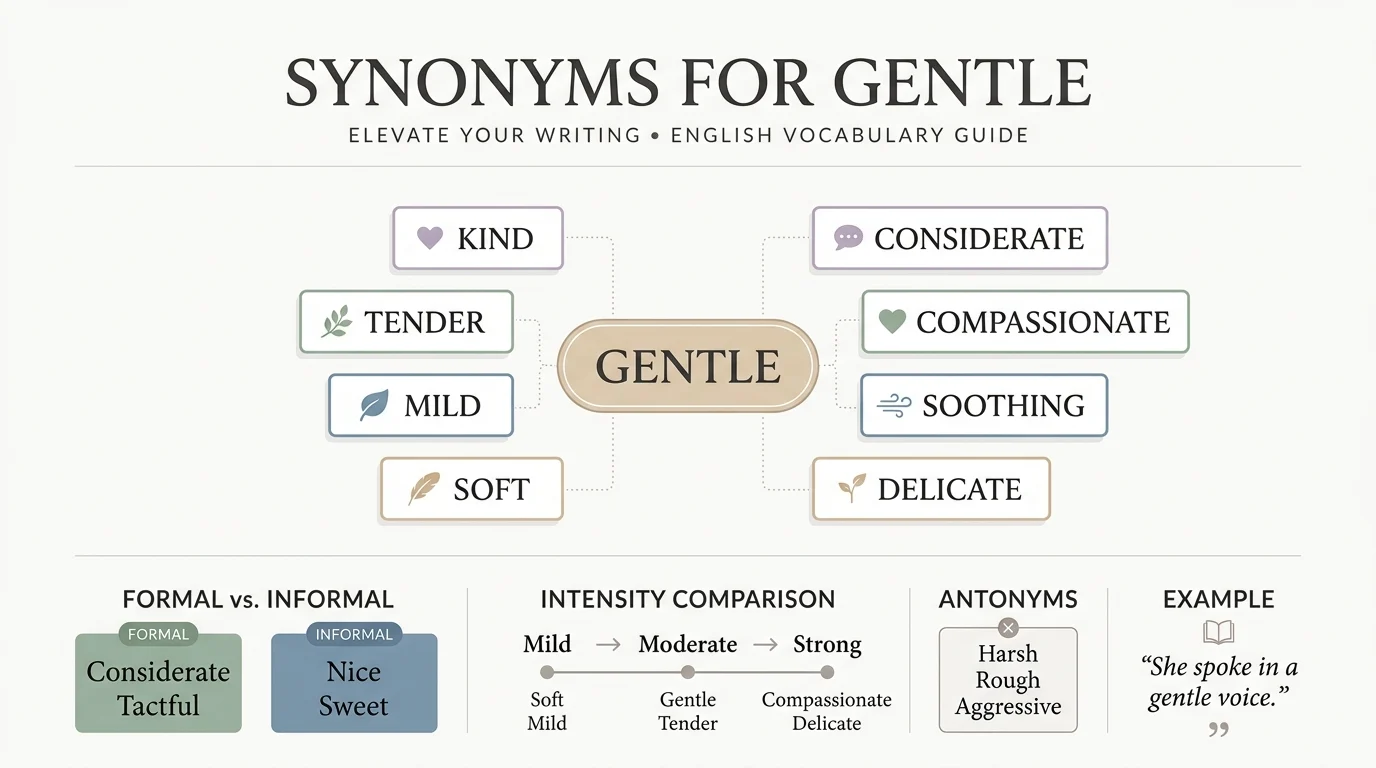
Gentle means kind, mild, soft, or careful in manner, action, or effect. Common synonyms include kind, tender, mild, soothing, considerate, delicate, and compassionate. Choose considerate for professional communication, tender for emotional writing, mild for intensity, and soothing for calming effects.
Meaning, Tone and Context
What Does Gentle Mean?
Gentle describes someone or something that acts without unnecessary force, harshness, or aggression. It can suggest kindness toward others, a careful physical action, a mild sensation, or a peaceful quality.
For example, a gentle teacher corrects mistakes without humiliating students, while a gentle breeze moves through the trees without strong force.
Part of Speech
Gentle is primarily an adjective. It describes a person’s behavior, an object’s qualities, or the way an action feels.
Examples:
- A gentle voice made the nervous child feel safe.
- She used a gentle touch to calm the frightened cat.
- The hillside slopes down in a gentle curve.
Tone and Formality
Gentle usually has a positive or neutral tone. When describing people, it often communicates kindness, patience, and care. When describing physical actions or natural conditions, it usually suggests mildness or a lack of force.
The word works in casual conversations, academic descriptions, professional communication, creative writing, and personal messages.
Common Word Forms
| Word | Part of Speech | Meaning | Example |
|---|---|---|---|
| Gentle | Adjective | Kind, mild, or careful | He has a gentle personality. |
| Gently | Adverb | In a mild or careful way | She gently closed the door. |
| Gentleness | Noun | The quality of being gentle | His gentleness reassured the child. |
| Gentler | Comparative adjective | More gentle | Use a gentler approach. |
| Gentlest | Superlative adjective | Most gentle | She chose the gentlest method. |
When and How to Use “Gentle”
Use gentle when you want to communicate care, restraint, softness, or a lack of harshness. The specific context determines whether another word would express your meaning more clearly.
1. Professional: The manager took a gentle approach when discussing the employee’s mistakes.
2. Personal: Her gentle nature makes people feel comfortable sharing their worries.
3. Academic: Researchers used a gentle heating process to protect the sensitive material.
4. Emotional: He offered a gentle smile that reassured his nervous friend.
5. Creative writing: A gentle breeze carried the scent of wildflowers across the meadow.
6. Social media: A gentle reminder to slow down and appreciate the little things.
7. Email: Please use a gentle cleaning method to avoid damaging the surface.
Another Word for “Gentle”
The best single replacement for gentle depends on the intended meaning. Kind works well for friendly behavior, mild describes low intensity, and tender conveys affection or emotional sensitivity.
Here are practical alternatives by context.
| Context | Best Alternative | Example |
|---|---|---|
| Professional writing | Considerate | She gave considerate feedback. |
| Academic writing | Mild | The solution caused mild irritation. |
| Casual conversation | Nice | He is a really nice person. |
| Emotional writing | Tender | She gave her daughter a tender hug. |
| Creative writing | Delicate | Delicate petals covered the ground. |
| Resume or workplace | Supportive | Maintained a supportive team environment. |
| Social media captions | Peaceful | Enjoying a peaceful morning. |
| Stronger expression of care | Compassionate | The nurse was compassionate toward every patient. |
| Softer description | Mild | A mild breeze cooled the room. |
For a formal synonym for gentle, consider considerate, compassionate, or restrained, depending on the sentence. For an informal synonym, nice, sweet, or soft may work in everyday conversation.
When Not to Use “Gentle”
Although gentle is versatile, it does not always communicate enough detail. A more specific word can make your writing clearer and more convincing.
| Vague Sentence | More Precise Sentence | Why It Is Better |
|---|---|---|
| She is gentle with her team. | She is considerate of her team’s concerns. | Identifies the behavior. |
| He gave me a gentle look. | He gave me a reassuring look. | Explains the emotional effect. |
| The medicine has a gentle effect. | The medicine has a mild effect. | Describes the intensity. |
| She gave him a gentle hug. | She gave him a tender hug. | Emphasizes affection. |
| The teacher was gentle. | The teacher was patient with struggling students. | Shows the specific quality. |
Avoid using gentle when you actually mean weak, passive, or uncertain. Kindness and restraint do not necessarily indicate a lack of confidence or strength.
Similarly, a gentle correction is not always a vague correction. You can communicate a clear boundary in a calm, respectful manner.
Words Commonly Confused With “Gentle”
Several words overlap with gentle, but they emphasize different qualities. Choosing the right one helps you communicate your meaning accurately.
| Word | Main Difference | Best Use |
|---|---|---|
| Kind | Focuses on goodwill and helpful behavior | A person who helps others |
| Soft | Describes texture, sound, appearance, or intensity | A soft blanket or voice |
| Mild | Means not severe, strong, or intense | Mild weather or discomfort |
| Tender | Suggests affection, sensitivity, or emotional care | A tender moment |
| Calm | Describes a peaceful state or manner | A calm response to criticism |
| Meek | Suggests quietness and a reluctance to assert oneself | A person who rarely challenges others |
Remember: A person can be gentle without being meek, and a voice can be soft without sounding kind. Consider the exact quality you want to describe before selecting a synonym.
Best Synonym by Context for “Gentle”
The following recommendations show how to select a synonym for different writing situations.
| Context | Best Synonym | Why It Works | Example |
|---|---|---|---|
| Formal writing | Considerate | Highlights thoughtfulness | She was considerate of everyone’s needs. |
| Academic writing | Mild | Describes limited intensity | Participants experienced mild discomfort. |
| Business communication | Tactful | Shows sensitivity when addressing an issue | He offered tactful criticism. |
| Resume | Supportive | Communicates helpful leadership | Created a supportive environment for new employees. |
| Casual conversation | Nice | Sounds natural and familiar | Our new neighbor is really nice. |
| Creative writing | Delicate | Adds imagery and softness | Delicate snowflakes covered the branches. |
| Emotional writing | Tender | Expresses affection | She remembered his tender words. |
| Strong expression of care | Compassionate | Emphasizes empathy and concern | The volunteer was compassionate toward struggling families. |
| Soft or moderate intensity | Mild | Indicates a limited degree | A mild wind rustled the leaves. |
| Social media captions | Peaceful | Creates a relaxed mood | A peaceful morning by the lake. |
| Describing touch | Light | Emphasizes minimal physical pressure | She placed a light hand on his shoulder. |
| Describing sound | Soothing | Emphasizes a calming effect | The soothing music helped me relax. |
There is no single best synonym for every situation. Tactful is particularly useful when discussing sensitive workplace matters, while soothing is better for sounds, experiences, or actions that reduce anxiety.
Which Synonym Should You Choose?
Use this practical decision guide to select the most accurate alternative.
1. Focus on kindness
Choose kind, compassionate, or considerate when describing someone’s treatment of others.
2. Focus on physical softness
Choose light, delicate, or soft when describing touch, texture, movement, or sound.
3. Focus on communication
Choose tactful, patient, or diplomatic when describing respectful conversations or sensitive feedback.
4. Focus on intensity
Choose mild, moderate, or subtle when describing something that is not strong or severe.
5. Focus on emotion or atmosphere
Choose tender, soothing, or peaceful when you want readers to feel affection, comfort, or calmness.
A useful vocabulary habit is to ask yourself whether gentle describes a person’s character, a physical quality, an action, or an emotional effect. That small distinction often reveals the strongest synonym.
Real Life Examples of “Gentle” in Sentences
Here are examples of how alternatives to gentle can improve everyday communication.
| Situation | Example Sentence |
|---|---|
| School | The patient tutor explained the difficult concept without making anyone feel embarrassed. |
| Workplace | Her tactful feedback helped the employee understand what needed improvement. |
| Writing | The delicate pattern gave the invitation an elegant appearance. |
| Conversation | My grandfather is kind and always listens carefully. |
| Social media | Choosing a peaceful morning and a slower pace today. |
| Resume | Fostered a supportive environment that encouraged team collaboration. |
| Please use a mild detergent to protect the fabric. | |
| Storytelling | A tender expression crossed her face as she watched her son leave. |
These examples demonstrate an important distinction: patient describes how someone responds to difficulty, tactful describes how someone handles sensitive communication, and tender adds emotional warmth.
25 Synonyms for “Gentle”
The following 25 alternatives cover kindness, physical softness, calmness, emotional sensitivity, and restrained behavior. Some are synonyms only in particular contexts, so always check the surrounding sentence.
| Synonym | Simple Meaning | Best Used For | Example Sentence |
|---|---|---|---|
| 1. Kind | Caring and helpful | Personality and behavior | Our kind neighbor brought us dinner. |
| 2. Tender | Affectionate and sensitive | Relationships and emotions | She gave the puppy a tender hug. |
| 3. Mild | Not severe or intense | Weather, effects, and conditions | The cream has a mild fragrance. |
| 4. Soft | Not hard, harsh, or loud | Texture, sound, and touch | His soft voice calmed the baby. |
| 5. Delicate | Fine, fragile, or subtle | Objects, touch, and appearance | She handled the delicate ornament carefully. |
| 6. Compassionate | Deeply concerned about others | Caregiving and emotional support | The compassionate counselor listened without judgment. |
| 7. Considerate | Thoughtful about other people’s needs | Personal and professional conduct | He was considerate of his coworkers’ time. |
| 8. Tactful | Careful with sensitive subjects | Feedback and difficult conversations | She found a tactful way to disagree. |
| 9. Patient | Able to tolerate delays or difficulties | Teaching and relationships | The patient instructor answered every question. |
| 10. Soothing | Having a calming effect | Sounds, words, and experiences | A soothing melody filled the room. |
| 11. Peaceful | Free from disturbance or conflict | Places, moods, and experiences | We spent a peaceful afternoon in the garden. |
| 12. Calm | Not agitated or excited | People and reactions | He remained calm during the disagreement. |
| 13. Meek | Quiet and not assertive | Reserved behavior | The meek character rarely spoke up. |
| 14. Mild mannered | Having a calm, nonaggressive manner | Personality descriptions | Our mild mannered professor welcomed questions. |
| 15. Amiable | Friendly and pleasant | Social and professional settings | The amiable host greeted every guest. |
| 16. Affectionate | Showing fondness or love | Family and close relationships | Her affectionate greeting made him smile. |
| 17. Nurturing | Encouraging growth and well being | Parenting, teaching, and leadership | A nurturing mentor helped her develop confidence. |
| 18. Supportive | Providing help and encouragement | Teams and relationships | My supportive colleagues celebrated my progress. |
| 19. Gracious | Courteous and considerate | Hospitality and public interactions | She gave a gracious response to the criticism. |
| 20. Courteous | Polite and respectful | Formal and professional communication | The courteous receptionist answered our questions. |
| 21. Diplomatic | Skillful at handling disagreements | Business and sensitive discussions | His diplomatic response prevented further tension. |
| 22. Subtle | Not obvious or forceful | Hints, effects, and changes | A subtle fragrance lingered in the room. |
| 23. Light | Applying little pressure or force | Touch and movement | She gave the door a light push. |
| 24. Tranquil | Deeply peaceful and undisturbed | Literary descriptions and settings | The tranquil lake reflected the morning sky. |
| 25. Benign | Harmless or not damaging | Medical and technical contexts | The report described the growth as benign. |
Usage note: These words are not interchangeable in every sentence. Benign emphasizes harmlessness, amiable emphasizes friendliness, and delicate often describes fragility or subtle qualities rather than kindness.
Synonym Groups and Usage Differences
Professional vs. Personal Synonyms
Professional writing benefits from words that describe observable behavior. Considerate, tactful, diplomatic, and supportive are useful when discussing teamwork, leadership, feedback, and communication.
Personal writing can be warmer and more expressive. Tender, affectionate, kind, and compassionate often communicate care in relationships and family situations.
For example, “She is considerate of her colleagues” sounds appropriate in a performance review. “She gave her daughter a tender embrace” feels more personal.
Formal vs. Conversational Synonyms
Formal alternatives help communicate specific qualities without sounding overly casual.
| Formal or Polished | Conversational | Typical Use |
|---|---|---|
| Considerate | Nice | Thoughtful behavior |
| Compassionate | Caring | Empathy and concern |
| Tactful | Careful with words | Sensitive discussions |
| Amiable | Friendly | Pleasant personality |
| Delicate | Soft | Physical qualities |
| Tranquil | Peaceful | Calm environments |
In everyday texts, nice, soft, and caring are usually natural. In formal reports or essays, considerate, compassionate, and tranquil may communicate more specific meanings.
Academic Synonyms
Academic writing requires precision rather than unnecessarily sophisticated vocabulary. The best synonym depends on whether you are describing intensity, behavior, or a physical process.
Consider these examples:
- Use mild to describe a limited effect or degree of severity.
- Use subtle to describe a change or effect that is difficult to notice.
- Use gentle when the lack of force is important to the process.
- Use benign when the intended meaning is harmless or nonmalignant in the appropriate medical context.
- Use moderate when describing a middle degree between low and high intensity.
For example, “The researchers applied gentle pressure to the sample” is more accurate than “The researchers applied compassionate pressure.” The second sentence uses a word associated with empathy in a physical context where it does not belong.
Professional and Business Synonyms
Workplace communication often requires a balance between respect and clarity.
Considerate is suitable for describing awareness of other people’s needs. Tactful works for sensitive feedback. Diplomatic is useful when managing disagreements, while supportive describes someone who encourages others.
For example, instead of writing, “The supervisor was gentle when discussing performance,” you could write, “The supervisor delivered tactful feedback while maintaining clear expectations.”
This wording explains what the supervisor actually did.
Creative or Literary Synonyms
Creative writing benefits from synonyms that help readers imagine a scene or feel an emotion.
Delicate suggests fragility or fine detail. Tender conveys affection. Tranquil creates a peaceful atmosphere, while soothing emphasizes a calming effect.
Compare these sentences:
“The gentle evening settled over the town.”
“The tranquil evening settled over the town.”
The second version places greater emphasis on stillness and peace. Neither is universally better. The right choice depends on the mood of the passage.
Slang or Modern Synonyms
There is no single slang word that replaces gentle accurately in every context. Informal alternatives such as sweet, chill, and soft can work in everyday speech, but their meanings vary.
For example, “He’s a sweet guy” emphasizes warmth or kindness. “Let’s keep things chill” means keeping a situation relaxed, not necessarily treating someone gently.
Use these expressions in casual conversation, texts, and social media captions. In academic papers, formal reports, and resumes, choose a more precise alternative.
Strongest vs. Weaker Synonyms
The words below represent different degrees of emotional warmth or physical intensity. This is a practical guide, not a universal ranking, because the words describe different qualities.
Mild physical force to strong emotional care
Light
Little pressure
Mild
Low intensity
Tender
Affectionate care
Compassionate
Empathy and concern
Choose a word based on the quality you want to emphasize, not simply its perceived strength.
For physical actions, light or mild may be more accurate than tender. For emotional care, tender and compassionate provide more meaning than light.
Emotional vs. Neutral Synonyms
Emotional synonyms communicate warmth, affection, or concern. Neutral synonyms describe a quality without necessarily adding a strong emotional message.
| Emotional Synonyms | Neutral or Descriptive Synonyms |
|---|---|
| Tender | Mild |
| Affectionate | Soft |
| Compassionate | Light |
| Caring | Subtle |
| Nurturing | Moderate |
For example, “She spoke in a tender voice” suggests emotional warmth. “She spoke in a soft voice” mainly describes volume or sound quality.
Antonyms of “Gentle”
An antonym expresses the opposite of a particular meaning. Since gentle can describe kindness, physical force, or mildness, its opposites vary by context.
The following table contains 15 useful contrasts, although not every word is an exact antonym in every sentence.
| Antonym | Meaning | Example Sentence |
|---|---|---|
| 1. Harsh | Severe or unpleasant | His harsh criticism upset the team. |
| 2. Rough | Not smooth or careful | The rough handling damaged the package. |
| 3. Cruel | Deliberately causing suffering | The cruel remark hurt her feelings. |
| 4. Aggressive | Forceful or confrontational | His aggressive approach escalated the argument. |
| 5. Violent | Involving extreme physical force | The violent storm damaged several buildings. |
| 6. Abrasive | Harsh in manner or effect | Her abrasive tone discouraged discussion. |
| 7. Brutal | Extremely harsh or violent | The brutal treatment shocked the observers. |
| 8. Severe | Very serious or intense | The patient experienced severe pain. |
| 9. Forceful | Applying considerable force | He gave the door a forceful push. |
| 10. Abrupt | Sudden or unexpectedly direct | Her abrupt reply ended the conversation. |
| 11. Unkind | Lacking kindness | It was unkind to exclude him. |
| 12. Hostile | Unfriendly or antagonistic | The hostile response surprised the visitors. |
| 13. Callous | Insensitive to others’ feelings | His callous comment showed little empathy. |
| 14. Harried | Under pressure and visibly strained | The harried assistant rushed through the instructions. |
| 15. Intense | Very strong or concentrated | The intense heat made outdoor work difficult. |
The most accurate opposite depends on the sentence. Cruel contrasts with kind, rough contrasts with soft or careful, and severe contrasts with mild.
Comparison: Gentle vs. Similar Words
Understanding subtle differences between related words helps you choose alternatives that preserve your intended meaning.
Gentle vs. Kind
Main difference: Gentle emphasizes mildness, care, or a lack of force. Kind emphasizes goodwill and helpful behavior.
Stronger: Neither is universally stronger. Kind focuses more directly on goodwill.
Formality: Both work in formal and informal contexts.
Examples:
- Gentle: The nurse used a gentle touch.
- Kind: The nurse was kind to the worried patient.
Gentle vs. Soft
Main difference: Gentle often describes careful behavior, while soft describes texture, sound, or a lack of hardness.
Stronger: Neither is inherently stronger.
Formality: Both are common in everyday and professional English.
Examples:
- Gentle: She gave the child a gentle hug.
- Soft: The pillow has a soft surface.
Gentle vs. Mild
Main difference: Gentle can suggest care or kindness. Mild usually describes limited intensity or severity.
Stronger: Mild is more specific when describing low intensity.
Formality: Mild is especially useful in technical, academic, and medical descriptions.
Examples:
- Gentle: He spoke in a gentle voice.
- Mild: She experienced mild discomfort.
Gentle vs. Tender
Main difference: Gentle emphasizes care or lack of force. Tender often communicates affection or emotional sensitivity.
Stronger: Tender often carries a stronger emotional association.
Formality: Both work in everyday and creative writing.
Examples:
- Gentle: She handled the injured bird gently.
- Tender: He gave his daughter a tender smile.
Gentle vs. Calm
Main difference: Gentle describes a mild or caring manner. Calm describes a peaceful state or lack of agitation.
Stronger: Neither is inherently stronger.
Formality: Both are appropriate in professional and personal writing.
Examples:
- Gentle: The teacher gave a gentle correction.
- Calm: The teacher remained calm during the disruption.
Gentle vs. Meek
Main difference: Gentle usually suggests care and restraint. Meek suggests a quiet, submissive, or unassertive manner.
Stronger: Meek carries a more specific implication about assertiveness.
Formality: Both can appear in formal writing, but meek is more evaluative.
Examples:
- Gentle: She was gentle but firm with her students.
- Meek: He was too meek to challenge the unfair decision.
Common Phrases and Expressions with “Gentle”
These expressions are useful in everyday conversation, professional communication, and descriptive writing.
1. Gentle Reminder
Meaning: A polite reminder that avoids sounding demanding.
Example sentence: This is a gentle reminder to submit your application by Friday.
2. Gentle Touch
Meaning: A light, careful physical contact.
Example sentence: The veterinarian used a gentle touch to examine the frightened kitten.
3. Gentle Breeze
Meaning: A light wind that feels pleasant rather than strong.
Example sentence: A gentle breeze made the afternoon more comfortable.
4. Gentle Approach
Meaning: A careful, nonaggressive way of handling a situation.
Example sentence: The counselor used a gentle approach to help the student discuss his concerns.
5. Gentle Voice
Meaning: A voice that sounds soft, calm, or reassuring.
Example sentence: Her gentle voice helped the audience relax.
6. Gentle Slope
Meaning: A gradual incline rather than a steep rise.
Example sentence: The walking trail follows a gentle slope toward the river.
7. Gentle Giant
Meaning: A large or physically imposing person or animal with a calm, friendly nature.
Example sentence: Despite his enormous size, the rescue dog is a gentle giant.
8. Gentle Reminder of
Meaning: A polite way to draw attention to something important.
Example sentence: The meeting was a gentle reminder of how much preparation matters.
Common Mistakes to Avoid
1. Using Gentle When Kind Is More Accurate
Incorrect choice: “She was gentle by donating money to the shelter.”
Better: “She was kind to donate money to the shelter.”
Kind communicates goodwill more naturally in this sentence.
2. Confusing Gentle With Weak
Gentleness does not mean a person lacks confidence or authority.
Better example: “The manager was gentle but firm when explaining the new policy.”
This sentence communicates care without suggesting indecision.
3. Using Casual Words in Formal Writing
Words such as nice and sweet may sound too informal in a research paper or professional report.
Instead, choose considerate, compassionate, or supportive when those meanings accurately fit the situation.
4. Choosing an Overly Dramatic Synonym
Words such as tender and compassionate can sound unnatural when describing a routine physical action.
For example, “He applied mild pressure” is more precise than “He applied compassionate pressure.”
5. Repeating Gentle Too Often
Using the same adjective repeatedly can make descriptive writing monotonous.
Instead of “a gentle breeze, a gentle voice, and a gentle smile,” consider “a light breeze, a soothing voice, and a warm smile.”
6. Ignoring Emotional Tone
Soft, tender, and compassionate communicate different ideas. A soft voice describes sound, a tender voice suggests affection, and a compassionate response conveys empathy.
Choose the word that matches the intended message.
7. Using Slang in Academic or Professional Writing
Informal expressions may suit conversations and social media, but they can weaken the tone of formal work.
Choose calm, considerate, or tactful instead of an imprecise casual expression when writing professionally.
FAQs
1. What Is the Best Synonym for Gentle?
The best synonym depends on context. Kind suits caring behavior, mild describes low intensity, tender expresses affection, and soothing describes a calming effect.
2. What Is a Formal Synonym for Gentle?
Considerate, compassionate, and tactful are useful formal alternatives when describing behavior or communication. For physical intensity, mild or restrained may be more precise.
3. What Is an Informal Synonym for Gentle?
Nice, sweet, and soft are common informal alternatives. Use nice for friendly behavior, sweet for warmth, and soft for sound, texture, or touch.
4. What Is Another Word for Gentle in Professional Writing?
Considerate works for thoughtful behavior, tactful for sensitive feedback, and supportive for helpful leadership. Select the word that accurately describes the person’s actions.
5. What Is the Difference Between Gentle and Kind?
Gentle emphasizes mildness, carefulness, or a lack of force. Kind emphasizes goodwill and helpfulness. A person can demonstrate both qualities through thoughtful actions.
6. What Is the Opposite of Gentle?
Common opposites include harsh, rough, aggressive, cruel, and severe. Choose cruel for unkind behavior, rough for physical handling, and severe for intensity.
Conclusion
Gentle describes kindness, softness, carefulness, and mildness, but its best synonym depends on what you want to communicate. Words such as kind, tender, considerate, mild, soothing, and compassionate each add a different shade of meaning.
For professional communication, consider tactful or considerate. Emotional writing, choose tender or affectionate. For physical actions and intensity, light, soft, or mild may be more accurate.
The most useful vocabulary tip is to replace a word only when the alternative improves precision. The best synonym is not necessarily the most sophisticated one. It is the word that communicates your meaning naturally and clearly.
Discover More Post:
- 50+ Synonyms for Snow | From Gentle Flurries to a Winter …
- 50+ Synonyms for Impressive | Powerful Alternatives to …
- 50+ Synonyms for Opinion | Meanings, Examples, and Best …