The word factors appears frequently in essays, research papers, business reports, emails, and everyday conversations. However, repeating it in every paragraph can make your writing feel vague or predictable.
Learning synonyms for factors helps you explain causes, influences, conditions, and contributing elements more precisely. The best replacement depends on what you mean, whether you are writing academically, communicating professionally, or explaining a situation in simple English.
What Does “Factors” Mean?
Factors are circumstances, conditions, elements, or influences that contribute to a result or affect a situation. Common synonyms include elements, causes, influences, considerations, variables, and determinants. Academic writing often favors variables or determinants, while professional communication may benefit from considerations or contributing elements.
Meaning, Tone and Context
The word factors refers to elements or circumstances that influence a situation, contribute to an outcome, or help explain why something happens.
For example, price, quality, and customer service can all be factors that influence a customer’s purchasing decision.
Simple definition
A factor is something that helps produce, explain, or influence a particular result.
Consider this sentence: Several factors contributed to the project’s success.
Here, factors refers to the different elements that helped the project succeed.
Part of speech
Factor is a noun. Its plural form is factors. It can describe a cause, an influence, a condition, or a component, depending on the sentence.
Tone and formality
The word is generally neutral and works in formal, academic, professional, and conversational English.
It is particularly common in research, business analysis, education, economics, health discussions, and decision making.
Common uses
Factors frequently appears when discussing:
- Causes of a problem or outcome
- Conditions that influence a decision
- Variables in scientific research
- Elements that contribute to success
- Considerations in planning
- Circumstances affecting people or organizations
Important word forms
| Word form | Meaning | Example |
|---|---|---|
| Factor | One contributing element | Cost is an important factor. |
| Factors | Multiple contributing elements | Several factors affect demand. |
| Factor in | To include something in a calculation or decision | Factor in the delivery cost. |
| Factor into | To contribute to a result or calculation | Experience factors into the final score. |
| Factoring | The process of including or accounting for something | Factoring in travel time improves the plan. |
When and How to Use “Factors”
Use factors when you want to discuss several elements that influence a result without claiming that each one directly causes it.
The following examples show how the word fits different situations.
1. Academic: Researchers examined the factors associated with student performance.
2. Professional: Several factors influenced the company’s decision to expand.
3. Business: Price and product quality are important factors in customer retention.
4. Personal: Many factors affect how people choose a place to live.
5. Email: We should review all relevant factors before approving the proposal.
6. Social media: Small factors can make a big difference in your daily routine.
7. Creative writing: A combination of unexpected factors changed the course of her journey.
Notice that factors does not always mean direct causes. Sometimes it refers to circumstances that influence an outcome or deserve consideration.
Another Word for “Factors”
The best alternative depends on the relationship between the elements and the result.
| Context | Best alternative | Why it works |
|---|---|---|
| Professional writing | Considerations | Emphasizes points that need attention |
| Academic writing | Variables | Identifies measurable or changing elements |
| Casual conversation | Things | Offers a simple, conversational expression |
| Emotional writing | Influences | Highlights the effect on feelings or behavior |
| Creative writing | Elements | Adds descriptive flexibility |
| Resume or workplace use | Contributions | Highlights elements that helped produce a result |
| Social media captions | Reasons | Makes an explanation easier to understand |
| Stronger meaning | Determinants | Suggests elements that strongly shape an outcome |
| Softer meaning | Considerations | Avoids implying direct causation |
| Scientific research | Variables | Fits research involving measurable differences |
Best overall synonym: Elements is a versatile alternative when referring to parts of a situation. However, causes is more precise when you mean things that produce an outcome, while considerations works better when discussing points to evaluate.
When Not to Use “Factors”
Although factors is useful, it can sound vague when the reader needs to know exactly what influenced an outcome.
Choose a more precise synonym when the relationship is clear.
| Vague sentence | More precise sentence | Why it improves the writing |
|---|---|---|
| Many factors caused the delay. | Several scheduling conflicts caused the delay. | Identifies the actual causes. |
| We considered different factors. | We evaluated cost, quality, and delivery time. | Names the relevant considerations. |
| Factors affected the results. | Changes in temperature affected the results. | Identifies the influencing variable. |
| Several factors helped the team. | Strong communication and effective planning helped the team. | Explains the specific contributions. |
| Factors explain the decline. | Reduced demand and higher prices help explain the decline. | Makes the explanation more informative. |
Avoid using factors as a substitute for evidence. If you know the specific causes, influences, or conditions, naming them usually creates clearer writing.
Words Commonly Confused With “Factors”
Several related words overlap with factors, but they do not mean exactly the same thing.
| Word | Main difference | Example |
|---|---|---|
| Causes | Things that produce an outcome | Equipment failure caused the delay. |
| Reasons | Explanations for an action or situation | Budget concerns were the main reasons for postponing the event. |
| Variables | Elements that can change or take different values | Researchers measured three variables. |
| Conditions | Circumstances under which something happens | Dry conditions increased the risk of fire. |
| Elements | Parts that make up a whole or contribute to it | Trust is an essential element of teamwork. |
| Influences | Things that affect decisions, behavior, or outcomes | Family influences shaped her career choice. |
The distinction matters because a factor may influence a result without directly causing it. A reason explains why something happened or why someone acted, while a variable is especially useful when discussing measurable differences.
Best Synonym by Context for “Factors”
The following recommendations show which alternative works best for different writing situations.
| Context | Best synonym | Why it works | Example |
|---|---|---|---|
| Formal writing | Considerations | Professional and measured | Several considerations informed the decision. |
| Academic writing | Variables | Precise for research | The study measured four variables. |
| Professional communication | Contributing elements | Clear and neutral | We identified three contributing elements. |
| Resume writing | Contributions | Highlights meaningful input | My contributions improved team efficiency. |
| Casual conversation | Things | Simple and natural | A few things influenced my choice. |
| Creative writing | Elements | Flexible and descriptive | Several elements shaped the story. |
| Emotional writing | Influences | Emphasizes personal impact | Childhood influences shaped his outlook. |
| Strong emphasis | Determinants | Highlights powerful influences | Income can be a determinant of housing access. |
| Softer emphasis | Considerations | Avoids overstating causation | Timing was one of several considerations. |
| Social media captions | Reasons | Accessible and direct | Three reasons made this trip unforgettable. |
| Scientific research | Variables | Suitable for measurable attributes | Researchers controlled the relevant variables. |
| Business analysis | Drivers | Highlights forces behind change | Customer demand is a key growth driver. |
| Problem solving | Root causes | Focuses on underlying problems | The team investigated the root causes of failure. |
| Decision making | Criteria | Identifies standards used to evaluate options | We compared the proposals against five criteria. |
| Historical analysis | Circumstances | Captures the wider situation | Economic circumstances influenced the migration. |
Which Synonym Should You Choose?
Use this quick decision guide to select the right word.
Choose by meaning
Use causes for things that produce an outcome, influences for things that affect it, and elements for contributing parts.
Choose by formality
Use considerations in reports, variables in research, and things in casual conversation.
Choose by intensity
Use influences for general effects and determinants when an element has a particularly important role in shaping an outcome.
Choose by professional value
Use drivers to explain business growth, criteria to explain evaluation standards, and contributions to describe helpful input.
Choose by sentence context
Read the sentence with the replacement. If the meaning changes or the sentence becomes less accurate, keep factors or choose a more precise alternative.
Real Life Examples of “Factors” in Sentences
Here are practical examples of factors and stronger alternatives across everyday and professional situations.
| Situation | Example sentence |
|---|---|
| School | Several variables affected the students’ test scores. |
| Workplace | Communication and planning were key contributors to the project’s success. |
| Writing | The author explores the circumstances that shaped the character’s decision. |
| Conversation | A few things influenced my choice. |
| Social media | These five reasons made the experience worthwhile. |
| Resume | My contributions helped improve the team’s workflow. |
| Please review the key considerations before confirming the order. | |
| Storytelling | Unexpected events changed the direction of their journey. |
| Business | Customer demand remains a major driver of growth. |
| Research | The team controlled external variables during the experiment. |
The best replacement adds information rather than merely changing a word. Whenever possible, identify the actual factor and explain how it affected the result.
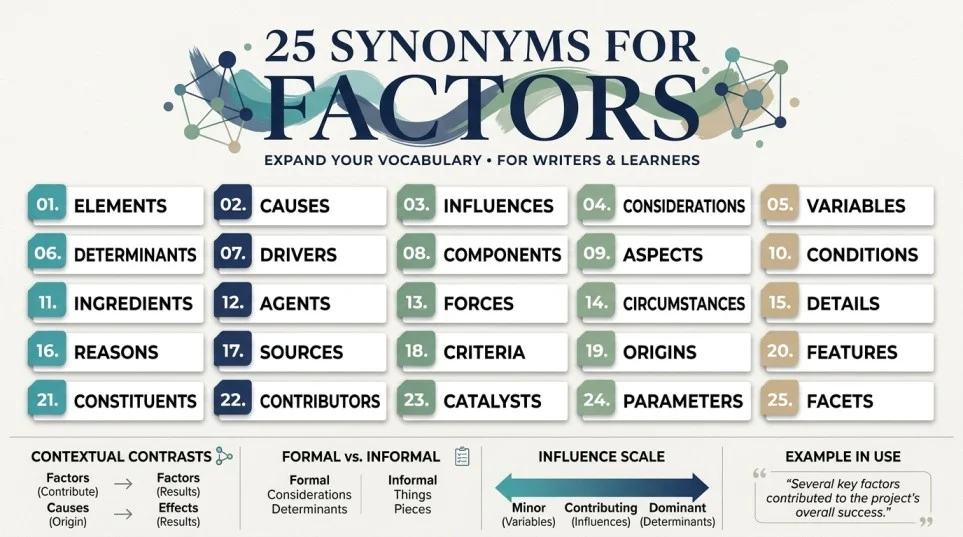
25 Synonyms for “Factors”
These 25 alternatives cover different meanings and contexts. Some are close synonyms, while others work only when the sentence expresses a specific relationship.
| Synonym | Simple meaning | Best used for | Example sentence |
|---|---|---|---|
| 1. Elements | Parts of a situation or whole | General writing | Several elements contributed to the project’s success. |
| 2. Causes | Things that produce an outcome | Explaining problems | Researchers identified the causes of the decline. |
| 3. Influences | Things that affect behavior or results | Personal and social topics | Cultural influences shaped her perspective. |
| 4. Considerations | Points worth thinking about | Decisions and planning | Cost was one of several considerations. |
| 5. Variables | Elements that can change | Scientific research | The experiment involved three variables. |
| 6. Determinants | Elements that strongly shape an outcome | Technical and academic writing | Access to education is an important determinant of opportunity. |
| 7. Contributors | People or things that help produce a result | Reports and analysis | Several contributors supported the project’s success. |
| 8. Conditions | Circumstances affecting an event | Science and everyday explanations | Weather conditions delayed the flight. |
| 9. Components | Parts of a larger system | Technical writing | Safety is a core component of the design. |
| 10. Aspects | Particular parts or features | General analysis | We discussed the financial aspects of the proposal. |
| 11. Reasons | Explanations for actions or events | Everyday communication | Several reasons influenced the decision. |
| 12. Drivers | Forces that propel change | Business and economics | Innovation is a major driver of growth. |
| 13. Circumstances | The situation surrounding an event | Personal and historical writing | Their circumstances influenced the final choice. |
| 14. Considerations for review | Points requiring examination | Formal reports | The committee listed its considerations for review. |
| 15. Criteria | Standards used for evaluation | Selection and assessment | The applicants were judged against clear criteria. |
| 16. Determining conditions | Conditions that shape an outcome | Technical explanations | Temperature was one of the determining conditions. |
| 17. Contributors to change | Elements that help bring about change | Social and business analysis | New policies were contributors to change. |
| 18. Motivations | Reasons behind behavior | Psychology and storytelling | Personal motivations influenced his response. |
| 19. Impacts | Effects produced by an event or action | Outcome analysis | The report examined the impacts of the new policy. |
| 20. Variables of interest | Specific variables being investigated | Research writing | Researchers recorded the variables of interest. |
| 21. Prerequisites | Requirements that must be met beforehand | Planning and eligibility | Training is a prerequisite for the role. |
| 22. Determinants of success | Elements that shape achievement | Performance analysis | Preparation is one of the determinants of success. |
| 23. Drivers of change | Forces that encourage change | Business and social analysis | Technology is among the drivers of change. |
| 24. Underlying causes | Deeper reasons behind a problem | Troubleshooting | The audit revealed the underlying causes of the errors. |
| 25. Contributing circumstances | Situational elements that help explain an outcome | Formal and investigative writing | Investigators reviewed the contributing circumstances. |
Usage note: Entries such as criteria, prerequisites, impacts, and motivations are context dependent rather than interchangeable with factors in every sentence. Choose them only when their specific meanings fit.
Synonym Groups and Usage Differences
Choosing a synonym becomes easier when you organize alternatives by their purpose, tone, and level of precision.
Professional vs. Personal Synonyms
Professional writing benefits from words that clarify decisions, results, and responsibilities. Considerations, variables, drivers, and contributing elements work well when their meanings match the situation.
Personal writing often benefits from influences, circumstances, reasons, and elements. These words help explain how experiences, relationships, and individual choices shape a person’s life.
For example:
Professional: Several contributing elements affected the project’s completion date.
Personal: Family influences helped shape her career interests.
Formal vs. Conversational Synonyms
Formal vocabulary works best when precision and credibility matter. Conversational vocabulary prioritizes natural, accessible language.
| Formal expression | Conversational alternative |
|---|---|
| Determinants | Things that shape an outcome |
| Considerations | Things to think about |
| Variables | Things that can change |
| Contributing elements | Things that played a part |
| Underlying causes | Reasons behind the problem |
In an academic paper, variables may be more accurate than things. In a casual conversation, the simpler word often sounds more natural.
Academic Synonyms
Academic writing requires precision, especially when discussing evidence, relationships, and research findings.
Consider these distinctions:
- Variables: Use when discussing measurable or changing characteristics.
- Determinants: Use when emphasizing elements that shape a particular outcome.
- Contributing factors: Use when several elements help explain a result.
- Conditions: Use when the circumstances surrounding an event matter.
- Underlying causes: Use when evidence points to deeper explanations.
Example: Instead of writing, “Many factors affected the results,” specify, “Temperature, sample size, and measurement accuracy affected the results.”
The revised sentence gives readers a clearer understanding of the research.
Professional and Business Synonyms
Business communication often discusses performance, growth, risk, planning, and decision making.
- Drivers: Forces that support growth or change.
- Considerations: Points that need evaluation before a decision.
- Criteria: Standards used to compare options.
- Contributors: People or elements that help produce a result.
- Root causes: Underlying reasons for an operational problem.
For instance, “Customer demand is a major driver of sales growth” communicates a more specific relationship than “Customer demand is an important factor.”
Creative or Literary Synonyms
Creative writing benefits from words that add context, atmosphere, and emotional depth.
- Influences highlights how experiences shape a character.
- Circumstances establishes the situation surrounding an event.
- Elements describes the parts that make a story distinctive.
- Motivations reveals why a character acts in a particular way.
- Forces can emphasize powerful pressures, whether internal or external.
Example: “Several forces pushed the family toward a difficult decision” gives the sentence a stronger narrative quality than “Several factors affected the decision.”
Slang or Modern Synonyms
There is no single widely accepted slang synonym for factors. Informal alternatives such as things, stuff, and reasons may work in casual speech, but they differ in precision.
For example:
Casual: A few things influenced my decision.
Professional: Several considerations influenced my decision.
Avoid stuff in academic writing, formal reports, and professional documents because it rarely identifies the relevant details clearly.
Strongest vs. Weaker Synonyms
The following scale describes how strongly a word may suggest influence or causation. It is a practical guide, not a universal ranking, because context determines the exact meaning.
Mild
Considerations
Points to examine without claiming they caused a result.
Moderate
Elements and influences
Parts or circumstances that affect a situation.
Strong
Drivers and determinants
Emphasize forces or elements that shape an outcome.
Causal
Causes and root causes
Identify what produced a result or contributed to an underlying problem.
A stronger sounding word does not automatically make a sentence more accurate. Use causes only when the evidence supports a causal relationship.
Emotional vs. Neutral Synonyms
Neutral words describe a situation without adding much emotional judgment. Emotional or interpretive words can highlight personal experiences, intentions, or pressures.
| Neutral word | More expressive alternative | Difference |
|---|---|---|
| Elements | Forces | Suggests powerful influences |
| Conditions | Circumstances | Emphasizes the surrounding situation |
| Reasons | Motivations | Highlights personal intentions |
| Influences | Pressures | Suggests stress or external demands |
| Causes | Root causes | Emphasizes deeper explanations |
For a factual report, conditions or variables may be appropriate. For a personal essay, pressures or motivations may communicate the intended feeling more effectively.
Antonyms of “Factors”
The noun factors has no single set of direct antonyms because it can refer to causes, conditions, influences, or components. The following words express contrasting ideas in particular contexts, rather than universal opposites.
| Antonym or contrasting term | Meaning | Example sentence |
|---|---|---|
| Irrelevancies | Details unrelated to the issue | The reviewer removed irrelevancies from the report. |
| Exclusions | Things deliberately left out | The exclusions were documented separately. |
| Omissions | Things that have been left out | The omission of key data weakened the analysis. |
| Insignificances | Matters of little importance | The team focused on major issues rather than insignificances. |
| Irrelevancies to the outcome | Details that do not affect the result | The discussion excluded irrelevancies to the outcome. |
| Noncontributors | People or things that do not help produce a result | The review distinguished noncontributors from essential team members. |
| Noncauses | Things that do not cause an outcome | Researchers separated noncauses from established causes. |
| Unrelated details | Information without a meaningful connection | Unrelated details were removed from the summary. |
| Distractions | Things that draw attention away from the issue | The team ignored distractions during the investigation. |
| Irrelevant variables | Variables that do not matter to the specific question | Irrelevant variables were excluded from the final model. |
| Exceptions | Cases that do not follow the usual rule | The report discussed exceptions to the general pattern. |
| Constants | Values that remain unchanged in a particular model | Researchers kept the constants fixed. |
| Outcomes | Results rather than contributing elements | The study measured outcomes after the intervention. |
| Effects | Results produced by a cause or influence | The analysis separated possible causes from their effects. |
| Consequences | Results that follow an action or event | The report discussed consequences rather than contributing conditions. |
Important distinction: These are contextual contrasts, not 15 exact antonyms. For example, effects contrasts with causes in some explanations, but effects are not the opposite of factors in every context.
Comparison: Factors vs. Similar Words
Factors vs. Causes
Main difference: Factors may influence an outcome, while causes are things that produce it.
Stronger word: Causes makes a more direct causal claim.
More formal: Both words are appropriate in formal writing.
Examples:
- Factors: Several factors influenced the outcome.
- Causes: A power failure caused the interruption.
Factors vs. Reasons
Main difference: Factors influence a situation, while reasons explain an action, decision, or event.
Stronger word: Neither is universally stronger. Reasons directly identifies explanations, while factors allows broader influences.
More formal: Both are suitable, depending on the subject.
Examples:
- Factors: Cost and convenience influenced the choice.
- Reasons: Cost and convenience were the main reasons for the choice.
Factors vs. Variables
Main difference: Factors is a broad term, while variables are elements that can change or take different values.
Stronger word: Variables is more technically precise in many research settings.
More formal: Both are formal, but variables is especially useful in scientific writing.
Examples:
- Factors: Several factors affected the results.
- Variables: Age and temperature were the measured variables.
Factors vs. Conditions
Main difference: Factors may include causes or influences, while conditions describe the circumstances in which something happens.
Stronger word: Neither is inherently stronger. Conditions is more specific when the surrounding situation matters.
More formal: Both work well in professional and academic writing.
Examples:
- Factors: Several factors affected crop production.
- Conditions: Dry soil conditions reduced crop production.
Factors vs. Elements
Main difference: Factors influence or help explain an outcome, while elements are parts of a larger whole.
Stronger word: Factors emphasizes influence; elements emphasizes composition.
More formal: Both work in formal writing.
Examples:
- Factors: Several factors influenced the decision.
- Elements: Trust and communication are essential elements of teamwork.
Factors vs. Influences
Main difference: Factors is a general term, while influences emphasizes the effect something has on a person, decision, or result.
Stronger word: Influences is more explicit about an effect, but it does not necessarily imply direct causation.
More formal: Both are suitable for academic and professional communication.
Examples:
- Factors: Several factors shaped her career path.
- Influences: Her teachers were important influences on her career path.
Common Phrases and Expressions with “Factors”
These expressions are widely useful in academic, professional, and everyday English.
1. Contributing factors
Meaning: Elements that help produce or explain a particular result.
Example sentence: Poor communication was one of the contributing factors behind the missed deadline.
2. Key factors
Meaning: The most important elements influencing a situation.
Example sentence: Price and reliability are key factors when choosing business software.
3. Risk factors
Meaning: Characteristics or conditions associated with an increased likelihood of a negative outcome.
Example sentence: The report identified several risk factors associated with project delays.
4. Multiple factors
Meaning: Several different elements that affect an outcome.
Example sentence: Multiple factors contributed to the company’s declining sales.
5. External factors
Meaning: Influences that originate outside a person, organization, or system.
Example sentence: External factors, including changing regulations, affected the launch schedule.
6. Internal factors
Meaning: Elements originating within a person, organization, or system.
Example sentence: Internal factors such as staffing and communication influenced team performance.
7. Take into account
Meaning: To consider something when making a decision or judgment.
Example sentence: We must take customer feedback into account before revising the product.
8. Factor in
Meaning: To include something when calculating, planning, or deciding.
Example sentence: Remember to factor in shipping costs when comparing suppliers.
Common Mistakes to Avoid
1. Using “Factors” When a Specific Word Is Better
Weak: Several factors caused the system failure.
Better: A software defect and a power interruption contributed to the system failure.
Specific details help readers understand what actually happened.
2. Confusing Factors With Causes
Not every factor directly causes an outcome. Some factors merely influence the likelihood of an event or affect its severity.
Use causes when a causal relationship is established. Use factors when the relationship is broader or uncertain.
3. Using Casual Synonyms in Formal Writing
Words such as stuff and things are acceptable in everyday conversation, but they often lack precision in research papers and business reports.
Replace them with elements, variables, or considerations when appropriate.
4. Choosing an Overly Technical Synonym
Using determinants or variables in every sentence can make simple writing unnecessarily complicated.
Choose familiar words when they communicate the intended meaning accurately.
5. Repeating the Same Word Too Often
Repeating factors several times in a short paragraph can make your writing monotonous.
Vary your wording naturally with alternatives such as influences, conditions, and contributing elements. Do not replace every occurrence if the original word remains the clearest choice.
6. Ignoring Emotional Tone
The words pressures, motivations, and circumstances can suggest different emotional meanings.
For example, pressures suggests demands or stress, while considerations usually sounds more neutral.
7. Using Slang in Academic or Professional Writing
Replacing factors with stuff may make a sentence sound casual and imprecise.
Instead of “Many things affected the results,” write “Several variables affected the results” when discussing measurable research variables.
FAQs About Synonyms for Factors
1. What is the best synonym for factors?
The best synonym depends on context. Elements works broadly, causes identifies what produces an outcome, and influences emphasizes effects on decisions or situations.
2. What is a formal synonym for factors?
Considerations, determinants, and contributing elements are formal alternatives. Use variables when discussing measurable characteristics in scientific or academic research.
3. What is an informal synonym for factors?
Things is a natural informal alternative. Reasons also works when explaining why something happened or why someone made a particular decision.
4. What is another word for factors in professional writing?
Considerations, drivers, and contributing elements work well in professional writing. Choose drivers for forces behind change and considerations for decision making.
5. What is the difference between factors and causes?
Factors can influence or contribute to an outcome, while causes more directly explain what produced it. A factor does not always establish causation.
6. What is the opposite of factors?
There is no universal opposite of factors. Depending on context, contrasting terms include irrelevant details, omissions, and noncontributors, but each expresses a different relationship.
Conclusion
The word factors helps explain the elements, conditions, and influences that shape a situation. However, stronger vocabulary choices can make your writing more precise, natural, and informative.
Use elements for general explanations, causes for direct causal relationships, variables for research, considerations for decisions, and drivers for forces behind change.
The most useful vocabulary tip is simple: Choose a synonym that explains the relationship, not merely one that sounds different. This approach will help you write clearer essays, more effective emails, stronger reports, and more natural everyday English.
Discover More Post:
- 50+ Synonyms for Correct | Meanings, Examples, and Best …
- 50+ Synonyms for Investigate | Meanings, Examples, and Best …
- 50+ Synonyms for Nose | From Everyday Expressions to Vivid …