Finding the right word can make a big difference in how clearly you communicate. If you keep using accurate in reports, school assignments, emails, social media captions, or professional documents, choosing a more specific alternative can make your writing more natural and precise.
The best synonym depends on what you want to describe. A precise measurement, a correct answer, a factual statement, and a reliable report express related ideas, but they do not mean exactly the same thing. Understanding these differences helps you choose words that fit your message.
What Does “Accurate” Mean?
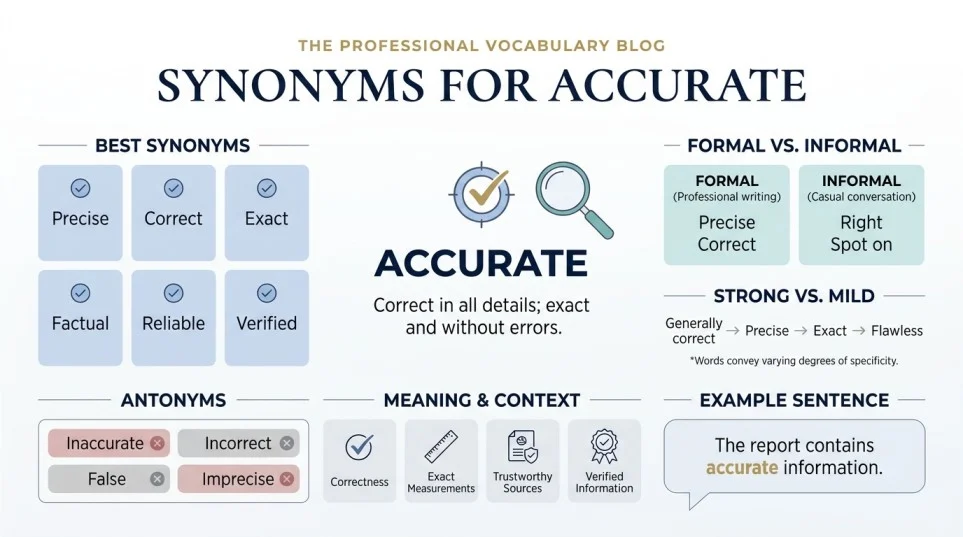
Accurate means correct, exact, and free from errors. Common synonyms include precise, correct, exact, factual, reliable, and true. Use precise for detailed measurements, correct for answers, factual for information, and reliable for trustworthy results or sources.
Meaning, Tone and Context
What Does Accurate Mean?
The word accurate describes something that closely matches the facts, the truth, or the intended standard. It suggests that information, measurements, descriptions, or results contain no significant errors.
For example, an accurate weather report reflects actual conditions as closely as possible. An accurate calculation produces the correct result based on the information provided.
Part of Speech
Accurate is an adjective. It describes the quality of information, measurements, statements, records, descriptions, and other things that can be evaluated for correctness.
Examples:
- The accountant prepared an accurate financial report.
- Her description was accurate and easy to understand.
- We need accurate measurements before ordering the materials.
Tone and Formality
Accurate generally has a neutral, professional tone. It is suitable for everyday conversation, academic writing, technical documents, journalism, business communication, and research.
The word can also communicate confidence in someone’s work because it emphasizes correctness rather than personal opinion.
Common Uses of Accurate
| Context | What Accurate Describes |
|---|---|
| Education | Correct answers and information |
| Science | Measurements and experimental results |
| Business | Financial records and reports |
| Journalism | Information that reflects verified facts |
| Technology | Data, calculations, and system outputs |
| Everyday conversation | Correct details or descriptions |
| Creative writing | Realistic descriptions of people or events |
Word Forms and Related Words
| Word | Part of Speech | Meaning |
|---|---|---|
| Accurate | Adjective | Correct and free from errors |
| Accurately | Adverb | In a correct or precise way |
| Accuracy | Noun | The quality of being correct |
| Inaccurate | Adjective | Containing errors or incorrect information |
| Inaccuracy | Noun | An error or lack of correctness |
When and How to Use “Accurate”
Use accurate when you want to emphasize that information, measurements, descriptions, or results match the facts. It is particularly useful when correctness matters more than style, emotion, or personal preference.
Here are seven realistic examples across different situations.
1. Professional: The team reviewed the figures to ensure the quarterly report was accurate.
2. Academic: Students should use accurate information from credible sources in their research papers.
3. Personal: Your description of what happened was accurate, including the time and location.
4. Email: Please confirm that the contact details in the attached document are accurate.
5. Workplace: Accurate inventory records help the manager identify missing products.
6. Social media: An accurate caption gives readers the right context for the photograph.
7. Creative writing: The author researched local traditions to create an accurate portrayal of the community.
Another Word for Accurate
The best single replacement for accurate is usually correct, especially when discussing answers, facts, or information. However, precise is often better for measurements, while reliable describes information or sources that can be trusted.
Choose your replacement according to the message you want to convey.
| Situation | Best Alternative | Example |
|---|---|---|
| Professional writing | Precise | The report provides precise figures. |
| Academic writing | Correct | The student selected the correct interpretation. |
| Casual conversation | Right | You were right about the meeting time. |
| Emotional writing | Truthful | She gave a truthful account of the experience. |
| Creative writing | Authentic | The story presents an authentic view of rural life. |
| Resume or workplace | Detail oriented | She is detail oriented when reviewing financial records. |
| Social media captions | Correct | Make sure the location details are correct. |
| Strong emphasis on exactness | Exact | The technician recorded the exact temperature. |
| Softer, general meaning | Generally correct | The summary is generally correct, although it omits some details. |
For resumes, detail oriented describes a person’s working style rather than serving as a direct synonym for accurate. Use it when the emphasis is on careful work.
When Not to Use “Accurate”
Although accurate is versatile, it is not always the most informative choice. Sometimes, another word communicates the intended meaning more clearly.
| Situation | Less Specific Sentence | Better Alternative |
|---|---|---|
| A math problem | Her answer is accurate. | Her answer is correct. |
| A scientific measurement | The measurement is accurate. | The measurement is precise to the nearest millimeter. |
| A news report | The report is accurate. | The report is factual and supported by verified evidence. |
| A data source | The website is accurate. | The website is reliable and regularly updated. |
| A historical portrayal | The movie is accurate. | The movie offers an authentic portrayal of the period. |
| A personal statement | He gave an accurate account. | He gave a truthful account of what happened. |
Avoid replacing accurate with a more dramatic word when a simple description is enough. For example, flawless suggests an absence of imperfections, which is a stronger claim than merely being accurate.
Words Commonly Confused With Accurate
Several words overlap with accurate, but each emphasizes a different quality.
| Word | Main Difference | Example |
|---|---|---|
| Precise | Emphasizes exactness or detail | Record the precise dimensions. |
| Correct | Emphasizes being right | Your answer is correct. |
| Exact | Emphasizes a perfect match or specific value | Give me the exact total. |
| Reliable | Emphasizes consistency and trustworthiness | This is a reliable source. |
| Valid | Emphasizes acceptability under a rule, method, or standard | The study uses a valid method. |
| Truthful | Emphasizes honesty and truthfulness | She gave a truthful explanation. |
These words are not interchangeable in every sentence. A source can be reliable without every statement being accurate, and a method can be valid without guaranteeing that every result is correct.
Best Synonym by Context for Accurate
The best synonym for accurate changes depending on whether you are describing information, a person, a measurement, a report, or a method.
| Context | Best Synonym | Why It Works | Example |
|---|---|---|---|
| Formal writing | Precise | Highlights exactness | The document contains precise figures. |
| Academic writing | Correct | Emphasizes correctness | The correct interpretation supports the argument. |
| Business communication | Reliable | Suggests dependable information | We need reliable sales data. |
| Resume | Detail oriented | Describes careful working habits | A detail oriented analyst reviews every entry. |
| Casual conversation | Right | Sounds natural and direct | You were right about the result. |
| Creative writing | Authentic | Suggests a believable representation | The novel offers an authentic portrait of city life. |
| Emotional writing | Truthful | Emphasizes honesty | He shared a truthful account of the disagreement. |
| Strong emphasis | Exact | Highlights a specific value or detail | Enter the exact amount shown on the receipt. |
| Moderate emphasis | Correct | Communicates correctness without extra intensity | The information is correct. |
| Social media captions | Factual | Focuses on verifiable information | Keep the caption factual and informative. |
| Scientific research | Valid | Emphasizes acceptability under a method or standard | The researchers used a valid measurement procedure. |
| Journalism | Verified | Indicates that information has been checked | The newsroom published verified details. |
| Technical documentation | Precise | Reduces ambiguity | Follow the precise installation instructions. |
| Historical writing | Faithful | Emphasizes consistency with the original record | The account is faithful to historical evidence. |
| Everyday descriptions | True | Indicates agreement with reality | That is a true description of the situation. |
There is no single synonym that works best in every context. Choose the word that describes the specific quality you want readers to recognize.
Which Synonym Should You Choose?
Use these five questions to select the most appropriate alternative.
1. What are you describing? Choose correct for answers, exact for specific values, factual for information, and reliable for sources.
2. How formal is the writing? Use precise, verified, or valid in suitable professional and academic contexts. Choose right for ordinary conversation.
3. How strong is your claim? Accurate means correct, while flawless suggests perfection. Avoid stronger words unless the evidence supports them.
4. Does the sentence emphasize honesty? Choose truthful when describing an honest account or statement. Choose accurate when the main concern is factual correctness.
5. What evidence supports the statement? Use verified when information has been checked, reliable when something can be trusted, and correct when it matches the relevant facts or standard.
A useful rule is to select the most specific word that preserves your original meaning. A precise synonym should improve clarity, not simply make a sentence sound more sophisticated.
Real Life Examples of Accurate in Sentences
These examples show how synonyms can make everyday writing more specific.
| Situation | Example Sentence |
|---|---|
| School | The student gave the correct answer after reviewing the formula. |
| Workplace | Our team needs reliable figures before preparing the budget. |
| Writing | The author included factual details to support the main argument. |
| Conversation | You were right about where we parked the car. |
| Social media | The caption provides verified information about the event. |
| Resume | I maintained detailed records and checked entries for accuracy. |
| Please confirm that the dates in the attached schedule are correct. | |
| Storytelling | The writer created an authentic portrayal of life in a small town. |
These substitutions make the purpose of each sentence clearer. Rather than repeating accurate, you can explain whether something is correct, dependable, verified, or authentic.
25 Synonyms for Accurate
The following table includes 25 alternatives, with explanations to help you distinguish direct synonyms from words that apply only in particular situations.
| Synonym | Simple Meaning | Best Used For | Example Sentence |
|---|---|---|---|
| 1. Correct | Free from mistakes | Answers and facts | Her answer was correct. |
| 2. Precise | Exact and carefully defined | Measurements and instructions | The technician recorded precise measurements. |
| 3. Exact | Matching a specific value or detail | Numbers and quantities | The exact cost appears on the invoice. |
| 4. Right | Correct or appropriate | Casual conversation | You were right about the schedule. |
| 5. True | In agreement with reality | Statements and claims | The statement is true. |
| 6. Factual | Based on facts | Reports and articles | The report contains factual information. |
| 7. Reliable | Dependable and trustworthy | Sources and data | We found a reliable source for the figures. |
| 8. Trustworthy | Worthy of confidence | People and information sources | The researcher consulted a trustworthy reference. |
| 9. Verifiable | Capable of being checked | Claims and evidence | Every claim should be verifiable. |
| 10. Verified | Checked and confirmed | Records and information | The company released verified results. |
| 11. Valid | Acceptable under relevant rules or standards | Methods and arguments | The study follows a valid procedure. |
| 12. Sound | Well supported or logically correct | Reasoning and judgments | The committee reached a sound conclusion. |
| 13. Faithful | True to an original or source | Accounts and representations | The biography offers a faithful account of her career. |
| 14. Authentic | Genuine or true to its origins | Cultural and historical descriptions | The museum displays authentic artifacts. |
| 15. Truthful | Honest and not deceptive | Personal accounts | He provided a truthful explanation. |
| 16. Consistent | In agreement across records or instances | Data and repeated results | The figures are consistent across both reports. |
| 17. Error free | Containing no errors | Documents and calculations | The final copy was error free. |
| 18. Unerring | Consistently correct | Exceptional judgment or performance | Her unerring judgment impressed the team. |
| 19. Meticulous | Extremely careful with details | Work processes and record keeping | A meticulous review revealed no missing entries. |
| 20. Dependable | Able to be relied upon | People, systems, and processes | The system provides dependable readings. |
| 21. Objective | Based on evidence rather than personal bias | Assessments and analysis | The reviewer offered an objective assessment. |
| 22. Faithful to the facts | Closely matching the available evidence | Reports and descriptions | The summary remained faithful to the facts. |
| 23. On target | Close to the intended result | Estimates and predictions | The initial estimate was on target. |
| 24. On the mark | Correct or well judged | Informal feedback and observations | Your observation was right on the mark. |
| 25. Flawless | Without noticeable faults or imperfections | Exceptional performance or execution | The presentation was flawless. |
Important usage note: These alternatives have overlapping meanings, but some are contextual substitutes rather than direct synonyms. Meticulous describes carefulness, objective describes freedom from personal bias, and flawless makes a stronger claim than accurate. Choose them only when the sentence supports that meaning.
Synonym Groups and Usage Differences
Professional vs. Personal Synonyms
Professional communication usually benefits from specific, evidence based wording. Use precise for measurements, verified for checked information, and reliable for data or sources that can be trusted.
Personal communication can sound more natural with right, true, or truthful. For example, “You were right about the time” feels more conversational than “Your statement regarding the time was accurate.”
Formal vs. Conversational Synonyms
Formal writing often requires wording that identifies the type of correctness being discussed.
| Writing Style | Suitable Words | Example |
|---|---|---|
| Formal report | Precise, verified | The report includes verified figures. |
| Academic essay | Correct, valid | The analysis uses a valid method. |
| Business email | Correct, reliable | Please confirm that the information is correct. |
| Casual conversation | Right, true | That sounds right to me. |
| Informal message | Right, exact | Send me the exact address. |
The goal is clarity, not formality for its own sake. A simple word is often the strongest choice when it communicates the meaning directly.
Academic Synonyms
Academic writing benefits from words that communicate exactly what the evidence supports.
Use valid when discussing a method or argument that meets relevant standards. Use precise for detailed measurements, factual for statements based on facts, and verified for information that has been checked.
For example, “The researchers used a valid method and reported precise measurements” communicates two different qualities. The method meets an appropriate standard, while the measurements express a specific degree of exactness.
Professional and Business Synonyms
In workplace communication, the most useful synonym depends on the task.
Correct works well for figures, names, dates, and entries. Reliable is suitable for data sources and systems. Verified communicates that information has been checked. Detail oriented describes a person who pays close attention to details.
For example, “I verified the client records before submitting the report” describes an action more clearly than “I made the records accurate.”
Creative or Literary Synonyms
Creative writing may require a word that describes realism, truthfulness, or faithful representation rather than numerical correctness.
Authentic works well for believable voices and cultural details. Faithful suits adaptations and historical accounts. Truthful emphasizes honest representation, while exact highlights a particular detail.
Example: “The novelist created an authentic character whose dialogue reflected the local community.”
Slang or Modern Synonyms
English has informal expressions that communicate correctness, but most are unsuitable for formal documents.
| Expression | Meaning | Appropriate Context |
|---|---|---|
| Spot on | Exactly right | Conversation and informal feedback |
| On the mark | Correct or well judged | Casual discussion |
| Nailed it | Got something exactly right | Informal praise |
| Right on | Correct or in agreement | Casual conversation |
For example, “Your estimate was spot on” sounds natural in conversation. In a technical report, “Your estimate was accurate” or “Your estimate closely matched the final result” is more appropriate.
Strongest vs. Weaker Synonyms
These words form a useful guide to emphasis, although they do not create a strict universal scale because each word expresses a slightly different idea.
| Level | Word or Phrase | Intended Meaning |
|---|---|---|
| Mild | Generally correct | Correct overall, with possible limitations |
| Moderate | Correct | Meets the relevant standard |
| Detailed | Precise | Expresses detail or exactness |
| Highly specific | Exact | Matches a particular value or detail |
| Strong | Unerring | Consistently correct in judgment or action |
| Very strong | Flawless | Free from faults or imperfections |
Use flawless cautiously. A report may contain accurate facts but still have formatting mistakes, omissions, or weaknesses in presentation.
Emotional vs. Neutral Synonyms
Neutral synonyms focus on correctness. Emotional or personal synonyms add implications about honesty, trust, or authenticity.
| Neutral Word | More Personal Alternative | Difference |
|---|---|---|
| Correct | Truthful | Emphasizes honesty |
| Accurate | Authentic | Emphasizes genuineness |
| Reliable | Trustworthy | Emphasizes deserving confidence |
| Faithful | Sincere | Emphasizes honesty of intention, not factual exactness |
For objective reporting, prefer correct, verified, or factual when they fit. For personal stories, truthful or authentic may better communicate the writer’s intention.
Antonyms of Accurate
Antonyms describe the opposite of accuracy, including incorrect information, poor precision, unreliable sources, and misleading representations.
| Antonym | Meaning | Example Sentence |
|---|---|---|
| 1. Inaccurate | Not correct | The initial report was inaccurate. |
| 2. Incorrect | Not right | The answer was incorrect. |
| 3. Wrong | Contrary to the facts or correct answer | The address on the form is wrong. |
| 4. False | Not true | The article repeated a false claim. |
| 5. Erroneous | Containing an error | An erroneous calculation changed the total. |
| 6. Mistaken | Based on an incorrect belief or judgment | I was mistaken about the deadline. |
| 7. Imprecise | Lacking exactness | The instructions were imprecise. |
| 8. Inexact | Not fully exact | The estimate was inexact. |
| 9. Faulty | Defective or affected by problems | Faulty equipment produced inconsistent readings. |
| 10. Misleading | Likely to create a false impression | The misleading headline confused readers. |
| 11. Distorted | Changed from its original form or meaning | The summary presented a distorted account. |
| 12. Untrue | Not in accordance with the facts | The rumor turned out to be untrue. |
| 13. Invalid | Not acceptable under a relevant rule or standard | The calculation used an invalid assumption. |
| 14. Unreliable | Not dependable | The unreliable source contained conflicting figures. |
| 15. Unsound | Based on weak reasoning or an inadequate foundation | The proposal relied on unsound assumptions. |
Some antonyms apply only in particular contexts. Imprecise is the opposite of exactness, while misleading describes information that creates a false impression. Neither necessarily means that every detail is factually incorrect.
Comparison: Accurate vs. Similar Words
Accurate vs. Precise
Main difference: Accurate means correct, while precise emphasizes exactness or a high level of detail.
Strength: Neither word is universally stronger. The right choice depends on the task.
Formality: Both are suitable for formal and informal writing.
Examples:
- Accurate: The thermometer gave an accurate reading.
- Precise: The thermometer measured the temperature to one decimal place.
Accurate vs. Correct
Main difference: Accurate often describes information, measurements, and representations. Correct commonly describes answers, facts, decisions, or actions that meet a standard.
Strength: Neither is inherently stronger.
Formality: Both work in professional and academic writing.
Examples:
- Accurate: The report accurately describes the results.
- Correct: The answer to the equation is correct.
Accurate vs. Exact
Main difference: Accurate emphasizes correctness. Exact emphasizes a specific value, detail, or match.
Strength: Exact can communicate a narrower, more specific claim.
Formality: Both are appropriate in technical and everyday contexts.
Examples:
- Accurate: The estimate was accurate.
- Exact: The final cost was exactly $250.
Accurate vs. Reliable
Main difference: Accurate concerns correctness. Reliable concerns dependability or consistency.
Strength: They describe different qualities rather than different levels of strength.
Formality: Both are suitable for professional communication.
Examples:
- Accurate: The database contains accurate customer details.
- Reliable: The database is a reliable source for current customer records.
Accurate vs. Valid
Main difference: Accurate means correct. Valid means acceptable under a particular rule, method, or standard.
Strength: Neither is universally stronger.
Formality: Valid is particularly useful in research, logic, law, and technical discussions.
Examples:
- Accurate: The calculation produced an accurate result.
- Valid: The researchers used a valid experimental method.
Accurate vs. Truthful
Main difference: Accurate focuses on factual correctness. Truthful emphasizes honesty and telling the truth.
Strength: Truthful may communicate personal honesty more directly, but it does not guarantee that every detail is correct.
Formality: Both work in formal and personal writing.
Examples:
- Accurate: The witness gave an accurate account of the event.
- Truthful: The witness gave a truthful account of what they remembered.
Common Phrases and Expressions with Accurate
1. Accurate information
Meaning: Information that correctly represents the facts.
Example sentence: Accurate information helps customers make informed decisions.
2. Accurate measurements
Meaning: Measurements that closely match the actual quantities or values.
Example sentence: Accurate measurements are essential when cutting materials for construction.
3. Accurate representation
Meaning: A description or portrayal that reflects the subject correctly.
Example sentence: The documentary provides an accurate representation of life in the region.
4. Accurate estimate
Meaning: An estimate that comes close to the actual value.
Example sentence: Her accurate estimate helped the team prepare an appropriate budget.
5. Accurate record
Meaning: A record that contains correct details.
Example sentence: The clinic maintains an accurate record of every appointment.
6. Factually accurate
Meaning: Correct according to the available facts.
Example sentence: Before publication, the editor checked whether the article was factually accurate.
7. Highly accurate
Meaning: Correct to a high degree.
Example sentence: The instrument provides highly accurate readings under normal operating conditions.
8. Accurate account
Meaning: A description or report that correctly reflects an event.
Example sentence: The journalist worked to produce an accurate account of the public meeting.
Common Mistakes to Avoid
1. Treating Accurate and Precise as Identical
Accuracy concerns correctness, while precision concerns exactness or detail. A measurement can be precise but consistently wrong.
Better approach: Explain whether you mean correctness, exactness, or both.
2. Using Reliable When You Mean Correct
A reliable source is generally dependable, but a particular statement from that source may still contain an error.
Better approach: Say “The figure is correct” when you are confirming a specific value.
3. Choosing Casual Language for Formal Reports
Expressions such as nailed it and spot on can sound too informal in academic papers or business reports.
Better approach: Use correct, precise, or verified when appropriate.
4. Using Flawless for Ordinary Accuracy
Flawless suggests that something has no faults or imperfections, which goes beyond factual correctness.
Better approach: Use accurate for correct information and flawless only when the broader claim is justified.
5. Repeating Accurate Too Often
Using the same adjective in every paragraph can make writing feel repetitive.
Better approach: Replace it with a contextually suitable alternative, such as correct, exact, or factual.
6. Confusing Truthful With Factually Correct
Someone may honestly report what they remember without every detail being correct.
Better approach: Use truthful to emphasize honesty and accurate to emphasize factual correctness.
7. Using Slang in Academic Writing
Informal expressions may communicate the right idea but weaken the tone of formal writing.
Better approach: Match your vocabulary to your audience and purpose.
FAQs
1. What is the best synonym for accurate?
The best synonym for accurate is usually correct. Precise works better for measurements, factual suits information, and reliable describes sources or systems people can depend on.
2. What is a formal synonym for accurate?
Precise, verified, factual, and correct are useful formal alternatives. Choose precise for exact details and verified when information has been checked against suitable evidence.
3. What is an informal synonym for accurate?
Right is a common informal alternative to accurate. Expressions such as spot on and on the mark also work in casual conversations, depending on the sentence.
4. What is another word for accurate in professional writing?
Precise, correct, verified, and reliable are useful professional alternatives. Select the word according to whether you mean exact measurements, correct details, checked information, or dependable sources.
5. What is the difference between accurate and precise?
Accurate means correct, while precise means exact or detailed. A measurement can be precise without being accurate if it consistently differs from the true value.
6. What is the opposite of accurate?
Common opposites include inaccurate, incorrect, wrong, false, and imprecise. Use inaccurate for incorrect information and imprecise when something lacks sufficient exactness or detail.
Conclusion
Accurate means correct and free from significant errors, but the best synonym depends on your intended meaning. Use correct for answers, precise for measurements, factual for information, reliable for dependable sources, and truthful for honest accounts.
When choosing an alternative, consider your audience, the evidence available, and the type of correctness you want to communicate. The most effective vocabulary choice is not necessarily the most sophisticated word. It is the word that expresses your meaning clearly and naturally.
A practical tip: before replacing accurate, ask yourself whether you mean correct, exact, dependable, verified, or honest. That small distinction can make your writing more precise and professional.
Discover More Post:
- 50+ Synonyms for Correct | Meanings, Examples, and Best …
- 50+ Synonyms for Investigate | Meanings, Examples, and Best …
- 50+ Synonyms for Nose | From Everyday Expressions to Vivid …