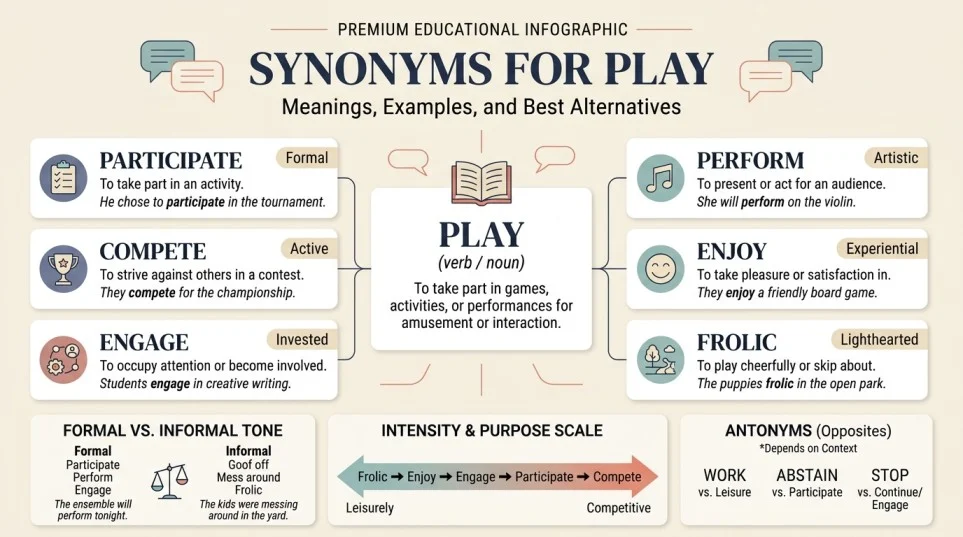
Do you often use the word play when talking about games, sports, music, children, or creative activities? Repeating the same word in essays, emails, captions, and everyday conversations can make your writing feel less interesting. Choosing a more precise word helps you explain exactly what you mean.
The best synonyms for play depend on the situation. You might use participate for a formal activity, perform for music or theater, compete for sports, or enjoy yourself for a relaxed social moment. This guide explains the meaning of play, its different uses, and practical alternatives with natural examples. You will also learn which words fit academic writing, professional communication, creative storytelling, and social media captions.
What Does Play Mean?
Play means taking part in an enjoyable activity, game, sport, or creative performance. Depending on the context, useful synonyms include participate, engage, perform, compete, frolic, entertain, and amuse oneself. The best replacement depends on the activity and the intended tone.
Meaning, Tone and Context
What Does Play Mean?
Play has several meanings. It can describe having fun, participating in a game, performing music or theater, using a toy, or allowing something to operate or influence a situation.
Part of speech: Play is mainly a verb and a noun.
Tone: Usually neutral or positive. It often suggests enjoyment, relaxation, creativity, or competition. In some situations, it can describe manipulation or unserious behavior.
Formality: The word works in casual conversation, academic writing, professional communication, and creative writing. However, a more specific word may communicate your meaning more clearly.
Common Uses of Play
- Recreation: Children play outside after school.
- Sports: The team will play against its biggest rival.
- Music: She can play the piano beautifully.
- Theater: The actors will play their roles tonight.
- Technology: Please play the video again.
- Influence: Several factors play a role in the final decision.
- Pretending: The children play that they are explorers.
Important Word Forms
| Word form | Meaning | Example |
|---|---|---|
| Play | To take part in an activity | We play chess every Sunday. |
| Plays | Present tense for he, she, or it | He plays the guitar. |
| Played | Past tense | They played soccer yesterday. |
| Playing | Ongoing activity | The children are playing outside. |
| Player | A person who participates in a game or sport | She is a skilled player. |
| Playful | Full of fun or lighthearted energy | His playful attitude made us smile. |
| Playful behavior | Behavior that is fun or teasing | The puppy showed playful behavior. |
When and How to Use Play
Use play when the activity involves fun, games, sports, music, acting, pretending, or a role in a larger situation. When the activity has a more specific purpose, a stronger verb can improve clarity.
- Casual: The kids play in the backyard every afternoon.
- Sports: Our school will play against another team on Friday.
- Academic: Researchers examine the role that sleep plays in memory.
- Creative: The actor will play a detective in the new production.
Notice how the meaning changes with the context. Playing a sport involves competition, playing a musical instrument involves producing music, and playing a role involves acting or representing someone.
Another Word for Play
The best single replacement for play is participate when you mean taking part in an organized activity. However, there is no universal synonym that fits every use.
| Situation | Best alternative | Example |
|---|---|---|
| Professional writing | Participate | Employees can participate in the training program. |
| Academic writing | Engage | Students engage in practical learning activities. |
| Casual conversation | Have fun | We had fun at the park. |
| Emotional writing | Enjoy oneself | She finally enjoyed herself after a stressful week. |
| Creative writing | Frolic | The puppies frolicked across the grass. |
| Resume or workplace | Participate | Participated in team building activities. |
| Social media captions | Have fun | Making memories and having fun with friends. |
| Stronger competitive meaning | Compete | The athletes compete for the championship. |
| Softer, relaxed meaning | Enjoy | The children enjoyed a quiet afternoon outdoors. |
For music, use perform or practice when those words accurately describe the activity. For theater, use act or portray. A video or song, use play back when you mean to reproduce recorded content.
When Not to Use Play
Although play is flexible, it can sometimes sound too general. A more exact verb helps readers understand the action without guessing.
| Vague sentence | More precise sentence | Why it is better |
|---|---|---|
| She plays music at events. | She performs music at events. | Perform highlights a live presentation. |
| They play for the championship. | They compete for the championship. | Compete emphasizes the contest. |
| He plays with the software. | He experiments with the software. | Experiment suggests testing features or ideas. |
| The students play a role in the project. | The students contribute to the project. | Contribute emphasizes useful work. |
| The children play in the garden. | The children frolic in the garden. | Frolic adds a sense of lively enjoyment. |
Do not replace play simply to sound sophisticated. If play is the clearest and most natural choice, keep it. The goal is precision, not complicated vocabulary.
Words Commonly Confused With Play
Several words overlap with play but have different meanings.
| Word | Main difference | Best use |
|---|---|---|
| Act | To perform an action or portray a character | Theater, behavior, and drama |
| Perform | To present a skill, piece of music, or dramatic role | Music, theater, and public presentations |
| Participate | To take part in an activity | Meetings, events, and organized programs |
| Compete | To try to win against others | Sports, contests, and championships |
| Practice | To repeat an activity to improve a skill | Music, sports, and learning |
| Enjoy | To experience pleasure or satisfaction | Leisure, experiences, and personal activities |
For example, a musician may practice a song at home, perform it on stage, and enjoy the experience. These verbs describe different parts of the same event.
Best Synonym by Context for Play
The best synonym for play changes according to the action, audience, and purpose. Use this table to choose a word that fits your sentence naturally.
| Context | Best synonym | Why it works | Example |
|---|---|---|---|
| Formal writing | Participate | Emphasizes taking part | All members may participate in the event. |
| Academic writing | Engage | Highlights active involvement | Students engage in collaborative exercises. |
| Business communication | Participate | Sounds clear and professional | Staff can participate in the workshop. |
| Resume | Contribute | Highlights useful involvement | Contributed to team activities and projects. |
| Casual conversation | Have fun | Sounds friendly and natural | We had fun at the beach. |
| Creative writing | Frolic | Suggests lively movement | The lambs frolicked in the meadow. |
| Emotional writing | Enjoy | Emphasizes positive feelings | She enjoyed every moment with her family. |
| Competitive sports | Compete | Focuses on trying to win | The team will compete for the title. |
| Gentle recreation | Amuse oneself | Suggests relaxed entertainment | He amused himself with a puzzle. |
| Social media captions | Celebrate | Adds excitement to an occasion | We celebrated a wonderful day together. |
| Music | Perform | Highlights presenting music | The band performed at the festival. |
| Theater | Act | Refers to portraying a character | She will act in the school production. |
| Video playback | Replay | Means playing something again | Please replay the final scene. |
| Skill development | Practice | Emphasizes improvement | He practices the piano every evening. |
| Role or influence | Contribute | Highlights an effect on a result | Trust contributes to a strong friendship. |
| Imaginative activity | Pretend | Emphasizes make believe | The children pretended to be astronauts. |
US and UK Usage
Play is common in both American and British English. Most synonyms in this guide work in both varieties, although the surrounding expressions may differ.
In American English, children commonly play soccer, while British English often uses football for the same sport. The verb play itself does not change. Choose familiar wording for your audience.
Which Synonym Should You Choose?
Use these five questions to find the right replacement.
1. What action do you mean? Choose compete for a contest, perform for a show, practice for skill development, and participate for general involvement.
2. How formal is the situation? Participate and engage fit many formal settings. Have fun and mess around are more casual.
3. How much emotion should the word convey? Enjoy suggests pleasure, while frolic suggests lively and playful movement.
4. What do you want to emphasize? Use contribute when the action helps a larger effort. Use entertain when the goal is to give people enjoyment.
5. What sounds natural in the sentence? Read the sentence aloud after replacing play. If the meaning becomes less clear, keep the original word.
A useful rule is to choose the word that describes the action most accurately. A simple, precise verb is often better than an unusual synonym.
Real Life Examples of Play in Sentences
Here are examples showing how different alternatives work in everyday situations.
| Situation | Example sentence |
|---|---|
| School | Students participate in a science activity after lunch. |
| Workplace | Our team engages in problem solving exercises each month. |
| Writing | The author uses humor to entertain readers. |
| Conversation | We had fun playing board games last night. |
| Social media | Enjoying every moment of this beautiful weekend. |
| Resume | Contributed to group projects and school activities. |
| Please participate in the scheduled training session. | |
| Storytelling | The young fox frolicked beneath the trees. |
| Music | My sister performs at local music events. |
| Sports | The players compete with confidence and teamwork. |
| Technology | Replay the recording to hear the announcement again. |
| Learning | Children experiment with different building blocks. |
These examples show why context matters. Participate works well for organized activities, while frolic suits lively movement and perform suits public presentations.
18 Synonyms for Play
The following 18 alternatives cover recreation, competition, performance, learning, and professional involvement. Some replace only one meaning of play, so check the example and intended meaning before choosing.
| Synonym | Simple meaning | Best used for | Example sentence |
|---|---|---|---|
| 1. Participate | Take part in something | Events and group activities | Everyone can participate in the school festival. |
| 2. Engage | Become actively involved | Academic and professional settings | Students engage in hands on experiments. |
| 3. Compete | Try to win | Sports and contests | The team will compete against experienced players. |
| 4. Perform | Present a skill or piece of music | Music and entertainment | She will perform at the concert tonight. |
| 5. Act | Portray a character or perform an action | Theater and drama | He hopes to act in a comedy. |
| 6. Practice | Repeat an activity to improve | Skills and training | I practice the guitar before dinner. |
| 7. Enjoy | Experience pleasure | Recreation and personal experiences | They enjoy outdoor games on sunny days. |
| 8. Frolic | Move or behave in a lively way | Creative and descriptive writing | The puppies frolic in the fresh snow. |
| 9. Amuse | Provide enjoyment | Entertainment and humor | The magician amused the young audience. |
| 10. Entertain | Give people enjoyment | Shows and social occasions | The performers entertained the crowd. |
| 11. Recreate | Take part in leisure activities | Recreation and formal writing | Families recreate in the park on weekends. |
| 12. Gamble | Risk money or something valuable | Games involving wagers | They gamble only small amounts during the game. |
| 13. Toy | Handle or consider something casually | Informal writing or experimentation | She toyed with the idea of joining a band. |
| 14. Pretend | Act as if something is true | Imaginative games | The children pretend to run a restaurant. |
| 15. Experiment | Try something to learn what happens | Learning and creative exploration | We experiment with new painting techniques. |
| 16. Replay | Play or show again | Videos, audio, and recorded events | Can you replay that section of the recording? |
| 17. Contribute | Help produce a result | Work and teamwork | Every member contributes to the group activity. |
| 18. Celebrate | Mark an occasion with enjoyment | Parties and special events | Friends celebrate together after the final match. |
Important distinction: These words are not interchangeable in every sentence. Gamble, toy, replay, and contribute fit particular meanings of play rather than replacing the word in every context.
Synonym Groups and Usage Differences
Professional vs. Personal Synonyms
Professional writing often benefits from words that explain involvement, achievement, or responsibility. Participate, engage, and contribute are useful when discussing meetings, projects, and organized activities.
Personal writing can be more relaxed. Enjoy, have fun, amuse oneself, and frolic work well when describing leisure, family time, and everyday experiences.
For example, write Employees participated in the team event for a workplace report. In a personal message, write We had fun at the team event.
Formal vs. Conversational Synonyms
Choose a word that suits the reader and setting.
| Writing style | Suitable words | Example |
|---|---|---|
| Reports | Participate, engage | Staff participated in the annual program. |
| Essays | Engage, participate | Students engage in group learning. |
| Speeches | Perform, entertain | The choir performed for the audience. |
| Casual writing | Have fun, enjoy | We enjoyed our afternoon together. |
| Text messages | Play, hang out | Want to hang out after school? |
| Emails | Participate, attend | Please participate in the discussion. |
Attend is appropriate when you mean being present at an event, but it does not always mean taking part actively. Choose participate when involvement is the main point.
Academic Synonyms
In academic writing, precise words make your ideas easier to understand. Engage is useful for active learning, participate for involvement in a study or activity, and experiment for testing an idea or method.
Consider these examples:
- General: Children play an important part in the activity.
- More precise: Children participate actively in the activity.
- Research focused: Researchers experiment with different learning methods.
When play means having an effect, as in play a role, words such as contribute to, influence, and affect may be more accurate.
Professional and Business Synonyms
In workplace communication, avoid replacing play with a fancy word that changes the meaning. Choose the verb that matches the responsibility.
- Participate: Employees participate in professional development sessions.
- Contribute: Team members contribute ideas during planning.
- Engage: Managers engage staff in problem solving.
- Perform: The band performs at the company celebration.
- Compete: The business competes with several established brands.
For resumes, describe what you did and what changed as a result. Contributed to a team project is more informative than played a part in a project when your contribution can be explained specifically.
Creative or Literary Synonyms
Creative writing benefits from verbs that help readers picture an action.
- Frolic: Suggests lively, cheerful movement.
- Prance: Suggests proud or energetic steps.
- Rom p: Suggests energetic and often playful movement.
- Amuse: Emphasizes giving someone enjoyment.
- Pretend: Highlights imagination or make believe.
- Revel: Suggests enjoying an experience with great enthusiasm.
For example, The children played in the garden gives a general picture. The children frolicked among the flowers creates a livelier scene.
Slang or Modern Synonyms
Some casual expressions can replace play in specific situations, but they are not universal synonyms.
- Hang out: Spend relaxed time with friends.
- Mess around: Behave casually or experiment without a serious plan.
- Game: Play video games or participate in gaming.
- Chill: Relax without much activity.
Examples include We are hanging out after school and They are gaming online tonight.
These expressions work in friendly conversations and social media captions. In academic papers, formal emails, or business reports, use more precise language.
Strongest vs. Weaker Synonyms
There is no single intensity scale for every meaning of play. The following scale compares the energy or involvement suggested by selected words in recreational contexts.
| Intensity | Word | Meaning |
|---|---|---|
| Mild | Enjoy | Experience pleasure |
| Mild | Participate | Take part in an activity |
| Moderate | Engage | Become actively involved |
| Moderate | Romp | Move around energetically |
| Strong | Frolic | Move in a lively, playful way |
| Strong | Revel | Enjoy something with great enthusiasm |
The strongest word is not always the best one. Use enjoy for a calm afternoon and frolic for lively movement. Use revel when the sentence emphasizes strong enjoyment.
Emotional vs. Neutral Synonyms
Neutral words describe an activity without adding much emotion. Participate, engage, and perform often work this way.
More expressive words add a feeling or image. Frolic suggests playful energy, delight emphasizes happiness, and revel suggests enthusiastic enjoyment.
Compare these sentences:
- Neutral: The children participated in the outdoor activity.
- Warm: The children enjoyed the outdoor activity.
- Expressive: The children frolicked across the sunny field.
Choose the level of emotion that suits your purpose.
Antonyms of Play
Play has several meanings, so it does not have one opposite that works in every situation. The following words are opposites or contrasts for particular meanings, such as recreation, competition, performance, and playback.
| Antonym | Meaning | Example sentence |
|---|---|---|
| 1. Work | Perform a task or duty | She worked instead of playing outside. |
| 2. Labor | Work with physical or mental effort | They labored all afternoon rather than playing. |
| 3. Toil | Work very hard | He toiled in the fields throughout the day. |
| 4. Study | Focus on learning | She studied while her friends played. |
| 5. Work seriously | Focus on duties rather than recreation | The team worked seriously before the deadline. |
| 6. Abstain | Choose not to take part | He abstained from the tournament. |
| 7. Withdraw | Leave an activity or competition | The player withdrew from the match. |
| 8. Sit out | Choose not to participate | She decided to sit out the next game. |
| 9. Forfeit | Give up a right or competition | The team forfeited the match. |
| 10. Stop | Bring an activity to an end | Please stop the game for a moment. |
| 11. Pause | Temporarily interrupt an activity | He paused the video to answer the phone. |
| 12. Mute | Turn off sound | She muted the music during the call. |
| 13. Silence | Make or keep something quiet | They silenced the instrument between performances. |
| 14. Suppress | Hold back or prevent an action | The coach suppressed unnecessary celebrations. |
| 15. Neglect | Fail to give proper attention | He neglected his homework while playing games. |
Some entries are contextual contrasts rather than exact dictionary antonyms. For instance, mute contrasts with playing audio, while work contrasts with recreational play. Always match the opposite to the intended meaning.
Comparison: Play vs. Similar Words
Play vs. Participate
Main difference: Play often suggests recreation or a game, while participate means taking part in an activity of almost any kind.
Which is stronger? Neither is inherently stronger. Participate emphasizes involvement.
Which is more formal? Participate is usually more suitable for formal writing.
- Play: We play games after class.
- Participate: We participate in the school science fair.
Play vs. Perform
Main difference: Play can describe many activities, while perform usually means presenting a skill, musical piece, or dramatic role.
Which is stronger? Perform is more specific when describing a presentation.
Which is more formal? Perform is common in both formal and everyday settings.
- Play: She plays music at home.
- Perform: She performs music at a local concert.
Play vs. Compete
Main difference: Play may describe taking part in a sport, while compete emphasizes trying to win.
Which is stronger? Compete puts more focus on the contest.
Which is more formal? Both work in formal writing, but compete is more precise when the goal is victory.
- Play: Our team plays soccer on Saturdays.
- Compete: Our team competes for the regional title.
Play vs. Practice
Main difference: Play can mean enjoying an activity or taking part in a game. Practice means repeating an activity to improve.
Which is stronger? Practice emphasizes learning and effort rather than enjoyment.
Which is more formal? Both are suitable for most settings.
- Play: He plays the piano after school.
- Practice: He practices the piano for an hour each day.
Play vs. Enjoy
Main difference: Play describes an activity, while enjoy describes the pleasure someone experiences.
Which is stronger? Enjoy emphasizes the feeling of pleasure.
Which is more formal? Both are suitable for casual and professional writing, depending on the sentence.
- Play: The children play in the park.
- Enjoy: The children enjoy spending time in the park.
Play vs. Engage
Main difference: Play often refers to games or recreation. Engage emphasizes active involvement in an activity or process.
Which is stronger? Engage can suggest deeper or more focused involvement, but context matters.
Which is more formal? Engage is often preferred in academic and professional writing.
- Play: The students play learning games.
- Engage: The students engage in collaborative learning.
Common Phrases and Expressions with Play
1. Play a role
Meaning: Have an effect on a situation or outcome.
Example sentence: Good communication plays a role in building strong relationships.
2. Play a game
Meaning: Take part in a structured activity with rules.
Example sentence: We play a game of chess after dinner.
3. Play it safe
Meaning: Choose the less risky option.
Example sentence: I decided to play it safe and leave early.
4. Play along
Meaning: Cooperate with an idea or situation, sometimes without fully believing it.
Example sentence: She played along with the surprise until everyone arrived.
5. Play fair
Meaning: Follow rules and treat others honestly.
Example sentence: Good athletes play fair even when they lose.
6. Play a part
Meaning: Contribute to an event or outcome.
Example sentence: Regular practice played a part in his improvement.
7. Play by the rules
Meaning: Follow the rules of an activity or system.
Example sentence: Everyone must play by the rules during the competition.
8. Play with fire
Meaning: Take a risk that could lead to trouble.
Example sentence: Ignoring safety instructions is playing with fire.
Common Mistakes to Avoid
1. Using Play When a More Precise Word Is Better
Play can be too general when the exact action matters.
Instead of writing She plays in concerts, consider She performs in concerts. The second sentence clearly describes a public presentation.
2. Confusing Play With Practice
Playing a musical instrument can mean enjoying the activity or producing music. Practicing an instrument means working to improve your skills.
Choose practice when the sentence focuses on learning or preparation.
3. Using Casual Words in Formal Writing
Expressions such as mess around and chill work well in casual conversations. They may sound unsuitable in research papers, workplace reports, or formal emails.
Choose participate, engage, or experiment when those words match your intended meaning.
4. Choosing an Overly Dramatic Synonym
Frolic and revel can add energy, but they may sound exaggerated in a simple factual sentence.
For example, The children enjoyed the lesson is more neutral than The children frolicked through the lesson.
5. Repeating Play Too Often
Repeating the same word can make a paragraph less engaging. Use alternatives when they describe the action accurately.
For example, The children played outside, enjoyed a ball game, and competed in a friendly race.
6. Choosing the Wrong Emotional Tone
Perform, participate, and engage are often neutral. Frolic and revel carry stronger emotional or descriptive meaning.
Match the word to the feeling you want readers to understand.
FAQs
1. What is the best synonym for play?
The best synonym depends on context. Participate suits organized activities, compete fits sports, perform describes presentations, and enjoy emphasizes pleasure.
2. What is a formal synonym for play?
Participate is a useful formal synonym when play means taking part in an activity. Engage also works in academic and professional contexts.
3. What is an informal synonym for play?
Have fun is a natural informal alternative when describing enjoyable activities. Hang out works when you mean spending relaxed time with friends.
4. What is another word for play in professional writing?
Participate, engage, and contribute can work in professional writing. Choose participate for involvement, engage for active involvement, and contribute for adding value.
5. What is the difference between play and perform?
Play can describe games, recreation, music, and acting. Perform usually refers to presenting a skill, musical piece, or dramatic role to an audience.
6. What is the opposite of play?
Work is a common opposite when play means recreation. Other contrasts include abstain, withdraw, or stop, depending on whether play means competing, participating, or playing recorded content.
Conclusion
Play is a flexible word that can describe games, sports, music, recreation, imagination, and influence. The best synonyms for play include participate, compete, perform, engage, enjoy, and frolic, but each word fits a different situation.
For professional writing, choose precise words such as participate or contribute. Sports, use compete when winning matters. For creative writing, words such as frolic and revel can add energy and emotion.
The most useful vocabulary tip is to identify the action before choosing a synonym. A precise word makes your writing clearer, more natural, and easier to understand.
Discover More Post:
- 50+ Synonyms for Investigate | Meanings, Examples, and Best …
- 50+ Synonyms for Other | Meanings, Examples, and Best …
- 50+ Synonyms for Truly | Meanings, Examples, and Best …