You may use the word “lovely” when describing a person, place, idea, experience, or feeling, only to notice that you are repeating it in every sentence. Finding a more precise alternative can make your writing sound more natural and expressive.
The best synonym depends on what you mean. A beautiful garden, a charming person, a delightful experience, and an elegant design may all be lovely, but each alternative creates a slightly different impression.
This guide explains the meaning, tone, context, and practical use of synonyms for lovely. You will also find examples for school, work, conversation, social media, emails, creative writing, and everyday communication.
What Does “Lovely” Mean?
“Lovely” describes something that is beautiful, pleasant, attractive, enjoyable, or emotionally appealing. Depending on context, strong alternatives include beautiful, charming, delightful, elegant, appealing, adorable, enchanting, and pleasant.
Meaning, Tone and Context
Simple Definition
“Lovely” generally means pleasing, attractive, beautiful, enjoyable, or emotionally warm. It can describe appearance, personality, experiences, places, objects, ideas, and situations.
For example, “She has a lovely smile” focuses on appearance and warmth, while “We had a lovely evening” describes an enjoyable experience.
Part of Speech
“Lovely” is primarily an adjective.
It can describe a person, object, place, experience, event, idea, or quality.
Examples:
“Your daughter has a lovely smile.”
“That was a lovely dinner.”
“She gave me a lovely gift.”
Tone
The word usually has a positive and warm tone. It can communicate admiration, affection, appreciation, or simple enjoyment.
Unlike some stronger words, “lovely” does not always sound dramatic. It can be gentle and understated.
Formality Level
“Lovely” is generally neutral to moderately conversational. It works well in everyday speech, personal writing, messages, descriptions, and many informal professional situations.
For highly formal writing, a more precise word such as attractive, elegant, appealing, or impressive may sometimes communicate the intended meaning more clearly.
Common Use Cases
You can use “lovely” to describe:
- Physical appearance
- Personality
- Places and scenery
- Experiences
- Food and meals
- Gifts
- Ideas
- Weather
- Events
- Emotional moments
Related Word Forms
“Lovely” comes from the word “love.”
Related words include “love,” “lovely,” “loving,” “lovable,” and “loveliness.” These words are related but do not always have the same meaning or grammatical function.
When and How to Use “Lovely”
“Lovely” works best when you want to express positive appreciation without sounding excessively intense.
Professional
“The new office has a lovely atmosphere that makes visitors feel welcome.”
Personal
“You have a lovely family, and it was wonderful meeting everyone.”
Academic
“The author creates a lovely contrast between the natural landscape and the industrial setting.”
For academic writing, however, a more precise descriptive word may be preferable when the exact quality matters.
Emotional
“She wrote a lovely message for her grandmother.”
Creative
“The cottage stood beside a lovely meadow filled with wildflowers.”
Social Media
“Such a lovely evening with wonderful friends.”
“Thank you for the lovely note. I really appreciated your kind words.”
Casual
“That is a lovely jacket. Where did you find it?”
Another Word for “Lovely”
There is no single replacement that works in every situation. The best choice depends on what “lovely” means in your sentence.
| Situation | Recommended Word |
|---|---|
| Professional writing | Appealing |
| Academic writing | Attractive |
| Casual conversation | Beautiful |
| Emotional writing | Endearing |
| Creative writing | Enchanting |
| Resume or workplace use | Impressive |
| Social media captions | Gorgeous |
| Stronger meaning | Exquisite |
| Softer meaning | Pleasant |
- For professional writing, “appealing” is useful when discussing designs, ideas, products, or experiences.
- For academic writing, “attractive” can be more precise when discussing visual qualities or characteristics.
- For emotional writing, “endearing” suggests affection rather than simple physical beauty.
When Not to Use “Lovely”
“Lovely” can become vague when you need to explain exactly why something is good.
For example:
“The presentation was lovely.”
This sounds positive, but it does not explain what worked.
A more precise sentence would be:
“The presentation was clear, engaging, and visually appealing.”
Similarly, saying “She has a lovely personality” gives a general compliment. If you mean that she is kind, use “kind.” If you mean that she makes people comfortable, “welcoming” may be better.
Avoid using “lovely” repeatedly when stronger descriptive vocabulary can make your writing more specific.
Words Commonly Confused With “Lovely”
Lovely vs. Beautiful
“Beautiful” usually focuses more directly on appearance or aesthetic quality. “Lovely” often adds warmth or pleasantness.
Lovely vs. Pretty
“Pretty” commonly describes attractive appearance and can sound lighter or more casual. “Lovely” can describe both appearance and experiences.
Lovely vs. Attractive
“Attractive” is more neutral and precise. It can describe physical appearance, designs, ideas, or features without necessarily adding emotional warmth.
Lovely vs. Charming
“Charming” suggests an appealing quality that creates pleasure or affection. It is especially useful for people, places, behavior, and small details.
Lovely vs. Delightful
“Delightful” emphasizes enjoyment or pleasure. It is particularly useful for experiences, personalities, conversations, events, and discoveries.
Lovely vs. Adorable
“Adorable” expresses strong affection and is often used for babies, children, animals, objects, or people with an especially endearing quality.
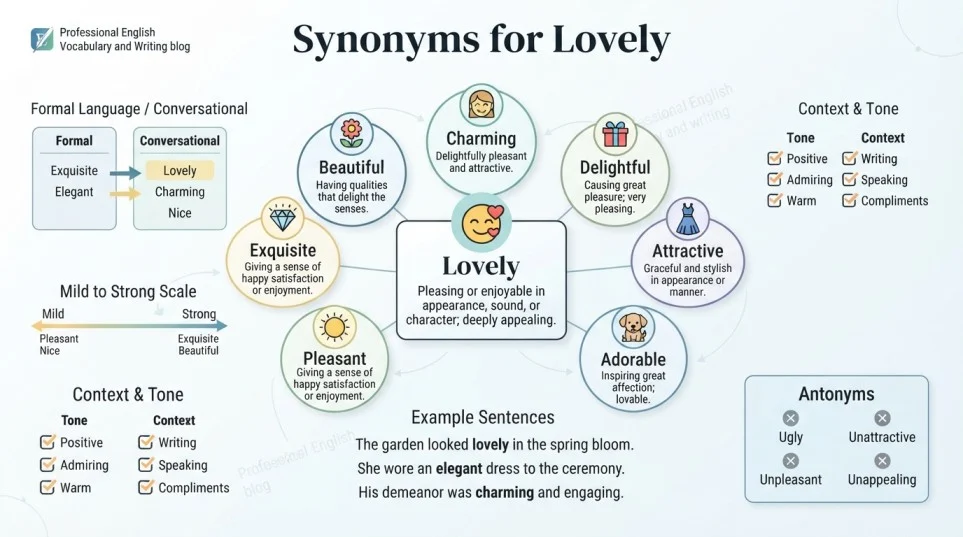
Best Synonym by Context for “Lovely”
| Context | Best Synonym | Why It Works | Example |
|---|---|---|---|
| Formal writing | Elegant | Suggests refined beauty | The building has an elegant interior. |
| Academic writing | Attractive | Clear and relatively neutral | The design offers an attractive visual structure. |
| Professional use | Appealing | Works well for products, ideas, and designs | The proposal presents an appealing solution. |
| Resume | Impressive | Highlights positive impact or quality | She created an impressive presentation. |
| Casual conversation | Beautiful | Natural and familiar | That is a beautiful painting. |
| Creative writing | Enchanting | Adds imagination and atmosphere | An enchanting forest surrounded the village. |
| Emotional tone | Endearing | Communicates affection | His endearing sense of humor made everyone smile. |
| Strong intensity | Exquisite | Suggests exceptional beauty or refinement | The restaurant served an exquisite dessert. |
| Soft or moderate tone | Pleasant | Positive without strong emotion | We spent a pleasant afternoon outside. |
| Social media | Gorgeous | Energetic and expressive | This sunset is absolutely gorgeous. |
| US usage | Beautiful | Very common in everyday American English | You look beautiful tonight. |
| UK usage | Lovely | Very common for appreciation and pleasantness | That was a lovely afternoon. |
Which Synonym Should You Choose?
Start by asking what you actually mean.
- If you mean visual beauty, consider “beautiful,” “gorgeous,” “pretty,” or “attractive.”
- If you mean warmth or personal appeal, “charming,” “endearing,” or “lovable” may be more accurate.
- If you mean enjoyment, “pleasant,” “delightful,” or “wonderful” can work better.
- If you mean refined beauty, “elegant” or “exquisite” may be appropriate.
- If you want a creative or imaginative feeling, “enchanting” and “captivating” can add more personality.
Also consider your audience. A word that sounds natural in a text message may feel too casual in an academic essay or business report.
Real Life Examples of “Lovely” in Sentences
School
“The teacher gave us a lovely example that made the lesson easier to understand.”
Workplace
“Your team created a lovely presentation for the client.”
For a more professional tone, “polished,” “effective,” or “impressive” may provide more specific praise.
Writing
“The writer uses a lovely description of the countryside.”
A stronger literary choice might be “vivid,” “evocative,” or “enchanting,” depending on the intended effect.
Conversation
“You have a lovely home.”
Social Media
“Lovely memories from a beautiful weekend.”
Resume
Instead of writing, “Created lovely presentations,” use a specific professional description such as:
“Created engaging presentations for client meetings and internal training.”
“Thank you for the lovely invitation. I am looking forward to joining you.”
Storytelling
“The travelers discovered a lovely village surrounded by green hills.”
25 Synonyms for “Lovely”
| Synonym | Simple Meaning | Best Used For | Example Sentence |
|---|---|---|---|
| Beautiful | Very pleasing to look at | People, places, objects | The lake looked beautiful at sunrise. |
| Charming | Pleasant and appealing in a warm way | People, places, behavior | The little town has a charming character. |
| Delightful | Very enjoyable or pleasing | Experiences, people, events | We had a delightful conversation over dinner. |
| Attractive | Visually or generally appealing | People, designs, products | The website has an attractive layout. |
| Appealing | Likely to attract interest or approval | Ideas, products, designs | The company introduced an appealing new service. |
| Pretty | Pleasant to look at | People, objects, places | She wore a pretty blue dress. |
| Gorgeous | Extremely beautiful or impressive | People, scenery, objects | The mountain view was gorgeous. |
| Adorable | Extremely endearing or cute | Children, animals, people, objects | The puppy looked adorable in its little sweater. |
| Wonderful | Extremely good or enjoyable | Experiences, people, events | We had a wonderful time at the concert. |
| Pleasant | Enjoyable and comfortable | Experiences, surroundings, conversations | The weather was pleasant all afternoon. |
| Enchanting | Delightfully magical or captivating | Places, stories, scenery | The garden had an enchanting atmosphere. |
| Captivating | Holding attention through strong appeal | People, stories, performances | Her captivating speech kept the audience focused. |
| Alluring | Strongly attractive or tempting | People, places, ideas | The resort offers an alluring combination of comfort and privacy. |
| Graceful | Beautiful through smoothness and elegance | Movement, people, designs | The dancer made a graceful turn across the stage. |
| Elegant | Refined, tasteful, and attractive | Clothing, design, writing, spaces | The restaurant has an elegant interior. |
| Endearing | Inspiring affection or fondness | People, habits, behavior | His endearing laugh made everyone feel comfortable. |
| Lovable | Easy to love or feel affection for | People, animals, characters | The main character is funny, kind, and lovable. |
| Winsome | Pleasantly charming and appealing | People, expressions, literary descriptions | Her winsome smile brightened the room. |
| Exquisite | Exceptionally beautiful or refined | Art, jewelry, food, design | The artist created an exquisite piece of jewelry. |
| Ravishing | Extremely beautiful and striking | People and appearance | She looked ravishing in the evening gown. |
| Fetching | Attractive in an appealing way | Clothing, appearance | That jacket looks particularly fetching on you. |
| Comely | Pleasant or attractive in appearance | Literary or formal descriptions | The novel describes a comely young traveler. |
| Handsome | Attractive, often used for men or objects | People, architecture, objects | The building has a handsome stone exterior. |
| Splendid | Excellent, impressive, or magnificent | Events, objects, experiences | We enjoyed a splendid afternoon by the coast. |
| Fantastic | Extremely good, impressive, or enjoyable | Experiences, ideas, casual speech | Your idea for the celebration is fantastic. |
Synonym Groups and Usage Differences
Professional vs. Personal Synonyms
Personal communication allows warmer choices such as “lovely,” “beautiful,” “adorable,” and “charming.”
Professional communication often benefits from more specific terms such as “appealing,” “attractive,” “elegant,” or “impressive.”
Instead of calling a business proposal “lovely,” explain what makes it effective. You might describe it as “clear,” “appealing,” “well designed,” or “persuasive.”
Formal vs. Conversational Synonyms
“Lovely,” “beautiful,” “pretty,” “gorgeous,” and “wonderful” are natural in everyday conversation.
“Elegant,” “exquisite,” “attractive,” and “appealing” can fit more formal or polished writing, depending on the subject.
Academic Synonyms
Academic writing generally benefits from precision.
Use “attractive” when discussing visual characteristics, “appealing” when discussing interest or preference, and “elegant” when describing a refined design or solution.
Avoid replacing every occurrence of “lovely” with a more impressive sounding word. The goal is accuracy, not unnecessary sophistication.
Professional and Business Synonyms
In workplace communication, “appealing,” “attractive,” “effective,” “impressive,” and “elegant” can be useful when their meanings match the situation.
For example, a product may have an appealing design, while a presentation may be impressive. A user interface may have an elegant structure.
Creative or Literary Synonyms
Creative writing gives you more room for expressive vocabulary.
“Enchanting,” “captivating,” “alluring,” “exquisite,” and “ravishing” can create stronger imagery or emotion.
Choose carefully because highly expressive words can change the mood of a sentence.
Slang or Modern Synonyms
There is no single slang replacement for “lovely” that works in every situation.
Words such as “gorgeous,” “awesome,” and “fantastic” can sound casual and modern, but their exact meaning differs from “lovely.”
They are better suited to conversations, texts, captions, and informal posts than formal academic writing.
Strongest vs. Weaker Synonyms
A useful intensity scale is:
Mild: pleasant
Gentle: lovely
Positive: beautiful
Stronger: gorgeous
Very strong: exquisite
The scale is approximate because intensity depends on context. “Charming” and “elegant,” for example, describe different qualities rather than simply stronger beauty.
Emotional vs. Neutral Synonyms
- Words such as “attractive” and “pleasant” can sound relatively neutral.
- Words such as “adorable,” “endearing,” “lovable,” and “charming” add emotional warmth.
- Words such as “gorgeous,” “ravishing,” and “exquisite” usually create stronger admiration.
Antonyms of “Lovely”
Some opposites depend on whether “lovely” refers to appearance, atmosphere, enjoyment, or emotional appeal.
| Antonym | Meaning | Example Sentence |
|---|---|---|
| Ugly | Unpleasant to look at | The old building had an ugly exterior. |
| Unattractive | Not visually appealing | The product has an unattractive design. |
| Unappealing | Not likely to attract interest or approval | The proposal seemed unappealing to investors. |
| Unpleasant | Not enjoyable or agreeable | The conversation became unpleasant. |
| Disagreeable | Difficult or unpleasant | The weather was disagreeable all afternoon. |
| Repulsive | Extremely unpleasant or offensive | The strong odor was repulsive. |
| Hideous | Extremely unattractive | The character wore a hideous costume. |
| Unsightly | Visually unpleasant | The damaged wall was unsightly. |
| Grotesque | Disturbingly distorted or unnatural | The sculpture had a grotesque appearance. |
| Dreadful | Extremely bad or unpleasant | We had dreadful weather during the trip. |
| Awful | Very bad or unpleasant | The service was awful that evening. |
| Nasty | Unpleasant, offensive, or mean | He made a nasty comment. |
| Dreary | Dull, gloomy, or depressing | The room looked dreary on that rainy day. |
| Drab | Lacking brightness, interest, or charm | The office looked drab and uninspiring. |
| Uninviting | Not welcoming or attractive | The entrance looked dark and uninviting. |
Comparison: “Lovely” vs. Similar Words
Lovely vs. Beautiful
The main difference is that “beautiful” usually emphasizes aesthetic beauty, while “lovely” can include warmth, pleasantness, and emotional appeal.
“Beautiful” can sound stronger for physical appearance.
Neither is inherently more formal, although “beautiful” is very common in both speech and writing.
Example:
“She has a beautiful voice.”
“She has a lovely voice.”
The first emphasizes the quality of the voice, while the second can add a warmer emotional feeling.
Lovely vs. Pretty
“Pretty” usually describes attractive appearance and often sounds casual.
“Lovely” is broader because it can describe people, places, experiences, ideas, and feelings.
Example:
“She bought a pretty necklace.”
“We had a lovely afternoon.”
Lovely vs. Charming
“Charming” emphasizes an appealing quality that creates affection or pleasure.
It can be more specific than “lovely” when describing personality, behavior, buildings, or small towns.
Example:
“The host was lovely.”
“The host was charming.”
The second suggests that the host had a particularly engaging or pleasant manner.
Lovely vs. Attractive
“Attractive” is more neutral and descriptive.
“Lovely” usually carries more warmth and personal appreciation.
Example:
“The hotel has an attractive design.”
“The hotel has a lovely atmosphere.”
Lovely vs. Delightful
“Delightful” focuses strongly on enjoyment.
“Lovely” can express enjoyment but may also describe appearance or emotional warmth.
Example:
“The garden is lovely.”
“The afternoon was delightful.”
Lovely vs. Adorable
“Adorable” communicates strong affection and often suggests cuteness.
“Lovely” is broader and can sound more mature or restrained.
Example:
“The baby looks adorable.”
“She gave me a lovely gift.”
Common Phrases and Expressions with “Lovely”
1. Have a Lovely Day
Meaning: A warm and friendly way to wish someone a pleasant day.
Example sentence: “Thank you for your help, and have a lovely day.”
2. Lovely to Meet You
Meaning: A polite and friendly expression used after meeting someone.
Example sentence: “It was lovely to meet you at the conference.”
3. A Lovely Idea
Meaning: A positive way to express approval of someone’s suggestion.
Example sentence: “Planning a picnic for the team is a lovely idea.”
4. A Lovely Time
Meaning: An enjoyable and pleasant experience.
Example sentence: “We had a lovely time visiting the museum.”
5. A Lovely Touch
Meaning: A thoughtful or attractive detail added to something.
Example sentence: “The handwritten note was a lovely touch.”
6. A Lovely View
Meaning: An attractive or enjoyable scene.
Example sentence: “Our hotel room had a lovely view of the ocean.”
7. A Lovely Surprise
Meaning: A pleasant unexpected event or gift.
Example sentence: “The birthday dinner was a lovely surprise.”
8. Lovely Weather
Meaning: Pleasant and enjoyable weather.
Example sentence: “We had lovely weather for the outdoor ceremony.”
Common Mistakes to Avoid
1. Using “Lovely” When a More Precise Word Is Better
“Lovely” can be too general.
Instead of “The report is lovely,” explain what is good about it. “The report is clear and well organized” provides useful information.
2. Confusing “Lovely” With “Beautiful”
These words overlap, but “beautiful” usually focuses more directly on aesthetic quality, while “lovely” can suggest warmth or pleasantness.
3. Using a Casual Synonym in Formal Writing
Words such as “gorgeous” may sound too conversational in a formal report.
Choose a more neutral term when professional precision matters.
4. Using an Overly Dramatic Synonym
Calling an ordinary meal “exquisite” may exaggerate the experience.
Choose vocabulary that matches the actual level of praise.
5. Repeating “Lovely” Too Often
Using the same adjective repeatedly can make your writing sound limited.
Replace it with precise alternatives when the context changes.
6. Choosing the Wrong Emotional Tone
“Adorable” suggests affection, while “attractive” is more neutral.
Choosing between them depends on the feeling you want to communicate.
7. Using Slang in Academic or Professional Writing
Highly casual expressions can weaken an otherwise polished piece of writing.
Use precise, audience appropriate vocabulary instead.
FAQs
What is the best synonym for “lovely”?
The best synonym depends on context. “Beautiful” works for appearance, “charming” for personality, “delightful” for experiences, and “elegant” for refined beauty.
What is a formal synonym for “lovely”?
“Attractive,” “appealing,” “elegant,” and “exquisite” can work as formal alternatives, depending on whether you mean visual appeal, usefulness, refinement, or exceptional beauty.
What is an informal synonym for “lovely”?
“Beautiful,” “pretty,” “gorgeous,” “adorable,” and “fantastic” can work in informal conversation, but each communicates a slightly different level or type of positive feeling.
What is another word for “lovely” in professional writing?
“Appealing” is often useful for professional writing because it can describe designs, ideas, products, experiences, and features without sounding excessively emotional.
What is the difference between “lovely” and “beautiful”?
“Beautiful” generally emphasizes aesthetic beauty, while “lovely” can also communicate warmth, pleasantness, affection, or enjoyment. Context determines which sounds more natural.
What is the opposite of “lovely”?
Common opposites include “ugly,” “unattractive,” “unappealing,” “unpleasant,” “unsightly,” and “hideous,” depending on what aspect of “lovely” you mean.
Conclusion
“Lovely” is a flexible positive adjective that can describe beauty, warmth, enjoyment, charm, or emotional appeal. Its best replacement depends on the exact quality you want to express.
Use “beautiful” for general aesthetic beauty, “charming” for personal appeal, “delightful” for enjoyable experiences, “attractive” for neutral description, “elegant” for refined beauty, and “enchanting” for a more imaginative effect.
The key to choosing the best synonym for lovely is precision. Before replacing the word, ask what you actually want the reader to notice: appearance, emotion, enjoyment, charm, elegance, or intensity.
A practical vocabulary tip is to choose synonyms by meaning rather than simply searching for different words. That small habit will make your writing more natural, specific, and effective.
Discover More Post:
- 25+ Synonyms for Proficient | Meanings, Examples, and Best …
- 25+ Synonyms for Depression | Meanings, Examples, and …
- 25+ Synonyms for Marginalized | Meanings, Examples, and Best …