Have you ever used the word harmful several times in an essay, email, social media caption, or work report? Repeating the same word can make your writing feel dull. Choosing a more precise alternative can help you explain risks, describe damage, and communicate your ideas more clearly.
The best synonym depends on what you want to say. Damaging works well when something causes harm, dangerous highlights a risk, and detrimental suits formal or academic writing. This guide explains the meaning of harmful, explores useful alternatives, and shows how to choose the right word for school assignments, professional communication, creative writing, and everyday conversations.
What Does Harmful Mean?
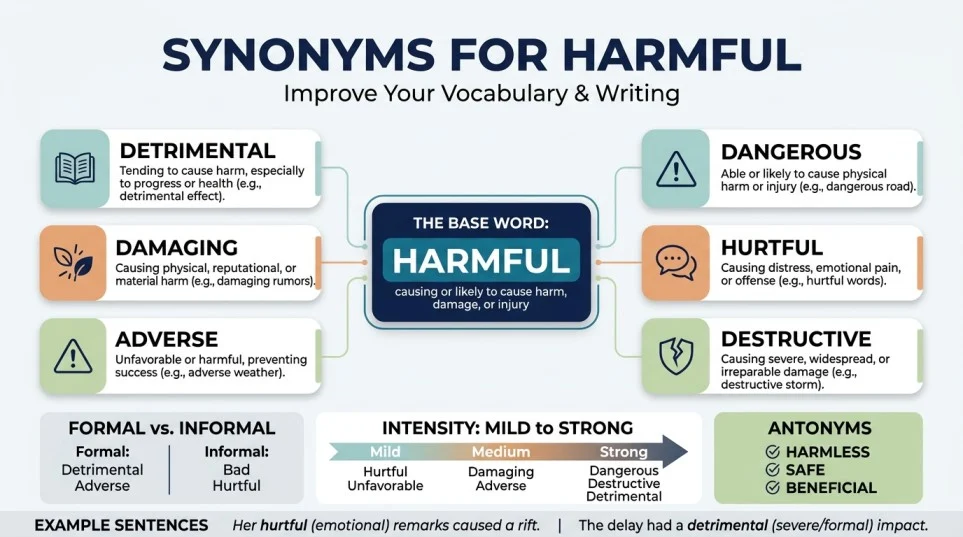
Harmful means causing or likely to cause damage, injury, loss, or a negative effect. Common synonyms include damaging, dangerous, detrimental, injurious, adverse, and destructive. Use detrimental in formal writing, damaging for general effects, and dangerous when something presents a clear risk.
Meaning, Tone and Context
What Does Harmful Mean?
Harmful describes something that causes damage or has a negative effect on a person, animal, environment, relationship, system, or situation.
For example, harmful chemicals may affect human health, while harmful rumors can damage someone’s reputation.
Part of Speech
Harmful is an adjective. It describes a person, action, substance, habit, decision, or condition that causes or may cause harm.
Word forms and related words:
| Word | Part of Speech | Meaning | Example |
|---|---|---|---|
| Harmful | Adjective | Causing damage or negative effects | Smoking can be harmful to health. |
| Harm | Noun or verb | Damage, injury, or the act of causing it | The policy could harm small businesses. |
| Harmfully | Adverb | In a way that causes harm | The substance can react harmfully with other chemicals. |
| Harmless | Adjective | Not causing harm | The insect is harmless to humans. |
| Harmfulness | Noun | The quality of causing harm | Researchers studied the harmfulness of the substance. |
Tone and Formality
Harmful usually has a negative tone because it describes an unwanted effect or possible risk. However, it is not always dramatic. It can describe anything from a minor habit to a serious threat.
The word is suitable for everyday speech, school essays, health information, business reports, and professional emails. More specific alternatives can make your meaning clearer.
Common Uses of Harmful
Harmful commonly describes:
- Health effects, such as harmful substances or habits.
- Environmental damage, such as harmful pollution.
- Social behavior, such as harmful stereotypes.
- Workplace decisions, such as harmful business practices.
- Digital content, such as harmful online misinformation.
- Personal relationships, such as harmful patterns of behavior.
When and How to Use Harmful
Use harmful when you want to explain that something causes damage or creates a negative effect. If the risk is more important than the actual damage, dangerous may be a better choice.
Professional Example
The manager reviewed a policy that could have harmful effects on employee morale.
Academic Example
The study examines how harmful substances affect water quality.
Personal Example
Constant criticism can be harmful to a person’s confidence.
Social Media Example
Spreading rumors can have harmful consequences for real people.
These examples show that harmful works across many situations. The most suitable synonym depends on the type and seriousness of the effect.
Another Word for Harmful
The best single replacement for harmful in general writing is damaging. It is natural, clear, and useful when discussing negative effects on people, relationships, property, or organizations.
However, damaging is not always the strongest option. Choose a synonym that describes the exact type of harm.
| Context | Best Alternative | Why It Works |
|---|---|---|
| Professional writing | Detrimental | Sounds precise and professional. |
| Academic writing | Adverse | Describes an unfavorable effect. |
| Casual conversation | Bad | Simple and easy to understand. |
| Emotional writing | Hurtful | Focuses on emotional pain. |
| Creative writing | Destructive | Creates a stronger sense of damage. |
| Resume or workplace use | Counterproductive | Describes an action that works against a goal. |
| Social media captions | Toxic | Works for unhealthy behavior or relationships. |
| Stronger meaning | Devastating | Emphasizes extremely serious effects. |
| Softer meaning | Unhelpful | Suggests something does not support a goal. |
Professional Writing
Choose detrimental when discussing policies, decisions, business performance, or long term outcomes.
Example: Poor communication can be detrimental to team productivity.
Academic Writing
Use adverse when describing negative outcomes, conditions, or effects in research.
Example: The researchers observed adverse effects under certain conditions.
Casual Conversation
Use bad or damaging when speaking naturally with friends or family.
Example: Skipping sleep every night is bad for your health.
Emotional Writing
Choose hurtful when someone’s words or actions cause emotional pain.
Example: His hurtful comments damaged their friendship.
Creative Writing
Use destructive when you want to emphasize serious damage or a force that breaks something down.
Example: A destructive storm swept through the coastal village.
Resume and Workplace Use
Use counterproductive when an action prevents progress or creates the opposite of the intended result.
Example: Micromanagement can be counterproductive in a team that needs independence.
Social Media Captions
Toxic can work well for posts about unhealthy relationships, behavior, or social environments. Avoid using it for every minor disagreement because it can sound overly dramatic.
Stronger Meaning
Devastating is appropriate when the consequences are severe.
Example: The devastating fire destroyed several homes.
Softer Meaning
Unhelpful works when an action offers little benefit without necessarily causing serious damage.
Example: Negative feedback without clear guidance can be unhelpful.
When Not to Use Harmful
Harmful is a broad word. Sometimes, a more specific alternative communicates the meaning more accurately.
When the risk is immediate: Use dangerous instead of harmful.
Less precise: The exposed wire is harmful.
Better: The exposed wire is dangerous because it could cause an electric shock.
When the effect is emotional: Use hurtful instead of harmful.
Less precise: Her comment was harmful.
Better: Her comment was hurtful because it embarrassed him in front of his classmates.
When the result goes against a goal: Use counterproductive instead of harmful.
Less precise: The extra meetings were harmful to productivity.
Better: The extra meetings were counterproductive because they left less time for focused work.
When describing a serious physical effect: Use injurious or damaging when the context supports it.
Example: The repeated impact caused injurious stress to the joint.
When discussing a minor inconvenience: Avoid dramatic words such as devastating or catastrophic unless the consequences are genuinely severe.
The goal is not to replace harmful every time. It is to choose the word that best describes the actual effect.
Words Commonly Confused With Harmful
Several related words describe negative effects, but they are not interchangeable in every sentence.
| Word | Main Difference | Best Used For |
|---|---|---|
| Dangerous | Suggests a risk of injury or serious trouble. | Hazards and unsafe conditions. |
| Damaging | Emphasizes actual or potential damage. | Reputations, property, relationships, and systems. |
| Detrimental | Highlights a negative effect on progress or well being. | Formal reports and academic writing. |
| Hurtful | Focuses on emotional pain. | Words, comments, and personal behavior. |
| Toxic | Suggests poisonous substances or deeply unhealthy conditions. | Chemicals, relationships, and environments. |
| Destructive | Emphasizes severe damage or breakdown. | Natural disasters, conflict, and damaging behavior. |
For example, a chemical can be toxic because of its properties, dangerous because it poses a risk, and harmful because it causes or may cause damage. Each word emphasizes a different part of the meaning.
Best Synonym by Context for Harmful
The table below helps you choose a suitable alternative based on your audience and purpose.
| Context | Best Synonym | Why It Works | Example |
|---|---|---|---|
| Formal writing | Detrimental | Professional and precise. | The change had detrimental effects. |
| Academic writing | Adverse | Fits research and evidence based discussion. | The treatment caused adverse reactions. |
| Business communication | Counterproductive | Connects an action to a poor outcome. | The policy proved counterproductive. |
| Resume or workplace | Ineffective | Highlights failure to achieve a goal. | The ineffective process slowed delivery. |
| Casual conversation | Bad | Simple and familiar. | That habit is bad for you. |
| Creative writing | Destructive | Adds force and intensity. | Destructive winds battered the coast. |
| Emotional tone | Hurtful | Highlights emotional pain. | Her hurtful words stayed with him. |
| Strong intensity | Devastating | Communicates very serious consequences. | The devastating loss affected the entire community. |
| Moderate tone | Unhelpful | Sounds less severe. | The advice was unhelpful. |
| Social media captions | Toxic | Direct and expressive for unhealthy behavior. | Leave toxic habits behind. |
| Health information | Injurious | Emphasizes physical injury. | The fall caused an injurious impact. |
| Environmental writing | Polluting | Identifies contamination directly. | Polluting runoff entered the river. |
| Legal or policy writing | Prejudicial | Describes an effect that unfairly harms rights or interests. | The ruling was prejudicial to the claimant. |
| Personal relationships | Abusive | Describes behavior involving mistreatment or abuse. | Abusive behavior should not be excused. |
| Safety instructions | Hazardous | Highlights a source of danger. | The area contains hazardous materials. |
| General nonfiction | Damaging | Clear and broadly useful. | The leak was damaging to the building. |
US and UK Usage
Harmful, damaging, dangerous, and detrimental are common in both American and British English. The main differences usually involve spelling, phrasing, or local usage rather than a different meaning.
For a US audience, use natural American phrasing and follow the spelling conventions of your publication. These synonyms generally do not require separate American and British versions.
Which Synonym Should You Choose?
Use this practical guide before replacing harmful in a sentence.
- Identify the effect. If something risks injury, choose dangerous. If it causes damage, choose damaging. If it causes emotional pain, choose hurtful.
- Consider formality. Detrimental and adverse fit formal reports. Bad and unhelpful suit everyday conversation.
- Match the intensity. Use harmful for a general negative effect, damaging for clearer impact, destructive for serious damage, and devastating for extremely severe consequences.
- Think about your audience. Readers of a scientific report may prefer adverse effects. Friends discussing an unhealthy habit may find bad or damaging more natural.
- Check the whole sentence. A synonym can be accurate by itself but sound awkward in a particular phrase. For example, adverse effects is natural, while dangerous effects may shift the meaning toward risk.
A good synonym improves clarity, not just vocabulary variety.
Real Life Examples of Harmful in Sentences
Here are practical examples across school, work, communication, and daily life.
School: A lack of sleep can be detrimental to a student’s concentration.
Workplace: Counterproductive meetings can reduce the time available for important projects.
Writing: Unsupported claims can be damaging to an article’s credibility.
Conversation: Staying in the sun too long can be bad for your skin.
Social media: Hurtful comments can affect someone’s confidence long after a post disappears.
Resume: I identified inefficient processes that were counterproductive to team performance and recommended practical improvements.
Email: Please review the proposed changes because they may have adverse effects on customer service.
Storytelling: The destructive flood swept away bridges and left the village isolated.
Health: Certain chemicals can be hazardous if handled without proper protection.
Environment: Polluting waste can contaminate rivers and threaten wildlife.
Each sentence uses a word that makes the type of negative effect more specific.
18 Synonyms for Harmful
The following 18 alternatives cover common, formal, academic, professional, emotional, and creative uses. Some overlap with harmful, but their meanings differ slightly, so choose according to context.
| Synonym | Simple Meaning | Best Used For | Example Sentence |
|---|---|---|---|
| 1. Damaging | Causing damage or loss | General writing | The rumor was damaging to her reputation. |
| 2. Dangerous | Likely to cause injury or trouble | Safety and risk | Driving in heavy fog can be dangerous. |
| 3. Detrimental | Having a negative effect | Formal and academic writing | The delay was detrimental to the project. |
| 4. Adverse | Unfavorable or negative | Research and reports | The drug may cause adverse reactions. |
| 5. Injurious | Causing physical or other injury | Medical and formal contexts | The impact was injurious to the athlete. |
| 6. Destructive | Causing serious damage | Disasters and behavior | Destructive winds damaged several homes. |
| 7. Toxic | Poisonous or deeply unhealthy | Chemicals and relationships | Toxic workplace behavior lowers morale. |
| 8. Hurtful | Causing emotional pain | Personal communication | His hurtful remark upset his friend. |
| 9. Hazardous | Involving a serious risk | Safety and workplaces | Hazardous waste requires careful disposal. |
| 10. Unhealthy | Bad for physical or emotional well being | Habits and relationships | An unhealthy routine can affect sleep. |
| 11. Counterproductive | Producing the opposite of the desired result | Business and planning | Constant interruptions are counterproductive to focused work. |
| 12. Deleterious | Having a damaging effect | Scientific and formal writing | The report examined deleterious environmental effects. |
| 13. Pernicious | Causing gradual or hidden harm | Advanced and analytical writing | Pernicious rumors weakened public trust. |
| 14. Devastating | Causing extremely serious damage | Major losses and events | The devastating storm destroyed the crops. |
| 15. Ruinous | Causing severe loss or ruin | Financial and historical writing | The ruinous decision left the company in debt. |
| 16. Polluting | Contaminating air, water, or land | Environmental writing | Polluting emissions affect local air quality. |
| 17. Abusive | Involving harmful mistreatment | Relationships and conduct | Abusive behavior should be addressed promptly. |
| 18. Unhelpful | Not useful or supportive | Everyday and professional communication | The vague instructions were unhelpful to new staff. |
Usage note: These words are related alternatives, not perfect replacements in every sentence. Dangerous focuses on risk, toxic can describe poisonous substances or unhealthy dynamics, and unhelpful is usually milder than harmful.
Synonym Groups and Usage Differences
Different synonyms for harmful communicate different levels of risk, damage, and emotional impact. Grouping them by context makes it easier to select the right word.
Professional vs. Personal Synonyms
Professional writing often benefits from precise, neutral language. Personal communication may need words that express feelings more clearly.
| Professional Synonyms | Personal Synonyms |
|---|---|
| Detrimental | Hurtful |
| Adverse | Upsetting |
| Counterproductive | Unhealthy |
| Deleterious | Damaging |
| Hazardous | Toxic |
Example for work: The proposed changes could have detrimental effects on productivity.
Example for personal communication: His hurtful comments affected their friendship.
Formal vs. Conversational Synonyms
Formal words are useful when the subject requires careful analysis. Conversational words are easier to understand in everyday discussions.
| Formal Word | Conversational Alternative | Example |
|---|---|---|
| Detrimental | Bad | The habit is bad for your health. |
| Adverse | Negative | The decision had negative effects. |
| Deleterious | Damaging | The substance may be damaging to plants. |
| Injurious | Harmful | The activity can be harmful to your knees. |
| Counterproductive | Not helpful | The extra work was not helpful. |
Use formal alternatives in research papers, reports, and professional presentations. Choose familiar words when writing texts, casual emails, or everyday advice.
Academic Synonyms
Academic writing requires words that describe evidence, effects, and risks accurately.
Adverse works well for negative outcomes, particularly in scientific or medical research.
Detrimental describes something that weakens progress, performance, or well being.
Deleterious is a more advanced term for something that causes damage. Use it when it fits the subject and your audience understands the wording.
Injurious is suitable when the emphasis is on injury or a damaging effect.
Example: The researchers investigated the adverse effects of poor air quality on respiratory health.
Choose the simplest accurate term. Advanced vocabulary does not automatically make an academic argument stronger.
Professional and Business Synonyms
In workplace communication, the best synonym depends on whether you are discussing risk, performance, safety, or employee behavior.
| Situation | Recommended Word | Example |
|---|---|---|
| Poor business decision | Detrimental | The decision was detrimental to growth. |
| Inefficient strategy | Counterproductive | The strategy became counterproductive. |
| Workplace safety | Hazardous | The storage area contains hazardous materials. |
| Negative customer experience | Damaging | The delay was damaging to customer trust. |
| Unhealthy management behavior | Toxic | Toxic management practices can lower morale. |
For resumes, focus on measurable outcomes rather than simply labeling something harmful.
For example, instead of writing that a process was harmful to productivity, explain that you identified workflow problems and improved team efficiency.
Creative or Literary Synonyms
Creative writing sometimes needs stronger words to create a vivid image or communicate emotional depth.
Destructive suggests forceful damage.
Pernicious suggests harm that develops gradually or remains difficult to notice.
Ruinous emphasizes severe loss or consequences.
Devastating communicates a powerful effect that may change lives or circumstances.
Example: A pernicious rumor spread through the village, slowly destroying years of trust.
Use these words when the intensity matches the story. A dramatic word can distract readers if the situation is ordinary.
Slang or Modern Synonyms
There is no single slang word that replaces harmful in every situation. Some informal terms work only in specific contexts.
Toxic is widely understood in casual discussions about unhealthy relationships, social behavior, and workplace cultures.
Bad is a simple everyday alternative.
Messy can describe a complicated personal situation, but it does not necessarily mean harmful.
Example: That relationship became toxic because neither person respected the other’s boundaries.
Avoid slang in academic papers, formal research, and official safety instructions when a more precise word is available.
Strongest vs. Weaker Synonyms
The intensity of a synonym should match the seriousness of the situation. This is a practical guide, not a universal ranking, because the words emphasize different kinds of harm.
| Intensity | Word | Typical Meaning |
|---|---|---|
| Mild | Unhelpful | Offers little benefit or support. |
| Mild to moderate | Unhealthy | Negatively affects well being. |
| Moderate | Harmful | Causes or may cause damage. |
| Moderate to strong | Damaging | Creates noticeable negative effects. |
| Strong | Destructive | Causes serious damage. |
| Very strong | Devastating | Causes extremely severe consequences. |
For example, unhelpful advice may waste time, while devastating news may cause profound distress. Do not use the strongest word simply to make a sentence sound more impressive.
Emotional vs. Neutral Synonyms
Neutral synonyms explain a problem without adding much emotion. Emotional synonyms highlight how the problem affects people.
| Neutral Word | Emotional Word | Difference |
|---|---|---|
| Adverse | Hurtful | One describes a negative effect, while the other emphasizes emotional pain. |
| Damaging | Cruel | One describes damage, while the other suggests deliberate or callous treatment. |
| Unhealthy | Toxic | The second can sound stronger when describing personal dynamics. |
| Detrimental | Devastating | The second suggests a much more severe impact. |
Use neutral words for reports and factual explanations. Choose emotional words when feelings, relationships, or personal experiences are central to the message.
Antonyms of Harmful
Antonyms of harmful describe safety, benefit, protection, or positive effects. The most accurate opposite depends on the sentence.
| Antonym | Meaning | Example Sentence |
|---|---|---|
| 1. Harmless | Not causing harm | The substance is harmless in the amounts tested. |
| 2. Safe | Free from unacceptable danger | The playground is safe for children. |
| 3. Beneficial | Producing a positive effect | Regular exercise is beneficial to health. |
| 4. Helpful | Providing assistance or value | Her advice was helpful to the team. |
| 5. Healthful | Supporting good health | Fresh vegetables are part of a healthful diet. |
| 6. Wholesome | Promoting health or well being | The children enjoyed a wholesome meal. |
| 7. Benign | Not dangerous or harmful in the relevant context | The examination revealed a benign growth. |
| 8. Innocuous | Unlikely to cause harm or offense | The comment was innocuous and caused no concern. |
| 9. Nonhazardous | Not presenting a recognized hazard | The material was classified as nonhazardous. |
| 10. Protective | Helping prevent harm | Protective clothing reduces exposure to chemicals. |
| 11. Constructive | Helping improve a situation | Constructive feedback helped her develop new skills. |
| 12. Advantageous | Creating a useful benefit | The new schedule was advantageous for the staff. |
| 13. Favorable | Producing or reflecting a positive outcome | The change had a favorable effect on sales. |
| 14. Salutary | Producing a beneficial effect | The break had a salutary effect on morale. |
| 15. Restorative | Helping restore strength or well being | A restorative night’s sleep improved his energy. |
Some of these are contextual opposites rather than direct antonyms in every sentence. For example, safe is the clearest opposite when harmful refers to danger, while beneficial is better when it refers to a negative effect.
Comparison: Harmful vs. Similar Words
Harmful vs. Dangerous
Main difference: Harmful emphasizes damage or negative effects. Dangerous emphasizes the risk of injury, loss, or trouble.
Which is stronger? Dangerous can suggest an immediate risk, while harmful can describe effects that develop over time.
Which is more formal? Both are suitable for formal and casual writing.
Examples:
Harmful: Too much screen time may be harmful to sleep quality.
Dangerous: Driving while severely tired can be dangerous.
Harmful vs. Damaging
Main difference: Both describe negative effects, but damaging often emphasizes a noticeable loss or injury to something.
Which is stronger? Damaging can sound more direct when actual damage is central.
Which is more formal? Both work well in professional writing.
Examples:
Harmful: The habit may be harmful to your health.
Damaging: The false report was damaging to the company’s reputation.
Harmful vs. Detrimental
Main difference: Detrimental describes an unfavorable effect on progress, success, or well being. Harmful is broader and more familiar.
Which is stronger? Neither is always stronger. The difference is mainly one of context and tone.
Which is more formal? Detrimental generally sounds more formal.
Examples:
Harmful: Poor sleep can be harmful to concentration.
Detrimental: Poor sleep can be detrimental to academic performance.
Harmful vs. Toxic
Main difference: Toxic can describe poisonous substances or unhealthy behavior and relationships. Harmful is more general.
Which is stronger? Toxic often sounds stronger in discussions about personal relationships.
Which is more formal? Harmful is broadly neutral. Toxic is also appropriate in technical contexts involving actual toxins.
Examples:
Harmful: The comments had a harmful effect on team morale.
Toxic: The team struggled under a toxic management culture.
Harmful vs. Hurtful
Main difference: Hurtful focuses on emotional pain, while harmful can include physical, emotional, social, or environmental damage.
Which is stronger? It depends on the situation. Hurtful is more specific about emotional impact.
Which is more formal? Harmful is generally more neutral in formal reports, while hurtful is natural in personal writing.
Examples:
Harmful: Repeated conflict can be harmful to a relationship.
Hurtful: Her hurtful words made him feel unwelcome.
Harmful vs. Destructive
Main difference: Destructive emphasizes serious damage or the breakdown of something. Harmful covers a wider range of negative effects.
Which is stronger? Destructive usually suggests more severe damage.
Which is more formal? Both are suitable for formal writing when used accurately.
Examples:
Harmful: Pollution is harmful to marine life.
Destructive: The destructive storm wiped out several coastal roads.
Common Phrases and Expressions with Harmful
1. Harmful Effects
Meaning: Negative results caused by an action, substance, or situation.
Example sentence: Researchers examined the harmful effects of prolonged noise exposure.
2. Harmful Substances
Meaning: Materials that can damage health or the environment.
Example sentence: Workers must handle harmful substances with appropriate safety equipment.
3. Harmful Behavior
Meaning: Actions that negatively affect other people or oneself.
Example sentence: The school introduced new rules to address harmful behavior.
4. Harmful to Health
Meaning: Likely to negatively affect physical or mental well being.
Example sentence: Smoking is harmful to health.
5. Potentially Harmful
Meaning: Capable of causing damage under certain conditions.
Example sentence: The website warned users about potentially harmful downloads.
6. Harmful Consequences
Meaning: Negative outcomes that follow an action or decision.
Example sentence: Ignoring the warning could have harmful consequences.
7. Harmful Chemicals
Meaning: Chemicals that may cause injury or other adverse effects.
Example sentence: The factory updated its procedures for storing harmful chemicals.
8. Harmful Influence
Meaning: A person, force, or situation that encourages negative behavior or outcomes.
Example sentence: The coach helped the young players recognize a harmful influence.
Common Mistakes to Avoid
1. Using Harmful When a More Precise Word Is Better
Harmful is broad. Dangerous, hurtful, and counterproductive each explain a more specific problem.
Instead of saying the decision was harmful to productivity, write that the decision was counterproductive to the team’s goals.
2. Confusing Risk With Actual Damage
Dangerous highlights risk, while damaging highlights negative effects.
A loose electrical wire may be dangerous even before it causes an injury.
3. Choosing an Overly Casual Word in Formal Writing
Bad and toxic can sound vague or informal in some professional contexts.
Use detrimental, adverse, or damaging when those words accurately describe the situation.
4. Using Dramatic Words for Minor Problems
Devastating and ruinous suggest severe consequences. They are not suitable for every mistake or inconvenience.
Use unhelpful or unfavorable when the effect is limited.
5. Repeating the Same Word Too Often
Repeating harmful in every paragraph can make an article feel monotonous.
Replace it with accurate alternatives when the meaning supports them. Do not sacrifice clarity just to avoid repetition.
6. Choosing a Synonym With the Wrong Emotional Tone
Hurtful emphasizes emotional pain, while hazardous describes risk. They are not interchangeable.
Review the full sentence before choosing a replacement.
FAQs
1. What Is the Best Synonym for Harmful?
Damaging is a strong general alternative to harmful. Dangerous, detrimental, adverse, and hurtful may be better when the sentence emphasizes risk, formal effects, or emotional pain.
2. What Is a Formal Synonym for Harmful?
Detrimental is a useful formal synonym for harmful, especially when discussing decisions, policies, or outcomes. Adverse and deleterious also work in suitable academic contexts.
3. What Is an Informal Synonym for Harmful?
Bad is a simple informal alternative to harmful. Damaging also sounds natural in conversation when you want to explain that something causes a negative effect.
4. What Is Another Word for Harmful in Professional Writing?
Detrimental is useful in business reports, while adverse suits discussions of negative outcomes. Counterproductive is better when an action works against a stated goal.
5. What Is the Difference Between Harmful and Dangerous?
Harmful focuses on damage or negative effects, while dangerous highlights the possibility of injury, loss, or trouble. A situation can be both harmful and dangerous.
6. What Is the Opposite of Harmful?
Harmless is a direct opposite when discussing the absence of harm. Safe emphasizes low risk, while beneficial describes something that produces a positive effect.
Conclusion
Harmful describes something that causes or may cause damage, injury, or a negative effect. Damaging is a useful general alternative, detrimental suits formal writing, dangerous highlights risk, and hurtful describes emotional pain.
The best synonym depends on your message, audience, and intended tone. Before replacing harmful, ask yourself whether you mean danger, actual damage, emotional distress, or an outcome that prevents progress.
Discover More Post:
- 50+ Synonyms for Investigate | Meanings, Examples, and Best …
- 50+ Synonyms for Other | Meanings, Examples, and Best …
- 50+ Synonyms for Truly | Meanings, Examples, and Best …